
Regional Homestay Playbooks: Plantation, Hill, Kerala, Rajasthan, Goa & the North-East
A homestay belongs to its region — in its materials, its climate, its layout and the guest who comes for it. This playbook reads India's great homestay regions one by one: the vernacular that feels authentic, the climate the design must answer, the layout that works, who the guest is, and how the economics and seasons behave.
The best homestays could not be anywhere else. A Coorg plantation home smells of coffee and rain on tin; a Spiti house is built thick against the cold; a Kerala tharavadu opens to a courtyard and the backwater beyond. That rootedness is the homestay's whole advantage over a hotel — and it is also a design discipline, because each region hands you a different climate to answer, a different guest to please, and a different season to earn in. This playbook takes India's great homestay regions one at a time. Read it alongside the design guide for the universal principles, and the economics guide for the numbers behind the seasons.
Scope. This is an editorial orientation to regional character and good practice, not legal or investment advice. Rates, seasons and demand vary year to year and property to property; licensing is state-specific — check the Licence Finder and your state tourism portal. All figures are indicative.
How the regions differ — at a glance
Before the detail, the shape of the thing. Each region has a signature material palette, a climate the design must answer, and a peak season that decides the cash flow.
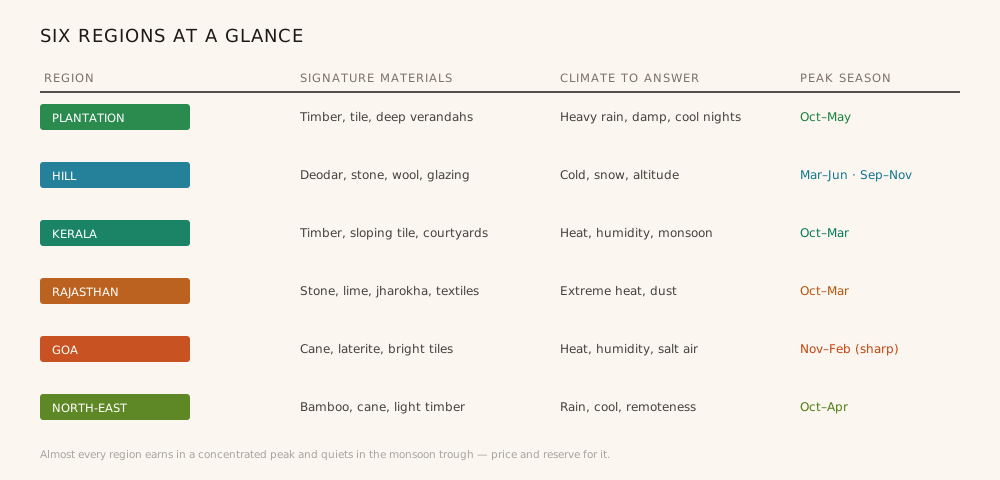
| Region | Signature materials | Climate to answer | Peak season |
|---|---|---|---|
| Plantation (Coorg, Chikmagalur) | Timber, tile, deep verandahs | Heavy rain, damp, cool nights | Oct–May (dry, post-monsoon) |
| Hill (Himachal, Uttarakhand, Spiti) | Deodar, stone, wool, glazing | Cold, snow, thin air at altitude | Mar–Jun & Sep–Nov; snow draws winter |
| Kerala (backwater, plantation, heritage) | Timber, sloping tile, courtyards | Heat, humidity, monsoon | Oct–Mar (and Ayurveda monsoon niche) |
| Rajasthan (heritage, havelis) | Stone, lime, jharokha, textiles | Extreme heat, dust | Oct–Mar (winter) |
| Goa (beach, Portuguese houses) | Cane, laterite, tiles, bright shutters | Heat, humidity, salt air | Nov–Feb (sharp monsoon trough) |
| North-East (Khasi, Sikkim villages) | Bamboo, cane, timber, light frames | Rain, cool, remoteness | Oct–Apr (dry) |
The pattern to notice: almost every Indian homestay region earns in a concentrated peak and goes quiet in a trough — usually the monsoon. That single fact should shape your pricing, your working-capital reserve and your expectations more than anything in the brochure.
Plantation homestays — Coorg & Chikmagalur
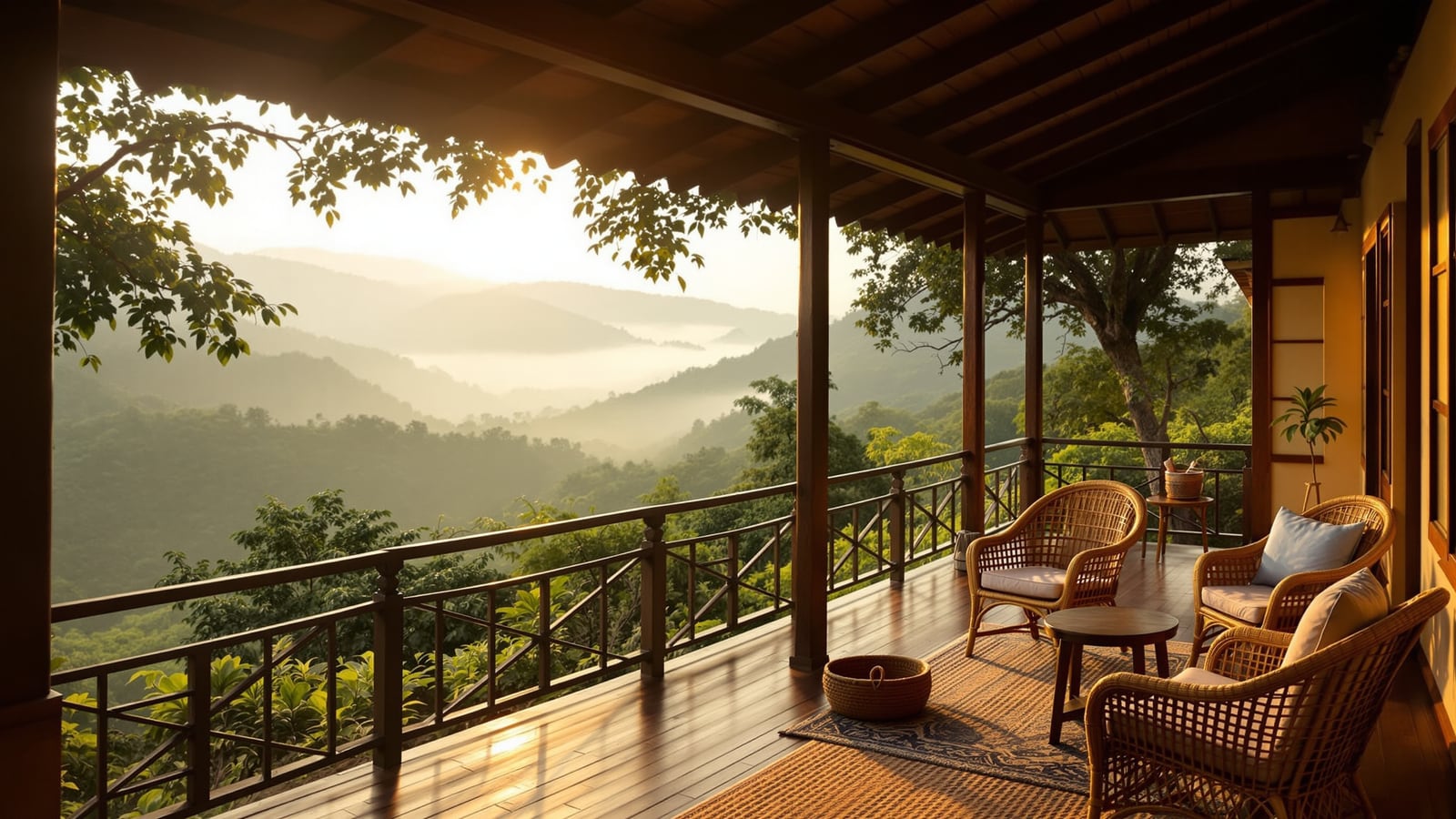
The archetypal Indian homestay. Set on a working coffee or spice estate, its draw is immersion: the estate walk, the smell of drying coffee, meals from the garden, mist in the valley. Build it in timber and tile with deep verandahs that work in the heavy rain, raise the floor against damp, and let the estate itself be the amenity — a guided walk beats a swimming pool here. Guests are urban couples and families chasing quiet and cool; they pay for authenticity and a good host, not for marble. The season runs roughly October to May, with the monsoon a dramatic but low-occupancy stretch some hosts now market deliberately to the rain-lover. See the dedicated plantation-homestay playbook for the full treatment.
Hill homestays — Himachal, Uttarakhand & the high desert
From a Tirthan Valley riverside room to a Spiti house in the high cold desert, hill homestays sell the mountain itself — treks, rivers, apple orchards, silence. The design problem is cold: build or insulate in stone and deodar, keep rooms snug and small, face the glazing to the winter sun, and plan for water that freezes and roads that close. Village homestays here are the backpacker's budget favourite, with rates that can start remarkably low, but the same regions also carry premium boutique stays. Two seasons matter — the spring-summer trekking window and the autumn clarity — with snow drawing a distinct winter guest. The hill-homestay playbook goes deeper, including altitude and winterisation.
Kerala homestays — backwater, plantation & heritage
Kerala practically invented the Indian homestay, and its vernacular is a gift: the tharavadu with its courtyard, the sloping tiled roof that sheds monsoon rain, the verandah, timber everywhere, and water — a backwater, a canal, a plantation stream — as the view. The climate to answer is heat and humidity: cross-ventilation, shade, raised plinths and breathable materials do more than air-conditioning. Guests range from backwater romantics to Ayurveda-seekers (who, unusually, come in the monsoon, the traditional treatment season — a real counter-seasonal opportunity). Peak is October to March, but the Ayurveda-monsoon niche can soften the trough. The Kerala homestay playbook covers the three stay types and the nalukettu vernacular in full.
Rajasthan homestays — heritage & the haveli
Rajasthan sells romance and history, and the homestay version is the family haveli or a few rooms in a heritage house. Lean into the vernacular — local stone and lime, jharokha windows, jaali screens, block-printed textiles, lantern light, a rooftop for dinner against a fort view. The climate to answer is extreme heat and dust: thick walls, small shaded openings, courtyards and jaali are centuries-tested passive cooling. Guests are heritage and wedding travellers, Indian and foreign, who want character and a story. The season is a sharp October-to-March winter; summer is punishingly hot and quiet, so price and plan accordingly. The Rajasthan heritage-homestay playbook goes deeper on the haveli and its passive cooling.
Goa homestays — the beach house
Goa's homestay is the converted Portuguese-Goan house or a bright 2BHK near the sand — cane and rattan, laterite and lime, Athangudi-style tiles, shaded balcãos and bright shutters, with the beach and the café scene as the draw. The climate is hot, humid and salty — ventilation, shade and salt-tolerant finishes matter. Goa has the market's sharpest seasonality: a well-placed house can clear ₹2–3 lakh a month in the November–February peak and fall below 30% occupancy through the monsoon. That trough is the defining feature of the Goa economics — budget for it. The Goa homestay playbook goes deeper on the Portuguese-Goan house and its coastal design.
North-East homestays — Khasi, Sikkim & the villages
The fastest-emerging region, and the most community-rooted. From a Khasi village near Mawphlang's sacred forest to a Sikkim hillside, the North-East homestay is light-framed in bamboo, cane and timber, close to living culture and extraordinary landscape. The draw is exactly that remoteness and authenticity — living root bridges, treks, food, festivals — so design lightly and honestly rather than importing a plains aesthetic. Access and connectivity are the real constraints, and several states (Meghalaya among them) have added mandatory tourist registration on top of the homestay scheme, so check the rules carefully via the Licence Finder. Season is broadly the dry October-to-April window. The North-East homestay playbook goes deeper on the community model, the bamboo vernacular and the extra permits.
Choosing — and building — for your region
Two principles carry across every region. First, let the region do the work: its materials age better in its climate, its vernacular is what the guest travelled for, and its landscape is a better amenity than any imported luxury. Second, respect the season: build the annual budget on the honest blended occupancy, price dynamically into the peak, and keep a reserve for the trough. Whatever the region, the universal moves still hold — good beds and bathrooms, real privacy between host and guest, genuine accessibility and safety — layered over the local character that makes the place unmistakably, valuably itself.
Key takeaways
- A homestay's region is its advantage — carry the local materials, climate response and landscape into the design rather than importing a generic look.
- Each region answers a different climate (plantation damp, hill cold, Kerala humidity, Rajasthan heat, Goa salt, NE rain) — design for it.
- Almost every region earns in a concentrated peak with a monsoon trough; build the budget and reserve around that, and price dynamically.
- All six regions — plantation, hill, Kerala, Rajasthan, Goa and the North-East — now have a dedicated deep-dive playbook; this overview is the map to them.
- Licensing is state-specific — always check the Licence Finder and your state portal for the region you choose.
References
- State tourism departments and homestay policies for each region (Karnataka, Himachal Pradesh, Uttarakhand, Kerala, Rajasthan, Goa, Sikkim, Meghalaya and others) — authoritative for rules, which change.
- Indian vernacular architecture references — for the regional material and passive-climate traditions described (courtyard, verandah, jaali, jharokha, sloping tiled roof, deodar-and-stone hill building).
- Travel and hospitality market commentary on regional demand and seasonality (2025–2026) — indicative of trend, not a guarantee of returns.
Indicative and region-dependent. Studio Matrx is a not-for-profit guide; this is educational content, not legal or investment advice. Confirm licensing for your state and treat all rates and seasons as indicative.
Export this guide
Related Guides — Deep-dive reading
Rajasthan Heritage Homestays: The Haveli Playbook
Rajasthan sells romance and history, and the homestay version is the family haveli — stone and lime, jharokha and jaali, a courtyard and a rooftop under the fort. This playbook covers the heritage draw, the centuries-tested passive cooling that answers brutal heat and dust, and the sharp winter season of a desert stay.
HomestaysGoa Homestays: The Portuguese-Goan House Playbook
Goa's homestay is the converted Portuguese-Goan house or a bright house near the sand — balcão and oyster-shell windows, laterite and lime, the beach and the café scene as the draw. This playbook covers the heritage house as product, the salt-and-humid design that keeps it standing, and the sharpest seasonality in the Indian market.
HomestaysKerala Homestays: The Backwater, Plantation & Heritage Playbook
Kerala practically invented the Indian homestay, and its vernacular is a gift — the courtyard tharavadu, the sloping tiled roof, the verandah and water as the view. This playbook covers the three Kerala stay types, the passive design that answers heat and monsoon, and the Ayurveda season that fills the trough.
HomestaysRelated Tools — Try Free
Cross-Ventilation Analyzer
Estimate airflow and air changes per hour (ACH) from room size, window areas, layout, and local wind — with NBC 2016 Part 8 compliance check.
Ventilation CalculatorHomestay Licence Finder
Pick your state for the homestay registration picture — room caps, residence rules and fees — plus the three compliance layers every host needs.
Licence FinderBrise-Soleil Visualizer
Interactive horizontal-louvre cut-off angle calculator — sun altitude, louvre depth, and spacing inputs with a live shadow preview. Computes θ = arctan(spacing/depth) for façade shading, ECBC envelope compliance, hospital daylight design, and tropical sun-control detailing.
Sun Shading Tool