
Karnataka Homestays: Coorg, Chikkamagaluru, Malenadu & the Canara Coast
Karnataka is one of India's densest homestay states — coffee estates in Kodagu and Chikkamagaluru, rain-forest farmhouses across Malenadu, temple-town and beach stays on the Canara coast, and heritage rooms in Hampi and Mysuru. This pillar maps the belts, explains the 2025 registration guidelines, and sets out the Western Ghats realities every host must plan around.
Few Indian states have as many homestays per square kilometre of hill as Karnataka. The category arguably grew up here: the coffee estates of Kodagu (Coorg) opened their bungalows to guests decades ago, Chikkamagaluru followed, and the model spread down the Western Ghats through the rain-forest farmhouses of Malenadu and out to the temple towns and beaches of the Canara coast. Reported counts for Kodagu alone run into the thousands. What unites them is a single landform — the ghats — and a single climate fact: a monsoon that delivers some of the heaviest rain in India on a narrow band of steep, forested slopes. This pillar is a map: it shows where each belt sits, what its guest wants, how Karnataka registers homestays today, and what the ghats demand of a builder. It links out to the deep dives rather than repeating them. Start with the how-to-start guide if you are new, and the regional overview for how Karnataka compares with other states.
Scope. Editorial orientation, not legal, tax or engineering advice. Karnataka's homestay registration guidelines were revised in 2025 and enforcement is active and evolving at district level — confirm every requirement with Karnataka Tourism and your district administration, and see the Licence Finder. Building on Western Ghats slopes needs a geotechnical and structural engineer. GST and income tax belong with a CA. Figures are indicative.
The map: five belts, one mountain range
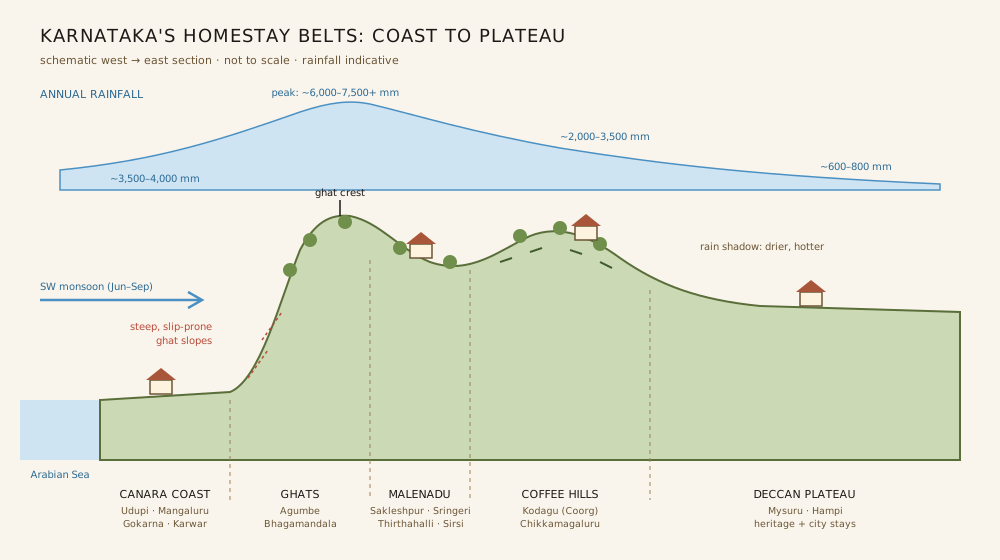
Read Karnataka west to east and the homestay map makes sense. A narrow coastal strip; the ghat escarpment that catches the monsoon full-face; the wet, forested uplands called Malenadu ("hill country"); the coffee hills of Kodagu and Chikkamagaluru at the eastern edge of the ghats; and then the drier Deccan plateau, where Mysuru and Hampi sell heritage instead of rain forest.
| Belt | The draw | Vernacular | Climate | Peak season | Typical guest |
|---|---|---|---|---|---|
| Kodagu (Coorg) | Coffee and pepper estates, Kodava culture and food, Abbey and Iruppu falls, Talakaveri | Estate bungalow; the Kodava ainmane (ancestral clan house) with sloping tiled roof and courtyard | Cool, very wet monsoon (~3,000+ mm in much of the district) | Oct–May | Bengaluru weekenders, families, groups, estate-curious foreigners |
| Chikkamagaluru | Coffee's birthplace in India, Mullayanagiri (state's highest peak), Baba Budangiri, Kudremukh | Estate bungalow; tiled Malnad house | Cool hills, heavy monsoon | Oct–May | Trekkers, weekend couples, coffee travellers |
| Malenadu — Hassan/Sakleshpur, Shivamogga/Agumbe/Thirthahalli, Sringeri, Uttara Kannada uplands (Sirsi, Yellapur, Dandeli) | Rain forest, waterfalls, areca and spice farms, temples, river rafting at Dandeli | Malnad thotti mane (courtyard house), steep tiled roofs, timber and laterite | Extreme rain at the crest (Agumbe often among India's wettest places), humid | Oct–Feb; monsoon niche | Nature lovers, monsoon chasers, pilgrims, families |
| Canara coast — Dakshina Kannada, Udupi, Uttara Kannada (Gokarna, Murudeshwar, Karwar) | Beaches, temple towns (Udupi, Kollur, Gokarna, Murudeshwar), coastal food | Laterite-and-tile Tulu and Konkani houses, coconut groves | Hot-humid, ~3,500–4,000 mm monsoon | Oct–Mar | Pilgrim families, beach backpackers, food travellers |
| Hampi and Mysuru (brief) | UNESCO ruins and boulder landscape; palace city, Dasara | Village and town houses; city bungalows | Hot, dry plateau (~600–800 mm) | Oct–Feb (Dasara spike in Mysuru) | Heritage and culture travellers, foreign backpackers |
The design playbook for the coffee belt — estate-as-amenity, verandah layout, host–guest separation — is already written: read the Coorg and Chikkamagaluru plantation playbook. For the wet uplands, see the Malenadu deep dive and the Malenadu thotti mane house plan. For the coast, the Canara coast deep dive. Neighbouring states share much of the vernacular — compare Kerala, Goa and the Konkan.
Kodagu and Chikkamagaluru, in a paragraph each
Kodagu is the most saturated homestay district in the state. Its guests come for estate life, the Kodava kitchen (pandi curry, kadambuttu, akki roti) and the clan culture of the ainmane, and the best homestays are still family estates where the host's presence is the product. Density brings competition and scrutiny in equal measure: the district has run repeated registration drives, and since 2026 police verification has been stepped up after a widely reported incident at a homestay. Assume you will be inspected.
Chikkamagaluru sells altitude and coffee — the Baba Budangiri hills where coffee is said to have first been planted in India, the Mullayanagiri ridge, the trails toward Kudremukh. Its weekend demand from Bengaluru is intense, and so is pressure on fragile ridge-top land; expect district-level checks on registration and on construction in forest-fringe and hilltop locations.
Registration: Karnataka's current regime
Karnataka's Department of Tourism issued revised Homestay Registration Guidelines in 2025, framed under the Karnataka Tourism Trade (Facilitation and Regulation) Act, 2015, and sits within the state's broader Karnataka Tourism Policy 2024–29. As reported by the department and the press in 2026, the key points are:
- Owner-resident and non-commercial. A homestay is a private residence where the owner or immediate family (spouse or children) lives on the premises. A property where the owner does not reside and a manager stays instead falls in a separate Bed and Breakfast category, treated as commercial.
- One to six guest rooms, with a cap of about twelve adults at a time.
- Registration is mandatory, applied for online; applications are scrutinised by tourism, police, the Deputy Commissioner's office and the panchayat or urban local body, followed by a physical inspection. Certificates are reported to issue within about 45 days of clearance and to be valid for five years.
- Domestic treatment. Registered homestays are reported to qualify for domestic electricity, water and property-tax rates and not to need a separate trade licence — but confirm with your gram panchayat or municipality, since practice on the ground varies.
- Safety and policing. Expect police verification of every staff member, a guest register with ID checks, CCTV at the entrance or reception, displayed emergency numbers, and Form C reporting of every foreign guest within 24 hours. Several districts (Kodagu, Chikkamagaluru, Mysuru, Dakshina Kannada, Udupi) have run drives requiring unregistered homestays to register or stop operating.
- Fire safety. Basic fire measures (extinguishers, clear exits, safe kitchen and wiring) are expected at inspection; whether a formal Fire NOC applies depends on building size and occupancy — confirm with Karnataka State Fire and Emergency Services.
Fees and the exact document list are on the department's portal — confirm there before applying. The general framework is in the registration and licensing guide; listing on platforms is in the Airbnb set-up guide. For GST thresholds, income tax and the platform-collected GST position, speak to a CA — this pillar does not advise on tax.
Western Ghats realities
The ghats are the reason guests come and the reason a careless build fails.
- Slopes and landslides. The 2018 and 2019 monsoons triggered deadly landslides in Kodagu; geological studies after the event pointed to human modification of slopes — road cutting, terracing and building — as a contributing factor, and the district has since served notices to homestays in landslide-vulnerable villages during heavy-rain periods. Do not cut a slope for a guest cottage without a geotechnical assessment, retaining design, and drainage that leads water away from the cut.
- Eco-sensitive area. A large part of Karnataka's Western Ghats falls within the Union government's draft Ecologically Sensitive Area notification, re-issued several times and not final at last check, which would restrict certain construction and activities in listed villages. Check whether your village is listed, and confirm the current status before you buy or build.
- Forest and wildlife. Much of Kodagu, Chikkamagaluru and Malenadu borders reserve forests, tiger reserves (Nagarahole, Bhadra, Kali/Dandeli) and elephant corridors. Forest-fringe land can carry eco-sensitive-zone restrictions around protected areas, and elephants are a real night-time safety question — design lighting, fencing and guest briefings accordingly, and check with the Forest Department.
- Rain. The gradient is extreme: roughly 3,500–4,000 mm on the coast, far more at the ghat crest around Agumbe and Bhagamandala, and only 600–800 mm on the plateau around Mysuru and Hampi. On the ghats, design for months of driving rain: steep tiled roofs with deep overhangs, raised plinths, laterite or stone bases, dehumidification, and storage that stays dry. The design guide covers the room-level details.
Season and economics
Across the hill belts the season runs October to May, with peaks at Christmas–New Year and long weekends, and a quieter, cheaper June–September monsoon that a growing niche of rain-seekers now books deliberately (waterfalls, leeches and all). The coast is strongest October to March; Hampi and Mysuru are winter destinations, with the Mysuru Dasara a short, sharp spike. Model the monsoon trough honestly in the ROI Calculator, cost a build in the Setup Cost Estimator, and read the profitability guide. For a ready layout, see the homestay house plans, including the three-guest-room 40x60 plan.
Key takeaways
- Karnataka's homestays sit on five belts across one mountain range: Canara coast, ghats, Malenadu, the Kodagu–Chikkamagaluru coffee hills, and the Deccan plateau (Hampi, Mysuru).
- The 2025 guidelines define a homestay as owner-resident, 1–6 rooms, about 12 adults, with mandatory five-year registration; owner-absent properties fall under Bed and Breakfast.
- Expect district enforcement: police verification of staff, guest registers, CCTV, Form C for foreigners, and drives against unregistered homestays — especially in Kodagu and Chikkamagaluru.
- Treat the ghats with respect: no slope cutting without a geotechnical engineer, check the draft ESA and forest-fringe status, and plan for elephants and extreme rain.
- The season is October to May in the hills, with a growing monsoon niche; tax questions go to a CA.
References
- Department of Tourism, Government of Karnataka — Homestay Registration Guidelines (revised 2025) and the registration portal; authoritative for room caps, residence, fees, validity and documents (karnatakatourism.org).
- Karnataka Tourism Trade (Facilitation and Regulation) Act, 2015, and the Karnataka Tourism Policy 2024–29.
- Geological Survey of India studies of the 2018–2019 Kodagu landslides; Kodagu district administration advisories for landslide-vulnerable villages.
- Ministry of Environment, Forest and Climate Change — draft notification on Ecologically Sensitive Areas of the Western Ghats (re-issued; check current status).
- Bureau of Immigration — Form C reporting of foreign guests; Karnataka State Fire and Emergency Services for fire-safety requirements.
Indicative and subject to change. Studio Matrx is a not-for-profit guide; this is educational content, not legal, tax or engineering advice. Confirm registration and safety requirements with Karnataka Tourism and your district administration, take tax advice from a CA, and engage a geotechnical engineer before building on a slope.
Export this guide
Related Guides — Deep-dive reading
Malenadu Homestays: Sakleshpur, Agumbe, Sringeri & Sirsi
Malenadu — Karnataka's rain-soaked Western Ghats hill-forest belt — sells rainforest, waterfalls, areca-and-pepper gardens and the monsoon itself. This playbook covers the draw, the thotti mane courtyard house that evolved to live with extreme rain, how to design and operate through a real Malnad monsoon, and the forest edge you share with elephants and king cobras.
HomestaysCoastal Karnataka Homestays: Mangaluru, Udupi, Gokarna & the Canara Coast
The Canara coast pairs quiet beaches and river estuaries with some of South India's great pilgrim temples, a living Tulu Nadu culture and one of the country's finest fish thalis. This playbook covers the three coastal districts, the guthu mane and Mangalorean house as product, design for a 4,000 mm monsoon and salt air, the coastal-zone rules, and the pilgrim-versus-backpacker season.
HomestaysMadhya Pradesh Homestays: Forest, Village & Heritage-Town Stays
India's heartland sells tiger forests, living villages and quiet heritage towns — and the homestay version is a mud-walled, tile-roofed house on a forest fringe, or a family home above the Narmada ghats. This playbook covers MP Tourism's rural homestay programme, buffer-zone siting rules, the earth-and-tile vernacular, and an honest season plan.
HomestaysRelated Tools — Try Free
Homestay Licence Finder
Pick your state for the homestay registration picture — room caps, residence rules and fees — plus the three compliance layers every host needs.
Licence FinderHomestay ROI Calculator
Model occupancy, rate, OTA commission vs direct bookings and running costs to see a homestay's real monthly profit, margin and payback.
Homestay ROIHomestay Setup-Cost Estimator
Estimate the one-time cost of setting up a homestay — rooms by fit-out level, renovation, shared spaces, licence and working capital.
Homestay Setup