
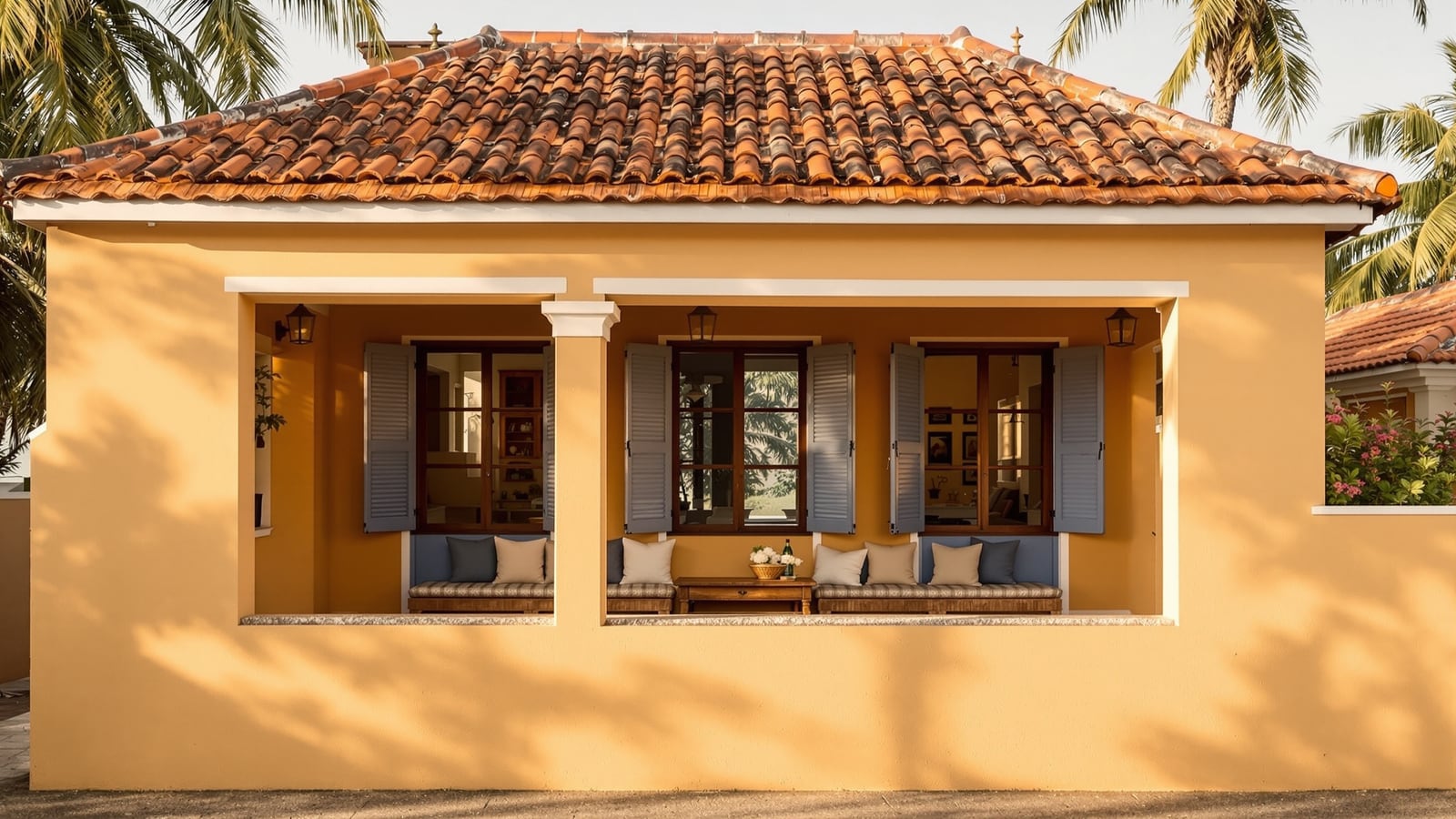
Goa Homestays: The Portuguese-Goan House Playbook
Goa's homestay is the converted Portuguese-Goan house or a bright house near the sand — balcão and oyster-shell windows, laterite and lime, the beach and the café scene as the draw. This playbook covers the heritage house as product, the salt-and-humid design that keeps it standing, and the sharpest seasonality in the Indian market.
Goa's homestay has a face everyone recognises: the Portuguese-Goan house — lime-washed in ochre, indigo or green, a covered balcão porch out front, tall shuttered windows, a red-tiled roof, set among palms a short ride from the sand. Alongside it sits the bright, practical 2BHK near a beach village. Both sell the same thing: Goa's unmistakable mix of sun, sea, café culture and susegad ease. For a host, the heritage house is the premium product and the modern house the volume one — but both live in the same demanding coastal climate and the same brutally seasonal market. This playbook covers all three: the heritage draw, the salt-and-humid design, and the economics that make or break a Goa stay. Pair it with the design guide and the regional overview.
Scope. Editorial good practice, not legal advice. Goa's homestay registration, the local-body and the fire layers apply, and a genuine heritage structure carries conservation questions — see the Licence Finder. Figures are indicative and move fast in Goa.
Sell the house, not just the beach
The beach is free and everyone has one; the house is your edge. A restored Portuguese-Goan home — in Assagao, Saligao, Siolim, Fontainhas or a quiet South-Goa village — is a premium product precisely because it cannot be copied: the balcão where guests take their morning coffee, the tall rooms, the courtyard, the patina of old lime and tile. Lean into the character and add comfort discreetly: good beds, a clean modern bathroom behind an old door, air-conditioning felt not seen. Where the structure is genuinely old, use a conservation architect — the charm is the asset, and bad renovation destroys it. A modern house competes instead on location, light, a pool and spotless finish; know which game you are playing.
The vernacular is a coastal survival kit
Goa's climate is hot, humid and salty, and the old Goan house answers all three with moves worth keeping or copying.
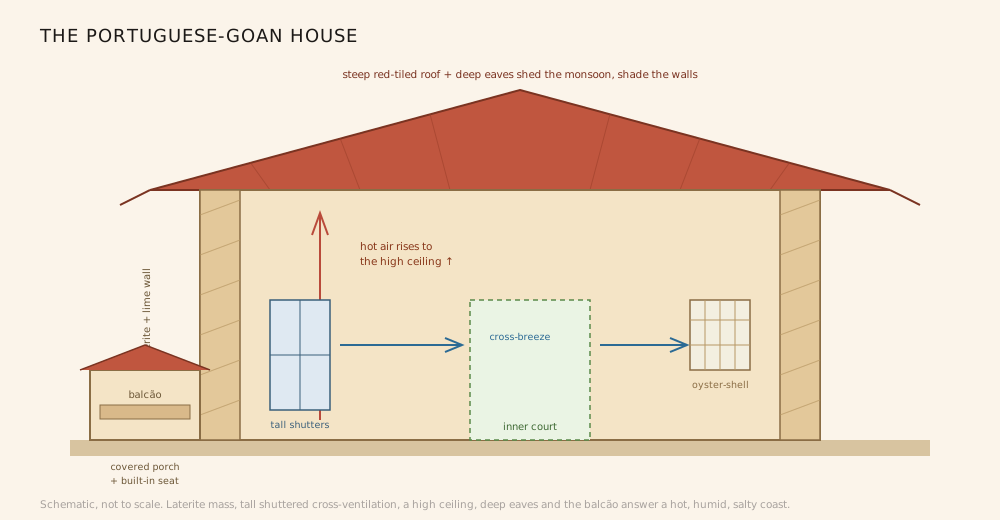
- The balcão. The covered entrance porch with built-in seats is the house's social heart and its shaded threshold — a homestay's most-loved spot, and pure Goa.
- Laterite and lime. Thick laterite walls finished in breathable lime handle the humidity and the salt far better than cement render, which traps damp and spalls near the coast.
- Tall rooms, high ceilings and big shuttered windows. Hot air rises away from the living level, and cross-ventilation through shuttered and oyster-shell (carepa) windows cools without machinery.
- Steep tiled roof, deep eaves and salt-tolerant finishes. The roof sheds the heavy monsoon and shades the walls; near the sea, choose fittings and hardware that survive salt air and specify them to last.
Design with these and a Goa house stays cool, dry and standing — fight them with a sealed concrete box and you pay in air-conditioning bills and salt damage.
The guest, and the sharpest season in India
The Goa guest spans the beach-and-café traveller, the long-staying remote worker, the wedding party and the design-conscious couple hunting a characterful villa. The defining feature of the economics is seasonality, the sharpest in the Indian market: a well-placed house can clear ₹2–3 lakh in a month through the November-to-February peak (and Christmas–New Year is a spike of its own), then fall below 30% occupancy through the monsoon, when many places simply close. Budget the whole year on that honest curve: price hard into the peak, hold a real reserve for the trough, and decide deliberately whether to chase the growing monsoon and remote-worker shoulder market or to close and maintain. Model your own blend in the ROI Calculator.
Key takeaways
- Sell the house, not the beach — a restored Portuguese-Goan home is a premium, un-copyable product; add comfort discreetly and use a conservation architect for genuine heritage.
- The vernacular is a coastal survival kit: the balcão, laterite-and-lime walls, tall rooms, shuttered cross-ventilation, deep eaves and salt-tolerant finishes.
- The guest ranges from beach traveller to remote worker to wedding party — a modern house competes on location, pool and finish; a heritage house on character.
- Goa has the sharpest seasonality in the market — a strong Nov–Feb peak and a sub-30% monsoon trough; price into the peak and reserve for the fall.
- Register under Goa's homestay scheme plus the local and fire layers — confirm via the Licence Finder.
References
- Goa homestay / tourism registration (Department of Tourism, Government of Goa) — authoritative for registration, categories and fees; see the state portal and the Licence Finder.
- Indo-Portuguese Goan domestic architecture — the balcão, laterite-and-lime construction, oyster-shell windows and tiled roofs as a hot-humid coastal response.
- A conservation architect and a local structural engineer — essential before restoring or altering a genuine heritage Goan house.
Indicative and state-dependent. Studio Matrx is a not-for-profit guide; this is educational content, not legal or conservation advice. Confirm licensing with Goa Tourism and your local body, and treat rates and seasons as indicative.
Export this guide
Related Guides — Deep-dive reading
Designing Your Home as a Homestay: Rooms, Privacy & Regional Character
A homestay is a design problem before it is a business. This guide covers the decisions that make guests book and return — zoning host from guest so both can relax, guest-room and bathroom standards, carrying your region's character into the space, accessibility, and the safety that quietly underpins it all.
HomestaysKerala Homestays: The Backwater, Plantation & Heritage Playbook
Kerala practically invented the Indian homestay, and its vernacular is a gift — the courtyard tharavadu, the sloping tiled roof, the verandah and water as the view. This playbook covers the three Kerala stay types, the passive design that answers heat and monsoon, and the Ayurveda season that fills the trough.
HomestaysRegional Homestay Playbooks: Plantation, Hill, Kerala, Rajasthan, Goa & the North-East
A homestay belongs to its region — in its materials, its climate, its layout and the guest who comes for it. This playbook reads India's great homestay regions one by one: the vernacular that feels authentic, the climate the design must answer, the layout that works, who the guest is, and how the economics and seasons behave.
HomestaysRelated Tools — Try Free
Cross-Ventilation Analyzer
Estimate airflow and air changes per hour (ACH) from room size, window areas, layout, and local wind — with NBC 2016 Part 8 compliance check.
Ventilation CalculatorBathroom Renovation Cost Calculator
Cost to renovate an existing bathroom with a replace-vs-keep model — demolition, re-waterproofing, tiles, fittings and the money saved by keeping items.
Bathroom CalculatorBefore & After Studio
Generate AI before-and-after renders to preview how your redesign could look.
DesignAI