
Brass After Dark
The Finish That Changes Without Moving
A brass panel can look remarkably different at ten in the morning and eight in the evening, even when its position has not changed. In daylight, the surface may appear pale, revealing fine lines left by finishing tools and subtle variations across the metal. Under artificial illumination, a concentrated highlight may travel across it, making one portion appear intensely golden while another becomes almost indistinguishable from the surrounding wall. If the observer moves sideways, that highlight can move again. The brass has not changed during those hours, but the conditions under which it is seen have changed considerably.
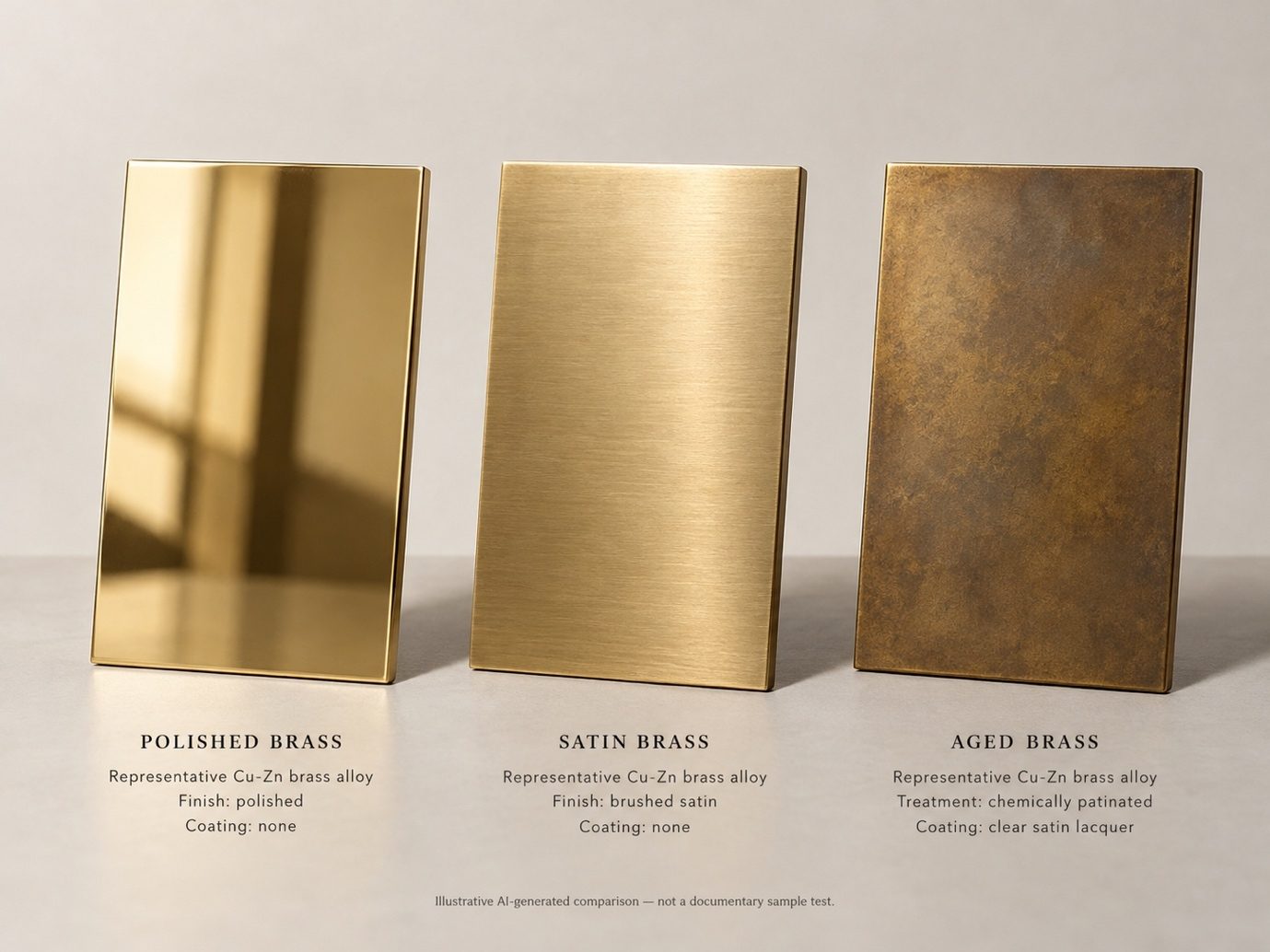
Now imagine three brass samples placed side by side. The first has a highly polished finish, the second a satin finish created through controlled abrasion, and the third a darker aged or patinated surface. From a distance, all three may look like brass. At closer range, their differences become more difficult to explain through colour alone. The polished sample may return a recognisable image of the surrounding environment. The satin sample may replace that image with a broader, softer reflection. The aged sample may have a chemically altered surface whose colour and optical response differ from those of newly finished metal. Each therefore creates a different relationship between material and illumination.
This is where brass becomes an architectural question rather than a decorative preference. A designer selecting a polished brass wall panel is not merely deciding that the panel should appear golden. The decision also influences what may become visible on its surface: bright light sources, window shapes, neighbouring objects, installation irregularities and traces of handling. A satin finish changes the character of those reflections but may make the direction of its surface texture important. An aged finish introduces another issue because chemical treatment or exposure over time may have altered the visible surface. Its present appearance may not describe how it will continue to change.
Brass itself is not a single fixed material composition. It belongs to a family of copper–zinc alloys whose composition and properties vary. The Copper Development Association’s alloy database identifies C26000, commonly called cartridge brass, as a wrought brass grade containing about 70 percent copper, with zinc making up most of the remainder. That information is useful as a material example, but it would be incorrect to treat C26000 as the grade used in every architectural brass fitting. Hardware, sheet material and decorative elements may be produced from different alloys and through different manufacturing methods.
The specification problem begins when the material is described only as brass finish. That phrase does not establish the alloy, whether the element is solid brass or a coating over another substrate, the finishing method, the presence of a protective layer or the expected appearance after use. Two products may satisfy that description while behaving very differently under the same lighting conditions.
This material study therefore does not aim to establish which brass finish is most attractive. It aims to explain how the surface is made, why its appearance changes, what that change means for its location in a building, and how a designer can distinguish a convincing sample from an adequately specified architectural component. The important question is not simply how brass catches light after sunset but what makes that behaviour predictable enough to become a deliberate design decision.
One Metal, Three Different Surfaces
Polished, satin and aged brass are often treated as three alternatives on a finish board. Yet the terms do not describe the same kind of material difference. Polishing and satin finishing primarily concern the physical texture produced on a surface. Ageing or patination concerns the development or deliberate creation of a surface layer through chemical processes. A piece of brass can consequently be both brushed and patinated, or polished and protected with a coating. These characteristics are not necessarily mutually exclusive.
Highly polished brass is produced through successive finishing operations intended to create a smooth, reflective surface. The Copper Development Association describes polished and buffed architectural copper-alloy finishes as the result of grinding, polishing and buffing, with the highest grades capable of producing a mirror-like appearance. On such a surface, reflections can retain relatively recognisable shapes. A window may appear as a bright rectangle, while a nearby luminaire can produce a concentrated highlight. The surface’s visual quality is therefore closely tied to the surrounding environment.
This has consequences not immediately apparent in a small sample. A highly polished sheet may reveal slight waviness, distortion or local differences in flatness because reflected lines bend across those irregularities. On a small sample held in the hand, this may be difficult to notice. Across a larger panel, the same behaviour can become conspicuous. What was expected to read as a continuous bright metal plane may instead reveal how the sheet was formed, supported or installed.
Satin brass behaves differently. Mechanical abrasion creates fine texture across the surface, often through directional grinding or brushing. The Copper Development Association identifies directionally textured finishes as a recognised group of architectural metal finishes, including different grades of satin appearance. The fine marks left by finishing tools change how reflected light behaves. Instead of returning a sharp image of the surroundings, the surface may spread the reflection into a softer or elongated highlight, depending on its texture, light source and viewing direction.
The finish direction becomes important. Imagine two adjoining brass panels installed with their brushing directions perpendicular to one another. Even when made from the same alloy and nominally finished to the same grade, they may reflect light differently. Under a directional source, the discrepancy can become especially apparent because the texture has a preferred orientation. The visual continuity of the finished wall therefore depends partly on fabrication instructions, not merely on the supplier providing matching sheets.
An aged or patinated surface introduces another kind of change. Chemical reactions can alter the colour and composition of the outermost layer of the metal. Some patinas develop naturally through exposure, while others are produced deliberately through controlled finishing treatments. The Canadian Conservation Institute recognises that copper-alloy surfaces can develop stable patinas with a range of colours, including golden, brown, black and greenish appearances. These changes should not be reduced to one standard shade of antique brass.
This creates three fundamentally different questions for specification. With polished brass, the designer must consider reflection clarity and the quality of the underlying metal surface. With satin brass, texture direction and consistency become central. With aged brass, you must understand the nature and stability of the surface treatment. A sample board that presents the three simply as different colours conceals these important differences.
What the Light Source Actually Reveals
A brass surface can look different when the light source moves, even if it produces no change in overall output. This comes down to the relationship between the incoming light, the surface's physical condition, and the observer's position. Highly polished and more textured surfaces redistribute reflected light differently, so a single lighting arrangement does not produce the same visible effect on every finish.
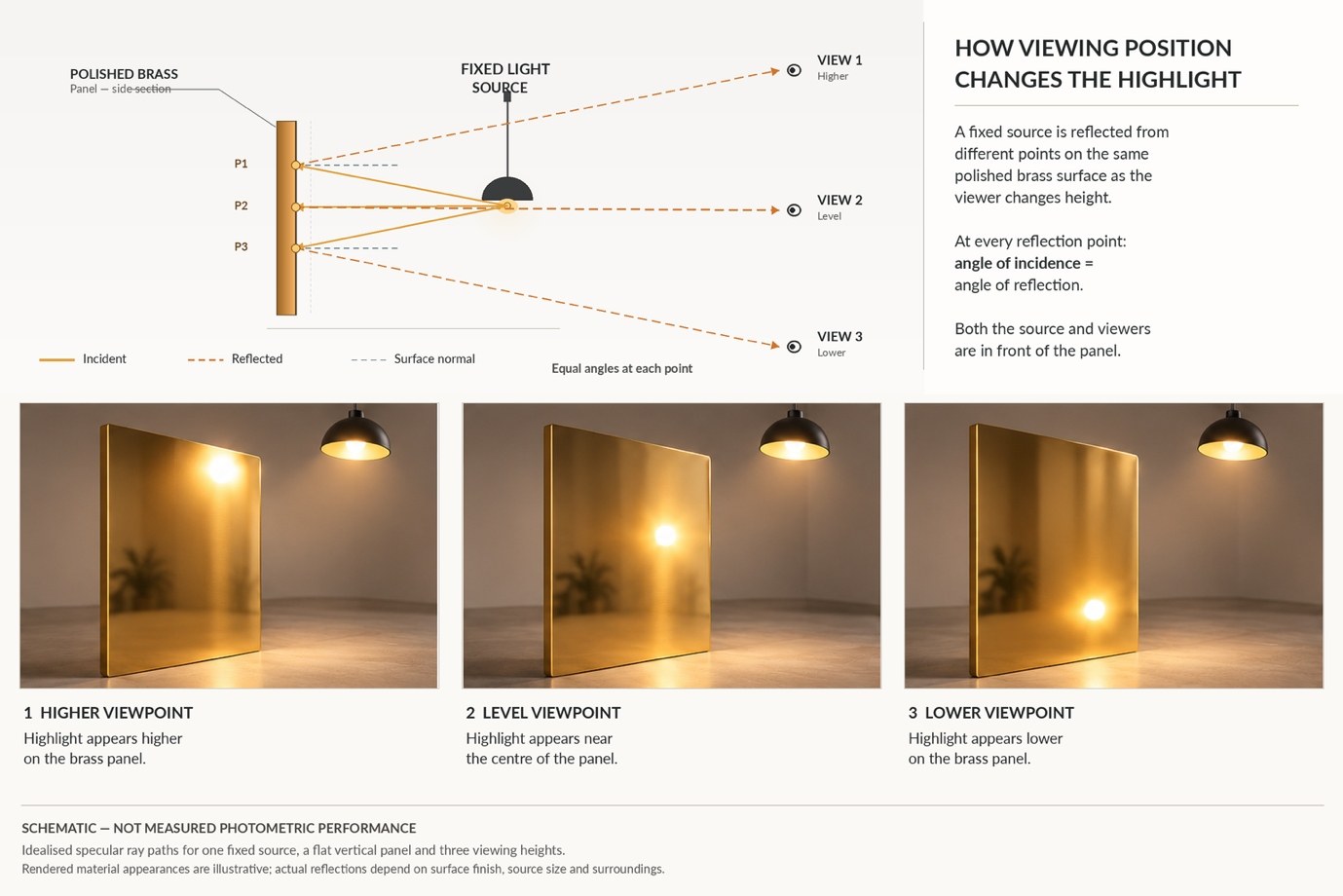
Consider a flat polished brass sheet illuminated by a relatively compact source. From some viewing positions, the observer may see a strong reflection of that source. A slight change in the observer’s position can shift the reflection, sometimes taking it out of the visible panel entirely. The result may be striking but also means the material does not have one stable illuminated appearance that can be captured in a single photograph.
Now place a directionally finished satin sample in the same position. The reflected source may become less sharply defined, with light distributed across a broader apparent region. The exact effect depends on the finish marks and the illumination geometry. A satin finish does not eliminate glare or return a uniformly soft reflection. It changes the surface response, but you must still assess the resulting visual quality from relevant viewing positions.
Surface geometry matters alongside finish. A perfectly flat, polished specimen and a slightly curved specimen can return markedly different reflections. A curved metal surface changes the orientation of its local surface at each point, redirecting incoming light differently across its form. On a bent brass panel, a highlight may follow the curve and make its geometry visually prominent. On a nominally flat but distorted panel, a similar highlight may reveal unintended variations. The same reflective behaviour that makes polished metal engaging can also expose imperfect fabrication.
Direct light, indirect light, and grazing light create different opportunities to observe these relationships. A direct source can produce a strong localised reflected image where the angles align. Light from a broad illuminated ceiling or wall may appear less concentrated in the metal’s reflection because the source occupies a larger apparent area. Grazing illumination may emphasise finishing marks, seams or small distortions where their geometry affects the light returned toward the observer. None of these effects is universally desirable or undesirable. Their relevance depends on whether the design intends to reveal or minimise surface characteristics.
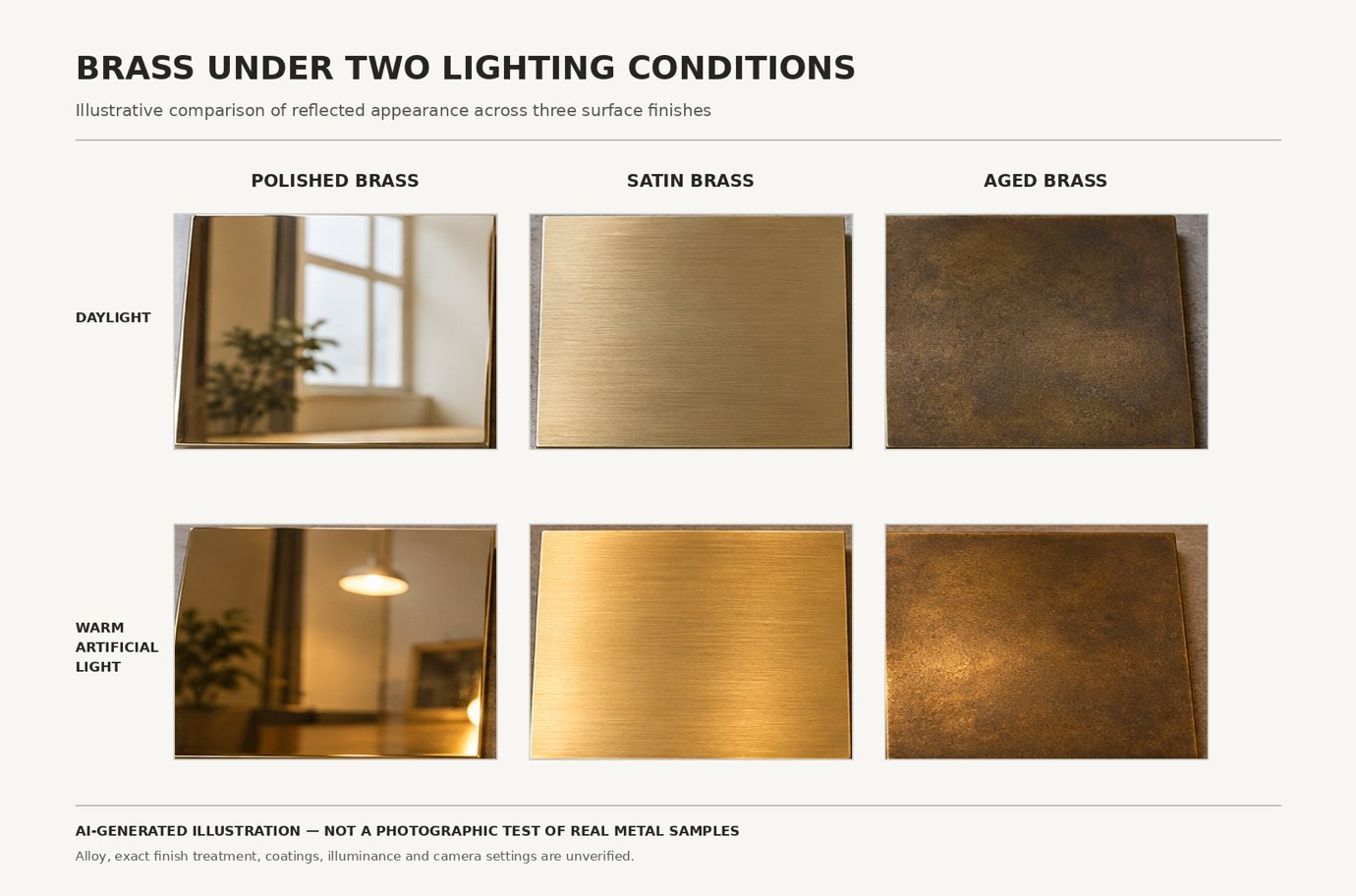
This relationship becomes more complicated when comparing daylight with artificial light. Daylight entering through a large opening can come from a broad range of directions and change throughout the day. Artificial lighting may remain fixed and differ in spectral characteristics. Brass reflects light selectively across wavelengths, meaning the colour appearance of reflected light depends on both the material and the source. A warm-looking lamp does not automatically make every brass finish appear richer or more convincing; it can alter colour relationships in ways that must be evaluated with the actual sample.
The National Institute of Standards and Technology treats specular gloss as a measurable surface property, with dedicated measurement methods and instruments. This is useful because it distinguishes a material property from a descriptive word such as shiny. However, a gloss measurement cannot replace the full experience of a panel under installed lighting. The observer sees the material within an environment, not in isolation.
For architectural evaluation, the important test is not whether brass appears luminous in a product photograph. It is how its reflection changes when the source, surface and viewer form different geometrical relationships. A sample that looks convincing from directly in front of a display may behave differently when installed along a corridor, near a window or beside a seated observer.
Patina Is a Surface Condition, Not a Colour Name
A designer may choose an aged brass finish for a darker, quieter, or time-worn appearance. Yet the word aged can conceal several different material conditions. The surface may have darkened naturally through exposure, been chemically patinated during manufacture, received a tinted coating or been finished using another decorative process. These methods can create similar appearances without producing identical surfaces or maintenance requirements.
The Canadian Conservation Institute explains that patinas on copper and copper alloys may arise naturally or be created artificially. It also distinguishes stable patinas from active corrosion. This distinction matters because a darkened or coloured surface is not automatically damaged, while visible corrosion is not automatically an acceptable part of ageing. A stable patina may form a coherent surface layer whose appearance has historical or aesthetic significance. Active corrosion, by contrast, may involve material loss, powdery deposits, or ongoing deterioration that requires investigation.
The institute provides a particularly relevant documented comparison of polished and tarnished brass candlesticks. In the example, the polished surface is visibly lighter than the darker tarnished specimen. The difference arises through the formation of a surface layer associated with exposure to moisture and atmospheric pollutants. The comparison demonstrates that the visible colour of the material can change without replacing the underlying brass with another alloy.
That observation has practical consequences for contemporary architecture. A designer choosing unfinished brass and expecting it to darken will likely be surprised. Handling, cleaning, local moisture, pollutants, contact with adjoining materials and exposure distribution can all affect the surface. A frequently touched handle and an inaccessible decorative panel may develop different appearances even if both began with the same finish.
You must also understand the difference between an intentionally aged finish and uncontrolled deterioration. In a manufactured patinated product, the designer should know how the appearance was created and whether it is protected or intended to continue changing. A dark coating applied over brass may not behave like a naturally developed patina. If a surface is deliberately distressed or coloured, the specification should describe that process accurately rather than hiding it under the general term antique.
This also changes how the surface should be maintained. Cleaning a metal object is not the same as polishing it. The Canadian Conservation Institute explains that polishing is an abrasive activity that removes tarnish and some surface metal. Repeated polishing can remove the material or surface characteristics the designer intends to retain. A patinated finish selected for its darkened appearance may be damaged by maintenance intended to restore the bright colour of untreated brass.
At the same time, leaving every greenish mark or stain untouched is not an adequate conservation strategy. The institute documents circumstances in which green corrosion products can result from contamination, including residues from inappropriate polishing. Before deciding whether to preserve, clean, or treat it, you must investigate the surface's appearance and condition.
For homeowners, the distinction changes a familiar maintenance question. Instead of asking how to make brass shiny again, the first question should be whether the component was ever intended to remain shiny. For a professional, the specification must state whether the desired appearance is polished and maintained, chemically patinated and protected, or deliberately allowed to change. The expectation of future appearance should be part of the original design decision, not an argument that begins after the material has already changed.
The Protective Layer Has Its Own Life
A brass finish does not necessarily end at the exposed metal. Architectural products may include lacquers, waxes or other protective treatments intended to reduce tarnishing, limit contact with environmental substances or preserve a particular appearance. These layers can be visually subtle, but they influence how the finish performs over time.
Clear lacquers are particularly relevant when a designer wants brass to retain something close to its newly polished appearance. By creating a barrier between the metal and its environment, a suitable coating can slow the reactions that would otherwise alter the surface. This can be valuable where the original colour is central to the design. It is not, however, a permanent guarantee that the material will remain unchanged.
The Copper Development Association describes protective coatings as one way to retain the original appearance of copper-alloy architectural surfaces. Its guidance also notes that coatings require maintenance and may eventually need removal or replacement. The practical difficulty is that a protective layer and the metal beneath it form a combined finishing system. If the coating is damaged, changes may begin locally, producing differences between protected and exposed regions of the same component.
Imagine a large brass panel installed beside a frequently used doorway. If part of its protective coating is scratched, the damaged area may respond differently to handling and environmental exposure from the rest of the surface. A later attempt to repair only that small portion may introduce another visible difference in gloss or colour. The material’s long-term appearance can therefore depend as much on coating repairability as on the finish initially selected.
Wax treatments introduce a related but different strategy. Conservation guidance describes suitable waxes as protective layers that can reduce the need for frequent polishing under appropriate conditions. Their performance and maintenance differ from lacquer, and their suitability depends on the object and environment. A wax applied to a heritage object under controlled conservation procedures should not be assumed appropriate for every newly manufactured architectural fitting, particularly without considering handling, cleaning and the manufacturer’s recommendations.
The underlying lesson is that the phrase clear protective finish is incomplete. A specification should identify the coating system, application method, compatibility with the underlying finish, intended environmental exposure, cleaning procedure, and repair strategy. The manufacturer or finishing specialist should confirm these matters for the actual product. The designer also needs to understand whether the coating will alter the metal's visual appearance, because even a transparent layer can change surface gloss and how reflected light is perceived.
Fabrication timing is also important. Some finishes and coatings may be applied after forming and joining, while others may be established on individual components before assembly. If the metal must be welded, soldered, bent, or otherwise worked, the finishing sequence needs to be coordinated with those operations. A sample made on a flat, separately finished sheet may not demonstrate how a completed assembly will look around corners, joins and exposed edges.
This is where the material study becomes closely connected to construction. The polished, satin or aged appearance is not an independent final colour added after all other decisions have been made. It results from fabrication, surface preparation, finishing treatment, protective systems, and eventual maintenance. The specification must describe enough of that sequence for the finished architectural element to be reproducible.
What the Showroom Sample Cannot Tell You
A small sample helps a designer or homeowner compare materials directly. Its size, however, also limits what you can learn. A sample may be perfectly finished, viewed up close and lit under carefully selected showroom lighting. The completed architectural installation may be much larger, in a different orientation, and viewed from positions never considered during the initial selection.
Consider a polished brass sample measuring only a small portion of the proposed wall panel. Held in the hand, it may appear smooth and consistent. When the same finish is applied to a full-height sheet, minor differences in flatness or fabrication can become more noticeable because the reflected environment spans a larger area. Straight architectural lines reflected across the panel may reveal waviness that was not evident on the sample. The Copper Development Association specifically recognises the tendency of highly reflective polished finishes to reveal slight distortions and irregularities.
Scale also changes how a directional finish is perceived. A brushed brass sample may show a consistent texture across its limited width. In a larger installation, the designer must determine how that texture continues across multiple panels. If some pieces are fabricated or installed with the brushing direction reversed, the overall composition may show unexpected variations when light crosses the joints. The visual effect can be mistaken for a difference in metal colour even when its cause lies in the orientation of the finishing marks.
Joints deserve particular scrutiny. Two panels may be manufactured from matching material but display a visible discontinuity where they meet. The seam itself may catch light differently from the adjacent surfaces. Folded edges can return stronger or weaker highlights because their orientation has changed. Exposed edges may reveal a different substrate or finish condition if the product is plated or coated rather than solid brass. The sample therefore has to explain not just the face of the material, but how that face relates to the actual construction.
There is also a difference between choosing brass and choosing a brass-coloured product. A component described commercially as having a brass finish may be solid brass, brass plated over another material or a non-brass surface designed to resemble the colour of brass. These distinctions affect fabrication, wear, repair and long-term maintenance. The Canadian Conservation Institute’s guidance on plated metals explains that plated objects have a surface layer over a different underlying material. Damage to that layer can expose the substrate and change the way the object deteriorates. A product’s visual similarity to brass is therefore insufficient evidence of its composition.
A responsible approval process should use more than one sample type. A small hand sample can establish the preliminary finish direction. A larger representative panel can show surface continuity, joints and expected reflections. A sample installed in the intended or a closely representative lighting environment can then test whether the appearance remains convincing from normal viewing positions. Where the work is sufficiently complex, a coordinated mock-up should incorporate the actual substrate, fabrication method, joint and coating.
This is not to say every brass door handle requires a full-scale architectural prototype. The appropriate level of testing should match the component's scale, cost, complexity, and importance. A small replaceable fitting presents a different risk from a continuous wall surface that would be expensive to refinish after installation.
The lesson for homeowners is that choosing a finish from a catalogue image is not equivalent to approving its installed appearance. For professionals, a finish schedule needs evidence of what was approved and the conditions under which it was examined. For students, the valuable skill is recognising which questions the sample answers and which still require a larger or more representative test.
Writing a Specification That Can Be Built
An architectural specification becomes useful only when another person can understand what is required, manufacture or source an appropriate component and assess whether the finished work corresponds to the approved intention. With brass, this is particularly important because words such as golden, antique, brushed or mirror may describe a desired impression without adequately defining the material or finishing process.
The first specification decision concerns the material itself. The designer should establish whether solid brass, brass sheet, cast brass, brass plating, or another brass-coloured surface is intended. Where a specific alloy is necessary for manufacturing or performance, it should be identified through a recognised material designation and verified against the supplier’s documentation. The Copper Development Association’s alloy references demonstrate why a standard designation is more precise than treating all brass as one composition.
The second decision concerns the required finish. Distinguish a polished appearance from a directionally textured satin finish, and identify the actual treatment for an aged or patinated appearance. Where the finish has a particular brushing direction, the drawing should indicate that direction and how it continues across adjoining components. Descriptions should also identify whether the appearance is expected to be consistent across all parts or whether a controlled range of natural variation is acceptable.
The third decision concerns the surface system. The designer must know whether the brass is intended to remain uncoated, receive a protective wax or be finished with a particular lacquer or other coating. The purpose of this information is not to prescribe one universally correct treatment. It is to make the expected ageing, cleaning and repair behaviour understandable before installation.
A fourth decision concerns fabrication and installation. An architectural brass surface may have folded edges, concealed supports, visible joints or adjoining materials that influence its appearance. The designer should coordinate the finishing process with the proposed fabrication method and confirm whether the finish can be repaired after forming or assembly. Where brass is installed in contact with other metals or exposed to moisture, compatibility and corrosion risks may also require assessment. The Canadian Conservation Institute documents galvanic corrosion mechanisms associated with contact between dissimilar metals in the presence of an electrolyte, reinforcing the need for project-specific material coordination rather than assumptions based on appearance.
Finally, approval must have a reference against which the completed work can be judged. The supplier’s sample should be identified, dated and retained as an approved control where practical. If the installation relies on a particular directional finish or patination range, the approved reference needs to describe those conditions. A photograph may be useful as part of the record, but it should not become the only evidence of acceptance because camera processing and lighting conditions can alter its apparent colour and gloss.
Consider the difference between two instructions. The first asks for antique brass panels with a soft warm appearance. That may communicate a broad design intention, but it leaves the manufacturing method, substrate, coating and expected variation unresolved. The second identifies the product’s actual metal composition, the documented finish process, an approved physical sample, the direction and continuity of surface treatment, the protective system and the required maintenance information. It leaves less room for unintended substitution or misunderstanding.
The more detailed description does not eliminate every visual uncertainty. Metals can still vary, and fabrication can produce results not fully anticipated from a small sample. But it sets the conditions for discussing and evaluating those variations.
A successful brass specification is therefore not the one that uses the most impressive finish terminology. It is the one that connects the desired appearance to a real material, a repeatable process and an agreed standard of acceptance.
A Material Test That Could Change the Decision
The most useful conclusion to this study is not that polished, satin or aged brass should be preferred. It is a method for discovering how each responds to the particular light and architectural conditions in which it is intended to be used. Such a test does not require an elaborate laboratory, but it must distinguish observation from measurement and maintain enough control for the comparison to mean something.
StudioMatrx can develop a sample-board investigation using three genuine metal specimens: polished brass, directionally finished satin brass and a documented aged or patinated brass surface. First, identify what each specimen actually is. If the alloys differ, or if one sample has a clear coating while another is uncoated, record that difference. Otherwise, you could incorrectly attribute appearance variations to surface texture alone when other material characteristics have changed.
A stronger comparative set would use samples from the same alloy and, where practical, comparable preparation, with each finishing process documented. Mount the specimens in the same orientation and examine them from a fixed viewing position. Their physical dimensions and surface geometry should be comparable enough to avoid introducing unnecessary variation into the test. If perfect equivalence is not possible, record the differences rather than ignore them.
Make the first observation under a defined daylight condition. Document the location, date, approximate time, orientation, and whether the light is direct sun or diffuse daylight. Photograph the samples together from a fixed camera position, using consistent exposure and white balance settings. This photograph establishes visible differences under one real lighting condition, but it does not show how the samples behave under every type of daylight.
The second observation would use a specified artificial light source in a controlled position. Identify the luminaire and record its operating conditions. Where possible, document the illuminance incident on the sample plane, stating the instrument and measurement positions. The result should not be converted into invented reflectance or luminance values. A photograph of a bright highlight is visual evidence of an appearance under a particular condition, not proof of a measured reflectance coefficient.
A third stage would examine changes in viewing geometry. Without moving the samples, the observer would shift to several recorded positions and note whether the reflections become sharper, broader, more concentrated or less prominent. For directionally finished brass, rotating a separate sample relative to the same source could help reveal the effect of brushing orientation, provided the test clearly identifies that rotation as the variable being changed. These observations can connect the material’s appearance to realistic conditions such as a person approaching a wall, walking along a corridor or viewing a panel from a seated position.
The results should be described carefully. A polished surface may produce a striking highlight from one position but make surface irregularities conspicuous from another. A satin finish may appear more consistent in one condition but reveal a directional difference when rotated. An aged finish may remain comparatively subdued under one source and show more surface variation under another. These are possible observations, not findings StudioMatrx can claim before carrying out the test.
The experiment would be particularly useful if its images were organised into a comparative matrix. A three-sample photograph could establish the finish differences under one condition, while a smaller four-cell study could compare two selected finishes under daylight and artificial light with the camera and sample geometry held consistent. The visual should state clearly which variables are controlled and which differ. If you test additional lighting positions, record them as separate conditions rather than quietly combining them into one illustrative composition.
Make the final decision only after relating the desired finish to the intended architectural application. A surface that must remain visually consistent across a large elevation demands different consideration than a small decorative object intended to develop character through handling. A frequently used fitting requires a clear cleaning and repair strategy, while a rarely touched panel may allow a different approach to surface change. When a particular appearance is essential, discuss its repeatability and maintenance burden before it becomes part of the approved design.
The material lesson is ultimately more precise than the familiar description of brass as warm, luxurious or timeless. Brass does not produce one fixed visual experience. Its alloy, surface texture, patina, protective treatment, geometry, and surroundings all contribute to how it is seen. Light reveals those decisions, sometimes making the material's intended character more apparent and sometimes exposing differences the original sample concealed.
For the homeowner, that means asking what the chosen finish will look like after handling, cleaning and years of use, not only how it appears in a showroom. For the professional, it means connecting the finish to fabrication, coating, joints, approval samples and maintenance instructions. For the student, it means learning to distinguish a documented material observation from an attractive rendering or an unsupported performance claim.
The value of brass after dark is not simply that it reflects light. It is that its surface can reveal the consequences of decisions made long before the luminaire was switched on. A well-considered brass detail should remain convincing as the light changes, the viewer moves, and the material ages. Achieving that requires more than selecting a colour. It requires understanding the metal, the finish, the surrounding light and the future life of the surface.
Sources & Technical References
Copper Development Association. Copper in Architecture: Design Handbook. Reference for polished, satin, directionally textured finishes, protective coatings and architectural applications.
Copper Development Association. C26000 — Cartridge Brass: Alloy Properties and Composition. Reference for copper–zinc alloy composition and material identification.
Canadian Conservation Institute. Caring for Metal Objects — Preventive Conservation Guidelines. Reference for natural and artificial patinas, stable corrosion layers, material ageing and surface preservation.
Canadian Conservation Institute. The Cleaning, Polishing and Protective Waxing of Brass and Copper. Reference for brass maintenance, abrasive polishing, tarnish removal and protective waxes.
Canadian Conservation Institute. Preventing and Treating the Dezincification of Brass. Reference for brass corrosion, protective coatings and their maintenance limitations.
National Institute of Standards and Technology (NIST). NIST Measurement Services: Specular Gloss (2006). Technical reference for gloss measurements and the optical properties of reflective surfaces.