
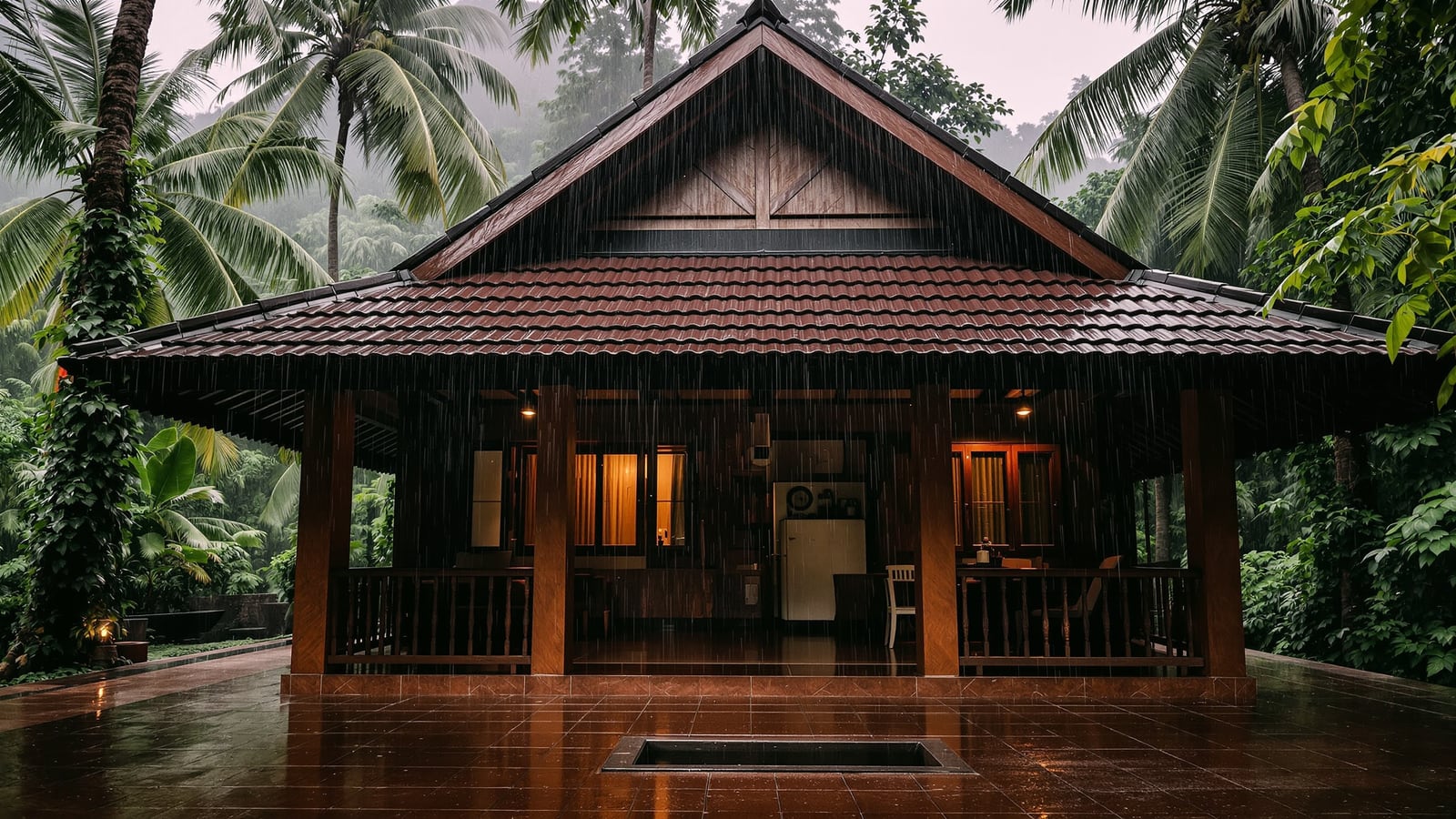
Malenadu Homestays: Sakleshpur, Agumbe, Sringeri & Sirsi
Malenadu — Karnataka's rain-soaked Western Ghats hill-forest belt — sells rainforest, waterfalls, areca-and-pepper gardens and the monsoon itself. This playbook covers the draw, the thotti mane courtyard house that evolved to live with extreme rain, how to design and operate through a real Malnad monsoon, and the forest edge you share with elephants and king cobras.
Malenadu (often written Malnad, "the hill country") is the long Western Ghats belt of Karnataka where the plateau breaks into forested ridges, deep valleys and some of the heaviest rain in South India. It runs from Sakleshpur in Hassan district, through Shivamogga — Agumbe, Thirthahalli, Hosanagara and Jog Falls — and the Sringeri, Kalasa and Kudremukh side of Chikkamagaluru, up to the Uttara Kannada uplands of Sirsi, Siddapur, Yellapur and Dandeli. Its homestays are not coffee-estate bungalows (that archetype has its own Coorg and Chikmagalur playbook); they are more often a family's areca-and-pepper garden house, a courtyard home in a temple town, or a cottage at the forest edge. This playbook covers the draw, the vernacular, the rain, and the forest. Pair it with the Karnataka overview and the regional playbooks.
Scope. Editorial good practice, not legal advice. Karnataka's homestay rules (owner-resident, small room counts), the trade-licence and fire layers, and any forest, eco-sensitive-zone or land-use conditions apply — see the Licence Finder and confirm with Karnataka Tourism and the district administration. Rainfall, wildlife and cost figures are indicative.
The draw: rain, forest, garden and temple
Malenadu's guest comes for an atmosphere rather than a single sight:
- Rainforest and waterfalls. Evergreen and semi-evergreen forest, mist on the ridges, and falls such as Jog on the Sharavathi, Sirimane near Sringeri and the many streams around Agumbe, Sakleshpur and Sirsi.
- The monsoon itself. Agumbe has long been called the "Cherrapunji of the South", with a long-term mean annual rainfall commonly cited around 7,600 mm; in recent years neighbouring stations such as Hulikal have recorded more. For a growing urban audience, sitting on a verandah watching that rain is the holiday.
- The tota. The areca-nut garden, threaded with pepper vines, cardamom, banana and betel, under a cool green canopy, is the Malnad equivalent of the coffee estate — a garden walk, harvest and drying in season, and the quiet of the place.
- Food. Havyaka and Malenadu home cooking — tambuli, akki rotti, kadubu, patrode, jackfruit and seasonal greens, fresh buttermilk — served at the family table is often the most remembered part of the stay.
- Temple towns and literary pilgrimage. Sringeri (the Sharada Peetham on the Tunga), Horanadu (Annapoorneshwari), Sirsi (Marikamba) and Kollur within reach; and Kuppalli near Thirthahalli, the childhood home of the poet Kuvempu, whose house is now the Kavimane museum, with the Kavishaila memorial nearby.
- Trekking and nature. Kudremukh, Kodachadri, Kurinjal, the Sakleshpur ridges, and the forests of Dandeli for birding and the Kali river.
Sell the place truthfully: a Malnad stay is slow, green and wet, not a resort.
The vernacular: the thotti mane
The traditional Malenadu and Havyaka house is a working answer to extreme rain, and it is the most authentic thing a host can offer.
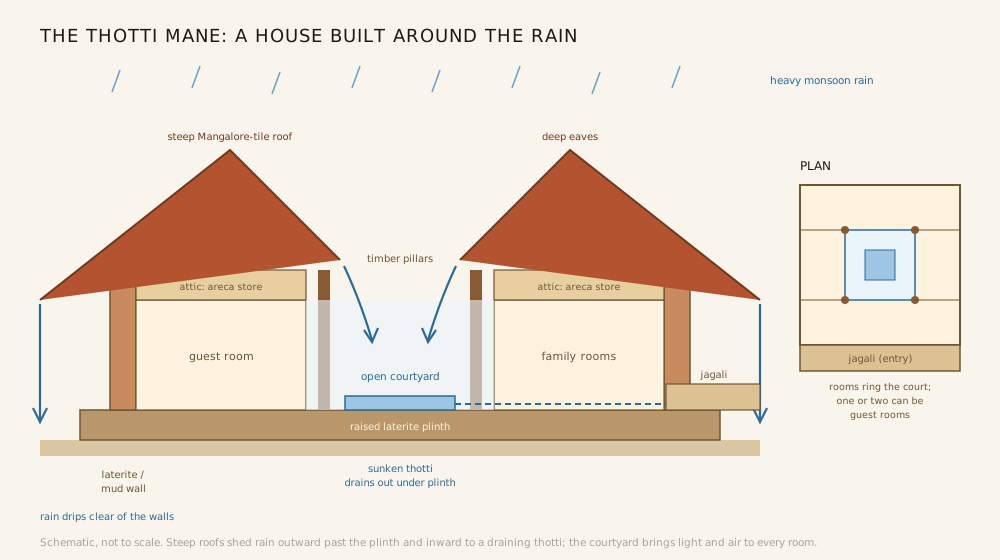
- Thotti mane — the courtyard house. Rooms are arranged around an open central court with a sunken, paved thotti that collects roof water and drains it away. It brings light and air deep into a house whose outer walls are closed against the weather — and it gives guests the unforgettable sight of rain falling inside the house.
- Steep roofs, deep eaves. Earlier thatch, later Mangalore tile on timber rafters, pitched steeply to shed water fast and overhanging generously so walls stay dry.
- Raised plinth and laterite or mud walls. Floors lifted clear of run-off on a laterite plinth; thick laterite, mud or rubble walls with lime plaster.
- Timber pillars and the jagali. Carved wooden columns ring the court; the jagali is the raised front verandah where visitors are received — the natural "lounge" of a homestay.
- The attic. Upper lofts traditionally stored areca and grain, kept dry above the living rooms.
Many old thotti manes are being demolished; restoring one (with a structural engineer checking timber and roof) or building a new courtyard house in this idiom can be a genuine differentiator. See the Malenadu thotti mane house plan, the house plans library and the design guide.
Design and operate for extreme rain
| Challenge | What to plan |
|---|---|
| Roof water | Steep pitch, deep eaves, oversized gutters or open drip-lines, a thotti and site drains sized for cloudburst-level rain; clear valleys and gutters before June |
| Damp and fungus | Raised plinth, damp-proofing, lime plaster that breathes, cross-ventilation, dehumidifiers or heated cupboards for linen, mattresses and wardrobes |
| Leeches | Paved or gravel paths, leech socks and salt for guests on garden and forest walks, honest briefing at booking |
| Power cuts | Inverter or battery backup for lights, Wi-Fi and pumps; solar-plus-storage where viable; hot water that does not depend on grid power |
| Road access | Ghat roads can be hit by landslides and tree-falls; keep supplies, communicate road status to guests, have a plan for a stranded guest |
| Snakes and wildlife | Clear vegetation near doors, good outdoor lighting, a contact for the forest department or a trained snake rescuer; never handle snakes |
Budget these honestly in the Setup Cost Estimator.
Two seasons, both sellable
Malenadu has a peak from roughly October to February — clear, green, cool, with waterfalls still full early in the season and temple festivals. And it has the monsoon, June to September, which hosts increasingly sell deliberately as rain tourism: book-a-verandah, rain walks, pakoras and kashaya, waterfall viewpoints, and cosy indoor time. Price the monsoon as its own product rather than as an off-season discount, but be honest that some treks, forest areas and roads close in heavy rain. March to May is warm and quieter. Model the year in the ROI Calculator and the profitability guide.
Living at the forest edge
Much of Malenadu borders protected forest: Kudremukh National Park (about 600 sq km, with an eco-sensitive zone notified around it), the Sharavathi Valley sanctuary, Shettihalli, Mookambika, and the Dandeli-Anshi (Kali) Tiger Reserve. Elephants move through parts of the Sakleshpur and Shivamogga landscapes, and Agumbe is famous as king cobra country — home to the Agumbe Rainforest Research Station, founded in 2005 by herpetologist Romulus Whitaker. For a host this means:
- Check eco-sensitive-zone and forest rules before buying, building or extending near a protected area — construction, lighting, noise and campfires may be restricted.
- No night drives, off-trail forest walks or feeding of wildlife; use forest-department or licensed guides for treks.
- Keep it low-impact — septic and grey-water treated properly, no plastic left on trails, quiet after dark. The forest is the asset; protect it.
Key takeaways
- Malenadu (Malnad) sells rainforest, waterfalls, the areca-pepper tota, Havyaka food, temple towns and the monsoon itself — distinct from Coorg-style coffee estates.
- The thotti mane courtyard house — steep tiled roofs, deep eaves, sunken thotti, raised plinth, timber pillars and a jagali — is the authentic product; restore or reinterpret it.
- Design for extreme rain: drainage, damp and fungus, leeches, power cuts and ghat-road access.
- Sell two seasons — an Oct–Feb peak and a deliberate Jun–Sep rain-tourism product.
- Respect the forest edge: eco-sensitive zones, elephants and king cobras, licensed guides and low-impact operations.
- Register under Karnataka's homestay rules — start with the Licence Finder and the registration guide; new hosts begin with how to start a homestay.
Nearby coasts and cousins: Coastal Karnataka, Kerala and Konkan.
References
- Karnataka Tourism homestay registration rules — authoritative for owner-residence, room caps and process; confirm with the department and the district administration via the Licence Finder.
- India Meteorological Department and Karnataka State Natural Disaster Monitoring Centre rainfall records — Agumbe's long-term mean (commonly cited around 7,600 mm a year) and recent higher totals at Hulikal and other Malnad stations.
- MoEFCC eco-sensitive-zone notification for Kudremukh National Park (2020) and Karnataka Forest Department rules for protected areas.
- Agumbe Rainforest Research Station (founded 2005) — king cobra and rainforest research and conservation.
- Malenadu and Havyaka vernacular architecture — thotti mane courtyards, laterite and mud walls, Mangalore-tile roofs and the jagali.
Indicative and location-dependent. Studio Matrx is a not-for-profit guide; this is educational content, not legal, structural or wildlife-safety advice. Confirm licensing with Karnataka Tourism and the district administration, check forest and eco-sensitive-zone rules with the Forest Department, and engage a structural engineer before restoring an old house.
Export this guide
Related Guides — Deep-dive reading
Karnataka Homestays: Coorg, Chikkamagaluru, Malenadu & the Canara Coast
Karnataka is one of India's densest homestay states — coffee estates in Kodagu and Chikkamagaluru, rain-forest farmhouses across Malenadu, temple-town and beach stays on the Canara coast, and heritage rooms in Hampi and Mysuru. This pillar maps the belts, explains the 2025 registration guidelines, and sets out the Western Ghats realities every host must plan around.
HomestaysCoastal Karnataka Homestays: Mangaluru, Udupi, Gokarna & the Canara Coast
The Canara coast pairs quiet beaches and river estuaries with some of South India's great pilgrim temples, a living Tulu Nadu culture and one of the country's finest fish thalis. This playbook covers the three coastal districts, the guthu mane and Mangalorean house as product, design for a 4,000 mm monsoon and salt air, the coastal-zone rules, and the pilgrim-versus-backpacker season.
HomestaysMadhya Pradesh Homestays: Forest, Village & Heritage-Town Stays
India's heartland sells tiger forests, living villages and quiet heritage towns — and the homestay version is a mud-walled, tile-roofed house on a forest fringe, or a family home above the Narmada ghats. This playbook covers MP Tourism's rural homestay programme, buffer-zone siting rules, the earth-and-tile vernacular, and an honest season plan.
HomestaysRelated Tools — Try Free
Homestay Licence Finder
Pick your state for the homestay registration picture — room caps, residence rules and fees — plus the three compliance layers every host needs.
Licence FinderAccess-Control Battery-Backup Calculator
Size the standby battery so an access system keeps running through a power cut, with an egress life-safety note.
Battery BackupStamp Duty Calculator — All Indian States
Stamp duty + registration charges for all 28 states and 8 UTs — gender concessions, urban/rural variants, metro cess built in.
Stamp Duty