
Kerala Homestays: The Backwater, Plantation & Heritage Playbook
Kerala practically invented the Indian homestay, and its vernacular is a gift — the courtyard tharavadu, the sloping tiled roof, the verandah and water as the view. This playbook covers the three Kerala stay types, the passive design that answers heat and monsoon, and the Ayurveda season that fills the trough.
Kerala did not just take to the homestay — it practically invented the Indian version, and it remains the benchmark. Part of the reason is cultural: a long tradition of hospitality and of the family home, the tharavadu, as a place that holds many. Part of it is the vernacular, which hands a host almost everything a great homestay needs — a courtyard, a sloping tiled roof that laughs at the monsoon, deep verandahs, timber warmth, and water or green everywhere you look. This playbook reads the Kerala homestay in its three forms, the passive design that makes it comfortable without fighting the climate, and the one season trick that is unique to the state. Pair it with the design guide and the regional overview.
Scope. Editorial good practice, not legal advice. Kerala's homestay scheme (owner/family resident, up to 6 rooms) and the trade-licence and fire layers apply — see the Licence Finder. Figures are indicative.
Three Keralas, three stays
"Kerala homestay" is really three different products, and knowing which you have shapes everything:
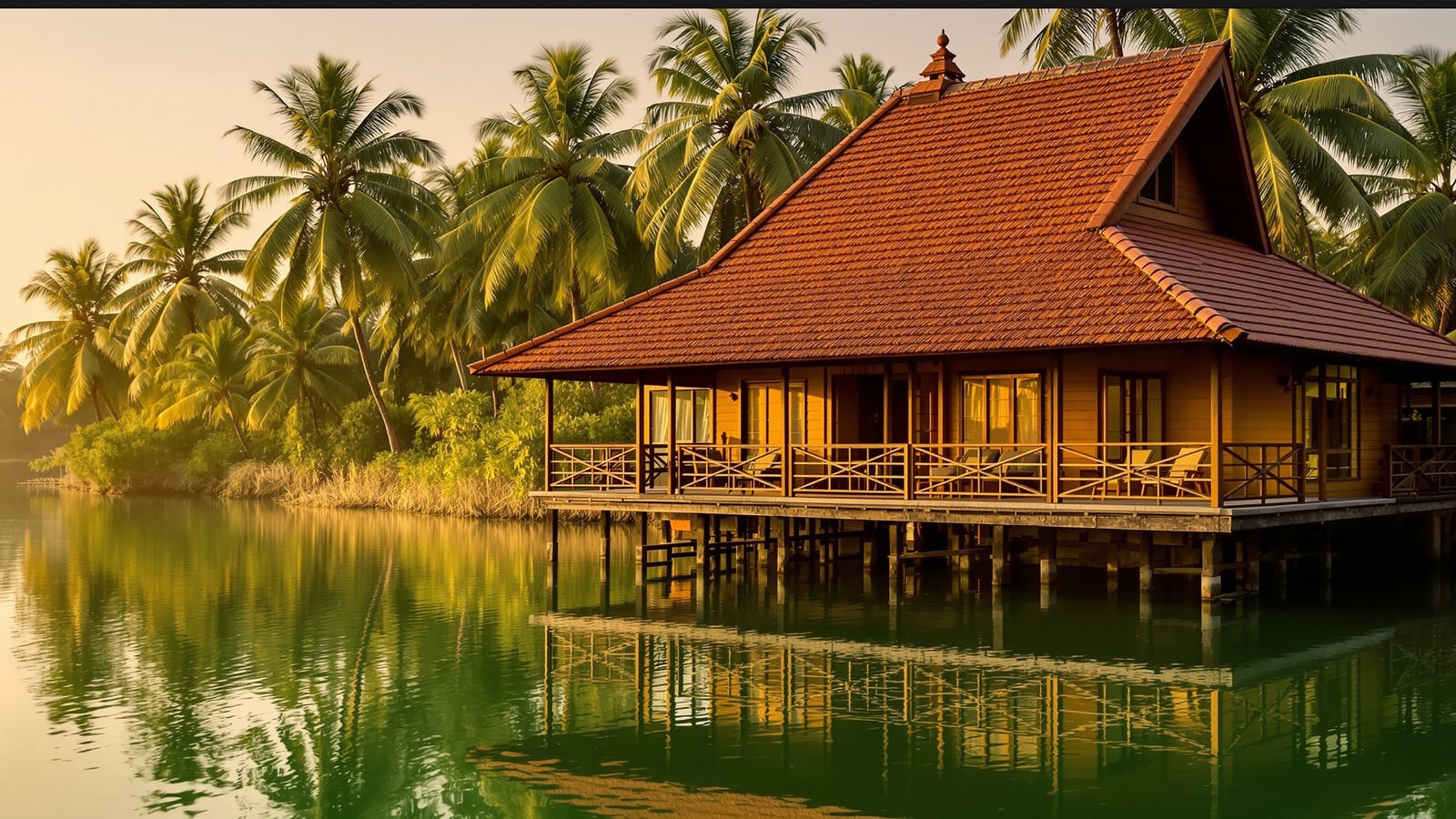
- Backwater homestays — Alleppey (Alappuzha), Kumarakom, the Kuttanad belt. The water is the star: a verandah or a room over a canal or lagoon, a country boat, fish from the backwater. Romance and stillness are the draw.
- Plantation / hill homestays — Munnar, Wayanad, Thekkady, Vagamon. Tea and spice estates, cool air, treks and birdlife. Closer to the Coorg plantation playbook in spirit.
- Heritage homestays — Fort Kochi, the old trading towns, a restored tharavadu or a Syrian-Christian or Mappila heritage house. History, craft and character are the product.
Each wants a slightly different guest, but all three share the same climate and the same gift of a vernacular.
The vernacular is the design — use it
The traditional Kerala house is a near-perfect warm-humid machine, and the homestay that leans into it is both more authentic and more comfortable than one that imports a generic look.
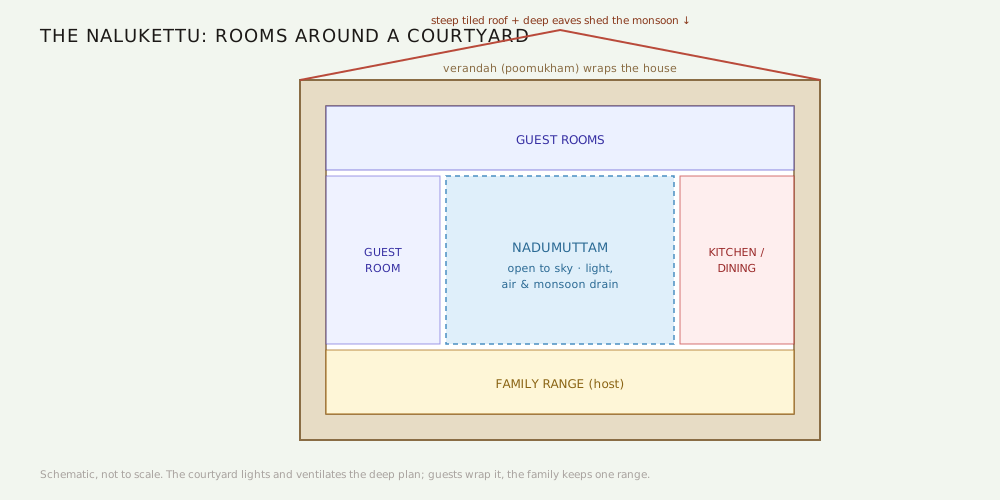
- The courtyard (nadumuttam). The classic nalukettu wraps four ranges of rooms around a central open-to-sky court. It lights and ventilates the deep plan, drains the monsoon, and gives a serene shared heart — a gift for a homestay.
- The steep tiled roof with deep eaves. It sheds Kerala's enormous rain well clear of the walls and shades them from the sun; the attic space under it buffers heat.
- The verandah (poomukham / charupady). The welcoming threshold and the best seat for the rain — the room guests love most.
- A raised plinth, timber and laterite, cross-ventilation. Keep the floor above monsoon ground-water, use breathable local materials, and let air move through the plan. In this climate, shade and breeze beat air-conditioning — offer AC, but design so it is rarely needed.
The guest, and a season trick found only in Kerala
The Kerala guest ranges from the backwater romantic and the European winter traveller to the wellness-seeker. Peak is the pleasant, dry October to March. But Kerala has a counter-seasonal secret the rest of India does not: Ayurveda's traditional treatment season is the monsoon (roughly June–August), when the cool, humid air is considered ideal for therapies. A homestay near an Ayurveda centre, or offering it, can fill its monsoon trough when every other region empties — a genuine, Kerala-specific opportunity worth designing for. Model your own blended season in the ROI Calculator.
Key takeaways
- A "Kerala homestay" is three products — backwater, plantation/hill, heritage — each for a slightly different guest; know which you have.
- Lean on the vernacular: the nalukettu courtyard, the steep tiled roof with deep eaves, the verandah and a raised plinth are a near-perfect warm-humid design — more authentic and more comfortable than an imported look.
- In heat and humidity, shade and cross-ventilation beat air-conditioning; offer AC but design so it's rarely needed.
- Peak is Oct–Mar, but Kerala's Ayurveda monsoon season can uniquely fill the low months — design for it if you can.
- Kerala's scheme allows up to 6 owner-resident rooms — confirm via the Licence Finder and the state portal.
References
- Kerala Department of Tourism homestay/classification scheme — authoritative for room caps, categories and fees; see the state portal and the Licence Finder.
- Kerala vernacular architecture — the nalukettu/tharavadu courtyard house, sloping tiled roofs, verandahs and laterite-and-timber construction as a warm-humid, monsoon response.
- Ayurveda seasonal practice (Karkidaka/monsoon treatment tradition) — for the counter-seasonal wellness opportunity; confirm specifics locally.
Indicative and state-dependent. Studio Matrx is a not-for-profit guide; this is educational content, not legal advice. Confirm licensing with Kerala Tourism and your local body, and treat rates and seasons as indicative.
Export this guide
Related Guides — Deep-dive reading
The Kerala Traditional Roof: Steep Timber-and-Tile Roofs for the Monsoon Coast
Kerala and the Malabar coast answered one of India's heaviest monsoons with a steep, sloping, deeply-overhanging roof: an elaborate timber frame carrying clay tiles, wide eaves that shade the wall and throw rain clear, and the pitched roofs of the nalukettu sloping in around a central open courtyard. This guide tells the story, the craft and how to live with or restore one today.
RoofingRegional Homestay Playbooks: Plantation, Hill, Kerala, Rajasthan, Goa & the North-East
A homestay belongs to its region — in its materials, its climate, its layout and the guest who comes for it. This playbook reads India's great homestay regions one by one: the vernacular that feels authentic, the climate the design must answer, the layout that works, who the guest is, and how the economics and seasons behave.
HomestaysThe Ultimate Guide to Roofing Systems
The one guide that makes roofing make sense — the five jobs every roof does, the three roof shapes (flat, sloping, terrace), the material families, the layers that keep water out and heat off, and how to choose the right system for an Indian home. Plain language, India-grounded.
RoofingRelated Tools — Try Free
Cross-Ventilation Analyzer
Estimate airflow and air changes per hour (ACH) from room size, window areas, layout, and local wind — with NBC 2016 Part 8 compliance check.
Ventilation CalculatorBrise-Soleil Visualizer
Interactive horizontal-louvre cut-off angle calculator — sun altitude, louvre depth, and spacing inputs with a live shadow preview. Computes θ = arctan(spacing/depth) for façade shading, ECBC envelope compliance, hospital daylight design, and tropical sun-control detailing.
Sun Shading ToolCircadian Light Meter
Patient-centric circadian lighting visualizer for Indian healthcare design — time-of-day × intensity → CCT, melanopic lux (EML / mEDI), melatonin suppression, and an alertness curve. Calibrated against WELL v2 L03 Circadian Lighting Design, CIE S 026:2018, Brainard 2001, and Lucas et al. 2014.
Circadian Tool