
Coastal Karnataka Homestays: Mangaluru, Udupi, Gokarna & the Canara Coast
The Canara coast pairs quiet beaches and river estuaries with some of South India's great pilgrim temples, a living Tulu Nadu culture and one of the country's finest fish thalis. This playbook covers the three coastal districts, the guthu mane and Mangalorean house as product, design for a 4,000 mm monsoon and salt air, the coastal-zone rules, and the pilgrim-versus-backpacker season.
Between the Western Ghats and the Arabian Sea, Karnataka's coast runs roughly 300 km through three districts — Dakshina Kannada (Mangaluru), Udupi and the coastal belt of Uttara Kannada (Gokarna to Karwar). It is a coast of quiet beaches, wide river estuaries, coconut groves and paddy, and — crucially for a host — some of South India's busiest pilgrim temples. That gives the Canara homestay a rare double market: a large, steady domestic pilgrim-family stream all year, and a seasonal beach and backpacker crowd around Gokarna. This playbook covers the places, the house, the food, the climate and the rules. Read it with the regional overview and the Karnataka homestays guide; the hills just inland are covered in the Malenadu and Coorg–Chikmagalur playbooks, and the coast continues north in Goa and the Konkan.
Scope. Editorial good practice, not legal advice. Karnataka Tourism runs a homestay registration (state guidelines describe 1–6 guest rooms with the owner family resident — confirm current terms), and local-body, fire, food-safety and Coastal Regulation Zone (CRZ) layers sit on top — see the Licence Finder and confirm with Karnataka Tourism / the district administration. Figures are indicative.
Where the Canara homestay works
| District / pocket | The draw | Typical guest |
|---|---|---|
| Mangaluru, Ullal, Someshwara (Dakshina Kannada) | City beaches, the Netravati–Gurupura estuary, churches and temples, Mangalorean food | Food travellers, NRI families, weekenders from Bengaluru |
| Dharmasthala, Kukke Subrahmanya (Dakshina Kannada, ghat foot) | Major pilgrim temples in green foothills | Pilgrim families, multi-generational groups |
| Udupi, Malpe, St Mary's Island, Kaup | Udupi Sri Krishna Matha, Malpe harbour and beach, the basalt columns of St Mary's Island, Kaup lighthouse | Pilgrim families, couples, day-trippers |
| Kundapura, Maravanthe, Kollur (Udupi) | The road squeezed between sea and the Souparnika river at Maravanthe; Kollur Mookambika temple in the ghats | Pilgrims, road-trippers, slow travellers |
| Gokarna — Om, Kudle, Half Moon, Paradise beaches (Uttara Kannada) | Mahabaleshwar temple town plus cliff-backed coves | Backpackers, young groups, and pilgrims — two very different guests |
| Murudeshwar, Honnavar, Karwar, Devbagh | Murudeshwar temple and tall Shiva statue, Sharavathi backwaters at Honnavar, the Kali estuary and islands near Karwar | Families, activity and island travellers |
The south (Mangaluru–Udupi) is a pilgrim-and-food coast that runs much of the year; Gokarna and the north swing harder between a winter beach peak and a quiet monsoon. Match the product to the pocket.
Two guests on one coast: pilgrims and beach-seekers
The pilgrim market is the Canara coast's quiet strength. Families travel to Udupi, Kollur, Murudeshwar, Gokarna, Dharmasthala and Subrahmanya in a temple circuit, often in a car with grandparents. They want clean, simple, vegetarian-friendly rooms, early breakfast before darshan, parking, help with temple timings and dress codes, and quiet — not a party. Gokarna's beach crowd, by contrast, wants character, a hammock, cafe culture and a walk to Om or Kudle. Pick one, or keep them apart: a pilgrim family and a late-night backpacker group rarely share a courtyard happily. Be honest in listings about what you serve (pure-vegetarian or not, alcohol or not), because pilgrim guests will ask.
The house is the product: guthu mane and Mangalorean homes
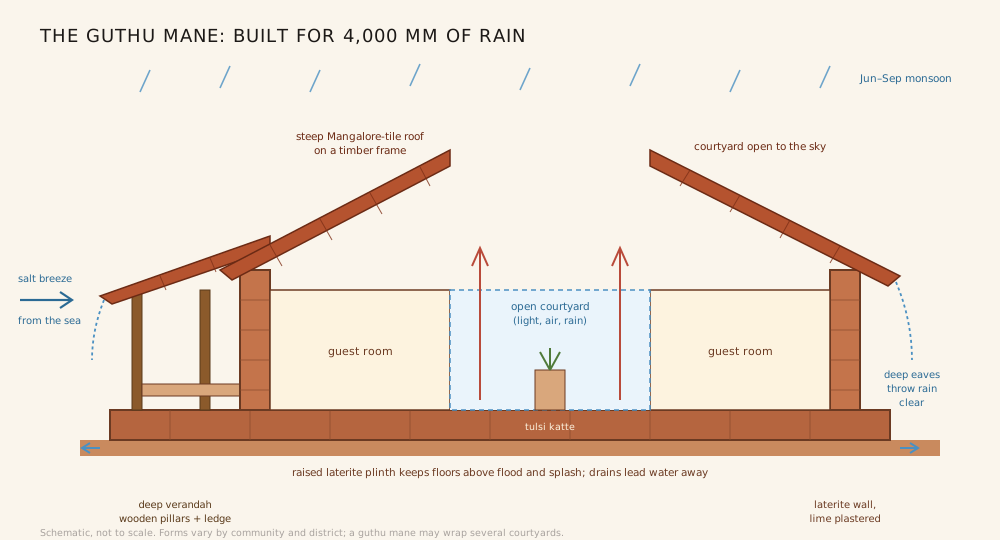
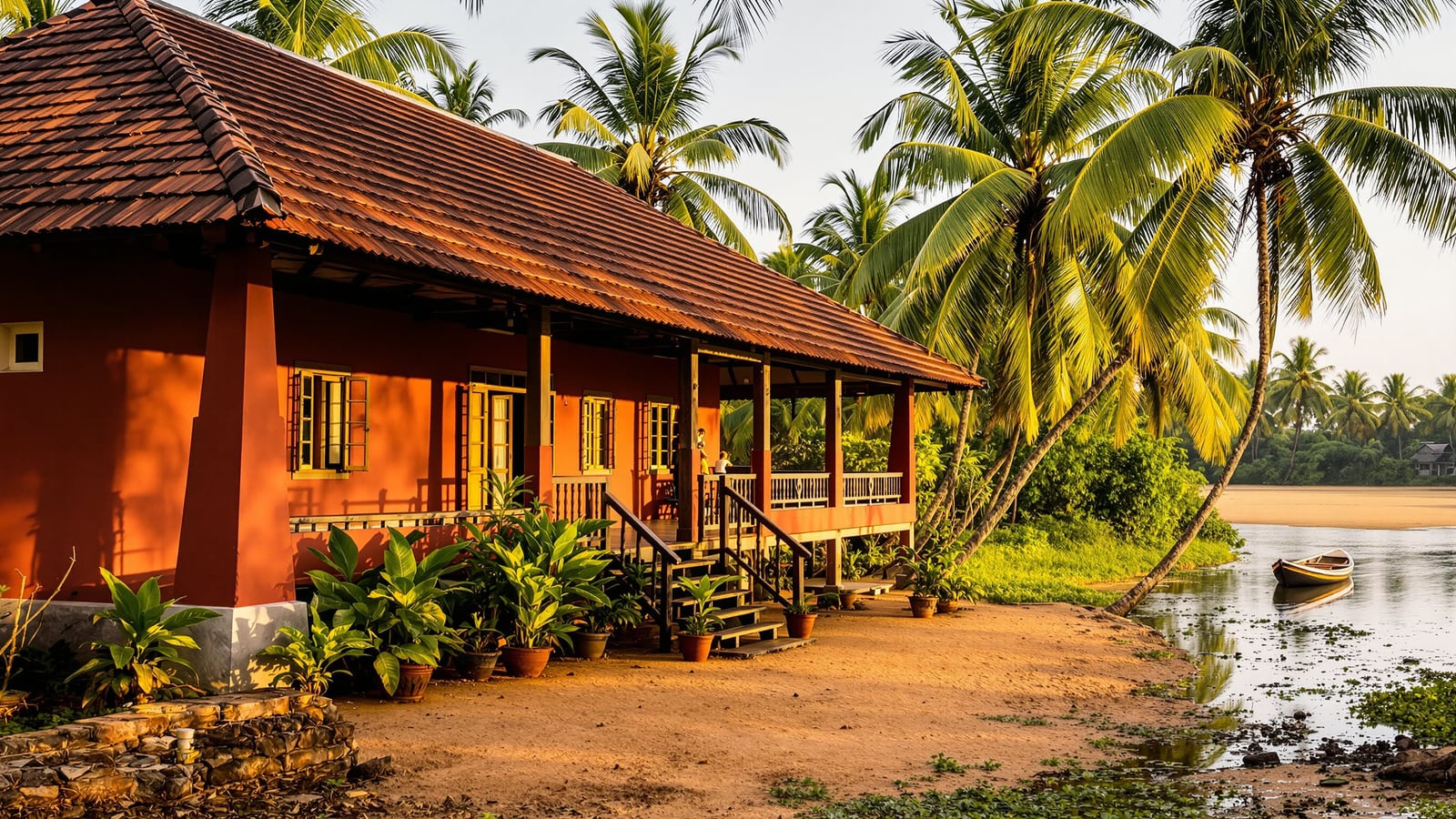
Tulu Nadu's grandest vernacular is the guthu mane — the ancestral manor of a Bunt (and some other landholding) families, the seat of the clan's land and rituals, often with a family shrine. Alongside it sit Konkani and Catholic Mangalorean houses and modest village homes, all built from the same answers to rain and heat:
- Laterite walls. The red, porous local stone, cut in blocks — cool and handsome, but it absorbs water, so it needs lime plaster or a breathable finish and a sound roof.
- Mangalore tiles. The interlocking clay tile owes its name to the Basel Mission, whose first tile works began at Jeppu, Mangaluru, in the 1860s using local river clay; the tile then spread across India. A steep tiled roof on a timber frame with deep eaves is the coast's signature.
- Deep verandahs and wooden pillars. The front verandah with its sitting ledge is the best seat in the house — morning coffee, monsoon rain, conversation.
- Courtyards. Larger houses wrap rooms around an open court (comparable to Kerala's nalukettu), bringing in light and air and a place for a tulsi katte.
- Raised plinths. A laterite plinth lifts floors above flood, splash and termites.
If you host in a guthu mane, remember it is often still a living family seat with active shrines and ritual spaces — keep those private and explain them to guests with care. Add comfort discreetly: clean ventilated bathrooms, mosquito-proofing, reliable hot water, fans and AC that is felt not seen. For a new build in the idiom, browse House Plans (the Goan balcão plan shows a related coastal verandah house) and see the design guide.
Culture: offer access, not a show
Tulu Nadu has a deep living culture, and the respectful host introduces it rather than staging it.
- Yakshagana — the all-night dance-drama of the coast, performed by troupes through the dry season. Tell guests where and when a performance is on; it is public theatre and welcomes audiences.
- Bhuta kola / daiva aradhane — spirit worship in which a performer embodies a local deity. It is a sacred ritual of the community, not a tourist performance. Do not sell tickets, promise it as an activity, or arrange photography; if a family or village invites a guest, brief them on dress, silence, no flash and following the hosts' lead.
- Kambala — the traditional buffalo race in flooded paddy fields, held in the winter months. It has been through legal debate over animal welfare, so check the current status locally before mentioning dates.
Food is half the stay
Few coasts in India eat this well. Udupi gave the country its vegetarian temple-town cooking — saaru, huli, gojju, neer dosa and the banana-leaf meal. Mangalorean kitchens (Bunt, Catholic, Konkani and Beary traditions) offer kori rotti, ghee roast, kane and anjal fry, pundi and sannas; further north, Navayath cooking in Bhatkal and the Konkani-Saraswat food of the Kanara coast add their own dishes. The coastal fish thali — rice, fish curry, a fry and sol kadhi or buttermilk — is a reason to come in itself. Serve home meals, offer a fish-market or temple-meal walk, and keep a clean, separate vegetarian kitchen if you host pilgrims. Register with FSSAI where you sell food — see the registration guide.
Monsoon and salt air: design for the extreme
Coastal Karnataka is among the wettest inhabited places in India — district averages of roughly 4,000 mm a year in Dakshina Kannada and higher in parts of Udupi, most of it between June and September, often wind-driven.
- Roof first. Re-lay slipped tiles, replace cracked ones and rotten battens, and clear valleys and gutters before June. Deep eaves and drip edges protect laterite walls.
- Walls and floors. Keep laterite plastered and breathable; raise floors, slope the ground away, and build drains big enough for a cloudburst.
- Corrosion. Salt air eats steel — choose stainless or galvanised hardware, coated AC outdoor units and fans rated for coastal use, and budget for replacement.
- Mould and linen. Cross-ventilate, dehumidify closed rooms, and rotate linen and mattresses.
- Rivers and access. Low-lying estuary land near the Netravati, Sharavathi or Kali can flood; check access roads in the monsoon before promising stays.
Season: an Oct–May coast with a monsoon trough
The beach season runs roughly October to May, with peaks at Diwali, Christmas–New Year and the winter festival calendar; summer is hot and humid but holiday-busy with families. The monsoon (June–September) closes the sea — swimming and boat trips stop and beaches are dangerous — so Gokarna and the beach pockets go quiet. Pilgrim homestays near Udupi, Kollur or Dharmasthala hold up better year-round, and the green monsoon itself can sell to Bengaluru weekenders on the ghat edge. Plan the trough in the ROI Calculator, cost the build in the Setup Cost Estimator, and read homestay profitability.
CRZ: shore and river banks are regulated
Much of this coast — and the banks of its tidal rivers and estuaries — falls under the CRZ Notification, 2019, administered through the Karnataka State Coastal Zone Management Authority and approved Coastal Zone Management Plans. Broadly, rural stretches carry a No Development Zone landward of the high tide line (50 m or 200 m depending on category), and tidal rivers, creeks, mangroves and islands such as Devbagh carry their own limits. Repairs to existing traditional homes are treated differently from new building. Check your plot on the approved CZMP map and take advice from a local architect and the coastal authority before you buy, build or extend; the Konkan playbook explains the zones in more detail.
Registration in Karnataka
Karnataka Tourism registers homestays through its online system; published guidelines describe the owner family living on the premises, a cap of 6 guest rooms / 12 adults, and a multi-year registration with some domestic-tariff benefits — confirm the current version with Karnataka Tourism or the district tourism office. Add gram panchayat or municipal permission, police intimation of guests (Form C for foreign nationals), fire safety, FSSAI and GST as applicable. Start with the Licence Finder and how to start a homestay.
Key takeaways
- The Canara coast has two markets: a steady pilgrim-family stream (Udupi, Kollur, Murudeshwar, Gokarna, Dharmasthala, Subrahmanya) and a seasonal beach and backpacker crowd around Gokarna — choose your guest deliberately.
- The guthu mane and Mangalorean houses — laterite, Mangalore tile, deep verandahs, wooden pillars, courtyards, raised plinths — are the product; respect living family shrines.
- Food (Udupi, Mangalorean, Konkani, Navayath, the fish thali) is half the stay; keep vegetarian options clean for pilgrims.
- Offer Yakshagana and kambala as access, and treat bhuta kola as sacred ritual, never a tourist show.
- Design for ~4,000 mm of monsoon and salt air: roof before June, plastered laterite, corrosion-proof hardware, drainage.
- CRZ limits building near the shore and tidal rivers — check the CZMP map; register with Karnataka Tourism and confirm current terms.
References
- Karnataka Tourism — official homestay registration guidelines (karnatakatourism.org), authoritative for room caps, eligibility and benefits; confirm the current version with Karnataka Tourism / the district administration.
- MoEFCC, Coastal Regulation Zone Notification, 2019; Karnataka State Coastal Zone Management Authority and approved CZMP maps.
- India Meteorological Department and Karnataka State Natural Disaster Monitoring Centre — district rainfall normals for Dakshina Kannada, Udupi and Uttara Kannada.
- Basel Mission tile factory history, Jeppu, Mangaluru (from 1865) — the origin of the Mangalore tile.
- Tulu Nadu vernacular architecture — the guthu mane, laterite masonry, tiled roofs and courtyards as responses to heavy rain and humid heat.
Indicative and location-dependent. Studio Matrx is a not-for-profit guide; this is educational content, not legal, coastal-zone or tax advice. Confirm registration with Karnataka Tourism / the district administration, check CRZ status with the coastal authority, and engage a local architect and CA before you build or open.
Export this guide
Related Guides — Deep-dive reading
Karnataka Homestays: Coorg, Chikkamagaluru, Malenadu & the Canara Coast
Karnataka is one of India's densest homestay states — coffee estates in Kodagu and Chikkamagaluru, rain-forest farmhouses across Malenadu, temple-town and beach stays on the Canara coast, and heritage rooms in Hampi and Mysuru. This pillar maps the belts, explains the 2025 registration guidelines, and sets out the Western Ghats realities every host must plan around.
HomestaysKonkan Homestays: The Coastal Maharashtra Playbook
The Konkan homestay is a laterite house under a Mangalore-tile roof, an otti verandah, a courtyard and an orchard of coconut, areca and Alphonso mango a few steps from a quiet beach. This playbook covers the house as product, Malvani food, the monsoon that tests every roof, the coastal-zone rules, and Maharashtra's homestay, B&B and agro-tourism routes.
HomestaysMalenadu Homestays: Sakleshpur, Agumbe, Sringeri & Sirsi
Malenadu — Karnataka's rain-soaked Western Ghats hill-forest belt — sells rainforest, waterfalls, areca-and-pepper gardens and the monsoon itself. This playbook covers the draw, the thotti mane courtyard house that evolved to live with extreme rain, how to design and operate through a real Malnad monsoon, and the forest edge you share with elephants and king cobras.
HomestaysRelated Tools — Try Free
Homestay Licence Finder
Pick your state for the homestay registration picture — room caps, residence rules and fees — plus the three compliance layers every host needs.
Licence FinderHomestay Setup-Cost Estimator
Estimate the one-time cost of setting up a homestay — rooms by fit-out level, renovation, shared spaces, licence and working capital.
Homestay SetupCross-Ventilation Analyzer
Estimate airflow and air changes per hour (ACH) from room size, window areas, layout, and local wind — with NBC 2016 Part 8 compliance check.
Ventilation Calculator