

What a Homestay Really Earns in India (2026): Honest Economics
Rooms times rate is the easy, misleading way to size a homestay. This guide explains what actually decides profit — realistic occupancy, the booking-channel mix that quietly eats a fifth of your revenue, running costs and seasonality — and how to read break-even and margin before you build.
Ask the internet whether a homestay is profitable and you will get a number dressed up as a promise. The honest answer is: it can be genuinely good, but only if you size it on the things that actually move the result — and those are not the ones most people reach for. "Three rooms at ₹2,500 a night is ₹7,500 a day, so ₹2.25 lakh a month" is the classic trap. No homestay runs at 100% occupancy, keeps all of its revenue, or earns the same in July as in December. This guide replaces that fantasy with the four levers that decide real profit, and shows how to read break-even before you spend.
Scope. These are planning estimates to help you judge feasibility, not a forecast or a promise of returns. Actual results vary with location, season, reviews and management; GST and income tax are separate and not modelled here — take tax advice from a chartered accountant. Every figure is indicative.
Lever 1 — Occupancy, honestly
Occupancy is the percentage of available room-nights you actually sell. The single most common mistake is to assume the peak. A realistic, defensible blended annual average for an established Indian homestay is around 40–50% — roughly 12 to 15 booked nights per room per month. New homestays run lower for the first several months while reviews build; exceptional, well-marketed ones in prime locations run higher. Plan on 40–50%, be delighted if you beat it, and never build a budget that only works at 70%.
Lever 2 — The channel mix (the quiet profit-killer)
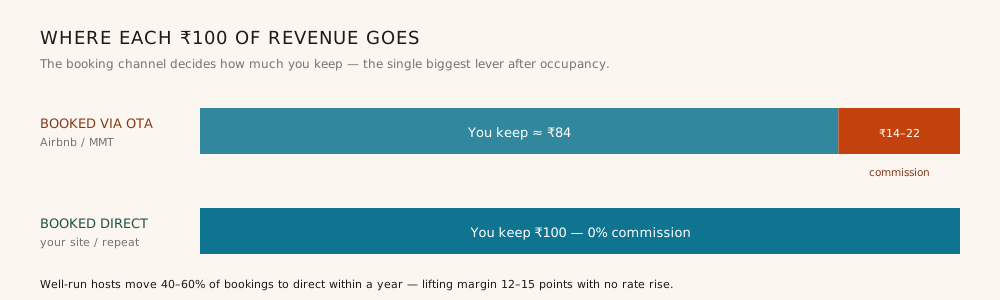
This is the lever almost nobody sizes, and it is the biggest one after occupancy. Where your bookings come from decides how much of each rupee you keep.
| Channel | Typical commission | Effect |
|---|---|---|
| Direct (your own site, repeat guests, referrals) | 0% | You keep everything |
| Airbnb | ~14–18% | Reach, but a real cut of every booking |
| MakeMyTrip / Booking.com | ~18–22% | More reach, a bigger cut |
OTAs are not villains — they bring the demand a new homestay cannot reach alone. But their commission quietly removes a fifth of your top line. The winning move is not to abandon them; it is to start on the OTAs for reach, then convert. Well-run hosts move 40–60% of their bookings to direct within a year — through great reviews, a simple website, repeat guests and word of mouth — and that single shift can lift net margin by 12–15 percentage points without raising a single rate. Model it yourself in the Homestay ROI Calculator: slide the direct-booking share up and watch the profit move.
Lever 3 — Running costs
Two kinds of cost eat into revenue. Variable cost scales with occupancy — linen and laundry, consumables and toiletries, breakfast, the utilities a guest actually uses — and is best thought of as a figure per occupied room-night (commonly a few hundred rupees). Fixed cost runs whether or not you have a guest — any help you employ, internet, base utilities, platform subscriptions and ongoing upkeep. Add the OTA commission from Lever 2 and you have your full cost stack. A useful rule of thumb: net margins for established homestays run around 20–35% of gross revenue.
Lever 4 — Seasonality
Averages hide the swings, and the swings are large. A beach homestay in Goa can clear ₹2–3 lakh in a good winter month and fall below 30% occupancy through the monsoon; a hill homestay peaks in summer and around the festive breaks. This matters for two reasons: your annual figure must blend the good and bad months (not multiply a peak month by twelve), and your working-capital reserve has to carry the lean season. Price dynamically — higher in demand, lower to fill the trough — rather than holding one rate all year.
Putting it together: a worked example
Take a modest, realistic case: 3 rooms, ₹2,500 average nightly rate, 50% blended occupancy.
| Line | Working | Monthly |
|---|---|---|
| Occupied room-nights | 3 rooms × 30 × 50% | 45 nights |
| Gross revenue | 45 × ₹2,500 | ₹1,12,500 |
| OTA commission (all via OTA, ~16%) | 16% of gross | − ₹18,000 |
| Variable cost (₹400/night) | 45 × ₹400 | − ₹18,000 |
| Fixed cost | help, utilities, internet | − ₹15,000 |
| Net profit | ≈ ₹61,500 |
That is a ~55% gross-to-net before the OTA cut and ~35% margin after it — and notice what happens if you move half those bookings to direct: the commission roughly halves and the net jumps towards ₹70,000, same rooms, same rate. Against a typical setup of ₹4–10 lakh, break-even commonly falls between 9 and 24 months. These are exactly the figures the ROI Calculator computes from your own inputs, and the Setup-Cost Estimator gives you the investment to divide into them.
What the headline numbers leave out
Two honest caveats. First, your time is a cost even when you do not pay yourself — a homestay that nets ₹60,000 but consumes your every evening is a different proposition from one you run in two hours a day with help. Second, tax: GST (where applicable) and income tax on the profit are real and sit outside the model here; factor them in with a chartered accountant before you call a number "take-home".
Key takeaways
- Size a homestay on four levers — occupancy, channel mix, running costs and seasonality — not on rooms × rate.
- Use a realistic 40–50% blended occupancy, never the peak.
- The channel mix is the quiet killer: OTAs take 14–22%; moving 40–60% of bookings to direct can lift margin 12–15 points with no rate change.
- Expect net margins of 20–35% and break-even in 9–24 months for a well-run small homestay.
- Blend the seasons into the annual figure, keep a working-capital reserve for the trough, and count your time and tax before calling it profit.
References
- Industry and platform data on Indian short-stay growth, host earnings and listing counts (Airbnb host reports and market research, 2025–2026) — indicative of trend and scale, not a guarantee of individual returns.
- Online travel agent published commission and fee structures (Airbnb, MakeMyTrip, Booking.com) — confirm current rates, which change.
- A chartered accountant — for GST applicability and income-tax treatment of homestay income.
Indicative and state-dependent. Studio Matrx is a not-for-profit guide; this is educational content, not financial or tax advice. Model your own numbers and confirm tax with a chartered accountant before you commit.
Export this guide
Related Guides — Deep-dive reading
STP Maintenance & AMC Cost in India (2025–26): What You Actually Pay Per Year
What a sewage treatment plant costs to keep running after it is built — what an AMC covers, typical Rs per KLD per year, the spares that quietly drain budgets, and how comprehensive contracts differ from basic ones.
Sewage Treatment PlantsSecurity for People Living Alone in India (2026): Calm, Practical Habits When There Is No Second Person to Notice
Living alone is an ordinary and growing part of Indian life - the student in a new city, the working single, the elder whose children are abroad, the person after a separation. It does not call for fear. It calls for a few deliberate habits, because there is no second person in the home to notice trouble, raise the alarm, or catch an accident. This is calm self-reliance, layer by layer.
SecurityResidential STP Cost Guide for Villas & Small Homes (2026 India Prices)
What a small 1–10 KLD packaged sewage treatment plant really costs to buy, install and run in India — honest capex ranges by technology, monthly running costs, and AMC rates, written for owners, developers and RWAs who want numbers they can plan around.
Sewage Treatment PlantsRelated Tools — Try Free
Homestay ROI Calculator
Model occupancy, rate, OTA commission vs direct bookings and running costs to see a homestay's real monthly profit, margin and payback.
Homestay ROIInterior Budget Planner
Live room-wise and component-wise cost breakdown in ₹ with contingency, GST, and PDF summary.
Budget CalculatorAcoustic Privacy (STC) Visualizer
Indian healthcare acoustic visualizer — compare wall assemblies and noise sources, see received SPL after STC attenuation, and check FGI 2018 / IS 1950 / NABH speech-privacy compliance with live dual-canvas waveform.
Acoustic Tool