
Interactive Calculator · 2026
Stamp Duty Calculator
Stamp duty, registration charges, applicable cess — all 28 states and 8 UTs, with gender concessions and urban/rural variants where they apply.
Stamp Duty & Registration Charges in India — A Working Reference
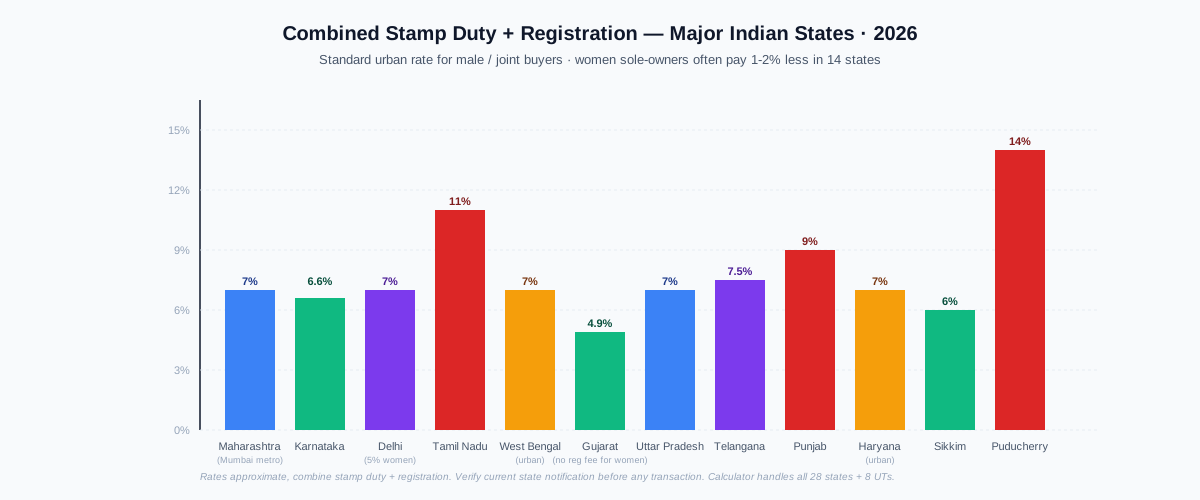
Stamp duty is the tax a state government collects when a property changes ownership, and it is the single largest transaction cost in any Indian property purchase after the property price itself. It is governed by the Indian Stamp Act 1899 and the Registration Act 1908, but the rates are a state subject — every state in India sets its own stamp-duty percentage, with separate variants for urban and rural, gender concessions in fourteen states, and additional cesses (metro, transport, agricultural land conversion). The combined cost of stamp duty plus registration charges typically runs 5–14% of the property value — ₹5 lakh to ₹14 lakh on a ₹1 crore home.
When Stamp Duty Is Paid — and Why It Matters
Stamp duty is paid before the sale deed is registered at the sub-registrar's office. An unregistered or under-stamped sale deed is, under §17 of the Registration Act, inadmissible as evidence of ownership in any Indian court — it cannot be used to claim title, transfer, or encumbrance. Banks will not disburse home loans against an unregistered property, and resale becomes legally complicated. The stamp duty amount itself is one-time and non-refundable in most states (with narrow exceptions for cancelled transactions within 6 months in Maharashtra, Karnataka, and Delhi).
The circle rate / ready reckoner / guidance value — the state-notified minimum price per square foot for each locality — sets a floor on stamp-duty calculation. Stamp duty is computed on the higher of the actual sale consideration or the circle rate. This prevents under-reporting transaction values to reduce the tax. Buyers should always cross-check the circle rate of their target locality on the state revenue department portal before finalising the deal.
How the Calculation Works
The calculation has four inputs: (1) the property value (higher of sale or circle rate), (2) the state stamp-duty percentage, (3) the registration charge (typically 1% of property value, capped in some states like Maharashtra at ₹30,000), and (4) any cesses or concessions applicable. For example, on a ₹1 crore Mumbai apartment for a male buyer: 5% stamp duty + 1% Mumbai metro cess + 1% registration = 7% = ₹7 lakh. For a woman sole-owner of the same property under Maharashtra's Rajmata Graha Swamini Yojana, the rate drops to 6% = ₹6 lakh.
Gender Concessions — Where Women Pay Less
Fourteen Indian states and two UTs offer reduced stamp duty for female sole-owners or for joint deeds where a woman is named first. Concessions range from 1% (Maharashtra) to 2% (Delhi, Rajasthan, Madhya Pradesh, Haryana, UP, Punjab, Uttarakhand, Jharkhand, Chhattisgarh) to a full registration-fee waiver (Gujarat for women sole-owners). Importantly: most states require the woman to be the sole owner or first-named in joint M+F deeds; co-ownership with male buyers usually does not qualify. Verify the current state notification — some concessions sunset and renew annually.
Common Pitfalls — and How to Avoid Them
- Under-reporting the sale value to reduce stamp duty is detected by the circle-rate cross-check; the deficit is recovered with penalty (10–25% in most states) and possible criminal liability under §27 of the Indian Stamp Act.
- Skipping registration to save costs leaves the buyer without a legally enforceable title — banks reject loans, resale becomes legally complicated, and ownership cannot be defended in court.
- Missing the gender concession by registering in the husband's name or as joint M+F where the female is named second — costs ~₹1–3 lakh on a ₹1 crore deal.
- Ignoring metro / transport / agricultural-land cesses that add 1–4% on top of base stamp duty in cities like Mumbai, Hyderabad, Chennai, and Kolkata.
- Using stale rates — state stamp-duty rates and circle rates revise annually or even mid-year. Always verify the current state revenue department notification on the day of registration.
E-Stamping vs Physical Stamp Paper
Most major Indian states have switched to e-stamping through the Stock Holding Corporation of India (SHCIL) portal, with state-specific implementations such as Maharashtra's GRAS, Karnataka's e-Khajane, Delhi's e-Stamp portal, Tamil Nadu's e-Stamping. E-stamps eliminate the physical stamp-paper black-market risk and the printing capacity constraints that previously affected high-value transactions. The buyer pays via NEFT / RTGS / UPI; the e-stamp certificate is generated within minutes and is valid for the registration appointment. Physical stamp paper above ₹50,000 is now disallowed in most states.
Refunds and Exemptions
Stamp duty paid on a sale deed that is subsequently cancelled within 6 months can be refunded in Maharashtra, Karnataka, Delhi, and a handful of other states (refund of 90–95% of stamp duty after deducting administrative charges). Beyond 6 months, refunds are not generally allowed. Specific exemptions exist for: (a) gift deeds between blood relatives in some states (Maharashtra ₹200 nominal; Karnataka, Delhi reduced rates), (b) settlement deeds in family partition arrangements, and (c) affordable-housing schemes (PMAY units in select states attract concessional rates). Always cross-check exemption applicability with the state revenue department or a registered lawyer before relying on it.
Disclaimer: Stamp-duty rates and circle rates are state subjects, change frequently, and may be modified by mid-year notifications. The calculator above reflects rates current as of mid-2026; verify with the relevant state revenue department portal before any specific transaction. This page is for informational purposes only and is not legal or tax advice. Engage a registered conveyance lawyer for property transactions of significance.
Related Guides — Deep-dive reading
Stamp Duty in India 2026 — State-wise Guide
Rates, Registration Charges, Concessions & How to Calculate Your Liability
ConstructionGram Panchayat Building Approval in India: Rural and Peri-Urban Permissions, and the Unapproved-Layout Trap (2026)
How a home permission works outside municipal limits - who approves in a gram panchayat, the documents and process, and how to tell a genuine panchayat plot from an unapproved layout sold as "panchayat approved".
Building RegulationsProperty Registration Process in India: How a Plot Is Registered in Your Name (2026)
Registration is the step that makes you the legal owner. This guide walks through the sequence - agreement to sell, drafting the sale deed, calculating and paying stamp duty and registration fee, the sub-registrar appointment, the registration day, and the mutation and khata transfer that follow.
Buying LandRelated Tools — You may also find these useful
Bathroom Renovation Cost Calculator
Cost to renovate an existing bathroom with a replace-vs-keep model — demolition, re-waterproofing, tiles, fittings and the money saved by keeping items.
Bathroom CalculatorBathroom Renovation ROI Calculator
Estimate the resale value added and % of spend recovered from a bathroom renovation — plus rental yield and payback for let-out homes.
Bathroom CalculatorDoor Cost Calculator
Estimate the all-in cost of a door — leaf, frame, hardware, fitting and GST — by type, material and size.
Door Calculator