
Tamil Nadu Homestays: Chettinad, the Nilgiris & Pondicherry
Tamil Nadu hands a host three very different products — a Chettinad merchant mansion of courtyards and Athangudi tiles, a misty colonial cottage in the Nilgiris or Kodaikanal, and a French- or Tamil-quarter guesthouse in Pondicherry. This playbook covers each one's design, the rules that bind it, and two seasons that mirror each other.
"Tamil Nadu homestay" is not one product but three, and they share almost nothing except a state boundary — and one of them does not even share that. In Chettinad, the guest sleeps inside a merchant family's mansion, a sequence of courtyards built with teak, tile and lime brought from across the world. In the Nilgiris, Kodaikanal and Yercaud, the guest wants a fireplace, a tea-estate view and mist at the window. In Pondicherry — legally the separate Union Territory of Puducherry — the guest wants a yellow-walled French-quarter room or a Tamil-quarter house with a thinnai on the street. Each has its own design logic, its own rules and its own season. Read this beside the regional overview and the design guide; the coastal-and-plantation neighbour across the Ghats is in the Kerala playbook.
Scope. Editorial good practice, not legal advice. Tamil Nadu registers B&Bs and homestays under its Department of Tourism scheme (Silver and Gold classification); the Nilgiris and Kodaikanal carry extra hill-area and court-driven scrutiny; Puducherry has its own 2026 guidelines. Local-body trade, fire and food layers apply — see the Licence Finder. Heritage structures need a conservation architect. Figures are indicative — confirm with Tamil Nadu Tourism / Puducherry Tourism.
Three Tamil Nadus, three stays
| Chettinad mansion | Nilgiris / Kodai / Yercaud | Pondicherry guesthouse | |
|---|---|---|---|
| Where | Karaikudi, Kanadukathan, Athangudi, Pallathur (Sivaganga / Pudukkottai) | Ooty, Coonoor, Kotagiri, Kodaikanal, Yercaud | White Town (French quarter), Tamil quarter, Auroville fringe |
| The draw | Heritage, scale, craft, Chettinad cuisine | Cool air, tea gardens, walks, fireplaces | Franco-Tamil streets, cafés, sea, spiritual circuit |
| Design problem | Huge under-used house, conservation | Damp, mist, cold nights, slopes | Small plots, heritage façades, humidity |
| Peak season | Nov–Feb | Apr–Jun (plus Oct–Dec bump) | Nov–Feb (watch NE monsoon) |
| Rule to know | Heritage-sensitive restoration | Hill-area / HACA approvals, licence drives | Puducherry 2026 scheme, heritage listing |
Chettinad: sleeping inside a merchant's mansion
The Nattukottai Chettiars were a banking and trading community whose wealth, made across Burma, Ceylon and South-East Asia in the late nineteenth and early twentieth centuries, came home as thousands of grand houses across dozens of villages. The mansions sit on India's UNESCO tentative list as Chettinad village clusters. For a host, the house itself is the product — and its plan already reads like a homestay.
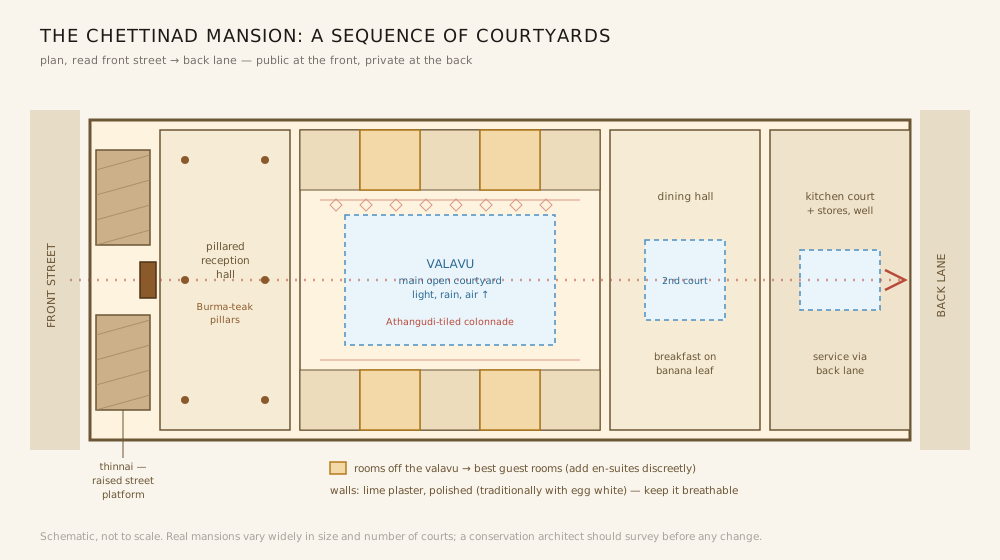
- The thinnai. The raised platform on the street front was where the family met the town. Keep it — it is the guest's first, best photograph and an evening sitting spot.
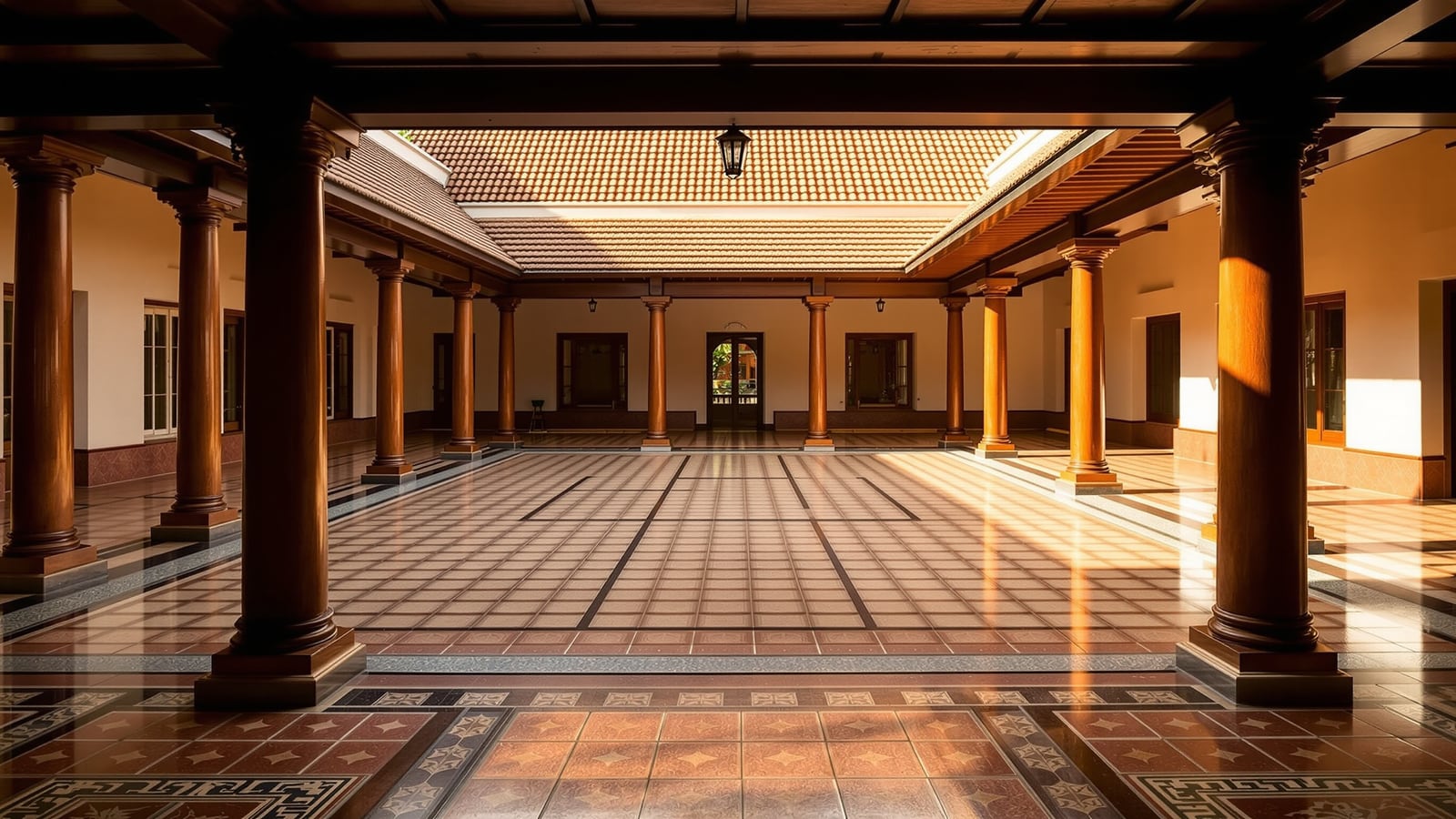
- The valavu. The main open courtyard, ringed by a colonnade of Burma-teak pillars and small rooms, brings light, rain and air into the middle of the house. Those rooms become the guest rooms; the court becomes the lobby, lounge and gathering place.
- The sequence. Court follows court — reception, the valavu, a dining hall with its own court, then a kitchen court on the back lane. Public at the front, private at the back: guests in the first courts, family and service at the rear.
- The materials. Hand-made Athangudi tiles (cast on glass from local earth and cement, sun-cured, not fired), Italian marble, Belgian mirrors, and walls of lime plaster famously polished with egg white and other natural additives to a cool sheen. These breathe; they do not want cement patches, plastic paint or sealed waterproofing.
The honest reality is conservation. Many mansions are vast, shared among dozens of heirs, and largely shut. A homestay can give one a life and an income, but it is a long project: roofs, termite-damaged timber, rising damp and failing lime are expensive, and a bad repair (cement plaster on lime walls is the classic) does lasting harm. Start with one wing, bring in a conservation architect and structural engineer before touching the fabric, get every co-owner's written consent, and slot modern bathrooms into secondary rooms rather than carving up the courts. A smaller new-build in the same spirit is sketched in the Chettinad courtyard homestay house plan. The Rajasthan haveli playbook covers the same "add comfort, keep the story" craft.
The hills: Nilgiris, Kodaikanal and Yercaud
Up in the hills the problem flips from heat to damp and cold. Colonial cottages with tiled or sheet roofs, fireplaces and bay windows are the archetype, and tea- or coffee-estate stays sell the view. Design for the mist: a dry, warm bedroom is the whole product.
- Fight damp first. Good roof overhangs, raised plinths, drained ground around the house, ventilated wardrobes, dehumidifiers in the monsoon, and breathable finishes. Musty linen ruins more hill reviews than anything else.
- Warm safely. A real fireplace is the dream, but it needs a sound chimney, a spark guard and a CO alarm; insulated ceilings and good curtains do the quiet work. Plenty of hot water, always.
- Build lightly on slopes. Stepped, small footprints suit both the terrain and the rules — the hill playbook and the plantation playbook go deeper, and the sloped hill-homestay plan shows one approach.
The hills are also where the rules bite hardest. The Nilgiris and other notified hill areas fall under the Hill Area Conservation Authority (HACA), which requires its own approval for larger buildings (commonly cited as above 300 sq m) on top of normal planning permission, alongside tree-felling and land-use controls; parts of the Nilgiris also sit near elephant corridors and forest. The Madras High Court has repeatedly directed action against unlicensed homestays in the Nilgiris and Kodaikanal, and in 2025 district committees inspected and sealed properties operating without valid licences. The lesson is simple: do not convert a hill house on the strength of an online listing. Confirm land use, building approval, local-body licence and tourism registration first — with the district administration, Town and Country Planning and Tamil Nadu Tourism.
Pondicherry: a separate rulebook
Puducherry is a Union Territory, so a Pondicherry guesthouse registers with Puducherry Tourism, not Tamil Nadu. Its 2026 guidelines (notified in May 2026) let a host self-certify into Silver, Gold or Gold Plus/Platinum — the top tier explicitly rewarding heritage buildings, heritage cuisine and sustainable practice. As notified, registration is online and valid for five years, with annual or one-time fees, one property per applicant, a self-undertaking on fire safety for larger houses, guest ID registers and FRRO reporting for foreign guests — and a stiff fine plus closure for operating unregistered. Confirm the current terms with Puducherry Tourism.
Design here is about small plots and heritage façades. The French quarter's lime-washed walls, tall shuttered windows and bougainvillea courts, and the Tamil quarter's thinnai and timber-pillared verandahs, are what guests come for. Puducherry notifies listed heritage buildings (informed by INTACH's long survey work) and controls alterations to them and their streetscape, so check whether your house is listed before changing a façade, window or roof — the planning authority and a conservation architect are your first calls. Inside, plan for humidity and the north-east monsoon and cyclone season (October–December): ceiling fans and cross-ventilation, rust-proof fittings, and sound shutters. The Goa playbook is the closest cousin for a colonial-heritage house.
Two seasons that mirror each other
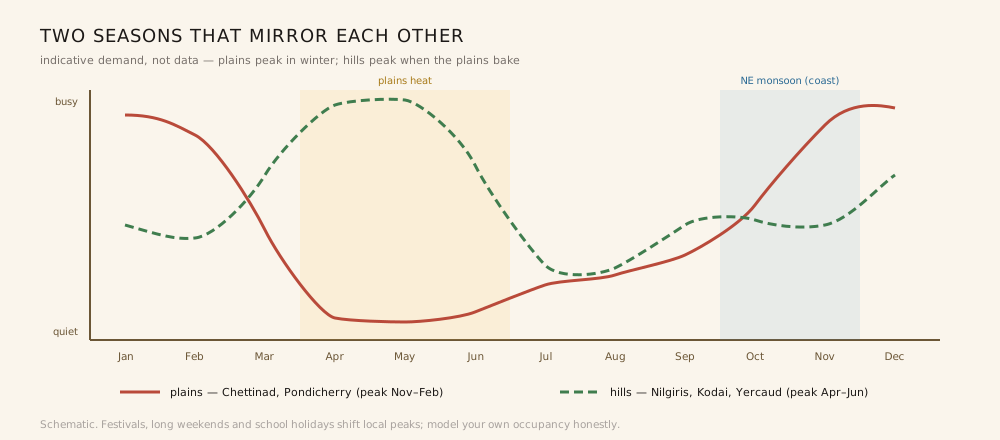
The plains products — Chettinad and Pondicherry — are winter businesses: November to February is pleasant and busy, April to June is hot and thin. The hills are the mirror image: Ooty and Kodaikanal fill in April–June as Chennai, Bengaluru and Coimbatore escape the heat, ease through the wet south-west monsoon, and pick up again from October to New Year. A Chettinad host should price into winter and hold a summer reserve; a hill host should do the reverse — and a family with a house in each can balance a year. Model your own blend in the ROI Calculator and the Setup Cost Estimator.
Registration in Tamil Nadu
Tamil Nadu runs a Department of Tourism scheme for registration of Bed & Breakfast and Homestay establishments, classifying them as Silver or Gold after inspection, broadly in line with the national Incredible India B&B/Homestay framework (owner-resident, one to six rooms). Registered stays can be listed and promoted by the department. Room caps, fees and documents change, so confirm the current scheme with Tamil Nadu Tourism, and layer on the local-body trade licence, fire safety, food registration and Form C reporting for foreign guests — the full map is in the registration guide. For the wider launch sequence see how to start a homestay and, if you will list online, setting up on Airbnb.
Key takeaways
- Tamil Nadu is three products: Chettinad mansions (plains heritage), Nilgiris/Kodai/Yercaud cottages (hill escape) and Pondicherry guesthouses (Franco-Tamil, separate UT).
- In Chettinad, the courtyard sequence is the homestay plan — guests around the valavu, family behind; protect the thinnai, teak, Athangudi tiles and lime plaster, and restore one wing at a time with a conservation architect.
- In the hills, damp is the enemy and approvals come first — HACA, planning, local licence and tourism registration before any conversion.
- Pondicherry follows its own 2026 scheme (self-certified Silver to Platinum, five-year registration); check heritage listing before touching a façade.
- Plains peak in winter, hills in summer — plan reserves for your trough, and confirm all rules with Tamil Nadu Tourism / Puducherry Tourism.
References
- Tamil Nadu Department of Tourism — Scheme for Registration of Bed & Breakfast and Homestay establishments (Silver / Gold classification); authoritative for current caps, fees and documents.
- Ministry of Tourism — Incredible India Bed & Breakfast / Homestay Establishments guidelines (Silver and Gold; owner-resident, one to six rooms).
- Government of Puducherry, Gazette Extraordinary Part II No. 30 (18 May 2026) — Guidelines for Approval and Registration of the Puducherry Bed and Breakfast, and Home Stay Establishments, 2026.
- Hill Area Conservation Authority (HACA), Tamil Nadu — approvals for development in notified hill areas including the Nilgiris; Directorate of Town and Country Planning.
- Madras High Court orders on unlicensed homestays in the Nilgiris (2021 onward) and the 2025 district enforcement drives in the Nilgiris and Kodaikanal (news reports).
- UNESCO World Heritage Tentative List — Chettinad, village clusters of the Tamil merchants; INTACH Pondicherry chapter heritage surveys; Puducherry Planning Authority heritage-building notifications.
- A conservation architect and structural engineer — essential before restoring a Chettinad mansion or altering a listed Pondicherry building.
Indicative and state-dependent. Studio Matrx is a not-for-profit guide; this is educational content, not legal or conservation advice. Confirm registration and building rules with Tamil Nadu Tourism, Puducherry Tourism and the local planning authority, and engage a conservation architect for heritage structures.
Export this guide
Related Guides — Deep-dive reading
Heritage Roof Conservation in India: Repair, Restore or Reinterpret
The practical anchor for anyone who owns an old or heritage roof in India — a Mangalore-tiled bungalow, a Kerala tharavadu, a Himalayan kath-kuni house, a Madras-terrace home, a wada, a haveli, a colonial or Art-Deco building. How to read its condition safely, decide between maintain, repair, restore and replace, match the right materials and craft, and modernise it without destroying its character.
RoofingMadhya Pradesh Homestays: Forest, Village & Heritage-Town Stays
India's heartland sells tiger forests, living villages and quiet heritage towns — and the homestay version is a mud-walled, tile-roofed house on a forest fringe, or a family home above the Narmada ghats. This playbook covers MP Tourism's rural homestay programme, buffer-zone siting rules, the earth-and-tile vernacular, and an honest season plan.
HomestaysHeritage Building Security Approvals in India (2026): Protecting Without Damaging
A conservation-aware guide to securing listed, protected and heritage-notified buildings in India: how to identify the protection status, which authority to approach, why approval must come before any work, and how to design security that is minimal, reversible and sympathetic to protected fabric.
SecurityRelated Tools — Try Free
Homestay Licence Finder
Pick your state for the homestay registration picture — room caps, residence rules and fees — plus the three compliance layers every host needs.
Licence FinderCross-Ventilation Analyzer
Estimate airflow and air changes per hour (ACH) from room size, window areas, layout, and local wind — with NBC 2016 Part 8 compliance check.
Ventilation CalculatorHomestay Setup-Cost Estimator
Estimate the one-time cost of setting up a homestay — rooms by fit-out level, renovation, shared spaces, licence and working capital.
Homestay Setup