
Plantation Homestays: The Coorg & Chikmagalur Playbook
The plantation homestay is the archetype — a working coffee or spice estate that lets guests live inside it for a few days. This playbook covers what makes it special, the timber-and-verandah vernacular that answers the heavy rain, the layout that keeps host and guest at ease, and the economics and seasons of an estate stay.
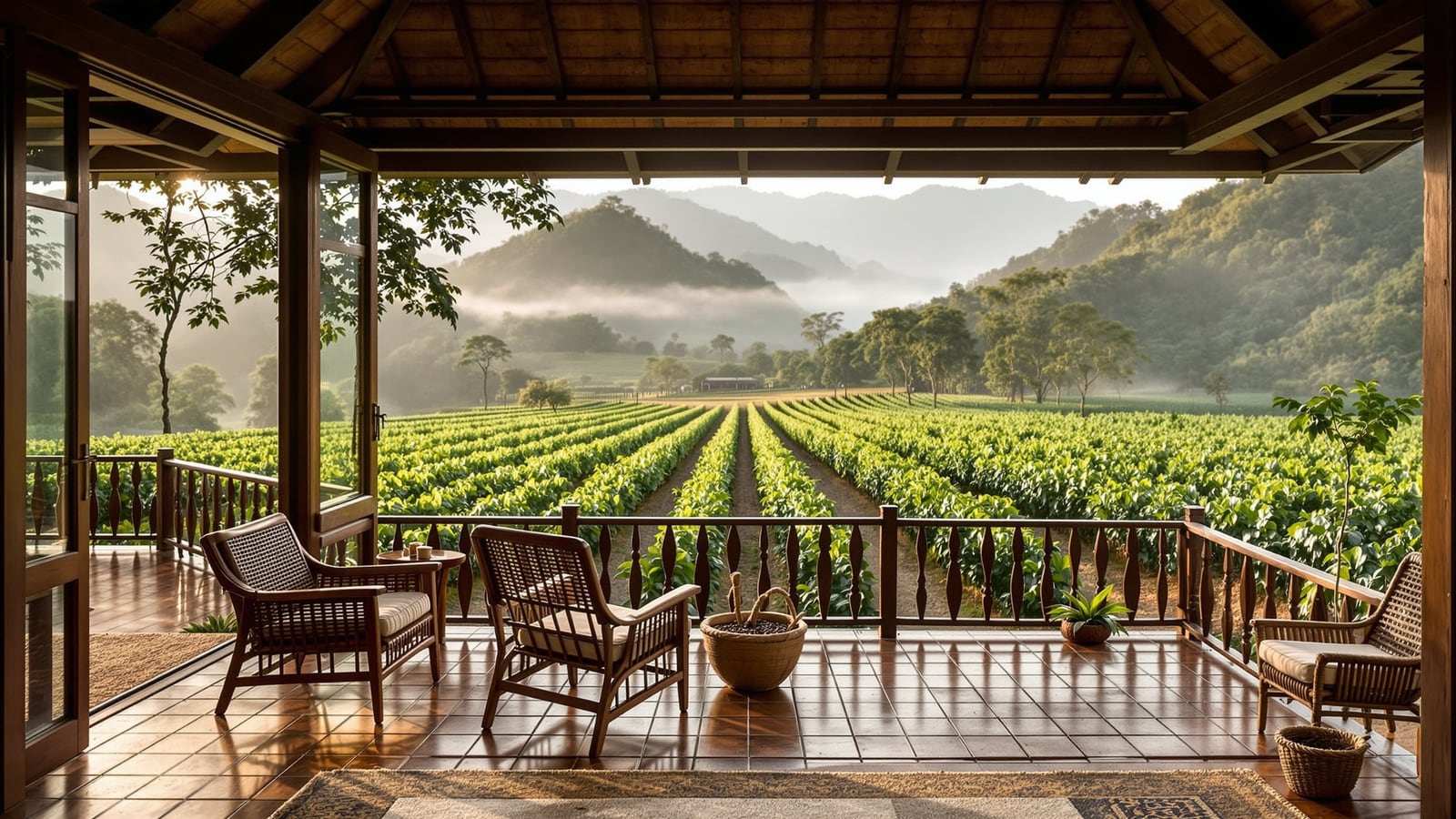
If one image defines the Indian homestay, it is a verandah over a coffee estate at dawn — mist in the valley, the smell of wet earth and drying beans, a cup of estate coffee in hand. The plantation homestays of Coorg (Kodagu) and Chikmagalur, in Karnataka's Western Ghats, are the archetype the whole category grew from, and they remain the benchmark. Their secret is not luxury; it is immersion. The guest does not visit a plantation — for a few days, they live inside one. This playbook is how to design and run that well. For the universal principles, read the design guide; for the numbers, the economics guide.
Scope. Editorial good practice, not legal or investment advice. Karnataka's homestay rules (owner-resident, 1–6 rooms) and the trade-licence and fire-NOC layers apply — see the Licence Finder. Estate land, plantation labour and land-use rules carry their own legal questions for a lawyer. Figures are indicative.
The estate is the amenity
The first and most important design decision in a plantation homestay is to understand that the estate itself is the product. Guests come for the experience of the plantation — the guided estate walk among the coffee and pepper and silver-oak shade trees, watching the beans dry on the yard, a meal of Kodava or Malnad food from the garden, a bonfire, birdsong, and above all the quiet. A swimming pool is a weak substitute for a well-led estate walk. Spend your effort and budget on the experience — a knowledgeable host, genuine estate access, good local food — far more than on imported luxury the setting does not need.
Build for rain, build in timber
The Western Ghats get some of India's heaviest rain, and the vernacular answers it directly. The traditional plantation bungalow is built in timber and tile with a steep roof and deep, wraparound verandahs, its floor raised on a plinth against damp and run-off. Carry that forward:
- Deep verandahs on the weather sides — they let a wall stay open to the view and the breeze while the rain sheets off the eaves, and they become the homestay's most-loved room.
- A steep tiled or sloping roof with generous overhangs to shed monsoon rain well clear of the walls.
- A raised floor / plinth and good drainage around the house to keep damp and ground water out.
- Timber and local stone, which age gracefully in the climate; plan active ventilation and dehumidifying for wardrobes and linen, because mould is the enemy here.
A layout that keeps host and guest at ease
Estates have room, so use it. The classic arrangement is the main house with the family and the shared verandah and dining, and separate guest rooms or a guest cottage a short walk away — close enough to be hosted, far enough for both sides to relax.
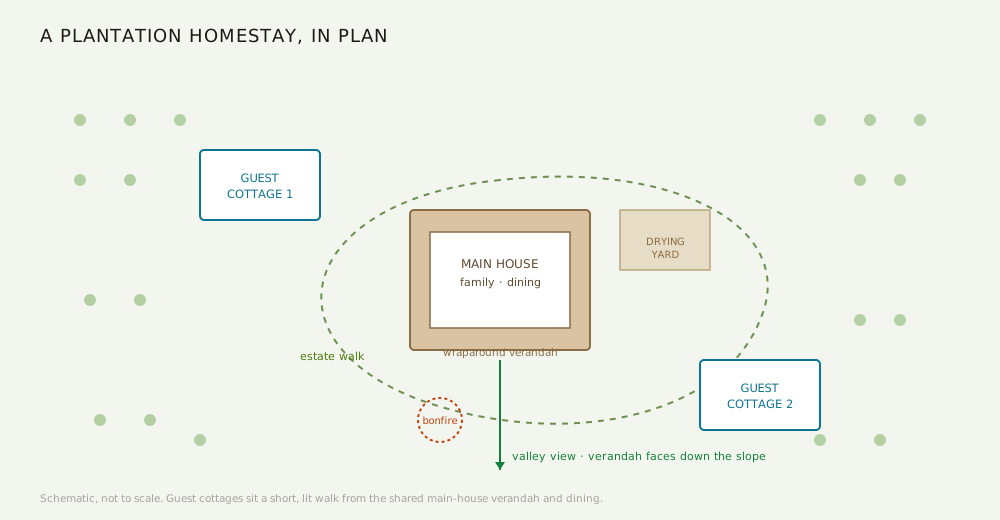
The verandah and dining of the main house are the social heart, where host and guest meet over coffee and meals. The guest cottages give privacy and the romance of waking up in the estate. A drying yard, a bonfire deck and a looping estate walk complete the experience. Keep the guest's route from cottage to dining clear and lit for the evening — and remember the practical: leeches in the monsoon, good torches for power cuts, and warm bedding for the cool nights.
The guest, and the season
The plantation guest is typically an urban couple or family from Bengaluru, Mysuru, Mangaluru or further chasing cool, quiet and authenticity for a two-or-three-night escape. They value a real host and a real estate over marble and buffets, and they book on reviews and word of mouth as much as on OTAs — which, given the commission, is good news for your margin.
Season-wise, the dry, pleasant October-to-May window is peak, with long weekends and the winter holidays the busiest. The monsoon (June–September) is low season — but a growing number of hosts now market it deliberately to the rain-lover, when the Ghats are at their most dramatic and green, turning a trough into a niche. Price into the peak, hold a reserve for the quiet months, and model it honestly in the ROI Calculator.
Key takeaways
- The estate is the amenity — spend on the experience (estate walk, host, local food) over imported luxury.
- Build for heavy rain: deep wraparound verandahs, a steep overhanging roof, a raised plinth, timber and stone, and active anti-damp ventilation.
- Use the estate's space: a main house (shared verandah + dining) with separate guest cottages gives privacy and romance at once.
- The guest wants authenticity and a good host; they book heavily on reviews — lean into direct bookings.
- Peak is Oct–May; the monsoon is a trough some now market as a rainy-season niche. Price and reserve accordingly.
References
- Karnataka homestay policy (owner-resident, 1–6 rooms) and the municipal trade-licence and fire-NOC requirements — see the state tourism portal and the Licence Finder.
- Western Ghats vernacular architecture — timber-and-tile plantation bungalows, deep verandahs and raised plinths as a monsoon-climate response.
- A property lawyer — for estate land, plantation-labour and land-use questions specific to agricultural/plantation holdings.
Indicative and state-dependent. Studio Matrx is a not-for-profit guide; this is educational content, not legal or investment advice. Confirm licensing and any estate land-use questions with the relevant authority and a lawyer.
Export this guide
Related Guides — Deep-dive reading
Roofing for Heavy Monsoon Areas
Kerala, the Konkan coast, the Western Ghats and the North-East get some of the heaviest rain on earth. A plain-language, India-grounded guide to designing and detailing a roof that sheds it fast, throws it clear of the walls, drains it away and never lets it in.
RoofingKerala Homestays: The Backwater, Plantation & Heritage Playbook
Kerala practically invented the Indian homestay, and its vernacular is a gift — the courtyard tharavadu, the sloping tiled roof, the verandah and water as the view. This playbook covers the three Kerala stay types, the passive design that answers heat and monsoon, and the Ayurveda season that fills the trough.
HomestaysThe Kerala Traditional Roof: Steep Timber-and-Tile Roofs for the Monsoon Coast
Kerala and the Malabar coast answered one of India's heaviest monsoons with a steep, sloping, deeply-overhanging roof: an elaborate timber frame carrying clay tiles, wide eaves that shade the wall and throw rain clear, and the pitched roofs of the nalukettu sloping in around a central open courtyard. This guide tells the story, the craft and how to live with or restore one today.
RoofingRelated Tools — Try Free
Cross-Ventilation Analyzer
Estimate airflow and air changes per hour (ACH) from room size, window areas, layout, and local wind — with NBC 2016 Part 8 compliance check.
Ventilation CalculatorHomestay Licence Finder
Pick your state for the homestay registration picture — room caps, residence rules and fees — plus the three compliance layers every host needs.
Licence FinderStamp Duty Calculator — All Indian States
Stamp duty + registration charges for all 28 states and 8 UTs — gender concessions, urban/rural variants, metro cess built in.
Stamp Duty