
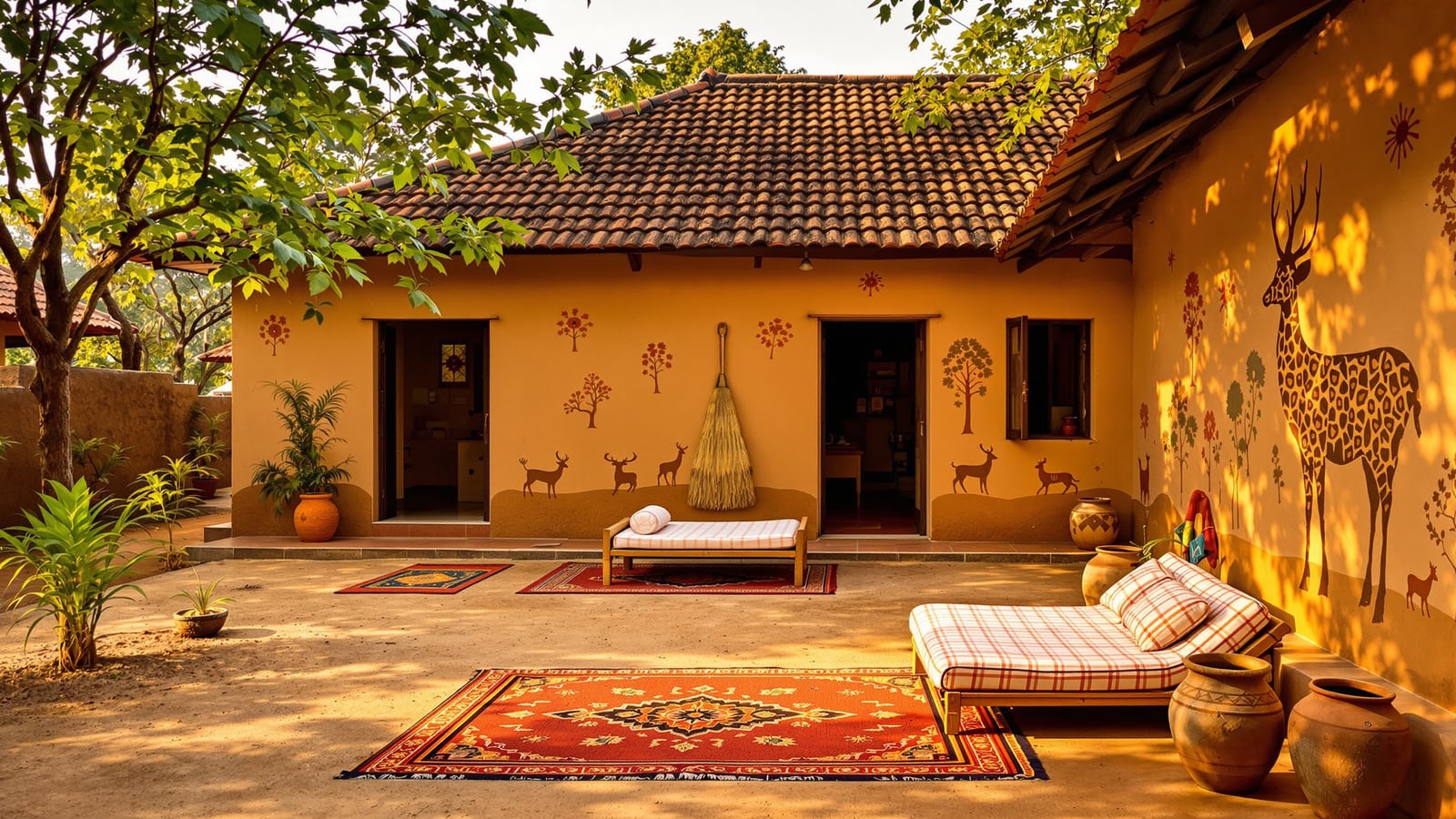
Madhya Pradesh Homestays: Forest, Village & Heritage-Town Stays
India's heartland sells tiger forests, living villages and quiet heritage towns — and the homestay version is a mud-walled, tile-roofed house on a forest fringe, or a family home above the Narmada ghats. This playbook covers MP Tourism's rural homestay programme, buffer-zone siting rules, the earth-and-tile vernacular, and an honest season plan.
Madhya Pradesh is India's geographic heart, and its homestays sell three things at once: tiger forests (Kanha, Bandhavgarh, Pench, Satpura, Panna), living villages whose earth-walled houses have not been redesigned for tourists, and quiet heritage towns like Orchha on the Betwa, Maheshwar on the Narmada and Mandu on its plateau. The guest does not come for luxury; they come to wake to a langur's alarm call, eat dal-baati or kodo-kutki off a leaf plate, and walk a village with someone who grew up in it. The state has backed exactly this kind of stay with one of India's more structured rural homestay programmes. This playbook covers the programme, the forest rules, the vernacular and the season. Pair it with the community and village playbook for the shared-benefit model and the regional overview.
Scope. Editorial good practice, not legal advice. MP Tourism runs registration for homestay-type units (Home Stay, Bed & Breakfast, Gram Stay and Farm Stay categories appear in state tourism material) — room caps, fees and conditions change, so confirm with MP Tourism Board and see the Licence Finder. Anything near a tiger reserve also falls under Forest Department and eco-sensitive-zone rules. Figures are indicative.
The rural homestay programme
MP Tourism Board's Rural Tourism Programme, launched around 2018 under the state's Responsible Tourism Mission, set out to develop roughly 100 villages in two phases near major attractions — Orchha, Khajuraho, Panna, Sanjay-Dubri and the central tiger reserves among them. The model selects a handful of families per village (often around ten) to open homestays, supports building or upgrading a room through government schemes, and pairs each cluster with an empanelled Project Support Organisation (an NGO or social enterprise) for training in hospitality, hygiene, cooking, accounts, guiding and photography. Villages such as Ladhpura Khas near Orchha and Savarvani in Chhindwara's Tamia hills have become reference examples; the programme has won responsible-tourism recognition. Newer layers include tribal homestay clusters along the Narmada Parikrama route (Mandla, Dindori, Anuppur) and central support under the PM Janjatiya Unnat Gram Abhiyan for rooms in tribal households. Numbers and eligibility evolve — confirm current terms with MP Tourism Board before planning around any grant.
| Stay type | Typical setting | What the guest expects |
|---|---|---|
| Village (Gram) homestay | Programme village near a park or heritage town | Family meals, village walk, simple clean room |
| Forest-fringe homestay | Buffer-zone village near Kanha, Bandhavgarh, Pench, Satpura | Early safari pickup, birding, quiet nights |
| Farm stay | Working farm, often near Indore, Bhopal or Jabalpur | Fields, cattle, fresh produce, space for children |
| Heritage-town home | Old house in Orchha, Maheshwar, Mandu | Walkable monuments, ghats, crafts, rooftop views |
Indicative categories; formal names, caps and fees are set by MP Tourism.
Forest-fringe stays: site with the rules, not against them
Tiger reserves are zoned. The core (critical tiger habitat) is for wildlife; the buffer around it holds villages and multiple uses; an eco-sensitive zone (ESZ), notified reserve by reserve, regulates what can be built beyond. Under typical ESZ notifications, large commercial hotels and resorts are restricted close to the protected-area boundary, while local residents' homes and small, community-run, eco-friendly stays are treated more favourably — but every ESZ has its own notification and zonal plan, so ask the Forest Department and the district before you build or convert.
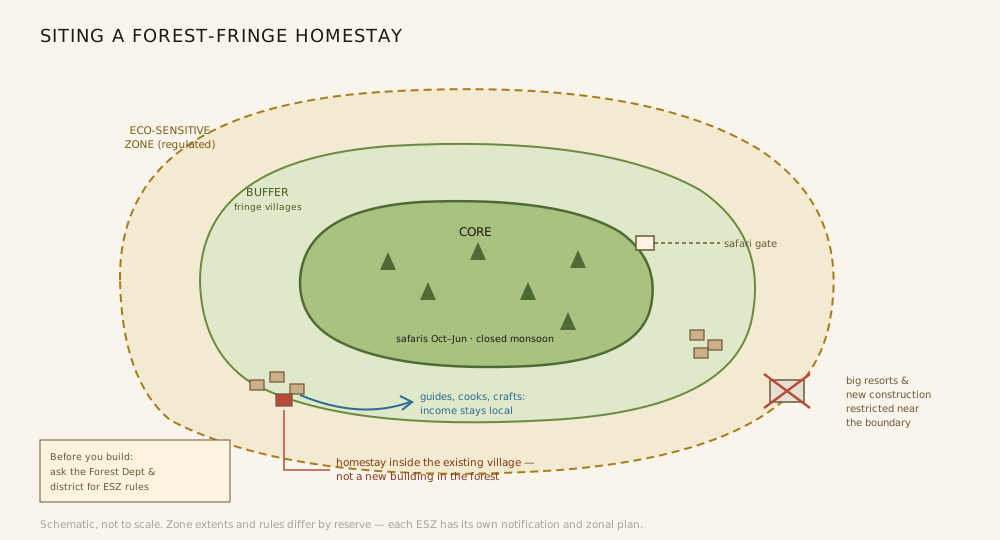
- Host inside the village, not in the forest. The strongest and most defensible model is a room in an existing family house in a buffer village — no new footprint, and income that reaches the people who live with the wildlife.
- Safaris are booked online, not by you. Core-zone permits for the MP reserves are issued through the Forest Department's official online booking; help guests plan but never promise a sighting or a gate.
- The calendar is fixed by the forest. Core zones generally run October to June and close from 1 July to 30 September for the monsoon breeding season; some buffer zones may open for limited drives — confirm each season with the reserve.
- Night, lights and noise. Keep outdoor lighting low and shielded, no loud music, no feeding animals, and brief guests on walking only with local guides.
The vernacular: earth, tile and aangan
The village house of central India — Gond, Baiga, Korku and other communities each with their own variations — is a superb answer to a composite climate: a fierce dry summer (often past 45 °C), a heavy monsoon, and a cold, clear winter.
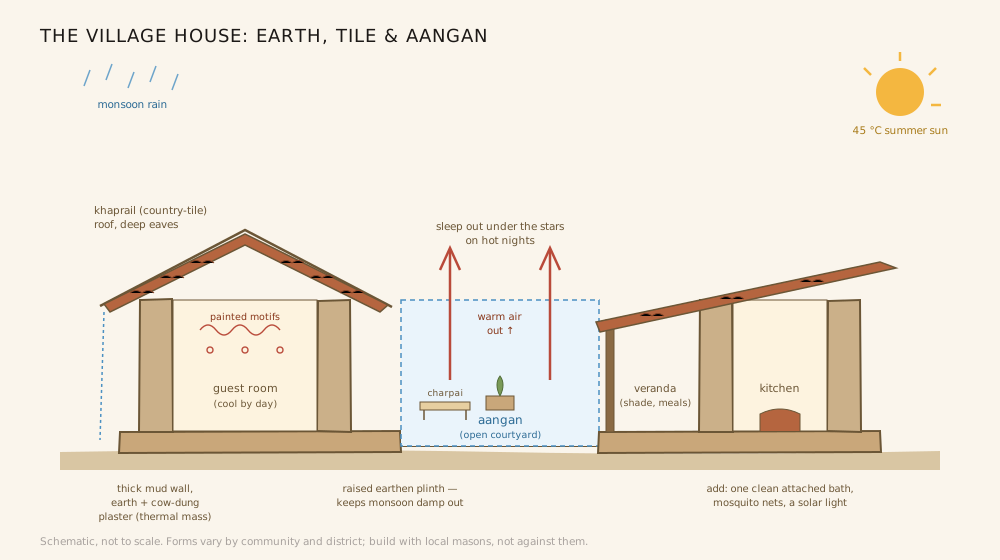
- Thick mud walls, earth-and-dung plaster. High thermal mass keeps rooms cool through summer afternoons and holds warmth on winter nights; the plaster is renewed after each monsoon, often before festivals.
- Painted walls. Many households decorate walls and floors with patterns and figures — the tradition that Gond painting grew from. Treat it as the family's art, not décor to commission for guests; if guests want to learn, pay the artist properly.
- Khaprail tile roofs with deep eaves. Locally fired country tiles on timber or bamboo rafters breathe, shed the monsoon and let heat escape; deep eaves shelter the mud walls from driving rain.
- Raised plinth and veranda. A raised earthen platform lifts the house above monsoon damp; the shaded veranda is where meals, chores and conversation happen.
- The aangan. The open courtyard is the family's outdoor room — cooking, drying grain, a tulsi platform, and charpais for sleeping out on hot nights. It is the best seat a guest will get.
Add only what comfort truly needs: one clean attached bathroom per room (ideally with a soak pit or septic system sized by a professional), mosquito nets, a fan, reliable drinking water, and a solar light for power cuts. Resist replacing mud and tile with a concrete box — it is hotter, costs more, and erases the reason guests came. For design detail see the design guide.
Heritage towns: Orchha, Maheshwar, Mandu
The heritage-town homestay is a different product: an old family house a short walk from monuments. Orchha offers Bundela palaces and cenotaphs on the Betwa, with programme villages like Ladhpura Khas nearby. Maheshwar has the Ahilya Fort and long Narmada ghats, and is the home of Maheshwari handloom — a guest who watches weavers at work and buys direct is the best kind of tourism. Mandu sells Afghan-era ruins on a monsoon-green plateau. Here the playbook resembles the Rajasthan haveli guide: keep the character, add bathrooms discreetly, use a rooftop, and consult a conservation architect before altering an old structure — protected-monument surroundings carry their own building restrictions.
Community benefit and honest expectations
The programme's whole logic is that tourism money stays in the village — so hire local guides and cooks, buy local produce and crafts, and share the guest rather than compete for them. Respect tribal communities as hosts, not attractions: ask before photographing people or homes, and follow village custom on dress, alcohol and sacred places.
Be equally honest with guests: simple rooms, shared family rhythms, patchy mobile signal, power cuts, Indian-style or basic bathrooms in some homes, and long drives from railheads like Jabalpur, Katni, Umaria or Nagpur. A clear listing that says all this earns better reviews than an oversold one. Price the season — busy October to March, a hot but still-active April to June near the parks, and a quiet monsoon when cores close (market it to monsoon-lovers for Pachmarhi and Mandu instead). Model it in the ROI Calculator and the setup-cost estimator.
Key takeaways
- MP's homestay market blends tiger forests, living villages and heritage towns — and the state backs it with a structured rural homestay programme (around 100 villages, NGO-supported training); confirm current terms with MP Tourism Board.
- Near a tiger reserve, host inside an existing buffer village, respect the ESZ notification, and check with the Forest Department before building.
- Core zones generally run Oct–Jun and close 1 Jul–30 Sep; plan pricing and marketing around the closure.
- The mud-wall, khaprail-tile, aangan house suits the composite climate — add a clean bathroom, nets and water, not a concrete box.
- Make community benefit and honest expectations part of the product; start with the registration guide and how to start a homestay.
References
- MP Tourism Board — Home Stay, Bed & Breakfast, Gram Stay and Farm Stay registration, and the Rural Tourism Programme under the Responsible Tourism Mission; authoritative for categories, caps, fees and support. See the state portal and the Licence Finder.
- MP Forest Department and individual tiger-reserve offices — safari booking, seasonal closure and zone rules; MoEFCC eco-sensitive-zone notifications and NTCA tourism guidelines for each reserve.
- Ministry of Tourism / Ministry of Tribal Affairs — PM Janjatiya Unnat Gram Abhiyan support for tribal homestays; confirm current eligibility.
- Central Indian vernacular architecture — mud walls with earth-and-dung plaster, khaprail tile roofs, raised plinths and aangan courtyards as composite-climate responses.
Indicative and state-dependent. Studio Matrx is a not-for-profit guide; this is educational content, not legal, forestry or conservation advice. Confirm registration with MP Tourism Board, siting with the Forest Department and district authorities, and engage an architect or conservation architect before building or altering.
Export this guide
Related Guides — Deep-dive reading
Ladakh & Spiti Homestays: The Cold-Desert Playbook
In the high cold desert of Ladakh and Spiti the homestay is not a business model borrowed from elsewhere — it is how villages have long hosted travellers. This playbook covers the passive-solar mud house that keeps guests warm at minus twenty, water-free dry toilets, altitude and acclimatisation, a short summer season with a winter counter-season, and the permits and rules that apply.
HomestaysHow to Plan a Home for Multi-Generational Living
Designing for grandparents, parents and children under one roof — privacy, accessibility and harmony
Home PlanningDesigning a Naturally Energy-Efficient Indian Home
Comfort first, gadgets last — passive design, orientation, insulation, ventilation and the climate wisdom that cuts Indian energy bills
SustainabilityRelated Tools — Try Free
Before & After Studio
Generate AI before-and-after renders to preview how your redesign could look.
DesignAICircadian Light Meter
Patient-centric circadian lighting visualizer for Indian healthcare design — time-of-day × intensity → CCT, melanopic lux (EML / mEDI), melatonin suppression, and an alertness curve. Calibrated against WELL v2 L03 Circadian Lighting Design, CIE S 026:2018, Brainard 2001, and Lucas et al. 2014.
Circadian ToolHomestay Licence Finder
Pick your state for the homestay registration picture — room caps, residence rules and fees — plus the three compliance layers every host needs.
Licence Finder