
Interactive Analyzer · 2026
Cross-Ventilation Analyzer
Does your room breathe well? Enter dimensions, window areas, your layout — get air changes per hour, NBC 2016 compliance, and targeted improvement suggestions.
Room
Floor area: 15.8 m² · Volume: 47.3 m³
Openings
One-click presets — fine-tune layout and areas below.
0 for windows at the same height; 1.5 for clerestory / transom above a low window.
Site & climate
Southwest monsoon breeze; plateau elevation keeps speeds steady through summer.
Use this if you have a windy.com or ventusky.com reading for your exact location.
Airflow rating
Strong airflow — 11.3 air changes/hour, clearing the 6 ACH target for a living / dining.
Airflow Map · 4.5 × 3.5 m room
11.3 ACH · Healthy airflow
Ventilation score
100 = meets 6 ACH target
Air changes / hr
11.3
target 6 ACH
Total airflow
535
m³ / hour
Effective opening
1.06
m² (paired)
Wind-driven
535 m³/hr
Stack / buoyancy
0 m³/hr
How to improve
- •This layout comfortably clears the target. Good candidate for a fan-off / AC-off strategy on mild days.
How this works
- Two airflow mechanisms. Wind-driven: pressure on the windward facade pushes air in, pulls it out the leeward side. Stack / buoyancy:warm indoor air rises and exits a high opening, drawing fresh air in through a low one — this is what makes jalis and clerestories so effective on still nights.
- Effective opening area. For cross-ventilation, Aeff = (Ain × Aout) / √(Ain² + Aout²). The smaller opening dominates — doubling just the inlet gives ~40% more flow, not 100%.
- Layout matters more than size. Cross-ventilation (opposite walls) delivers ~10–15× the airflow of single-sided for the same opening area. Corner / adjacent walls land in the middle.
- NBC 2016 Part 8. Minimum openable window area = 10% of floor area for habitable rooms (5% for bathrooms). This is a prescriptive minimum — clearing it doesn’t guarantee good real-world ventilation.
- What the calculator does not model: interior partitions, furniture blockages, balconies as wind shields, fly-screens (reduce airflow ~15%), security grilles, and wind approach angle. Real-world performance can be ±30% of the modelled number.
Related tools: Vastu Compliance · Sun Path Analyzer · Biophilic Score. Designing or specifying? The professional version adds NBC / ASHRAE compliance detail, discharge-coefficient tuning, and an SVG plan diagram.
Cross-ventilation in real Indian homes
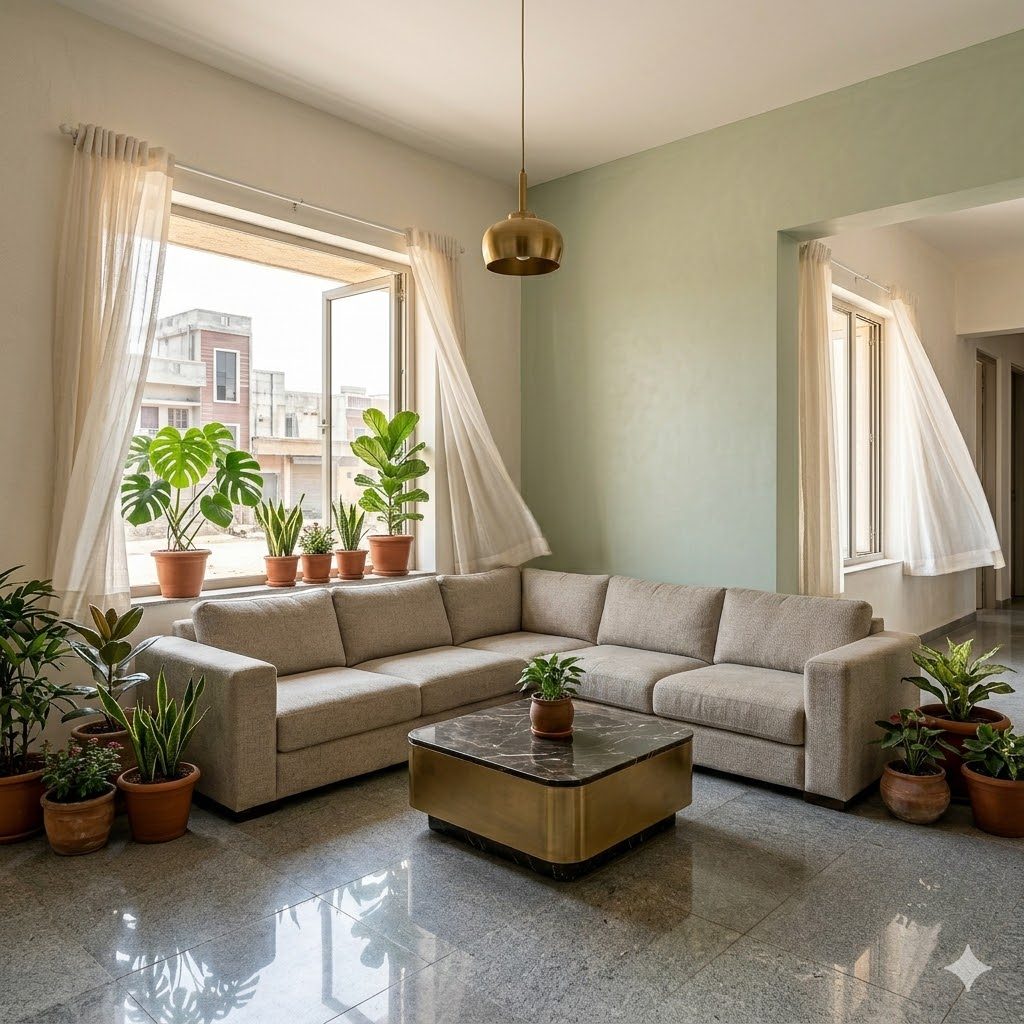
Open windows
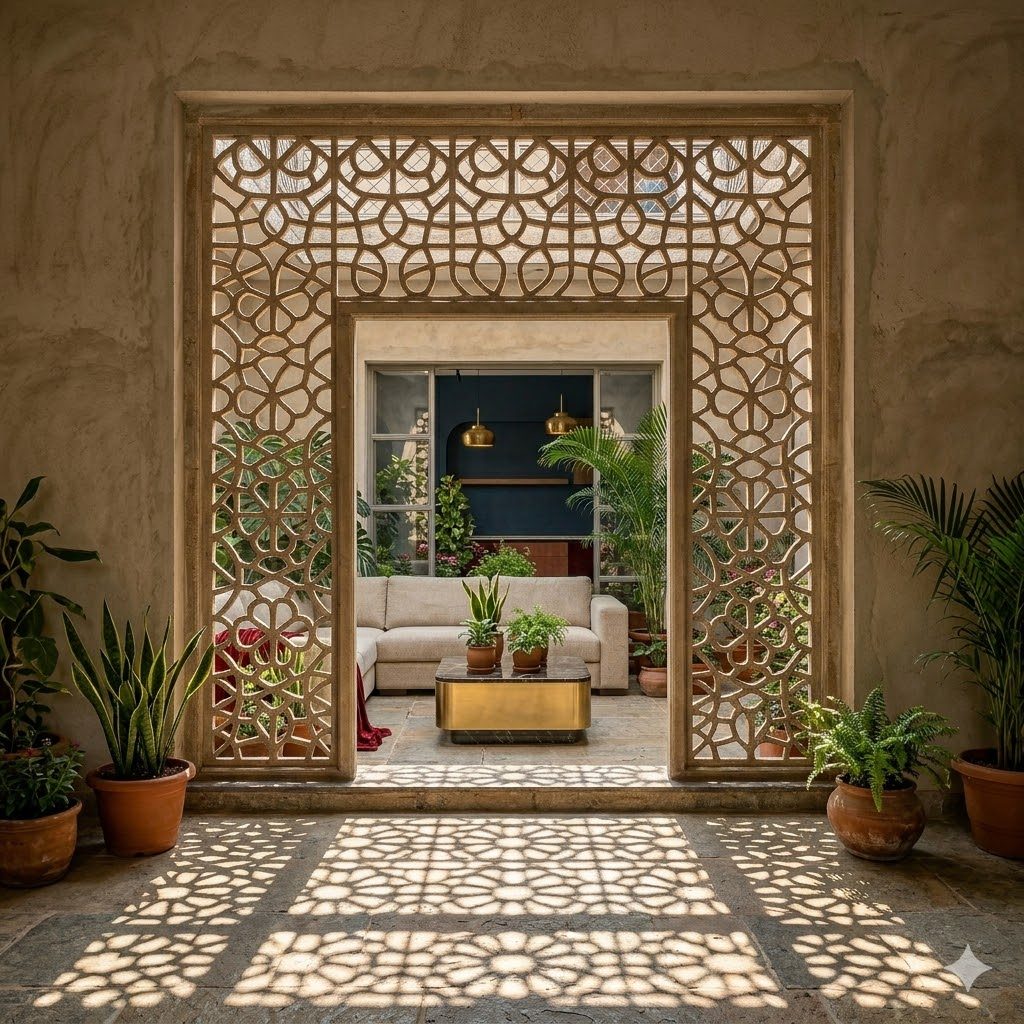
Jaali · permanent

Courtyard · stack
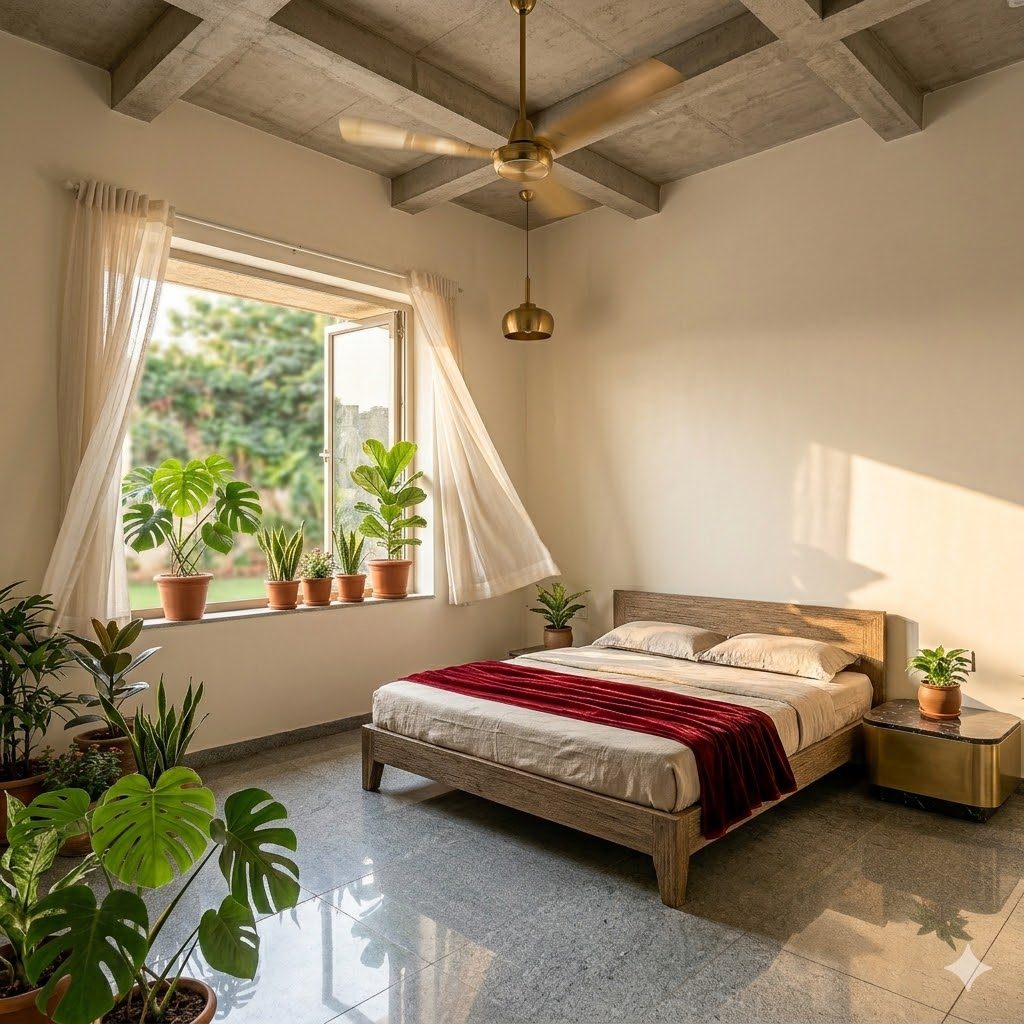
Mixed-mode · fan
Design for airflow
DesignAI specs ventilation strategies that fit your room layout + climate zone.
Natural Ventilation in Indian Homes — A Working Reference
Natural ventilation is the single most cost-effective passive cooling strategy for Indian homes. A well-ventilated room stays 3-6°C cooler than a sealed room of identical construction during peak summer, reduces dependency on air-conditioning, removes humidity buildup, and improves indoor air quality. The difference between "poor" and "good" ventilation is rarely about house size or budget — it is about opening placement. Two windows on opposite walls produce 10-15× the airflow of two windows of identical area on the same wall, simply because outdoor pressure differentials drive air through the room.
Three Ventilation Patterns — Same Total Area, Very Different Airflow
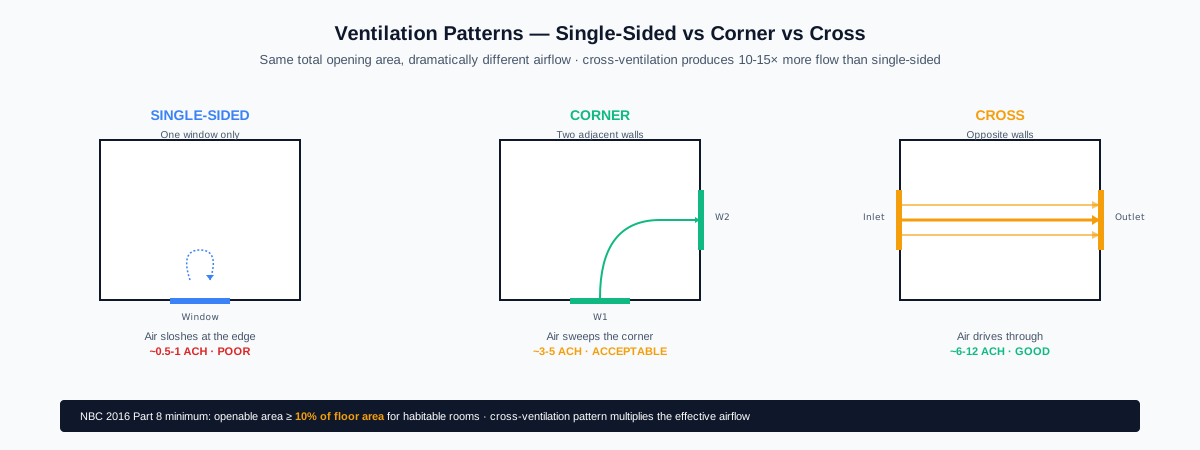
Single-sided ventilation (one window only) produces almost no useful airflow. Air sloshes back and forth at the window edge but does not refresh the room. Typical ACH (Air Changes per Hour): 0.5-1 — well below comfort thresholds.
Corner ventilation (two openings on adjacent walls) is much better. Outdoor pressure differential drives air diagonally through the room. Typical ACH: 3-5 — acceptable for bedrooms and study spaces.
Cross-ventilation (opposite walls) is the gold standard. Outdoor wind pushes through the inlet and out the outlet, carrying heat and humidity. Typical ACH: 6-12 — comfortable for living rooms, dining areas, and any space with elevated thermal load.
Once You Have Cross-Flow — Window Sizing & Stack Effect
Layout gets you the bulk of the win. Two further levers then decide how much extra airflow you actually capture: the relative size of inlet vs outlet, and the vertical placement of openings. The first uses pressure (Venturi); the second uses buoyancy (stack effect) and works even on still days.
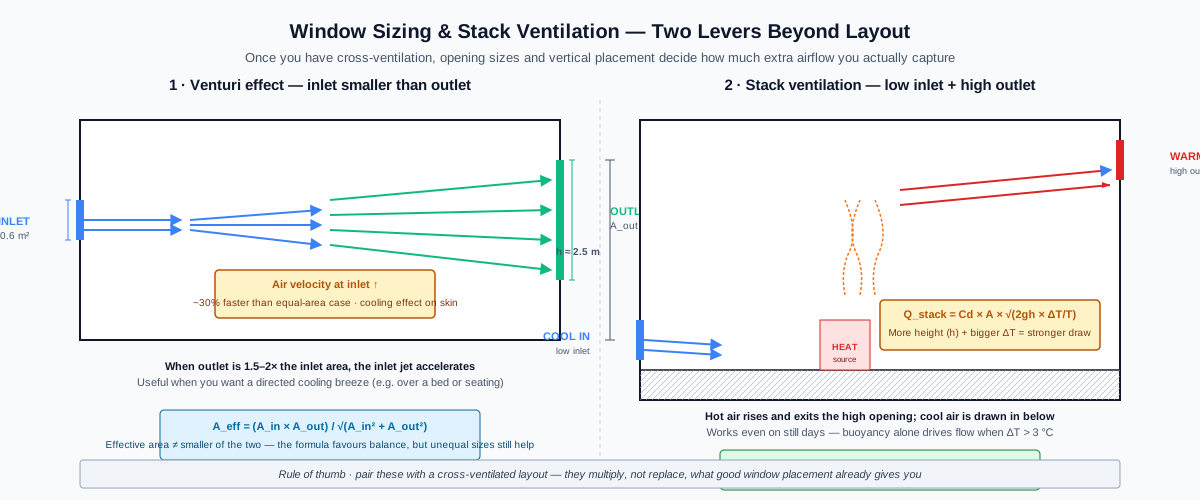
Inlet smaller than outlet (1 : 1.5 to 1 : 2) accelerates the inlet jet — useful when you want a directed cooling breeze across a bed or seating area. Stack ventilation (low inlet + high outlet, with at least 2 m of vertical separation) draws air on temperature alone — the bigger the indoor-outdoor temperature gap, the stronger the draw. Double-height living rooms, stairwells, and kitchens with vent shafts are natural candidates.
NBC 2016 Part 8 — The Indian Regulatory Minimum
The National Building Code 2016 Part 8 (Building Services) mandates a minimum openable window area of 10% of the floor area for habitable rooms (bedrooms, living rooms, kitchens). For bathrooms and toilets, 1 sq m or 4% of floor area, whichever is greater. These are prescriptive minimums, not optimal targets — many habitable rooms that comply with NBC still have poor real-world ventilation due to single-sided layout, deep room depth, low local wind speed, or window placement that misses prevailing breeze direction.
India-Specific Wind Patterns
India's prevailing wind direction varies by region and season. Knowing your local wind rose lets you orient inlet windows correctly:
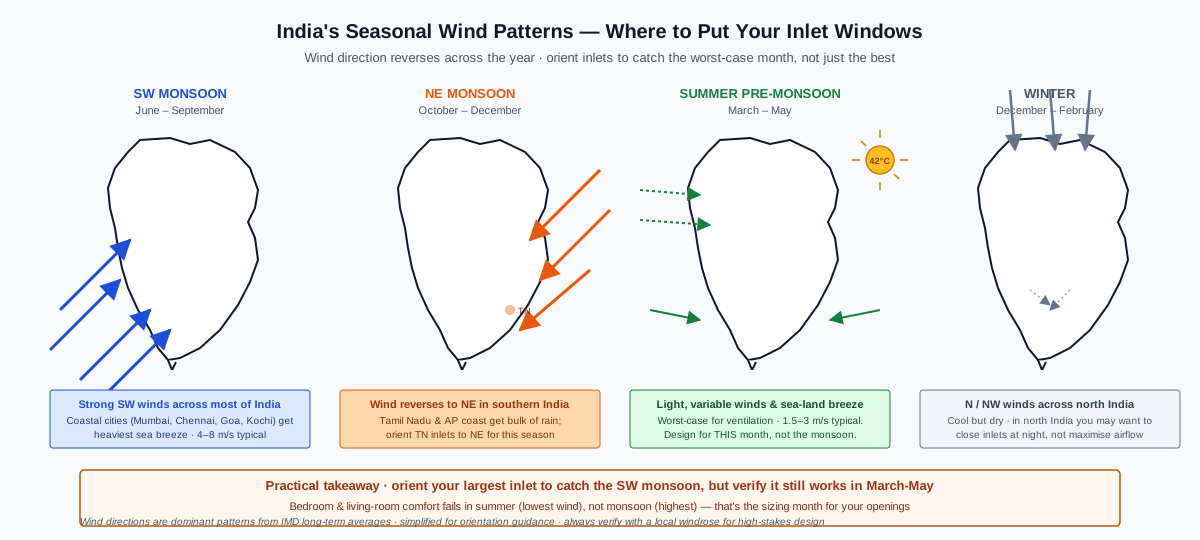
- South-west monsoon (June-September) — winds typically from the south-west across most of India. Coastal cities (Mumbai, Chennai, Goa) get strong sea breeze.
- North-east monsoon (October-December) — winds reverse to north-east in southern India (Tamil Nadu, AP coast).
- Summer pre-monsoon — typically light south-westerlies in north India; sea-land breeze cycles in coastal cities.
- Winter (December-February) — predominantly northerly / north-westerly across north India; weak winds in south India.
Practical Design Rules
- Always design for cross-ventilation — orient living rooms and bedrooms with windows on opposite walls when possible.
- Inlet smaller than outlet — when outlet is 1.5-2× the inlet area, airflow velocity into the room is higher (Venturi effect). Useful for cooling.
- Consider stack ventilation — when inlet is low and outlet is high (e.g., clerestory window), warm air rises and exits, drawing cool air in. Especially effective in rooms with double-height volumes.
- Avoid blocking airflow paths with internal walls, large furniture, or heavy curtains. Open layouts ventilate better than compartmented ones.
- Use ceiling fans as supplements, not replacements — fans move existing air; they don't bring fresh air. A 6-ACH room with a fan feels much cooler than 6-ACH alone (effective temperature drop of 2-3°C from air movement).
- Design for the worst-case wind month — verify ventilation works in May (typically lowest wind speed in north India), not just monsoon (highest).
Cross-References
- Cross-Ventilation in Indian Homes (Guide) — deeper treatment with case studies
- Passive Design Strategies for Indian Climate Zones — comprehensive climate-design reference
- Sun Path Analyzer — combine sun + wind in design
- Designing for Indian Climate (Guide)
Disclaimer: The analyser uses the CIBSE AM10 simplified model with city-preset wind speeds from IMD long-term averages at 10 m elevation. Site-specific obstructions (neighbouring buildings, trees, terrain) and seasonal variation can produce significantly different results — verify with on-site observation and CFD analysis for high-stakes design decisions. This page is for informational purposes only.
Related Guides — Deep-dive reading
Cross Ventilation in Indian Homes
Science, Physics, and Planning — A Professional Guide for Architects
Room PlanningNatural Light Planning for Indian Homes
Orientation, Windows, and Openings — A Professional Guide for Architects
Room PlanningUnderstanding Wind Analysis for a Comfortable Home
How to read your site's breeze and design openings that keep an Indian home naturally cool — long before you switch on an air-conditioner.
Site PlanningRelated Tools — You may also find these useful
Vastu Window Planner
Vastu guidance for window placement and size by wall direction and room — rating and remedies.
VastuBrise-Soleil Visualizer
Interactive horizontal-louvre cut-off angle calculator — sun altitude, louvre depth, and spacing inputs with a live shadow preview. Computes θ = arctan(spacing/depth) for façade shading, ECBC envelope compliance, hospital daylight design, and tropical sun-control detailing.
Sun Shading ToolVaastu + Orientation Advisor
Vaastu room placement by direction, sorted honestly by building science — climate-sound, contingent, or convention. Pick your entrance orientation.
Orientation