
Ladakh & Spiti Homestays: The Cold-Desert Playbook
In the high cold desert of Ladakh and Spiti the homestay is not a business model borrowed from elsewhere — it is how villages have long hosted travellers. This playbook covers the passive-solar mud house that keeps guests warm at minus twenty, water-free dry toilets, altitude and acclimatisation, a short summer season with a winter counter-season, and the permits and rules that apply.
Above the tree line, between roughly 3,000 and 4,500 metres, lies India's cold desert — Leh and the Indus valley, Nubra, Zanskar, and across the range in Himachal, Spiti, with Kaza, Kibber, Langza and Komic among some of the highest inhabited villages a traveller can sleep in. Here the homestay is not an import: villages have long put travellers up in the family home, and in many places today a rotation or village committee shares guests between households. The guest sleeps in a whitewashed mud house, eats thukpa and skyu in the warm kitchen, and walks out to a landscape that looks like nowhere else in the country. What makes it work — or fail — is cold, altitude and water. This playbook covers all three. Read it beside the hill homestay playbook for the wider Himalayan picture and the regional overview.
Scope. Editorial good practice, not legal, medical or structural advice. Ladakh (a Union Territory since 2019) runs its own homestay policy and permit regime; Spiti falls under Himachal Pradesh's Home Stay Rules 2025 — see the Licence Finder and confirm with the UT or state tourism department. Building in a seismic, snow-loaded high-altitude zone needs a qualified engineer. Figures are indicative.
The product is the village family
The cold-desert guest — trekker, biker, photographer, wildlife watcher, increasingly a family — wants the household, not a hotel room: butter tea in the kitchen, the barley fields, the gompa on the ridge, a host who knows which pass is open. Keep that core and add only what genuinely matters at altitude: a properly warm room, thick quilts, reliable hot water, and a clean toilet. Many villages work collectively, sharing bookings and agreeing prices; joining that system usually beats undercutting it. Community-based programmes in Ladakh and Spiti, including snow-leopard conservation homestays, show how a few rooms can tie household income to protecting the landscape guests come for.
The vernacular is a winter sun trap
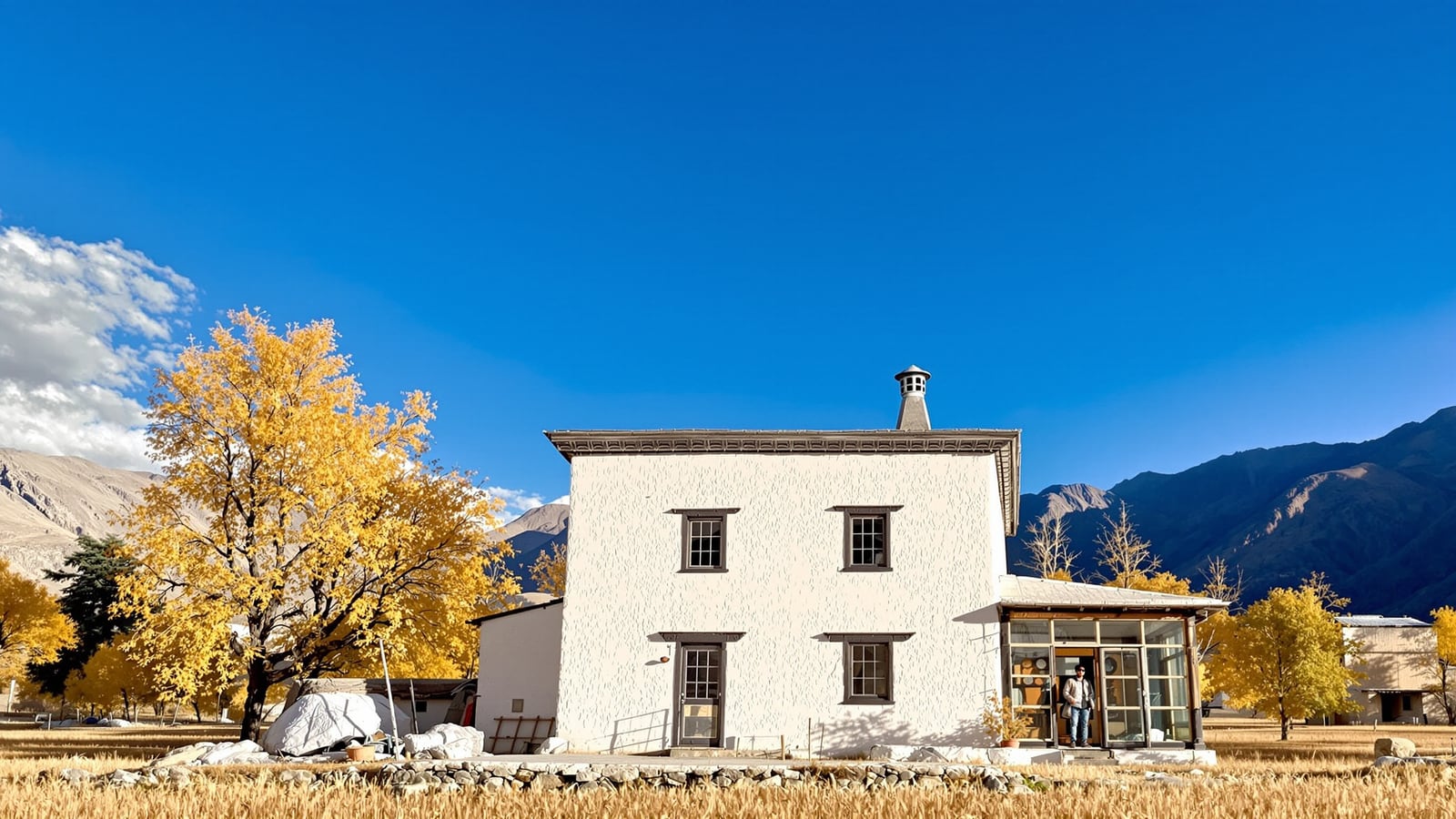
The traditional house is already a cold-climate machine: sun-dried mud-brick walls often half a metre thick on a stone plinth, a flat roof of poplar beams, willow twigs and packed mud (rain is scarce, so the roof is a drying and storage deck), small openings to the north and the family's winter kitchen on the sunny side. Since the 1980s groups such as LEDeG (Ladakh Ecological Development Group) have promoted Trombe walls and attached sunspaces for homes, and SECMOL's campus at Phey near Leh is a well-known demonstration of passive-solar mud building that stays warm through the winter largely on sunshine.
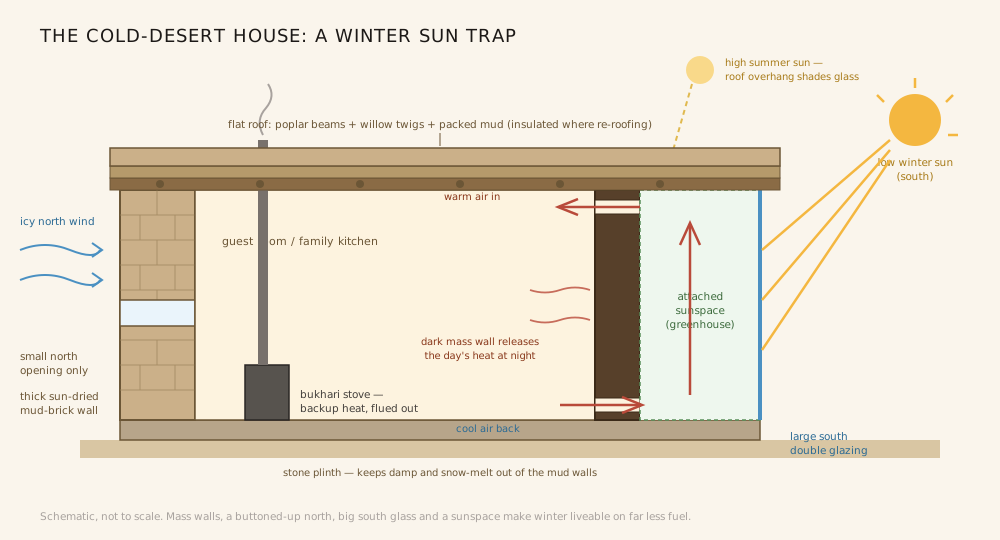
- Glaze the south, button up the north. Ladakh has intense sunshine for most of the year; large south-facing double glazing catches the low winter sun, while the north gets only small windows.
- Add a sunspace or Trombe wall. A glazed verandah or a dark mass wall behind glass soaks up the day's heat and releases it into the rooms at night — and a sunspace doubles as a greenhouse and a lovely guest sitting room.
- Keep the mass, add insulation. Mud walls store heat; when re-roofing, add insulation to the mud roof and seal draughts. Shade the glass from the high summer sun with a roof overhang.
- Heat with care. The bukhari (metal stove) burning wood, dung or kerosene is the traditional backup; fuel is scarce and carried up at cost. Always flue it outside, never sleep with a stove smouldering in a closed room, and fit a carbon-monoxide alarm in every heated guest room.
Resist the cement-block box with big glass on every side: it is cold in winter, needs far more fuel, and erases the character guests travel for. Brief an architect and engineer who know earthquake-resistant mud and stone detailing; the design guide covers room basics.
Water: the dry toilet earns its place
This is a desert fed by glacier and snow-melt streams, and tourism has strained it — flush toilets, daily showers and soak pits load supply and groundwater in towns like Leh. The traditional dry composting toilet — a two-level room where a scoop of soil or ash follows each use and the lower chamber composts into field manure — uses no water at all.
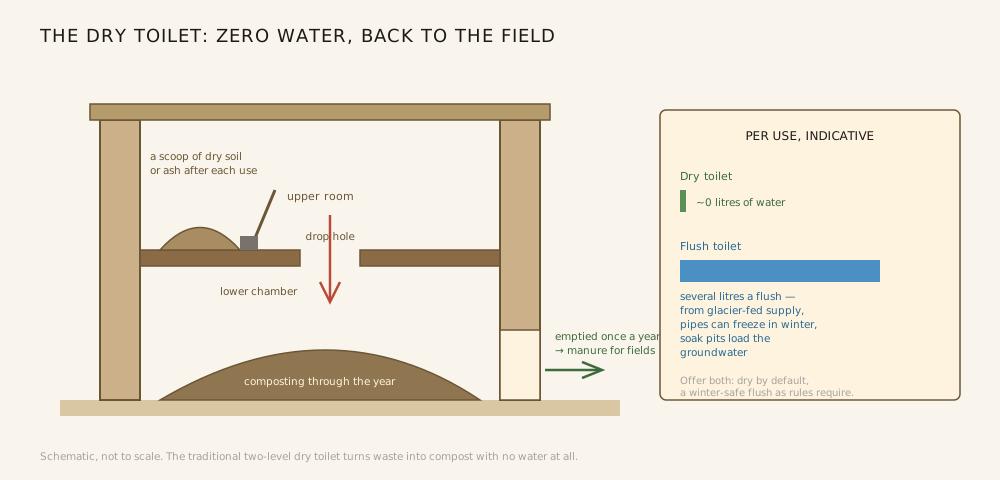
Note that Ladakh's homestay policy, as published, expects a winter-friendly flush toilet and bathroom for registration — so the practical answer is often both: a compliant, insulated attached bathroom, plus a clean, well-explained dry toilet that you invite guests to use. Add low-flow showers, solar water heaters, refill stations instead of bottled water, and a clear waste rule (carry plastics back out; segregate everything). Confirm current sanitation requirements with the tourism department.
Altitude: your guest's health is part of the job
Leh sits around 3,500 m, Kaza around 3,800 m, and Kibber higher still. Guests who fly into Leh go from the plains to high altitude in an hour, and acute mountain sickness (AMS) is common. Build care into the stay: encourage a full rest-and-acclimatisation day (two for the higher villages), plenty of fluids and no alcohol at first, keep a list of the nearest clinic or hospital and the local taxi number, and never discourage a guest who feels worse from descending. Do not diagnose or medicate; point guests to a doctor and the official advisories. Spiti travellers coming up by road via Kinnaur tend to acclimatise more gradually.
A short season — and a winter counter-season
The main season is short: roughly May/June to September, when the high passes open (the Manali-side roads into Ladakh and Spiti typically close through winter; access to Spiti via Kinnaur and flights into Leh continue, weather permitting). Expect a sharp summer peak and long quiet months — price into the peak, hold a working-capital reserve, and do repairs in the shoulder weeks. A growing winter counter-season exists for the prepared: the Chadar trek on the frozen Zanskar in mid-winter, snow-leopard watching around Hemis, Ulley, Kibber and nearby valleys, and quiet cultural stays. Only open in winter if your rooms are truly warm and your water does not freeze. Model both scenarios in the ROI Calculator and price the solar retrofit in the Setup Cost Estimator.
Rules and permits — confirm before you list
- Ladakh homestay registration. The UT's tourism department runs the Ladakh Homestay Policy 2023 (revised) for rural houses — as published, one to six rooms with a winter-friendly toilet and bathroom, with support for eligible households. Register with the department before you list.
- Permits. Indian nationals no longer need an inner-line permit for Ladakh's protected areas (relaxed in 2021), though environment or local fees may apply; foreign nationals still need a Protected Area Permit for areas such as Nubra, Pangong, Tso Moriri and Hanle. Rules are being simplified, so confirm current requirements with the UT administration and tell foreign guests before they book.
- Spiti. Homestays register under the Himachal Pradesh Home Stay Rules 2025; foreign guests travelling via Kinnaur may need an inner-line permit for the border stretch — confirm with the district administration.
The registration guide explains the general steps, and the starter guide covers the rest of the launch.
Key takeaways
- The cold-desert homestay sells the village family home — work with village rotations and community programmes rather than against them.
- The vernacular is a winter sun trap: thick mud-brick walls, a flat mud roof, small north openings, big south glazing, and a sunspace or Trombe wall as promoted by LEDeG and shown at SECMOL.
- Heat with a flued bukhari plus a CO alarm; never leave a stove smouldering in a closed guest room.
- Water is scarce: offer a dry composting toilet alongside the compliant winter-safe bathroom, and run low-flow, solar and plastic-free.
- Altitude care is part of hosting: an acclimatisation day, fluids, and a clear route to medical help.
- Season is May/June–September, with Chadar and snow leopards as a niche winter; confirm Ladakh's policy, permits for foreign guests, and Himachal's 2025 rules via the Licence Finder.
References
- Ladakh Homestay Policy 2023 (revised), Department of Tourism, UT of Ladakh — authoritative for eligibility, room limits and facilities; confirm the current version on the UT tourism portal.
- Protected Area Permit requirements for foreign nationals and the 2021 relaxation for Indian nationals — UT of Ladakh administration / district Leh notices.
- Himachal Pradesh Home Stay Rules 2025 — authoritative for Spiti homestays; see the state tourism portal and the Licence Finder.
- LEDeG and SECMOL — passive-solar building, Trombe walls and attached sunspaces in Ladakh.
- Traditional Ladakhi dry composting toilets — a water-free sanitation system suited to the cold desert.
- Official high-altitude health advisories for Leh-Ladakh — acclimatisation guidance for visitors.
Indicative and region-dependent. Studio Matrx is a not-for-profit guide; this is educational content, not legal, medical or structural advice. Confirm registration and permits with the UT of Ladakh or Himachal Pradesh tourism department, and engage a qualified engineer for any building work at altitude.
Export this guide
Related Guides — Deep-dive reading
Hill Homestays: The Himachal & Uttarakhand Playbook
From a riverside room in Tirthan to a stone house in Spiti, the hill homestay sells the mountain itself. This playbook covers the cold-climate design that keeps it warm and standing, building into a slope, the winter and water realities others forget, and the guest and seasons of a Himalayan stay.
HomestaysVernacular Architecture of Ladakh: Building Warmth in a Cold Desert
How thick earthen walls, a south-facing rabsal sun-room, a layered flat roof and the heat of stabled animals turn a -30°C Trans-Himalayan desert into a warm home.
Vernacular ArchitectureKutch Homestays: The Bhunga & the White Desert
Kutch sells the white salt desert, the craft villages of Banni and a night in a round mud bhunga. This playbook covers the Rann Utsav season, why the bhunga stood through the 2001 earthquake and stays cool in the heat, community-run village tourism, craft as the experience, and the hard realities of water, salt and Seismic Zone V.
HomestaysRelated Tools — Try Free
Cross-Ventilation Analyzer
Estimate airflow and air changes per hour (ACH) from room size, window areas, layout, and local wind — with NBC 2016 Part 8 compliance check.
Ventilation CalculatorBrise-Soleil Visualizer
Interactive horizontal-louvre cut-off angle calculator — sun altitude, louvre depth, and spacing inputs with a live shadow preview. Computes θ = arctan(spacing/depth) for façade shading, ECBC envelope compliance, hospital daylight design, and tropical sun-control detailing.
Sun Shading ToolCircadian Light Meter
Patient-centric circadian lighting visualizer for Indian healthcare design — time-of-day × intensity → CCT, melanopic lux (EML / mEDI), melatonin suppression, and an alertness curve. Calibrated against WELL v2 L03 Circadian Lighting Design, CIE S 026:2018, Brainard 2001, and Lucas et al. 2014.
Circadian Tool