
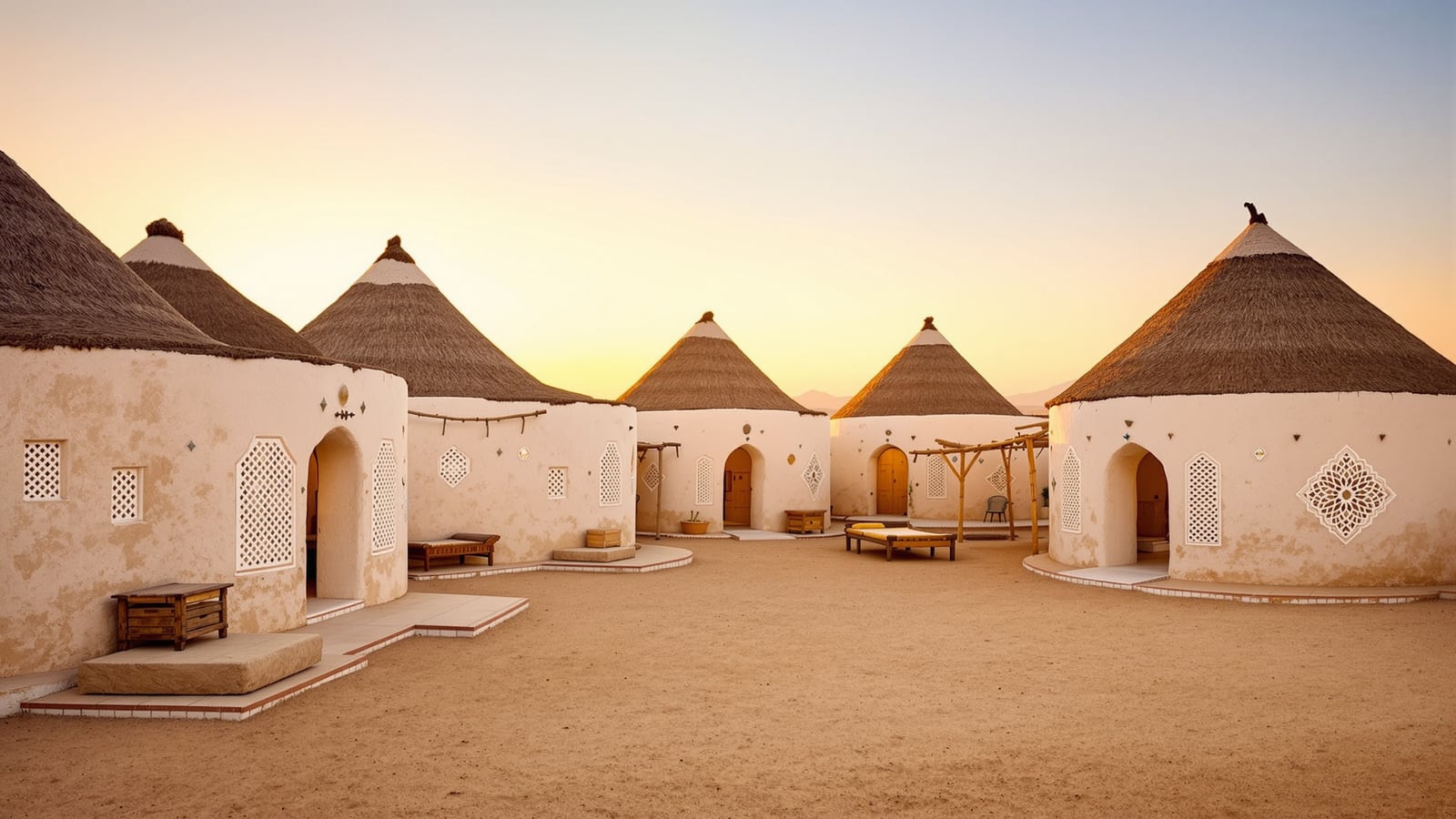
Kutch Homestays: The Bhunga & the White Desert
Kutch sells the white salt desert, the craft villages of Banni and a night in a round mud bhunga. This playbook covers the Rann Utsav season, why the bhunga stood through the 2001 earthquake and stays cool in the heat, community-run village tourism, craft as the experience, and the hard realities of water, salt and Seismic Zone V.
Kutch sells an experience no other part of India can: the white desert of the Great Rann under a full moon, the craft villages of the Banni grasslands, and a night in a bhunga — the round mud-and-thatch hut of the region. The homestay version lives in villages such as Hodka, Dhordo, Bhirandiyara and Ludiya, where families host guests in bhungas beside their own homes, cook Kutchi food, and open their workshops. The draw is real and seasonal, the architecture is a quiet masterclass in earthquake and heat resilience, and the craft is the experience. This playbook covers all three, and the hard realities of water and salt. Pair it with the design guide, the regional overview and its hot-dry neighbour, the Rajasthan haveli playbook.
Scope. Editorial good practice, not legal or structural advice. Gujarat's homestay registration framework (the revised 2020 policy: owner-resident, up to six lettable rooms) and the local, fire and panchayat layers apply — see the Licence Finder and confirm with Gujarat Tourism. Kutch is in Seismic Zone V: any new building needs a structural engineer. Figures are indicative.
The demand: Rann Utsav and a short, bright season
The single biggest demand driver is the Rann Utsav — the state-promoted winter festival centred on the tent city at Dhordo, on the edge of the white Rann, which typically runs from about November to February. It put the Banni villages on the map: festival visitors who want something more personal than a tent come looking for a village bhunga, a craft walk and a home-cooked meal. Around that core sit wildlife and birding (flamingos, the Banni grassland, the Little Rann's wild ass sanctuary to the east), Bhuj, Mandvi and the craft trail.
| Season | Months (indicative) | What it means for a host |
|---|---|---|
| Peak | Nov – Feb | Rann Utsav, cool clear days, full-moon nights; price for it |
| Shoulder | Oct, Mar | Pleasant early / late; craft and birding guests |
| Trough | Apr – Sep | 40 °C+ heat, then monsoon water on the Rann; many close |
Plan for a four-month earning window. Price into the festival peak, keep a strong working-capital reserve, and use the hot months for maintenance and re-plastering. Model it honestly in the ROI Calculator.
The bhunga: why a round mud hut stood through 2001
On 26 January 2001 the Bhuj earthquake devastated Kutch — yet many traditional bhungas in Banni came through with little damage while rigid modern buildings nearby collapsed. That is why the bhunga is now studied as a model of vernacular seismic design, and why guests want to sleep in one.
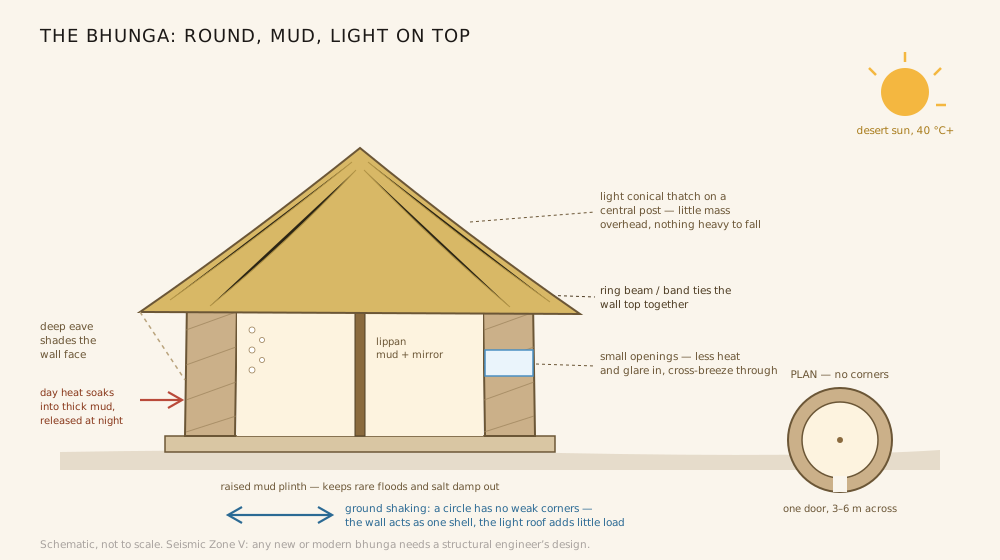
- A circular plan. With no corners, there are no weak points where walls meet and cracks start; the wall behaves as one continuous shell and resists shaking from any direction.
- Monolithic mud walls. Thick walls of mud (often with a binder and sometimes a timber or bamboo band) act together rather than as separate panels.
- A light roof. A conical thatch (or light tile) roof on a central post puts very little mass overhead — less inertia in a quake, and nothing heavy to fall on sleepers.
- Thermal performance. The thick mud absorbs the day's heat and releases it slowly, keeping the interior noticeably cooler by afternoon and warmer through the cold desert night; the deep eave shades the wall and small openings limit glare and dust.
Inside, the walls carry lippan — raised mud relief, traditionally mixed with dung and set with small mirrors, the work of the region's women. In lamplight it glitters; it is the single most photographed feature of a Kutch homestay, so commission it from local artisans rather than buying factory imitations.
Modern additions: Zone V means engineer it
A guest bhunga today needs a bathroom, wiring, perhaps a fan or cooler — and that is where the risk creeps in. The traditional bhunga's resilience came from its whole system; a heavy RCC slab, a large window punched through the wall or a toilet block bolted on can undo it. Kutch is in Seismic Zone V, the highest in India. Have a structural engineer design any new bhunga or annex (stabilised mud, seismic bands and lightweight roofing are well-documented approaches), keep wet areas in a separate, properly founded block, and keep openings small. See the indicative Kutch bhunga cluster house plan for one way to arrange guest bhungas around a shared court, and the Setup Cost Estimator to budget it.
Community-run village tourism
Kutch has a well-known model of tourism run by villagers themselves. Shaam-e-Sarhad in Hodka grew out of an endogenous rural-tourism project supported by the Ministry of Tourism and UNDP and is run by the village, with bhungas and tents, local food and craft. Several Banni villages have since added family homestays and bhunga resorts. The lesson for a new host is to plug into that ecosystem — share guest flows with neighbours, buy local, route craft sales directly to the maker — rather than compete with it. The Northeast community playbook explores the same collective model in a very different landscape.
Craft is the experience
The guest who comes to Kutch wants to watch and learn, not just shop. Kutch is one of India's richest craft regions, and a good host arranges unhurried visits:
| Craft | Where it is associated | The experience |
|---|---|---|
| Rogan painting | Nirona | Castor-oil paint drawn with a stylus; a rare living tradition |
| Ajrakh block printing | Ajrakhpur, Dhamadka | Natural-dye resist printing, many stages over days |
| Bandhani (tie-dye) | Bhuj, Mandvi, villages | Tiny tied dots, sold by the metre or saree |
| Embroidery and mirror work | Banni villages, Hodka, Ludiya | Distinctive community stitch styles |
| Leatherwork | Hodka and Banni | Embroidered and tooled leather goods |
| Lippan and pottery | Across Banni, Khavda | Mud relief and hand-thrown clay |
Pay artisans fairly for demonstrations, ask before photographing people, and never pass off bought goods as "made by our family". The authenticity is the product.
Water, heat and salt
- Water is the binding constraint. Banni is arid and groundwater is often saline. Budget for tanker supply and storage, harvest every drop of roof run-off, use low-flow fittings and dry or low-water sanitation where an engineer approves it, and set guest expectations politely.
- Heat. Even in winter, afternoons are bright; outside the season temperatures pass 40 °C. Lean on the bhunga's mass and shade rather than heavy air-conditioning — your solar and water budgets will thank you.
- Salt. Saline soil and air attack steel, cement plaster and fittings. Use a raised plinth, breathable lime or mud plasters, and corrosion-resistant hardware, and plan an annual re-plaster.
Registration in Gujarat
Gujarat's homestay registration framework (revised in 2020) is administered through the Office of the Commissioner of Tourism. As currently understood it requires the owner to reside on the premises, allows one to six lettable rooms, grades units (Silver, Gold, and a higher tier) after inspection, and offers benefits such as residential rather than commercial electricity and property-tax rates, training and listing on the Gujarat Tourism website. Panchayat, fire and food-safety layers sit alongside it. Rules and fees change — confirm the current policy with Gujarat Tourism before you build. Start with registration and licensing and the how-to-start guide.
Key takeaways
- Kutch sells the white Rann, Banni craft villages and the bhunga — demand peaks with the Rann Utsav, roughly Nov–Feb; plan for a short earning window and a long trough.
- The bhunga survived 2001 because of a circular plan, monolithic mud walls and a light roof — and its thick mud keeps it cool by day and warm by night.
- Seismic Zone V: have a structural engineer design every new bhunga or annex; keep wet areas separate and openings small.
- Plug into community-run tourism (Hodka's Shaam-e-Sarhad is the classic model) and make craft — Rogan, Ajrakh, bandhani, embroidery, leather, lippan — the experience, paying artisans fairly.
- Water, heat and salt shape everything: tanker and rainwater storage, passive cooling, raised plinths and lime or mud plasters.
- Register under Gujarat's homestay framework (owner-resident, up to six rooms) — confirm current rules with Gujarat Tourism and the Licence Finder.
References
- Gujarat Tourism — Policy for Registration of Homestay Establishments (revised 2020) — authoritative for eligibility, room cap, categories, fees and incentives; confirm the current version with the Commissioner of Tourism.
- Ministry of Tourism / UNDP Endogenous Tourism Project — the Hodka (Shaam-e-Sarhad) community-tourism model in Banni.
- Post-2001 Bhuj earthquake studies of vernacular bhunga performance — circular plan, monolithic mud walls and light roofs.
- IS 1893 (earthquake-resistant design) and IS 13827 / IS 13828 (earthquake resistance of earthen and low-strength masonry buildings) — for the engineer designing any new structure in Seismic Zone V.
- A structural engineer and local artisans — essential before building or altering any bhunga.
Indicative and policy-dependent. Studio Matrx is a not-for-profit guide; this is educational content, not legal or structural advice. Confirm registration with Gujarat Tourism, and engage a structural engineer for any construction in Kutch.
Export this guide
Related Guides — Deep-dive reading
Ladakh & Spiti Homestays: The Cold-Desert Playbook
In the high cold desert of Ladakh and Spiti the homestay is not a business model borrowed from elsewhere — it is how villages have long hosted travellers. This playbook covers the passive-solar mud house that keeps guests warm at minus twenty, water-free dry toilets, altitude and acclimatisation, a short summer season with a winter counter-season, and the permits and rules that apply.
HomestaysHow to Choose a Security System (2026): The Master Buying Guide for Indian Homes and Buildings
The mental model that ties the whole buying decision together: start from your own risk, not a product; build the layers your situation actually needs; make the big architecture choices (wired vs wireless, local vs cloud, DIY vs professional); tell real product quality from marketing; and choose a vendor you can trust.
SecurityBrick House, Wada: How iSTUDIO Bent an Ancient Craft into a Curve
A 2,500-square-foot farmhouse in rural Maharashtra bends the poorest, most ordinary building material — the fired clay brick — into free-flowing curved walls, and proves that low-cost, low-carbon, hand-built architecture can be as spatially ambitious as anything made of steel and glass. A close reading of its rat-trap-bond masonry, earthen-pot filler slabs, ferrocement roofs, and the Laurie Baker lineage it carries forward.
The Future of ArchitectureRelated Tools — Try Free
Cross-Ventilation Analyzer
Estimate airflow and air changes per hour (ACH) from room size, window areas, layout, and local wind — with NBC 2016 Part 8 compliance check.
Ventilation CalculatorStamp Duty Calculator — All Indian States
Stamp duty + registration charges for all 28 states and 8 UTs — gender concessions, urban/rural variants, metro cess built in.
Stamp DutyHome Building & Interior Cost Calculator — 20 Cities
Construction + interior costs for 20 Indian cities across kitchen, wardrobes, flooring, painting, ceiling.
Cost Calculator