

Heritage Building Security Approvals in India (2026): Protecting Without Damaging
A conservation-aware guide to securing listed, protected and heritage-notified buildings in India: how to identify the protection status, which authority to approach, why approval must come before any work, and how to design security that is minimal, reversible and sympathetic to protected fabric.
A heritage building is not an ordinary property with an old face. Its fabric — the stone, the timber, the plaster, the carving, the very surfaces you would normally drill into to mount a camera — is the protected thing itself. In a listed or notified building, those surfaces carry legal protection, and altering them without permission is not a minor liberty. It can attract penalties, it can trigger an order to undo the work, and, worst of all, it can permanently damage something that took generations to make and cannot be replaced. Securing such a building well means holding two ideas at once: the place genuinely needs protection from theft, vandalism and fire, and the protection you install must never harm what it is protecting.
This guide is about getting security right in heritage, listed and conservation buildings in India — how to find out what protects the building, whom to ask before you touch anything, and how to design security that a heritage authority will accept because it is minimal, reversible and sympathetic. It is written for the professional handling such a commission: the architect, the facility manager, the security consultant, the trustee of a temple or a haveli or a colonial-era institution. The single most important habit it teaches is simple. On a protected building you seek approval first and you intervene as lightly as the design allows.
Scope & how to read this. This is practical compliance literacy, not legal advice or authoritative code. Heritage protection is layered and varies enormously by building, by state and by city, and the rules change over time — always confirm the current position with the Authority Having Jurisdiction (the Archaeological Survey of India, the state archaeology or heritage department, or the municipal heritage conservation committee) and engage a qualified conservation professional before you act.
Why heritage buildings are a category apart
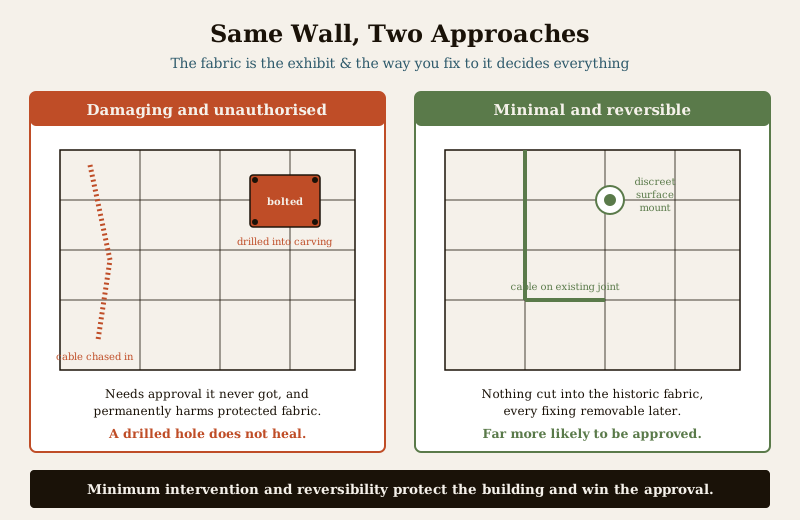
An ordinary security job treats the wall as a mounting surface. A heritage job treats the wall as the exhibit. That inversion changes everything. When a building is legally protected, its fabric is preserved in the public interest, and the default legal position is that you may not alter, add to, or fix things into protected surfaces without prior sanction from the relevant authority. Chasing a cable channel into carved stone, drilling anchor holes through original plaster, or bolting a bracket onto a timber column may all be routine on a modern building and forbidden on a protected one.
The stakes are both legal and physical. Unauthorised work on protected fabric can attract penalties and enforcement action, and an authority may require the intervention to be reversed at your cost. But the deeper stake is that heritage fabric is finite. A drilled hole in a five-hundred-year-old jaali does not heal. That is why the conservation world works to a principle of minimum intervention: do as little as possible, and make whatever you do reversible, so a future custodian can remove it and find the fabric unharmed underneath.
Find the protection status, then find the right authority
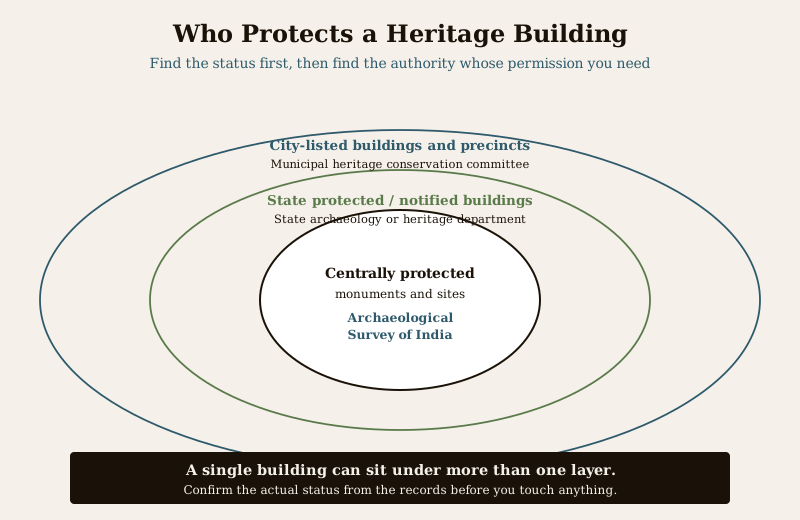
The first task on any heritage security commission is not choosing a camera. It is establishing exactly how the building is protected, because that determines whom you must approach. Protection in India is layered, and a building can fall under more than one regime at once.
Broadly, three kinds of authority may be in play, and you should confirm which apply to your specific building:
| Protection layer | Typical authority | What it generally covers |
|---|---|---|
| Centrally protected monument or site | Archaeological Survey of India (ASI) and its Circle office | Monuments and archaeological sites of national importance; strict controls on the monument and often a regulated area around it |
| State protected or notified building | State archaeology or heritage department | Monuments and buildings notified as protected at the state level |
| Listed building in a city | Municipal heritage conservation committee, under local heritage regulations or building bye-laws | Graded or listed heritage buildings and precincts within a city, and works within a notified heritage precinct |
The practical move is to establish the building's status from the records rather than assume it. Is it on a central list, a state list, a municipal heritage list, or inside a notified precinct where even neighbouring works are controlled? A conservation architect or the local body's heritage cell can help you read this correctly. Until you know the status, you do not know whose permission you need — and doing the work first and asking later is precisely the mistake that leads to penalties and undoing.
Defer to the authority, always. Which body approves your work, what a proposal must contain, and what is permitted on the fabric are all decided by the Authority Having Jurisdiction for that specific building, and they vary by state and city and change over time. Treat this guide as a map of the terrain, not a substitute for confirming the current requirement with the ASI, the state department, or the municipal heritage committee.
The approval path: apply before any work
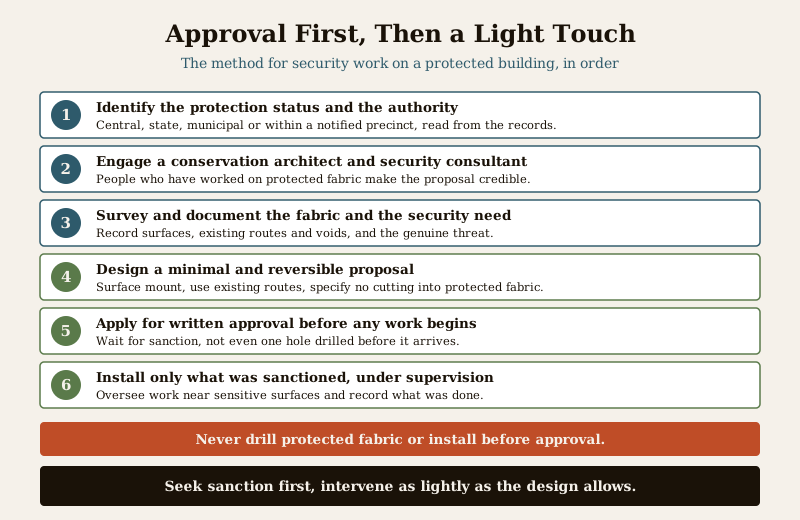
The order of operations on a heritage building is the opposite of a modern one. You do not install and then regularise. You obtain sanction and then install exactly what was sanctioned. The general flow looks like this, though the specifics differ by authority:
1. Identify the status and authority. Establish how the building is protected and which body has jurisdiction, using the records and a conservation professional.
2. Engage a conservation-aware team. Bring in a conservation architect and a security consultant who have worked on protected fabric. Their involvement is often what makes a proposal credible to the authority.
3. Survey and document. Record the existing fabric, existing routes and voids, and the security need. Photographs and measured notes of the surfaces you propose to work near are usually expected.
4. Design a minimal-intervention proposal. Show what you will install, exactly where, how it is fixed, how cables are routed, and — crucially — how every fixing can later be removed without damage.
5. Apply for approval before any work. Submit the proposal to the authority and wait for written sanction. Do not begin, not even the drilling of a single hole into protected fabric.
6. Install only what was sanctioned, under supervision. Execute the approved scheme, ideally with the conservation professional overseeing the work near sensitive surfaces, and keep records of what was done.
The reason for the sequence is not bureaucracy for its own sake. It is that the authority is the guardian of the fabric, and it needs to see and agree the intervention while it can still say no. A camera that has already been bolted to a carved bracket is a problem to be corrected; a drawing of that camera is a proposal to be improved.
Conservation principles for security kit
Once you understand that the fabric is the exhibit, the design rules for security follow naturally. They are the same principles a conservation architect applies to any addition, translated into cameras, sensors and cabling.
Minimum intervention. Install the least equipment that meets the genuine security need, in the least invasive way. A well-placed discreet camera that covers an approach is worth more than a dozen boxes bolted across a facade.
Reversibility. Prefer fixings and routes that can be undone later leaving the fabric unharmed. Surface-mounting to a non-original surface, using an existing hole, joint or void, and running cable along an existing route are all reversible moves. Chasing channels into carved stone or original plaster is not.
No damage to protected fabric. Do not drill, cut or chase into protected surfaces. Where a fixing is unavoidable, the conservation professional and the authority decide whether and where it is acceptable — never the installer alone on the day.
Aesthetic sensitivity. A heritage facade is a composition. Choose discreet, sympathetically finished equipment, position it where it does not dominate the character, and hide cabling out of sight. An authority is far more likely to approve a scheme that respects the building's appearance than one that scars it with visible boxes and trunking.
Use conservation-aware people. A generic security installer, however skilled with modern buildings, is the wrong person to be near protected fabric unsupervised. The right team pairs the security consultant with a conservation architect, and works to the authority's conditions.
These principles are not a tax on effective security. Discreet, well-routed, reversible systems are usually just as protective as intrusive ones — and they are the only kind you can actually get approved. For the security design itself, the general good practice in the CCTV installation planning guide still applies; heritage simply adds the constraint that the mounting and routing must respect protected fabric and the authority's sanction.
Balancing security and preservation
The tension at the heart of a heritage security job is real. These buildings are frequent targets — theft of artefacts, vandalism, and fire are genuine threats to places that are irreplaceable — so the instinct to protect them thoroughly is sound. But the protection must never become the damage. A camera scheme that scars a facade, or a fire installation that hacks through historic fabric, has in a sense already inflicted the loss it was meant to prevent.
Fire and life-safety deserve particular care, because they cannot simply be waved away in the name of preservation. Historic buildings are often more vulnerable to fire, not less, and life-safety obligations still apply. The resolution is not to skip fire protection but to negotiate it sensitively with the authority — favouring detection and suppression approaches that are effective yet minimally invasive, and agreeing the routing and fixing of alarm and detection equipment as part of the same approval. The framing in the security and fire regulations guide and the NBC security and fire safety requirements guide sets out the general expectations; on a protected building those expectations are met in dialogue with the heritage authority and the fire officer together, so that safety and fabric are both served.
Where a heritage building is also occupied — a museum, an institution, a hotel in a restored haveli, or homes within a heritage precinct managed by a society — the ordinary occupancy and community rules layer on top of the heritage ones. The commercial occupancy security requirements guide and, for residential heritage managed collectively, the housing society CCTV approval guide describe those overlapping obligations, which you satisfy alongside, never instead of, the heritage approval.
A heritage security approval and method checklist
Run this before and during any security work on a protected building:
- Confirm the protection status from the records — central, state, municipal, or within a notified precinct — before designing anything.
- Identify the correct authority and, where more than one applies, plan to satisfy each.
- Engage a conservation architect and a security consultant experienced with protected fabric.
- Survey and document the fabric, the existing routes and voids, and the genuine security need.
- Design for minimum intervention and full reversibility — surface-mount to non-original surfaces, use existing routes, and specify no cutting into protected fabric.
- Choose discreet, sympathetic equipment that does not dominate the character, with cabling hidden.
- Apply for written approval before any work begins, and install only what was sanctioned.
- Handle fire and life-safety in dialogue with the heritage authority and the fire officer, not by hacking historic fabric.
- Supervise the install near sensitive surfaces and keep a record of exactly what was done.
Never do this on a protected building
The heritage never-do list. Never drill, chase or cut into protected fabric — carved stone, original plaster, historic timber — without prior written approval. Never use irreversible fixings where a reversible one would serve. Never bolt ugly boxes or run visible trunking across a heritage facade, blocking or scarring its character. Never let a generic installer work unsupervised near protected surfaces. Never install first and seek approval afterwards. And never treat fire or life-safety as an excuse to hack historic fabric — negotiate it sensitively instead.
Who to ask, and getting professional help
Heritage security is one of the clearest cases where the right first move is to ask, not to act. The people to bring in early are a conservation architect who can read the building's status and design interventions the fabric will tolerate; the heritage authority with jurisdiction — the ASI Circle office for centrally protected monuments, the state archaeology or heritage department for state-notified buildings, or the municipal heritage conservation committee for city-listed buildings and precincts; a security consultant experienced with protected fabric; and, for the fire dimension, the fire officer and a fire engineer, because life-safety is negotiated, not skipped. For the broader map of security and fire rules that sit around any building, the security regulations hub gathers the general picture into which this heritage layer fits.
The reward for doing it in this order is a building that is both safer and unharmed — protected against the threats it faces, without a single mark on the fabric that made it worth protecting. That is the whole aim of a heritage security job, and it is entirely achievable when approval comes first and the touch stays light.
References
- Archaeological Survey of India (ASI) — the authority for centrally protected monuments and sites of national importance and the regulated areas around them; confirm a monument's status and the applicable controls with the relevant ASI Circle office before any work. https://asi.nic.in/
- State archaeology and heritage departments — notify and protect monuments and buildings at the state level; the specific department and its process vary by state and must be confirmed locally.
- Municipal heritage conservation committees and city heritage regulations — govern listed and graded heritage buildings and notified precincts within a city, including works within a precinct; confirm the current listing, grade and procedure with the local body's heritage cell.
- National Building Code of India (SP 7) and the state fire rules — set the general fire and life-safety expectations that still apply to occupied heritage buildings; on protected fabric these are met in dialogue with the heritage authority and the fire officer. Verify the current edition via the BIS catalogue.
This is an educational compliance-literacy guide to securing heritage, listed and protected buildings in India, not legal advice, an approval application, or a substitute for the Authority Having Jurisdiction. Heritage protection is layered and varies by building, state and city, and it changes over time; always confirm the current status and requirements with the ASI, the state department, or the municipal heritage committee, and engage a qualified conservation professional, before carrying out any security work on protected fabric.
Export this guide
Related Guides — Deep-dive reading
Security and Fire Regulations Guide for India (2026): Know the Rules and How to Navigate Them
There is no single national rulebook you can read off. This is the map of the whole regulatory landscape for home, housing-society and commercial security and fire systems in India, and a calm way to navigate it: who sets the rules, who approves what, and how to stay on the right side of them.
SecurityCCTV Installation Planning in India (2026): From Site Survey to a Camera Plan
The measure-twice, install-once master guide: walk your plot, list what you are protecting, sketch a plan, mark every camera position, then size power, network, permissions and budget before a single bracket is drilled.
SecurityNBC Security and Fire Safety Requirements in India (2026): What the Code Covers
A plain-language tour of what the National Building Code of India broadly covers for fire, life safety and the security overlap, why the version that binds you is your local building bye-law, and why the specific numbers must always be read with a licensed professional and the fire service.
SecurityRelated Tools — Try Free
Building Plan Approval Roadmap
Step-by-step building plan approval process by city with documents, timelines, and fees.
ArchitectAIStructural Modification Approval Checklist
41 items across structural assessment, society approval, municipal compliance, and safety.
Approval ChecklistConstruction Approval Checklist — 24-Stage Tracker
Track every approval, permit, and NOC from land title to occupancy certificate across 24 stages.
Approvals