
How to Start a Homestay in India: A Complete 2026 Guide
Homestays are India's fastest-growing way to travel — and to earn from a spare room. This guide walks through the whole journey in plain language: deciding if it suits you, the three layers of registration and compliance, setting up the space, listing and pricing, and hosting well — with the legal specifics left to the right professionals.
A decade ago, "homestay" was a word mostly used in Kerala and the hills. Today it is one of the fastest-growing corners of Indian travel. Active short-stay listings in India have climbed from roughly 18,000 in 2016 to well over 95,000 by 2025, and a striking share of new hosts are young — nearly two in five are between 18 and 29. Travellers increasingly want a real place with a real person in it rather than an anonymous room, and families with a spare bedroom, an empty floor, or an ancestral house in a beautiful part of the country are discovering that hospitality can pay for itself.
A homestay is not a hotel, and that distinction is the heart of everything that follows. In most Indian states the legal definition turns on one thing: the owner or family lives on the premises and lets out a small number of rooms — typically one to six — to guests who share, to some degree, the life of the home. That keeps it personal, keeps it lightly regulated compared with a hotel, and keeps the investment within reach of an ordinary household. This guide walks through the whole journey, in order, so you understand each decision before you make it.
Scope and who should advise you. This guide explains the process of starting a homestay in plain language so you know what to plan for and what to ask. It is not legal, tax or financial advice. Homestay rules, registration, fees, fire-safety thresholds and GST are state-specific and change often. Confirm the current requirements with your state tourism department and local municipal body, take binding tax advice from a chartered accountant, and any property or contract questions to a lawyer. Every figure here is indicative.
First, is a homestay right for you?
Before any paperwork, be honest about four things. A homestay rewards the household that genuinely wants it and quietly punishes the one that does not.
- You are comfortable sharing your home. Guests will be in your space, meeting your family, eating near your kitchen. The warmth of that exchange is exactly what people pay for — but it is not for everyone, and "I'll just rent the room and stay out of the way" usually makes for a thin, forgettable stay.
- Your location has a reason to visit. A homestay near a hill station, a backwater, a heritage town, a plantation, a trek, a pilgrimage or a city's work-and-wedding traffic has natural demand. One in an ordinary residential pocket with no draw will struggle however nice the rooms are.
- You have time, or help. Hosting is a service: messages answered quickly, check-ins managed, rooms cleaned to a standard, small problems fixed at odd hours. Decide now whether you or a family member will run it, or whether you will pay for help — it changes the economics.
- The numbers work at honest occupancy. Not the peak-season fantasy — the blended annual average. Model it before you spend. Our Homestay ROI Calculator and Setup-Cost Estimator are built exactly for this feasibility check.
If those four land well, read on. If they do not, it is far cheaper to learn that here than after the renovation.
The journey, in five steps
Starting a homestay is not one decision but a sequence, and the order matters. Skip the compliance step and you can build a beautiful space you are not allowed to let; skip the honest costing and you can comply perfectly with a business that never pays back.
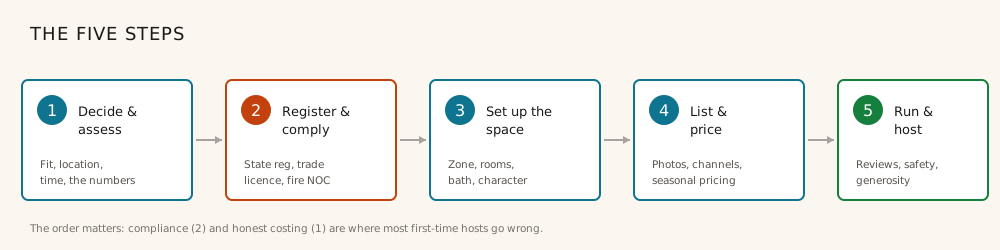
The rest of this guide takes each step in turn. Two of them — compliance and money — are where most first-time hosts go wrong, so they get the most space.
Step 1 — Decide and assess
Settle the shape of the thing. How many rooms will you let, and which ones? A homestay works best when there is a clear, dignified line between the family's private zone and the guest zone — guests should not have to walk through your bedroom to reach theirs, and you should not have to surrender your whole house. Decide whether you will offer breakfast (most do; it is a small cost and a large part of the experience), and whether the stay is room-only or more hosted.
Then assess demand and price honestly. Look at what comparable homestays near you charge across the year, not just in season, and what their reviews praise and complain about. Feed a realistic nightly rate and a 40–50% blended occupancy into the ROI calculator before you commit a rupee to renovation. This is also the moment to sketch the investment with the Setup-Cost Estimator so Step 3 has a budget to live within.
Step 2 — Register and comply
This is the step people most want to skip and most regret skipping. There is no single national homestay licence; instead there are three layers, and which apply depends on your state and local body.
| Layer | What it is | Who issues it |
|---|---|---|
| State homestay registration | The core, usually mandatory approval under your state's homestay/B&B policy — defines room caps, owner-residence rules and fees | State tourism department |
| Municipal trade licence | Local permission to run a commercial activity from the premises; required by most urban local bodies | Municipal corporation / panchayat |
| Fire NOC | A fire-safety no-objection certificate, required once rooms or floors cross a threshold | State fire services |
On top of these sits the Ministry of Tourism's Incredible India homestay/B&B scheme — a voluntary classification (Silver/Gold) that can lend credibility and marketing reach but does not replace your state's mandatory registration. And there is GST: small owner-run homestays below the turnover threshold are typically outside it, but the rules on thresholds and on bookings made through online platforms change — this is a question for a chartered accountant, not a blog.
The details differ sharply by state. Kerala, Karnataka, Himachal Pradesh, Uttarakhand, Goa, Rajasthan and the North-East each run their own policy with their own room limits, fees and conditions — a few examples give the flavour:
| State (indicative) | Typical room cap | Note |
|---|---|---|
| Kerala | Up to 6 rooms / 12 guests | Owner/family must stay on the premises |
| Karnataka | 1–6 rooms (max 12 beds) | Defined as owner-resident and "non-commercial" |
| Himachal Pradesh | Home-stay 1–3 rooms; Premier 4–9 | Rules revised in 2025; rural fees apply |
| Uttarakhand | Up to 6 rooms | Three-year registration validity |
Treat that table as a starting point, not gospel — the numbers move. We are building a state-by-state licensing cluster next to walk each one through properly; until then, confirm directly with your state tourism department and municipal office, and keep every approval on file.
Step 3 — Set up the space
Now the part that is genuinely enjoyable — but spend where it matters to a guest, not where it flatters you. A homestay lives or dies on three things: a comfortable bed and a clean, well-sorted bathroom, a sense of place and warmth, and privacy that lets both host and guest relax. A single clean, functional room can be ready for ₹30,000–75,000; a comfortable room with air-conditioning and an upgraded bathroom is closer to ₹2 lakh.
This is a design problem as much as a budget one — how you zone host from guest, carry your region's character into the rooms, handle bathrooms and storage, and make the place safe and, ideally, accessible. We cover it properly in Designing Your Home as a Homestay. Keep the build inside the figure your Setup-Cost Estimator produced, and hold back a working-capital reserve for the slow first months.
Step 4 — List and price
A homestay that nobody can find does not earn. Three things do most of the work here. First, photographs: your listing lives or dies on them, so this is the one place to pay a professional. Second, your channel mix — the single biggest lever on profit. Online travel agents (OTAs) like Airbnb and MakeMyTrip bring reach but take 14–22% commission; direct bookings cost nothing, and well-run hosts move 40–60% of their bookings to direct within a year by building a reputation, a simple website and repeat guests. Third, pricing to the season — rates that flex with demand, because occupancy swings hard between peak and monsoon.
The economics of all this — occupancy, rate, commission, costs, break-even — deserve their own treatment; see What a Homestay Really Earns and model your own numbers in the ROI Calculator.
Step 5 — Run and host
Everything so far gets you a guest; hosting gets you the review that gets you the next ten. Reply fast, make check-in effortless, keep the rooms spotless, and offer the small, specific generosity only a resident can — the real local recommendation, the umbrella in the rain, the chair in the sun. Keep guests safe: working smoke and gas alarms, a fire extinguisher, clear exits, basic first aid, and honest listing information. Build a light routine for housekeeping and linen so the standard never slips when you are busy.
Do this well and the compounding is real: better reviews lift occupancy, repeat and direct bookings lift margin, and a spare room quietly becomes a dependable second income — and, for many hosts, the most rewarding thing they have built.
Key takeaways
- A homestay is owner-occupied and small — usually 1–6 rooms with the family resident — which is what keeps it personal and lightly regulated compared with a hotel.
- Test the idea against four honest questions (sharing, location, time, numbers) before spending; model it with the ROI and Setup-Cost tools.
- Compliance has three layers — state homestay registration, municipal trade licence and a fire NOC above a threshold — plus the voluntary Incredible India classification and a GST question for your CA. Rules are state-specific and change.
- Set up for the guest, not for show: a great bed and bathroom, a sense of place, and real privacy between host and guest.
- The biggest profit lever is moving bookings to direct; the biggest trust lever is professional photographs and fast, warm hosting.
References
- Ministry of Tourism, Government of India — Incredible India Bed & Breakfast / Homestay Establishment scheme (voluntary classification). Confirm current guidelines on the official portal.
- State tourism departments — Kerala, Karnataka, Himachal Pradesh, Uttarakhand, Goa, Rajasthan and others each publish their own homestay policy with room caps, fees and conditions, which change over time.
- Your local municipal corporation / panchayat and state fire services — for the trade licence and fire-NOC requirements that apply to your property.
- A chartered accountant — for GST applicability, thresholds and platform-booking treatment; and a property lawyer for any ownership, tenancy or contract questions.
Indicative and state-dependent. Studio Matrx is a not-for-profit guide; this is educational content, not legal, tax or financial advice. Confirm every requirement with your state tourism department, municipal body and a chartered accountant before you start.
Export this guide
Related Guides — Deep-dive reading
Homestay Registration & Licensing in India: A State-by-State Guide (2026)
There is no single national homestay licence — there are three compliance layers and a different state policy for each. This guide explains the framework, compares the rules across the major homestay states, and points you to the right authority, so you register correctly and let the professionals confirm the binding detail.
HomestaysWhat a Homestay Really Earns in India (2026): Honest Economics
Rooms times rate is the easy, misleading way to size a homestay. This guide explains what actually decides profit — realistic occupancy, the booking-channel mix that quietly eats a fifth of your revenue, running costs and seasonality — and how to read break-even and margin before you build.
HomestaysHow to Set Up an Airbnb in India: The Honest, Complete Guide
“Setting up an Airbnb” in India is really setting up a homestay and then listing it — Airbnb is a booking channel, not the business. This guide walks the real path: the listing itself, the photos and pricing that win bookings, and the registration, safety and tax the platform will never remind you about.
HomestaysRelated Tools — Try Free
Homestay Licence Finder
Pick your state for the homestay registration picture — room caps, residence rules and fees — plus the three compliance layers every host needs.
Licence FinderHomestay ROI Calculator
Model occupancy, rate, OTA commission vs direct bookings and running costs to see a homestay's real monthly profit, margin and payback.
Homestay ROIHomestay Setup-Cost Estimator
Estimate the one-time cost of setting up a homestay — rooms by fit-out level, renovation, shared spaces, licence and working capital.
Homestay Setup