
How to Set Up an Airbnb in India: The Honest, Complete Guide
“Setting up an Airbnb” in India is really setting up a homestay and then listing it — Airbnb is a booking channel, not the business. This guide walks the real path: the listing itself, the photos and pricing that win bookings, and the registration, safety and tax the platform will never remind you about.
Type “how to set up an Airbnb” and you will get a thousand articles about writing a catchy listing and taking bright photos. All true — and all skipping the part that actually matters in India. Here is the honest version: “setting up an Airbnb” is really two separate things, and the platform is the easy half. The hard, important half is setting up the real-world business behind the listing — which, in India, is legally a homestay. Airbnb (like Booking.com, MakeMyTrip or Agoda) is simply a booking channel: a shopfront that sends you guests and takes a commission. It is not the business, it does not make you legal, and it will happily let you list a room you have no permission to let.
This guide gives you both halves properly. First the platform — the listing, the photos, the pricing that win bookings. Then the part Airbnb will never remind you about — the registration, safety and tax that keep you legal and protected. Do only the first and you have a pretty listing and a real liability. Do both and you have a proper little business. Pair this with the Homestays hub, and go deeper with the free Start & Run a Homestay course.
Scope. Educational good practice, not legal, tax or platform advice. Airbnb's own rules and fees, and India's homestay registration, local-body, fire and GST requirements, are set by those parties and change — confirm on the platform and with your state tourism department, local body and a CA. "Airbnb" and other platform names are used descriptively; this guide is not affiliated with or endorsed by them. Figures are indicative.
First, the mindset: the listing is the last step, not the first
The commonest and most expensive mistake is to start with the Airbnb listing. Start there and you build a shopfront for a business that does not yet legally exist. The right order is the reverse:
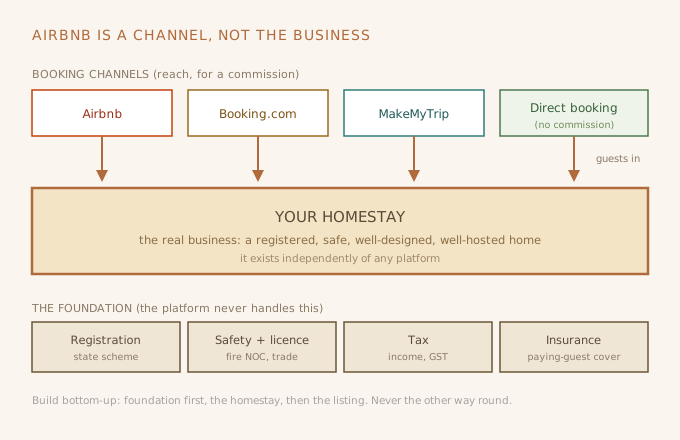
1. Decide and design the homestay — is it right for you, who is the guest, zone host from guest, make the room and bathroom good. (The design guide.)
2. Make it legal and safe — register under your state's homestay scheme, get the trade licence and any fire NOC, sort tax and insurance. (The registration guide and the Licence Finder.)
3. Then list it on Airbnb — and on any other channel you choose.
Everything below assumes you have done, or are doing, steps 1 and 2. If you only read one thing, read that.
Setting up the Airbnb listing itself
The platform part genuinely is straightforward. You create a free host account, add a new listing, and work through what Airbnb asks: property type (choose the homestay / private-room or whole-place option that matches reality), location, how many guests, bedrooms, beds and bathrooms, and your amenities. Then the three things that actually decide whether anyone books:
- The photos. This is 80% of the battle — see the next section.
- The title and description. Lead the title with the single most compelling, true thing (“Heritage room around a Kerala courtyard,” not “Nice room for rent”). Write the description for a traveller: the feeling, the space, the location and what is nearby, and who it suits — honestly.
- The price and calendar. Set a base nightly rate, open your calendar, and decide house rules, check-in method and a cancellation policy.
Airbnb will also verify your identity and, in many places, prompt you about local registration — which is your cue, not an afterthought.
Photos: where the booking is won
Guests scan a grid of thumbnails and decide in seconds, so your cover photo and first five images do almost all the work. You do not need a professional — a recent phone camera in good light beats a bad DSLR shot. The rules that matter: shoot in daylight with curtains open and lights on; tidy and style first (made bed, crisp linen, a few fresh touches, clutter gone); shoot straight and level from a corner at chest height to show the whole room; lead with the best room, then cover every space a guest uses — bedroom, bathroom, the view, the shared verandah or living area. Honest, bright, flattering photos that match reality earn bookings and good reviews; over-flattered ones earn a booking and then a one-star surprise.
Pricing, channels and the commission that bites
Airbnb is not free. It takes a commission on each booking (commonly in the mid-teens per cent once host and guest fees are counted), and so do the other platforms. That is the price of reach — and it is exactly why the channel mix is the single biggest lever on a homestay's profit. The smart play is to use the big platforms for discovery and visibility, while steadily building direct bookings (repeat guests, word of mouth, a WhatsApp number, a simple website) that pay no commission at all. Price with the commission in mind, not after it surprises you, and model the whole picture — occupancy, rate, channel mix — in the free Homestay ROI Calculator. For how to run pricing and channels well over time, the course's Getting Guests module goes deep.
The half Airbnb won't handle: legal, safe, taxed
This is the part the “how to set up an Airbnb” articles skip, and it is the part that protects your home and your peace of mind. Listing on a platform does not make you compliant. In India you still need:
- State homestay registration. Most states have a homestay / “paying guest house” scheme (commonly up to six owner-resident rooms; Rajasthan up to eight) — registering is how you are allowed to host, and it is usually cheap and friendly. Check yours with the Licence Finder.
- A municipal trade licence and, above a size threshold, a fire NOC. The local-body layer, which the platform knows nothing about.
- Safety and a guest register. Working smoke and gas alarms, an extinguisher, safe electrics, clear exits, and the guest-detail records many states require.
- Tax and insurance. Your hosting income is taxable; GST may apply above the threshold; and ordinary home insurance usually does not cover paying guests — you need the right cover. Talk to a CA and your insurer.
The full framework is in Homestay Registration & Licensing. Treat it as the foundation the Airbnb listing sits on.
Key takeaways
- “Setting up an Airbnb” in India = setting up a homestay and then listing it; Airbnb is a booking channel, not the business.
- Do it in order: design the homestay, make it legal and safe, then list — never the reverse.
- The listing is easy; the photos win the booking (bright, styled, honest, best room first).
- Airbnb takes a commission — use platforms for reach but build direct bookings to protect margin; model it in the ROI Calculator.
- Listing does not make you legal — you still need state registration, a trade licence, fire safety, tax and the right insurance. Confirm with the Licence Finder, your state and a CA.
References
- Airbnb Help Centre and responsible-hosting / local-registration pages — for the platform's own listing process, fees and host responsibilities; confirm current details on the platform.
- State homestay / paying-guest-house schemes (Kerala, Karnataka, Himachal Pradesh, Uttarakhand, Rajasthan, Goa and others) — authoritative for registration, room caps and fees; see the Licence Finder.
- Incredible India / Ministry of Tourism — for India's homestay and alternative-accommodation framework.
- A chartered accountant and your insurer — essential for the tax (income tax, GST) and insurance that short-term hosting requires.
Indicative and state-dependent. Studio Matrx is a not-for-profit guide; this is educational content, not legal, tax or platform advice, and is not affiliated with Airbnb or any booking platform. Confirm platform rules on the platform, licensing with your state tourism department and local body, and tax and insurance with a professional.
Export this guide
Related Guides — Deep-dive reading
Homestay Registration & Licensing in India: A State-by-State Guide (2026)
There is no single national homestay licence — there are three compliance layers and a different state policy for each. This guide explains the framework, compares the rules across the major homestay states, and points you to the right authority, so you register correctly and let the professionals confirm the binding detail.
HomestaysHow to Start a Homestay in India: A Complete 2026 Guide
Homestays are India's fastest-growing way to travel — and to earn from a spare room. This guide walks through the whole journey in plain language: deciding if it suits you, the three layers of registration and compliance, setting up the space, listing and pricing, and hosting well — with the legal specifics left to the right professionals.
HomestaysWhat a Homestay Really Earns in India (2026): Honest Economics
Rooms times rate is the easy, misleading way to size a homestay. This guide explains what actually decides profit — realistic occupancy, the booking-channel mix that quietly eats a fifth of your revenue, running costs and seasonality — and how to read break-even and margin before you build.
HomestaysRelated Tools — Try Free
Homestay Licence Finder
Pick your state for the homestay registration picture — room caps, residence rules and fees — plus the three compliance layers every host needs.
Licence FinderHomestay ROI Calculator
Model occupancy, rate, OTA commission vs direct bookings and running costs to see a homestay's real monthly profit, margin and payback.
Homestay ROIStamp Duty Calculator — All Indian States
Stamp duty + registration charges for all 28 states and 8 UTs — gender concessions, urban/rural variants, metro cess built in.
Stamp Duty