

Homestay Registration & Licensing in India: A State-by-State Guide (2026)
There is no single national homestay licence — there are three compliance layers and a different state policy for each. This guide explains the framework, compares the rules across the major homestay states, and points you to the right authority, so you register correctly and let the professionals confirm the binding detail.
The most common question a prospective host asks — "what licence do I need for a homestay?" — has no single answer, and that confuses almost everyone. India has no one national homestay licence. Instead there are three layers of compliance that apply almost everywhere, and on top of them a different homestay policy in every state, many of which were rewritten in 2025 and 2026 to raise room caps and move to single-window online approval. This guide untangles it: the universal framework first, then a state-by-state comparison, then the practical order to do things in. For a quick, interactive orientation to your own state, use the Homestay Licence Finder alongside this guide.
Scope and who should confirm this. This guide explains the registration framework in plain language. It is not legal or tax advice. Homestay rules are a state subject, are revised frequently, and the binding detail — current room caps, fees, documents and thresholds — sits with your state tourism department and local municipal body. Take GST and income-tax questions to a chartered accountant. Every figure here is indicative and was current at the last review; confirm before you act.
The three layers every host needs
Think of homestay compliance as a stack. You generally need all three, in roughly this order.
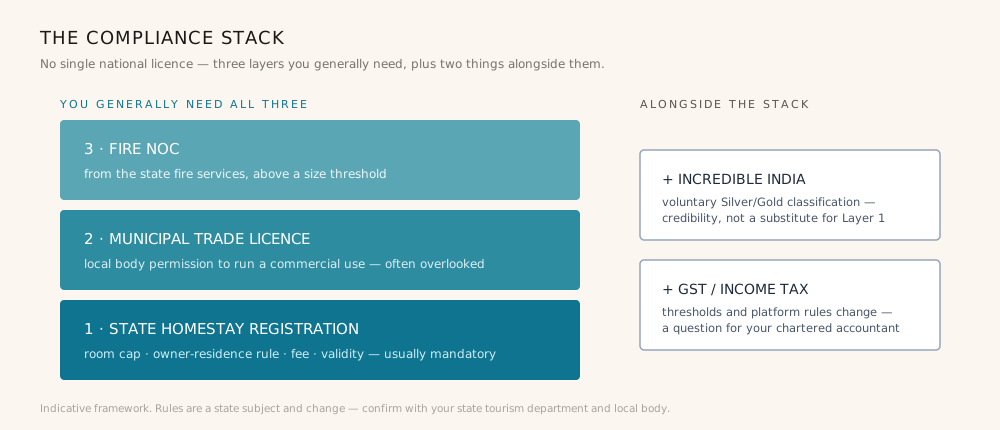
- Layer 1 — State homestay registration. The core approval under your state's homestay or bed-and-breakfast policy. It defines what a homestay is in that state, the room cap, the owner-residence rule and the fee. This is usually mandatory to operate legally and to list on many platforms.
- Layer 2 — Municipal trade licence. Local permission from your municipal corporation or panchayat to run a commercial activity from a residential premises. Most urban local bodies require it; rural requirements vary.
- Layer 3 — Fire NOC. A fire-safety no-objection certificate from the state fire services, required once your rooms or floors cross a threshold. Some state schemes (Goa's 2025 scheme, for instance) make it a mandatory document regardless.
Two things sit alongside the stack rather than inside it: the Incredible India classification (voluntary) and GST (a question for your CA). We cover both below.
Layer 1 in depth: state registration and the owner-residence rule
Layer 1 is where homestays differ most from a hotel, and it turns on one idea: a homestay is owner-occupied and small. In most states the owner or immediate family must live on the premises, and the number of lettable rooms is capped — commonly between one and eight. That residence requirement is not a formality; it is often the strict legal line that keeps a homestay lightly regulated, and letting a whole house with no resident host usually falls outside the scheme (and into hotel or rental territory, with heavier rules).
Registration typically asks for proof of ownership, identity, property-tax receipts, photographs, and — above the threshold — the fire NOC. Many states now run a single-window online portal with a fixed decision timeline; Rajasthan's 2026 scheme even grants temporary registration in about seven working days and treats an application as deemed registered if it is not decided in time. Validity is usually three to five years, then renewable.
The states at a glance
The table below compares the major homestay states. Treat every figure as indicative — several of these policies changed in 2025–2026, and your state portal is the only authoritative source.
| State | Lettable rooms (indicative) | Owner residence | Fee / validity (indicative) |
|---|---|---|---|
| Kerala | 1–6 rooms (up to 12 guests) | Owner/family resident | ≈ ₹1,000–5,000 · 3 years |
| Karnataka | 1–6 rooms (max 12 beds) | Owner/family resident | Nominal · confirm locally |
| Himachal Pradesh | Home-stay 1–3; Premier 4–9 | Owner-resident | ≈ ₹5,000–10,000 · rules revised 2025 |
| Uttarakhand | Up to 8 rooms (24 beds) | Permanent resident, on-site | ≈ ₹1,000 · 5 years (2026 rules) |
| Rajasthan | Up to 8 rooms (24 beds) | Owner-resident | Single-window · temp then 2-yr (2026) |
| Goa | 1–6 rooms (up to 12 beds) | Owner or caretaker | 5 years · Fire + Society NOC needed (2025) |
| Tamil Nadu | 1–3 rooms (6 beds) | Owner-resident | ≈ ₹3,000 (Silver)/₹5,000 (Gold) |
| West Bengal | 1–8 rooms (16 beds) | Owner-occupied, rural | Min room sizes apply (2026 policy) |
| Sikkim | Up to 5 rooms | Owner-resident | ≈ ₹500–2,000 · 3 years |
| Meghalaya & NE | Confirm on portal | Owner-resident | + mandatory tourist registration (2025) |
Use the Licence Finder to pull up any one of these with its notes, and always cross-check the live portal.
Layer 2: the municipal trade licence
Even with state registration, running a homestay is a commercial use of a residential property, and most urban local bodies require a trade licence for it. This is separate from the tourism registration, issued by your municipal corporation or panchayat, and renewed periodically. Requirements and fees vary widely by city, so confirm with your local body early — it is the layer most first-time hosts forget until a neighbour or an inspector raises it.
Layer 3: the fire NOC
Above a threshold of rooms or floors, a fire-safety no-objection certificate from the state fire services becomes mandatory. The threshold and the exact fire-safety provisions (extinguishers, exits, alarms, signage) depend on your state's fire rules and the size and height of your building. Because some state homestay schemes now ask for the fire NOC as a standard document, it is wise to plan fire safety into the design from the start rather than retrofit it — a point we make in the design guide.
The Incredible India classification (voluntary)
The Ministry of Tourism runs a national Incredible India Bed & Breakfast / Homestay classification — Silver and Gold tiers based on facilities. It is voluntary: it can lend credibility, appear in official listings and help with marketing, but it does not replace your state's mandatory registration. Treat it as a useful badge once you are properly registered, not as a substitute for Layer 1.
GST and tax — a question for your CA
Finally, the money. Small, owner-run homestays below the GST turnover threshold are typically outside GST, but the thresholds, and the treatment of bookings made through online platforms, change — and getting this wrong is expensive. This is precisely the kind of question to put to a chartered accountant rather than a checklist. Income tax on your homestay profit is separate and also applies. Budget for professional advice here; it is cheap insurance.
The practical sequence
Put together, the order is straightforward: confirm your state's policy (room cap, residence rule, documents) → apply for state registration on the portal → obtain the municipal trade licence → secure the fire NOC if you cross the threshold → consider the Incredible India classification → settle GST and tax with your CA → then list and host. Keep every approval on file; platforms and guests increasingly ask for them, and a complete paper trail is what separates a confident host from an anxious one.
Key takeaways
- There is no single national homestay licence — there are three layers (state registration, municipal trade licence, fire NOC) plus the voluntary Incredible India classification and a GST question.
- Layer 1 turns on the owner-residence rule and a room cap (commonly 1–8), which is what keeps a homestay lightly regulated versus a hotel.
- Rules are state-specific and were widely revised in 2025–2026; the state table here is indicative — your state tourism portal is authoritative.
- Don't forget Layer 2 (trade licence) and Layer 3 (fire NOC) — the two most commonly overlooked — and plan fire safety into the design.
- Take GST and income tax to a chartered accountant; the thresholds and platform rules change.
References
- Ministry of Tourism, Government of India — Incredible India Bed & Breakfast / Homestay Establishment scheme (voluntary classification); and the 2025 national roadmap to sustainable homestay tourism.
- State tourism department policies — e.g. Kerala, Karnataka, Himachal Pradesh (Home Stay Rules 2025), Uttarakhand (Registration Rules 2026), Rajasthan (Homestay/Paying Guest House Scheme 2026), Goa (Homestay & B&B Scheme 2025), Tamil Nadu, West Bengal (Homestay Policy 2026), Sikkim and the North-East states. Each is the authoritative source for its own rules, which change.
- Your municipal corporation / panchayat and state fire services — for the trade licence and fire-NOC requirements for your property.
- A chartered accountant — for GST applicability, thresholds, platform-booking treatment and income tax.
Indicative and state-dependent. Studio Matrx is a not-for-profit guide; this is educational content, not legal or tax advice. Confirm every requirement with your state tourism department, municipal body and a chartered accountant before you register or operate.
Export this guide
Related Guides — Deep-dive reading
Fire NOC Process in India (2026): Getting the Fire No-Objection Certificate
A plain-language guide for homeowners, builders and resident welfare associations to what a Fire NOC is, why buildings need one, and how the clearance from the state fire service generally works, from the design-stage no-objection to the final certificate and periodic renewal, framed as process navigation rather than a rulebook.
SecurityState-Wise STP Approval Process Comparison: How Consent Rules Differ Across India
Every Indian state runs the same national CTE/CTO consent framework under the Water Act — but the board names, portals, thresholds and effluent limits change as you cross state lines. Here is how the STP approval process actually compares, state by state, and how to find the rule that binds your project.
Sewage Treatment PlantsHome Loan Documents Checklist (India): The Complete List (2026)
Every home loan documents category explained in plain language - KYC, income proof (very different for salaried and self-employed), property papers and the loan forms - so you can assemble a clean file before you apply and avoid the back-and-forth that delays sanction.
Home FinanceRelated Tools — Try Free
Homestay Licence Finder
Pick your state for the homestay registration picture — room caps, residence rules and fees — plus the three compliance layers every host needs.
Licence FinderCross-Ventilation Analyzer
Estimate airflow and air changes per hour (ACH) from room size, window areas, layout, and local wind — with NBC 2016 Part 8 compliance check.
Ventilation CalculatorStamp Duty Calculator — All Indian States
Stamp duty + registration charges for all 28 states and 8 UTs — gender concessions, urban/rural variants, metro cess built in.
Stamp Duty