
Security for Specific Users: Tailoring Home Security to Who Lives There
A standard security setup optimised for a fit adult can fail, exclude or even endanger the actual people in the home. This is the pillar for tailoring security to who lives there — seniors, children, people with disabilities, people living alone, domestic staff, tenants, landlords, and empty homes — grounded in dignity, life-safety and lawful privacy.
Most security advice quietly assumes one kind of person: a fit adult who can reach a keypad on the wall, read a small screen, cross a room quickly in the dark, remember a PIN, and answer their own door. Buy for that person and you get a system that works beautifully — for someone who may not live in the house at all.
The mother alone in the flat while her children work abroad cannot reach the panel by the ceiling and will not touch an app she finds frightening. The child can open the grille onto the balcony that was meant to protect them. The wheelchair user cannot get to the intercom mounted at standing height. The person living alone needs the house to look occupied and needs one button that actually brings help. The domestic worker who has served a family for fifteen years is treated like a suspect by a camera pointed at where they eat. The tenant and the landlord argue over a camera in the shared stair. The holiday home sits empty and announced to the whole internet.
None of these are edge cases. They are simply who lives in Indian homes. This pillar is the map to the part of the Studio Matrx security library that starts from a different question — not "what kit is best?" but "who is this home for, and what do they actually need?" Everything below plans, chooses and coordinates; it never designs, wires or self-monitors life-safety systems, and it never turns security into surveillance of the very people it is meant to protect.
Scope & safety. This guide helps you understand, assess and specify — not install. Three commitments run through every choice. Dignity and rights: security here is FOR the people in the home, never against them; carers, staff, tenants, children and elders have privacy and are not suspects. Life-safety and accessibility: systems must be reachable, usable and reliable, must reach help fast, and must never trap anyone — fail-safe egress always wins (RPwD Act 2016 and NBC accessibility apply). Lawful boundaries: cameras on people capture sensitive personal data — the DPDP Act 2023 requires consent, notice and minimisation, no cameras belong in private spaces, and verified guards or agencies fall under PSARA 2005. Engage the right professional: a licensed installer for wiring and access control, your doctor for anything medical-alert, and a lawyer for tenancy. Verify any standard's current status via the BIS catalogue.
The core idea: fit the household, not the catalogue
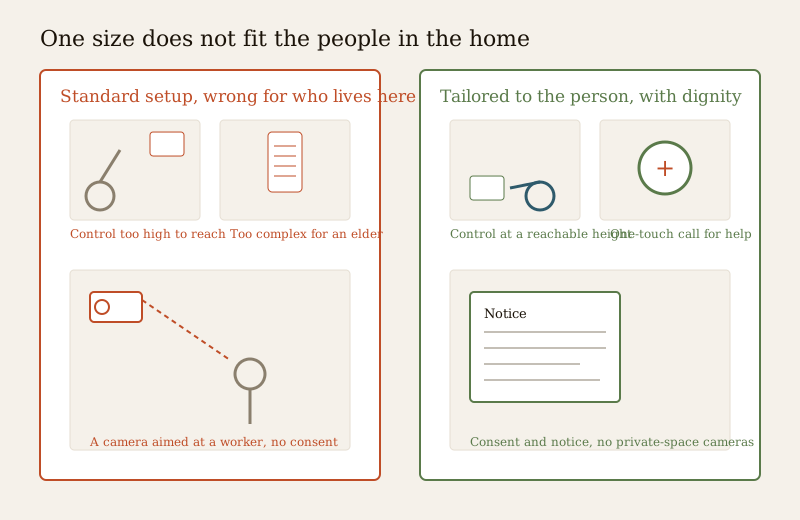
A security system is not a product you own; it is a set of behaviours the household has to perform, every day, on its worst day as well as its best. If the person who has to perform them cannot reach the control, cannot understand the app, cannot cross the room in time, or resents being watched, the system does not work — no matter how good the hardware is. It gets switched off, worked around, or quietly ignored, and the home is less safe than if you had done nothing and simply locked the door.
So the design brief for a tailored home is not "more" — it is fit. Fit means the control is where the person can reach it. Fit means help is one touch away for the person most likely to need it. Fit means the sensor does not scream every time the dog walks past, because the household will disarm a system that cries wolf. Fit means a worker or a tenant is protected and respected, not policed, because a home built on suspicion corrodes the trust it depends on. A tailored system is usually simpler than the generic one — it just points its simplicity at the right person.
This is the thread that connects the whole ultimate home security guide to the specific-user library: strategy first, then people, then kit. Start with a risk assessment; then read the household.
The four lenses of this library
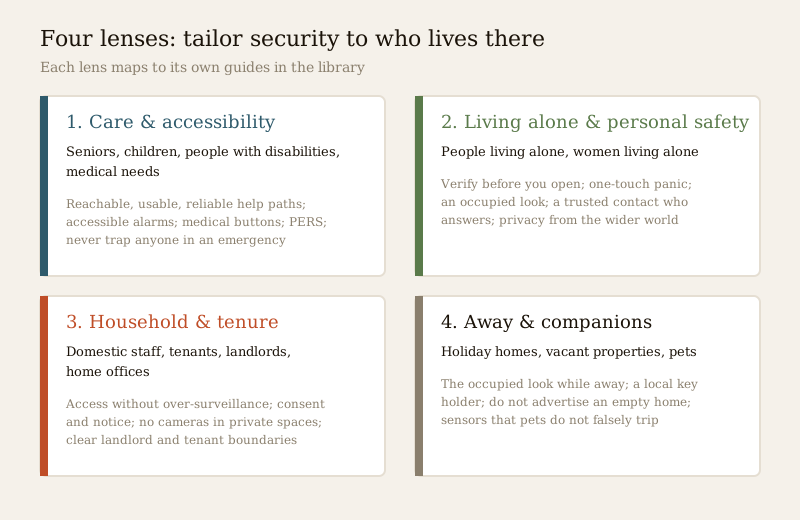
The specific-user guides group into four lenses. Find the one — or two, or three — that describe your home, and follow the spokes.
Lens 1 — Care & accessibility
For people whose safety depends on the system being reachable, usable and reliable: seniors, children, people with disabilities, and anyone with a medical need. Here security merges with care. The controls must sit at a height and complexity the person can use; the signals must be seen and heard (not sound alone, not light alone); help must arrive fast; and nothing may ever trap the person in an emergency.
| You are planning for | Start here | Then bring in |
|---|---|---|
| An elderly parent, alone or with family | Security for senior-citizen homes | Personal emergency response systems, medical emergency buttons |
| A home with young children | Children's home-safety guide | Child-safe window design, emergency escape windows |
| A person with a disability | Security for people with disabilities | Accessible alarm systems, accessible doors |
| A senior-friendly, accessible home layout | Accessible home design | Lift planning for senior-friendly homes, emergency door release |
The non-negotiable in this lens is fail-safe egress. A grille, gate or electric lock that keeps an intruder out must still let the person inside get out without a key in a fire — see fire-egress compatibility. Alarms and alerts must be perceivable by the person who lives there, which is exactly what accessible alarm systems covers.
Lens 2 — Living alone & personal safety
For the person whose safety rests, quietly, on the home looking occupied and on help being one touch away. Someone living alone has no second pair of eyes and no one to raise the alarm — so the system carries more weight, and the door becomes the decisive point.
| You are planning for | Start here | Then bring in |
|---|---|---|
| Anyone living alone | Security for people living alone | Panic buttons, occupancy simulation |
| A woman living alone | Security for women living alone | Visitor access management, video door phone privacy |
The pattern here is verify before you open, look occupied, and be able to summon help fast — a video door phone to see the caller, an occupied look while out, and a panic button or trusted contact who answers. Privacy from the wider world matters too: how much of your routine your devices reveal is itself a safety question, covered in smart-security privacy.
Lens 3 — Household & tenure
For homes where other people have a legitimate, everyday relationship to the property — they work in it, rent it, own it, or run a business from it. This lens is where the dignity and lawful-boundaries principles do the most work, because it is where security most easily curdles into surveillance and disputes.
| You are planning for | Start here | Then bring in |
|---|---|---|
| A home with domestic staff | Security for domestic staff | Visitor access management, CCTV privacy masking |
| A tenant securing a rented home | Security for tenants | Smart locks, security & privacy assessment |
| A landlord protecting a let property | Security for landlords | Access-control audit trails, gated-community security |
| A home office or work-from-home setup | Security for home offices | Home-office door, apartment home-office design |
The rule across this lens: access without over-surveillance. A worker needs to be let in and trusted, not filmed where they rest or eat; a tenant has a private home, and a landlord may not watch inside it; a home office needs a lockable, separable zone, not a camera on the family. Cameras on people are sensitive personal data — consent, notice, minimisation and no-camera-in-private-spaces are the law under the DPDP Act 2023, and CCTV privacy masking exists to keep lenses off the spaces they should never see.
Lens 4 — Away & companions
For the home that has to protect itself when the people are absent, and for the non-human members of the household who trip ordinary sensors.
| You are planning for | Start here | Then bring in |
|---|---|---|
| A holiday or second home | Security for holiday homes | Occupancy simulation, remote security monitoring |
| A home left vacant for a long stretch | Security for vacant properties | Alarm monitoring services, geofencing home security |
| A home with pets | Security for pets | Pet-friendly motion sensors, motion sensors |
The pattern here is the occupied look, a local human, and sensors that do not lie. An empty home should not be advertised empty — least of all on social media — and it needs a trusted local key-holder and, ideally, monitoring that someone will act on (smart-security notifications and remote monitoring). Pets need pet-immune sensors so the alarm stays armed instead of being disabled after the tenth false trip.
The three principles over everything
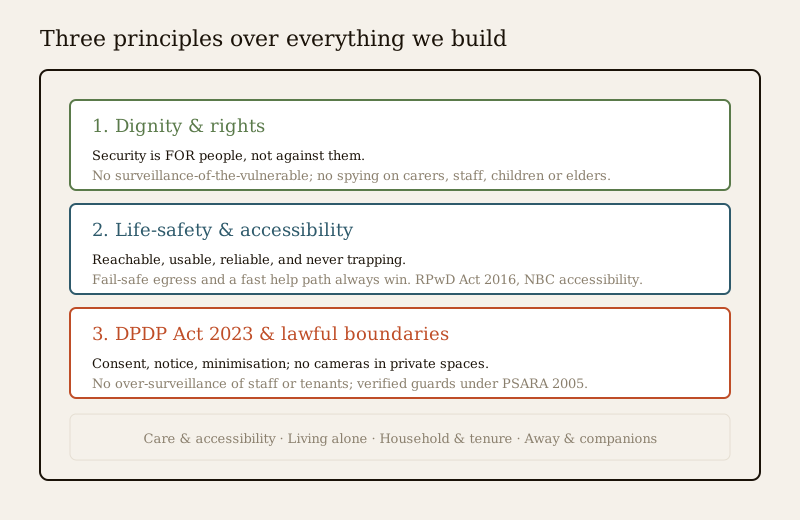
The four lenses tell you where to look. Three principles tell you how to decide — and they override any product feature or convenience. State them out loud before you buy anything.
| Principle | What it means | What it forbids |
|---|---|---|
| Dignity & rights | Security is FOR the people in the home. It protects and empowers them. | Surveillance-of-the-vulnerable; spying on carers, staff, children or elders; treating a trusted worker or tenant as a suspect. |
| Life-safety & accessibility | Reachable, usable, reliable, fast to summon help — and never trapping. Fail-safe egress always wins. | Controls the person cannot reach or use; alerts they cannot perceive; a lock or grille that could trap someone in a fire. |
| DPDP Act 2023 & lawful boundaries | Consent, notice, minimisation; cameras only where lawful; verified guards under PSARA 2005. | Cameras in bedrooms, bathrooms, staff rooms or a tenant's private space; over-surveillance of staff or tenants; covert recording. |
Dignity and rights comes first because it is the one most often forgotten. A camera pointed at where a domestic worker sleeps, a hidden camera in a rented flat, a listening device on an elderly parent "for their own good" — these are not security, they are harm, and this library refuses them. The test is simple: would you accept this being done to you, and have you asked?
Life-safety and accessibility is the principle that keeps the system honest under stress. It is easy to build a home that is hard to break into and just as hard to escape. For seniors, children and people with disabilities especially, every barrier must be openable from inside, every alert must reach the person, and every help path must actually work at 2 a.m. during a power cut. The RPwD Act 2016 frames accessibility as a right; the NBC frames egress as life-safety. Both apply to security kit.
DPDP Act 2023 and lawful boundaries is the principle that keeps you on the right side of the law and of your household's trust. Video and audio of identifiable people are personal — often sensitive — data. Collect the minimum, tell people it is happening, put nothing in a private space, and never use a camera to control a worker or tenant rather than to protect the property. When you engage guards or an agency, use a PSARA-verified, police-verified one. Read smart-security privacy and run a privacy assessment before you install.
How to assess your own household
You do not need every guide in the library — you need the two or three that match the people in your home. Work through this once, honestly, before you spend anything.
1. List who lives here — and who comes here. Not a headcount: an age-and-ability-and-relationship list. A parent of 78 who forgets PINs. A toddler who climbs. A partner who uses a wheelchair. A cook who comes daily. A tenant on the ground floor. A dog. Each name is a design constraint.
2. For each person, ask what they need from the system, and what could exclude or endanger them. Can they reach the control? Perceive the alert? Escape without a key? Would a camera on them be protection, or intrusion? This is the heart of it.
3. Note the absences and the strangers. When is the home empty, and for how long? Who legitimately needs access when you are not there — staff, a key-holder, a landlord? Absence and access are their own risks.
4. Read the two or three matching spokes and take one action each. Reachable control, one-touch help, an occupied look, a privacy-masked camera, a fail-safe grille. Small, correct changes beat a big generic install.
5. Score it and check the privacy line. Run the home-security risk scorecard and the security & privacy assessment — the second exists specifically to catch the over-surveillance mistake before it is wired in.
The output is a short, humane brief: this is who lives here, this is what each of them needs, this is where their dignity and safety must not be crossed. Hand that brief to your installer — it is worth more than any product spec.
Who to involve, and when
Tailored security is a coordination job, not a shopping trip. Know which decisions are yours and which belong to a professional.
- A licensed installer for cameras, alarms, electric locks and access control — anything wired or life-safety-adjacent. You set the humane brief; they make it safe, code-compliant and reliable. A badly fitted electric lock can trap someone in a fire; insist on a manual override and fire-egress compatibility.
- Your doctor or a monitored medical-alert provider for anything medical: fall detection, personal emergency response systems, medical emergency buttons. This is health and life-safety — use an established, monitored service with people who answer, and involve the family physician.
- A lawyer or your society's bye-laws for tenancy and shared-space questions — what a landlord may and may not install, what a tenant may fit and must restore, and where cameras are lawful in common areas. See security for landlords and security for tenants, and check your state's tenancy framing and your housing-society rules.
- A verified, PSARA-licensed guard or agency if the plan involves human guarding — police-verified people, a licensed agency, and a clear brief that respects residents, staff and visitors alike.
For the wider systems context, keep the building security systems guide and the complete smart-home security guide at hand — this pillar tells you who to build for; those tell you what the building blocks are.
Key takeaways
- Fit beats more. A system the actual resident can reach, understand, escape and consent to protects the home; a generic fortress they resent gets switched off.
- Four lenses map the library. Care & accessibility; living alone & personal safety; household & tenure; away & companions. Find yours and follow the spokes.
- Three principles override every feature. Dignity and rights; life-safety and accessibility; DPDP Act 2023 and lawful boundaries. State them before you buy.
- Security is FOR people, never against them. No surveillance-of-the-vulnerable, no cameras in private spaces, no policing of workers, tenants, carers or children.
- Fail-safe egress always wins. For seniors, children and people with disabilities especially, nothing may trap the person or fail when help is needed.
- Assess before you spend. List who lives and comes here, read the two or three matching guides, take one correct action each, and check the privacy line.
- Coordinate the right professionals — installer for kit, doctor for medical alert, lawyer for tenancy, PSARA-verified guards for human guarding.
Where to go next
- Pick your lens: seniors, children, people with disabilities, living alone, women living alone, domestic staff, tenants, landlords, home offices, holiday homes, vacant properties, pets.
- Browse the sub-hub: Security for specific users, and the cross-hubs for smart-home security and doors & openings.
- The whole picture: The Ultimate Guide to Home Security in India and the building security systems guide.
- Assess and protect privacy: the home-security risk scorecard, the site & perimeter security assessment, and the security & privacy assessment.
References
- Digital Personal Data Protection Act, 2023 (DPDP Act) — consent, notice, purpose limitation and data minimisation for personal data, including CCTV and audio of identifiable people; verify the current rules and their commencement.
- Rights of Persons with Disabilities Act, 2016 (RPwD Act) — accessibility as a right; relevant to reachable, perceivable and usable security controls and alerts.
- National Building Code of India (SP 7), Bureau of Indian Standards — fire, egress and accessibility provisions relevant to escape-openable grilles, alarms and help paths; verify the current edition via the BIS catalogue.
- Private Security Agencies (Regulation) Act, 2005 (PSARA) — licensing and verification of private security agencies and guards.
- State tenancy and rent-control framings, and municipal and housing-society bye-laws — govern cameras in shared spaces, landlord and tenant rights, and registration of domestic help; check your city, state and society rules.
- Your family doctor, an established monitored personal-emergency-response provider, a licensed security installer and a lawyer for tenancy — for the design, installation, monitoring and legal boundaries this pillar only frames.
This is an educational overview for planning and decision-making — not legal, medical or engineering advice. Medical-alert and fall detection, fire and gas alarms, electronic access control, electric locks and mains electrical work are qualified professional or monitored-service work; engage licensed professionals and established providers for design, installation, monitoring and certification, and verify any standard's or law's current status before relying on it.
Export this guide
Related Guides — Deep-dive reading
Security Guide for Senior-Citizen Homes
How to protect elderly people living independently or with family in India without stripping away their dignity or independence — verifying who is at the door, simple one-touch systems, the overlap of security with fall and medical emergencies, respectful remote reassurance for family, and honest vetting of caregivers and help.
SecuritySecurity for People Living Alone in India (2026): Calm, Practical Habits When There Is No Second Person to Notice
Living alone is an ordinary and growing part of Indian life - the student in a new city, the working single, the elder whose children are abroad, the person after a separation. It does not call for fear. It calls for a few deliberate habits, because there is no second person in the home to notice trouble, raise the alarm, or catch an accident. This is calm self-reliance, layer by layer.
SecuritySecurity for People with Disabilities
How to design home security that works for and empowers a person with a disability in India — reachable, usable controls; multi-sensory alerts that everyone can perceive; a reliable path to summon help; and accessible escape that is never traded away for a lock. Tailored by disability type, with dignity, autonomy and the RPwD Act 2016 at the centre.
SecurityRelated Tools — Try Free
Home Security Risk Scorecard
Score your home across six security layers — perimeter, entry points, lighting, detection, alarm and habits — and get a prioritised action plan.
Security ScorecardChild & Elder Home-Safety Audit
Room-by-room safety audit for households with children or seniors — 10 categories, 70+ checkpoints tagged by audience.
Safety AuditApartment Video Door System Planner
Enter flats, entrances, floors and guard desk for a first-pass building intercom plan — door stations, indoor monitors, guard station, the right architecture and an indicative cost band.
Building Planner