
Remote Security Monitoring in India (2026): Watching and Responding From Anywhere
Watching your home from your phone is easy; making an alert lead to a real response is the hard part. The two honest models compared — self-monitoring by you and your family versus a paid professional monitoring centre — plus the secure tech behind remote access, the privacy stakes of a stranger watching inside your home, and why remote monitoring is only ever as good as the responder behind it.
You are in a meeting three cities away when your phone buzzes: motion at the back gate, 2:14 p.m. You glance, see a courier, and put the phone down. That small moment is remote security monitoring working exactly as it should. But rewind to 2:14 a.m., phone on silent, you fast asleep, family abroad in another timezone — the same alert fires into an empty room. Nobody sees it. Nobody acts. The camera did its job perfectly and it made no difference at all.
That gap is the whole subject of this guide. Being able to watch your home from anywhere is the easy, cheap, satisfying part — almost every modern camera, smart hub and alarm app offers it. The hard part, the part that actually protects a house, is the response: who is watching, and what happens when they see something. This guide sets out the two honest models for that — doing it yourself and your family (self-monitoring), or paying a manned centre to do it (professional monitoring) — the secure technology that makes remote viewing possible without opening your home to strangers, and the limits nobody selling a camera wants to dwell on. It is part of the Studio Matrx smart home security section and a companion to the pillar, the complete guide to smart home security.
Scope & safety. Remote monitoring is convenience, not a guarantee. A live feed you can see from anywhere is only as good as the person able to act on it — an alert nobody sees is theatre. It also depends entirely on internet and power, both of which fail routinely in India, so plan for graceful degradation with a local recording and a non-smart fallback. Anything you can watch, someone else potentially can too: treat who may view your home feed as a first-class privacy question under the Digital Personal Data Protection Act, 2023, especially for indoor cameras. This is not a substitute for certified life-safety — a smart fire or emergency notification is an add-on, never a replacement for a proper alarm system — and mains, fire and lift work belong to licensed professionals. This is educational guidance, not legal advice.
The two models, honestly
Strip the marketing away and there are only two ways your home gets watched when you are not standing in it.
Self-monitoring means you and your family are the monitor. The camera or alarm sends an alert to your phones, and one of you looks, decides, and — if it is real — does something. It is free (beyond the device and any storage), private (nobody outside the household sees your home), and it is the overwhelming Indian norm. Its single, decisive weakness: it only works if a human actually sees the alert and acts on it in time. No family watches a phone 24x7. People sleep, drive, sit in meetings on silent, travel abroad, or simply stop looking after the hundredth false ping.
Professional (third-party) monitoring means a manned monitoring centre watches your system 24x7 and follows an agreed plan when something trips — verifying the event, calling you and your keyholders, and escalating to a guard, response team or the police helpline. It adds the one thing self-monitoring cannot: a guaranteed pair of eyes and a defined response, at all hours, whether or not you are awake or reachable. Its costs are equally honest: it is a paid subscription, its India availability is limited (largely metros and a handful of providers), and it carries its own reliability caveats — it is only as good as its uptime, its verification, and the response actually available on the ground.
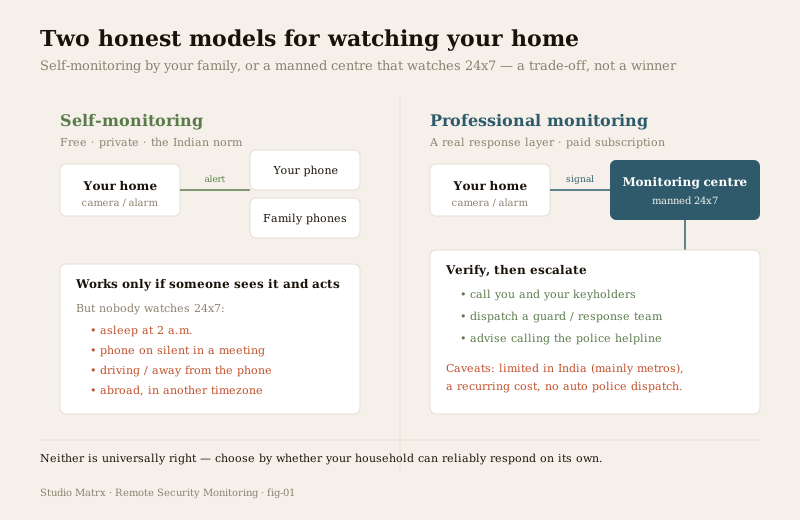
Neither is "better" in the abstract. They answer different questions: can my household reliably respond on its own, versus do I need a human in the loop when we cannot. Most Indian homes start — and stay — self-monitored, and for many that is genuinely the right call. The point is to choose it knowingly, not by default.
| Self-monitoring | Professional monitoring | |
|---|---|---|
| Who watches | You and your family, via the app | A manned central station, 24x7 |
| Cost | Free beyond devices and storage | Paid subscription |
| Privacy | Stays within the household | A third party can view feeds or signals |
| Coverage | Only when someone is awake and looking | Continuous, whoever is asleep or away |
| Response | Whatever you can arrange yourself | A defined, contracted escalation plan |
| India availability | Everywhere | Limited, mainly metros and some providers |
| Best when | Someone can reliably respond | Nobody in the household reliably can |
Self-monitoring: free, private, and the default — with one catch
For most people, self-monitoring is what "remote monitoring" already means: the smart CCTV app, the doorbell chime on the phone, the alarm that messages the family group. It costs nothing extra, keeps every frame of your home inside the household, and puts you in full control. When someone is home, awake, or simply near their phone, it is fast and effective — you see the courier, the maid, the unexpected car, and you act.
The catch is not the technology; it is human availability. A phone on silent in a cinema, a deep sleep at 3 a.m., a work call, a flight, a relative overseas eight hours behind — in every one of these the alert lands and no one acts. Self-monitoring quietly assumes a responder who is, in reality, unavailable a large fraction of the time. Be honest with yourself about when your household truly cannot respond, because those are precisely the hours a break-in prefers.
Two things make self-monitoring materially better. First, share the load: put more than one family member on the alerts so a single silenced phone is not a single point of failure. Second, agree a responder plan in advance — decide now who calls whom, which neighbour has a key, which guard or society number to ring — so a 2 a.m. alert meets a decision, not panic. That plan is the real subject of the next sections.
Professional / third-party monitoring: a real response layer, at a price
When your household genuinely cannot be the responder — a frequently empty home, a shop after hours, elderly parents living alone, a second house in another city — a professional service fills the gap that self-monitoring cannot. A central monitoring station watches your alarm and camera signals around the clock, and when one trips it verifies (a call to you, sometimes a look at a linked camera), then works an agreed escalation: keep calling your keyholders, dispatch a contracted guard or response team, advise you to call the helpline. This is the genuine response layer, and its full mechanics — how the chain works and the honest India caveats — are set out in alarm monitoring services. For camera-centric watching, the manned-desk model is covered in CCTV control room monitoring, and the realistic limits of getting the police to a verified alert in police response integration.
Two honest caveats before you subscribe. First, availability and reliability vary: professional monitoring in India is concentrated in metros and among a limited set of providers, and the service is only as good as its own uptime, its verification discipline, and — crucially — whether a response is genuinely available near your home. There is no nationwide automatic verified-alarm-to-police dispatch scheme as in some countries; "police response" realistically means a person verifies and then calls the helpline. Second, it costs a recurring subscription, and a lapsed payment silently removes the very layer you were relying on. Read what is actually contracted — verification, response, response times — not the brochure.
The technology that makes remote monitoring possible — done securely
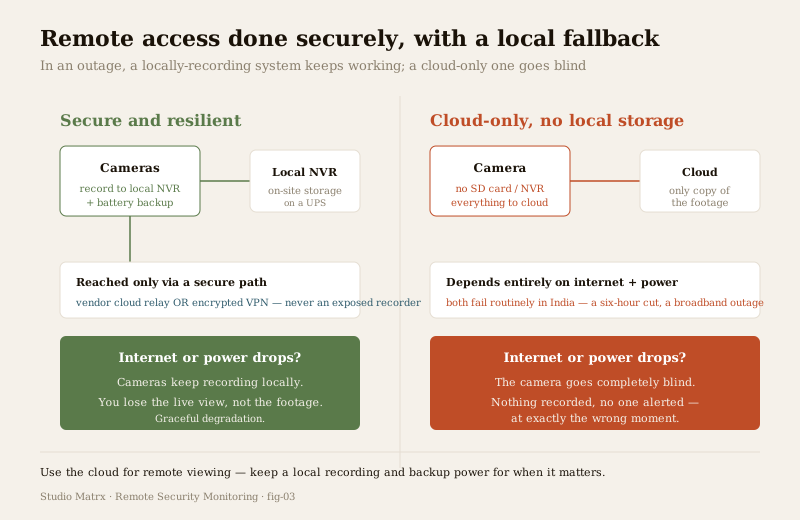
Both models rest on the same plumbing: secure remote access to your cameras and your hub or NVR from outside the home. This is what lets you — or a monitoring centre — see a live feed and receive events from anywhere. Done well it is safe and unremarkable. Done carelessly it is how a private camera ends up watched by strangers, because a recorder left on its factory password and pushed straight onto the open internet is a well-known, trivially found target.
The rule is simple: never expose your recorder or hub directly to the internet. Reach it through the vendor's secure cloud relay or an encrypted VPN back to your home network instead — and harden the basics: change every default password to a strong, unique one, turn on two-factor login, and keep firmware current. The full defensive setup is laid out in CCTV remote access security, and the wider device-hardening discipline in smart security cybersecurity. Treat this as non-negotiable: remote monitoring you can reach easily is, by definition, remote monitoring someone else might reach too if you leave the door open.
The response is everything
Here is the sentence to keep: remote monitoring is only as good as the response behind it. A perfect 4K feed, an instant push notification, an AI that labels "person at gate" — all of it is worthless if no one acts. An alert with nobody to respond is not security; it is theatre. So before you buy another camera, answer one question honestly: who is my responder?
There are only a handful of real answers, and each has a plainly different reach:
- You — fast when you are awake, near your phone, and close enough to do something; absent when asleep, silenced, driving, or abroad.
- A family member — widens coverage if they are on the alerts and can act, but shares all the same human gaps.
- A neighbour or relative with a key — the classic Indian first responder, invaluable for a real look-in, but a favour, not a duty, and not always home.
- A society guard or the RWA — often the nearest body who can physically reach the gate quickly, if your alert reaches them and they are briefed to act.
- A professional service — the only responder contracted to answer 24x7, at a subscription cost and where available.
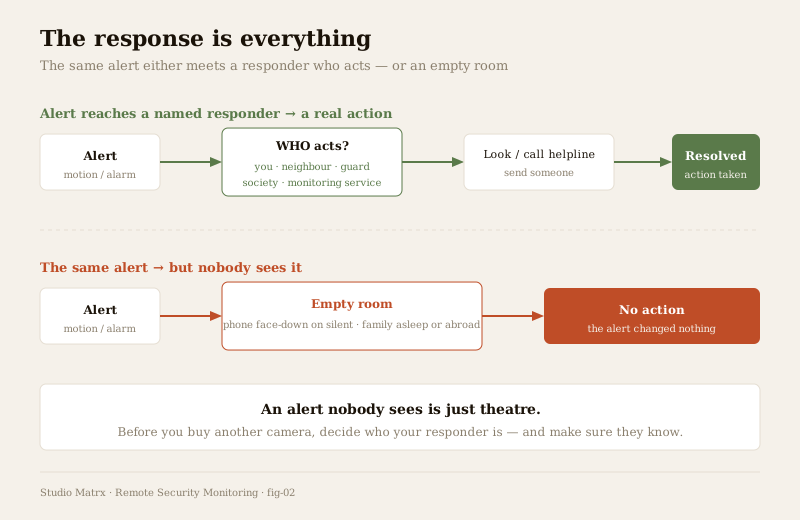
Write your responder chain down, in order, and make sure each link actually knows they are on it. A camera does not respond; a person does.
When the internet or power dies
Remote monitoring depends on two things India cannot always supply: internet and power. A cloud-only camera in a six-hour load-shed or a broadband outage is not degraded — it is blind, recording nothing and alerting no one, at exactly the moment an intruder might exploit the darkness. This is not a fault to fear so much as a design constraint to plan around.
Graceful degradation means the system loses convenience in an outage, never its core job. Three moves deliver it:
- Keep a local recording. A camera or NVR that writes to on-site storage — an SD card or a hard disk — still captures the event even with the internet down. The cloud is for remote viewing; local storage is for never losing the footage.
- Back the power. A modest UPS or inverter on the router, hub and recorder keeps them alive through a typical cut. Battery-powered cameras ride out a mains failure by design.
- Keep a non-smart fallback for what matters. A locally sounding siren that does not need the cloud to make noise, a physical lock alongside the smart one, a guard who can be phoned directly — so the loss of connectivity never leaves you with nothing.
Design so that the worst an outage costs you is the live view, not the whole system.
Alert fatigue: prioritise, or drown
The failure that quietly kills self-monitoring is not a missed alert — it is too many. A camera that pings fifty times a day for wind-blown leaves, passing cats, headlights and the maid arriving trains you, within a week, to swipe every notification away unread. When the one that matters finally arrives, it looks exactly like the ninety-nine that did not, and you dismiss it by reflex.
The fix is ruthless prioritisation: tune motion zones and sensitivity, prefer AI person and vehicle detection over raw motion, and split alerts into tiers so a door forced at night screams while a daytime delivery stays silent or merely logged. Getting notifications right is a subject in itself — the discipline is covered in smart security notifications. A monitoring service, notably, absorbs this problem on your behalf: its trained operators, not you, sift the noise. Fewer, truer alerts are what keep a human responder responsive.
The society and RWA angle
In apartments and gated communities, remote monitoring is often shared. The society's CCTV control room and manned guards act as a collective monitoring layer for the common areas — gates, lobbies, parking, perimeter — and for many residents that guard-plus-camera arrangement is the nearest thing to 24x7 professional monitoring they will have, at a cost split across the whole community. It is a genuine strength: the guard at the gate can physically reach an incident faster than any remote service.
But be clear about the boundary. The society watches the common areas, not the inside of your flat; its footage answers to the RWA's policies and to the DPDP Act; and its effectiveness depends on guards who are trained, alert and actually briefed to respond rather than merely present. How to make that shared layer work — control-room discipline, guard protocols, resident coordination — is the subject of security for gated communities. Your own in-flat monitoring sits on top of the society's, not instead of it.
The privacy dimension: who can watch inside your home
Remote monitoring's great convenience is also its sharpest risk: anything you can watch from anywhere, someone else might too. A feed reachable from your phone is a feed that a weak password, a breached vendor cloud, or an over-broad family login can expose. And a third party watching inside your home — whether a monitoring operator or an unknown intruder on an insecure camera — is a genuinely significant intrusion, not a footnote.
Handle it with discipline. Keep indoor cameras to the minimum you truly need, point them away from private spaces, and prefer local recording or privacy masking over always-on cloud for interiors. Control who can log in: each family member on their own account, no shared passwords, two-factor on, and immediate removal of anyone who leaves the household or a departed help. If you use a professional service, ask plainly who can view your feeds, when, and where the footage is stored — under the DPDP Act 2023, footage of identifiable people is personal data and you are responsible for it. The deeper treatment of consent, indoor-camera etiquette and data handling is in smart security privacy. Convenience should never quietly hand a view of your living room to someone you never chose.
Choosing self versus professional
There is no universal answer — only a match between how reliably your household can respond, your budget, and who is available near the home. Work the table honestly, from your real situation rather than the one you wish you had.
| Your situation | Lean towards | Because |
|---|---|---|
| Someone is usually home and phone-attentive | Self-monitoring | You are already a fast, free, private responder |
| Home often empty; nobody can reliably act | Professional monitoring | You need a contracted 24x7 responder |
| Tight budget, willing to build a responder chain | Self + neighbour / society | A briefed neighbour or guard costs nothing recurring |
| Elderly parents or a second home in another city | Professional monitoring | Distance removes you as a responder |
| A shop or office after hours | Professional or society-linked | A manned centre or guard covers unoccupied hours |
| Live in a gated community | Self, on top of the society layer | The RWA guard and control room already cover common areas |
| Privacy is your top concern | Self-monitoring, local-first | No outside party sees your feeds |
Run your overall exposure through the home security risk scorecard before deciding — it will surface the hours and gaps where you have no responder, which is exactly the question this choice turns on.
Key takeaways
- Remote monitoring is only as good as the response behind it. An alert nobody sees or acts on is theatre — decide who your responder is before you buy another camera.
- Two honest models. Self-monitoring is free, private and the Indian default, but works only when a human is awake, reachable and willing to act. Professional monitoring adds a 24x7 manned response at a subscription cost, with limited India availability and its own reliability caveats.
- Secure the tech. Reach cameras and the hub only through a vendor cloud relay or a VPN, never an exposed recorder; change defaults, enable 2FA, keep firmware current.
- Plan for outages. Internet and power fail in India — keep a local recording, back the power, and hold a non-smart fallback so an outage costs you the live view, not the whole system.
- Beat alert fatigue. Fifty false pings a day train you to ignore the real one; prioritise with AI detection and tiered alerts.
- Guard privacy. Anyone able to view your home feed is a serious matter — minimise indoor cameras, control who logs in, and know where footage is stored under the DPDP Act.
Where to go next
- The pillar: Complete Guide to Smart Home Security and the smart home security section.
- The response layer: Alarm Monitoring Services, CCTV Control Room Monitoring and Police Response Integration.
- The secure tech behind it: CCTV Remote Access Security, Smart Security Hubs and Smart Security Cybersecurity.
- Getting alerts right and keeping it private: Smart Security Notifications and Smart Security Privacy.
- The community layer: Security for Gated Communities. Sharper cameras: Smart CCTV and AI-Powered CCTV.
- Assess your exposure: Home Security Risk Scorecard, or browse all security guides.
References
- Digital Personal Data Protection Act, 2023 (India) — governs personal data, including any home footage, feeds or logs viewed remotely or processed on a cloud or monitoring service; verify current obligations for the provider you choose.
- Matter, Thread, Zigbee, Z-Wave and Wi-Fi — smart-home connectivity standards underlying remote access; describe device behaviour in outline and verify current versions and real device certification before relying on any specific claim.
- National Building Code of India (SP 7), Bureau of Indian Standards — fire and life-safety provisions relevant to any integrated smart emergency notification; verify the current edition via the BIS catalogue, and treat certified fire and egress systems as licensed professional work.
This is an educational overview for planning and decision-making. Remote security monitoring is a convenience and awareness layer, never a substitute for a hardened physical base, a real human responder, or certified life-safety systems. Mains electrical work, integrated fire and lift systems, and electronic access control are qualified professional work — engage licensed professionals for design, installation and certification, and verify any standard's current status via the BIS catalogue before relying on it.
Export this guide
Related Guides — Deep-dive reading
Smart Security Notifications in India (2026): Beating Alert Fatigue by Designing the Alert Layer
The single biggest reason smart security fails in a real home is not a weak camera or a cheap lock — it is alert fatigue. A system that pings you fifty times a day for a cat, a plant, a delivery and a neighbour's car trains you to swipe every alert away, so you miss the one that matters. The fix is to design notifications deliberately: tier alerts by severity, filter at the source, make each alert actionable, escalate to the right person, and keep a critical path that survives a phone on silent or an internet cut.
SecurityCCTV Remote Access in India (2026): Watch From Your Phone, Safely
How to view your own cameras from anywhere without leaving the front door open to the internet — change the defaults, use strong credentials and 2FA, keep firmware current, prefer the vendor's secure cloud relay or a VPN, segment the camera network, and treat footage as personal data.
SecuritySecurity for People Living Alone in India (2026): Calm, Practical Habits When There Is No Second Person to Notice
Living alone is an ordinary and growing part of Indian life - the student in a new city, the working single, the elder whose children are abroad, the person after a separation. It does not call for fear. It calls for a few deliberate habits, because there is no second person in the home to notice trouble, raise the alarm, or catch an accident. This is calm self-reliance, layer by layer.
SecurityRelated Tools — Try Free
CCTV Cloud vs Local Cost Calculator
Compare cloud CCTV subscription against a local NVR + HDD — upfront, 5-year total, monthly fee and break-even.
Cloud vs LocalCCTV Camera Coverage & Count Calculator
Estimate how many CCTV cameras you need, the NVR channels, storage in TB for your retention period, and an indicative all-in cost with GST.
CCTV CalculatorHome Security Risk Scorecard
Score your home across six security layers — perimeter, entry points, lighting, detection, alarm and habits — and get a prioritised action plan.
Security Scorecard