
Child-Safe Window Design in India
Fall prevention, cordless blinds and safe glass for homes with young children
In an Indian high-rise, the most ordinary object in a child's room can be the most dangerous: an open window. Every monsoon and every summer, hospitals in our metros admit young children who climbed onto a bed or a stool, leaned on a fly-screen they trusted, and fell. A window that is perfectly safe for an adult is a hazard for a curious two-year-old. This guide is the dedicated child-fall-and-injury safety reference for Indian homes — what to fit, how high, and which old habits to drop.
Child safety is not the same as keeping burglars out. For the forced-entry and lock side of the picture, start at our pillar, the Window Security Guide for India. And it sits at the opposite end of the age spectrum from Senior-Friendly Window Design, which is about easy ACCESS and ergonomics for elderly hands — here we are deliberately making a window harder to open fully and harder to reach. The brief child-safety paragraph in the Window Grills Design Guide is a starting point; this is the full treatment.
A child can pass through any gap a fraction wider than their head. The working rule for both window openings and guard bars is the same: nothing wider than 100 mm.
The three hazards, honestly
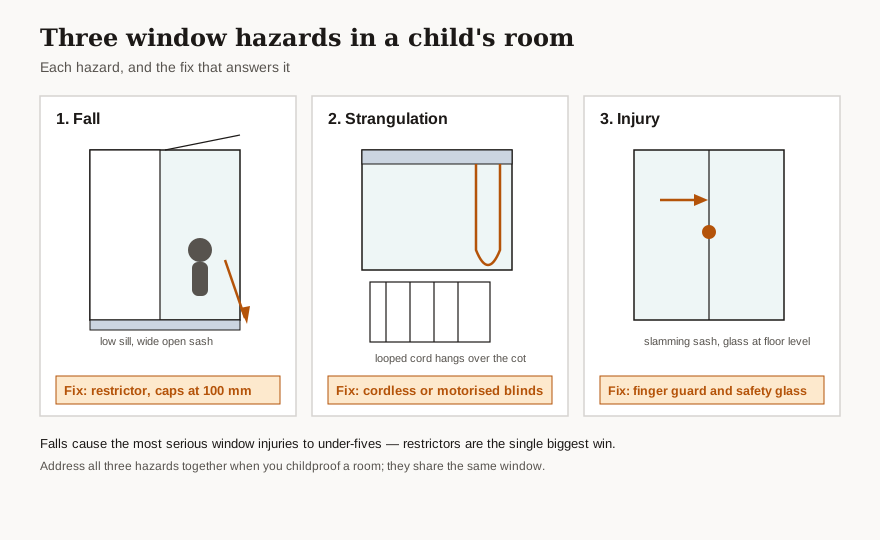
A window threatens a small child in three distinct ways, and each needs its own fix. Treating "child safety" as one thing is how gaps get missed.
- Falls — climbing out of, or toppling through, an open or low window. The single biggest risk, and worst in apartments above the ground floor.
- Strangulation — looped cords on blinds and curtains. A genuine, documented killer of toddlers worldwide, and entirely preventable.
- Injury — fingers crushed in slamming sashes, and cuts from ordinary glass breaking at low level where a child can fall against it.
Stopping falls: restrictors and the 100 mm rule
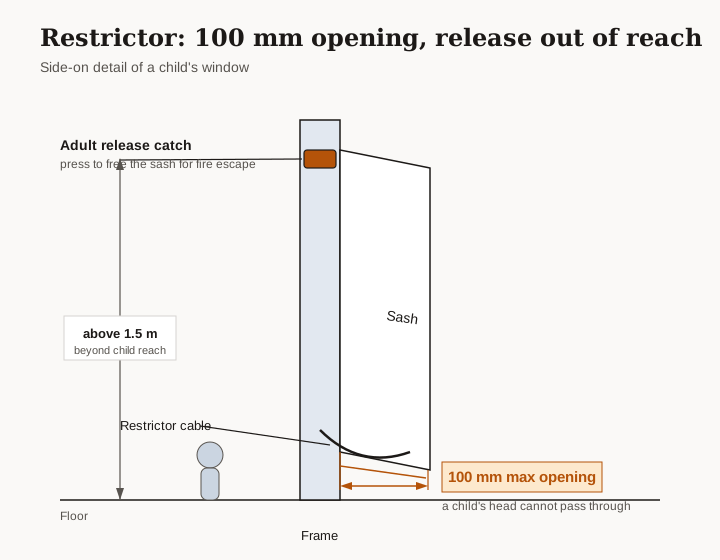
The core device is a window restrictor (also called a limiter or opening restrictor). It is a small catch or cable that lets a window open for ventilation but stops the sash before a child can get through. The accepted limit is a maximum opening of about 100 mm — a child cannot pass head and shoulders through a 100 mm gap.
Good restrictors have two qualities. First, they hold firmly against a child's push but release for an adult — important so the window can still be a fire escape. Second, the release should need a deliberate adult action (a key, or a two-finger squeeze placed high), not something a clever four-year-old copies after watching once.
| Window type | Child-safe opening control |
|---|---|
| Casement (side-hung) | Cable or arm restrictor capping the swing at 100 mm |
| Sliding (most Indian flats) | Track stop or sash jammer limiting slide to 100 mm |
| Awning / top-hung | Naturally safer — opens at the top, away from a child's reach |
| Tilt-and-turn | Use TILT (top vents in) for child rooms; lock out full turn |
A note on locks and reach: any window lock or restrictor release in a child's room should sit above roughly 1.5 m from the floor — beyond a toddler's stretch even on tiptoe. This is the same logic as the restrictor: make the safe state the easy one and the dangerous state require an adult.
Guards and grilles: bar spacing matters
Many Indian homes already have MS grilles, which is a real advantage for child safety. But a grille only protects a child if the bars are close enough. The rule mirrors the opening rule: vertical bar spacing of 100 mm or less, so a child cannot squeeze through or get their head stuck between bars. Horizontal bars are best avoided in a child's room — they form a ladder.
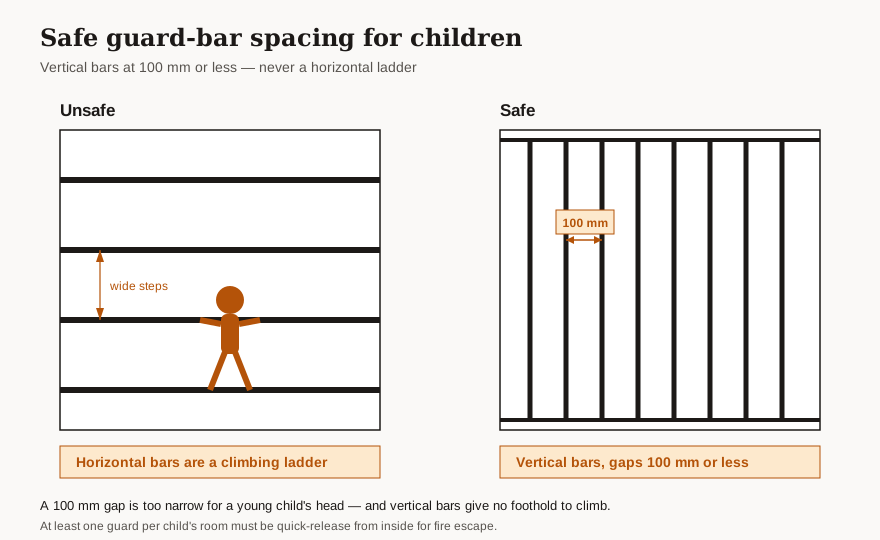
There is a critical caveat. A grille that protects a child must still let the family escape in a fire. Fixed welded grilles over every window are a documented cause of death in house fires. The rule, carried from our grilles guidance: at least one openable grille per room, with a quick-release that an adult can operate in the dark and smoke, but a child cannot. Grille costs run roughly Rs 150 to 300 per square foot for mild steel, more for stainless — a small price for both protection and a planned exit.
The cord hazard nobody expects
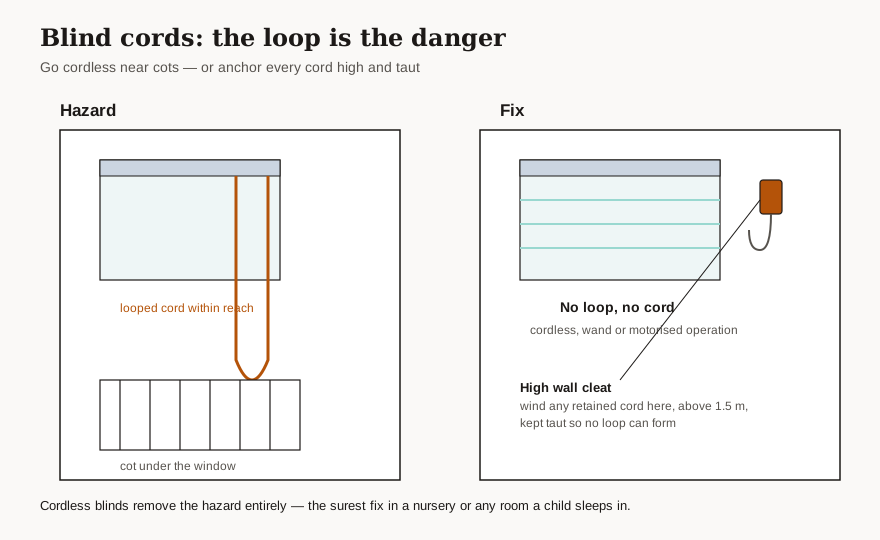
Looped pull-cords and chains on Venetian blinds, roller blinds and vertical blinds are a strangulation risk for toddlers and crawling babies. A child can wind a loop around the neck in seconds, and unlike a fall there is no noise. This is not a rare, theoretical hazard — it is one of the clearest causes of preventable toddler death in homes that use corded blinds.
The fix is simple and absolute for any room a child uses: go cordless. Choose cordless blinds, motorised blinds, or shutters with no looped cord at all. Where you keep corded blinds elsewhere, fit cleats high on the wall and wind every cord up out of reach, and never place a cot, bed or sofa where a child could reach a cord.
Sills, furniture and glass
Three quieter rules close the gaps:
- Sill height. A higher sill is safer — it raises the climb-over point. Where a window sill is low (under about 600 mm above the floor) the glazing is effectively at child height, so glass choice matters more.
- Never place climbable furniture under a window. A cot, bed, chest of drawers or stool beneath a window turns a safe sill into a launch pad. Plan the room so the wall under the window stays clear.
- Safety glass at low level. Where glass sits low or a child plays nearby, specify safety glass — laminated glass is ideal because if it breaks it stays bonded in the frame rather than showering down. This aligns with Indian practice under IS 2553 (Part 1):2018, which covers safety glass and carries a mandatory ISI mark; safety glass is expected for low-level windows with a sill below 600 mm. See Types of Glass for Windows in India for the product detail.
Finally, anti-slam and finger guards. Sashes and casements that bang shut crush small fingers. Friction stays, soft-close dampers, or simple foam finger-guards on the closing edge prevent a common and painful injury.
By age and by room
Risk changes fast as a child grows. Match the measures to the stage and the space.
| Age | Dominant risk | Priority measure |
|---|---|---|
| 0 to 1 (baby) | Cords; low glass | Cordless blinds; cot away from window |
| 1 to 4 (toddler) | Falls; climbing | Restrictors at 100 mm; clear the sill; locks high |
| 4 to 8 (child) | Climbing higher; opening locks | Key-operated restrictor; reinforce grille |
| 8+ | Leaning out of high windows | Habit and rules; keep restrictors on high-rise sashes |
- Nursery / baby room: cordless everything, cot well away from the window, laminated glass if the sill is low.
- Child's bedroom: restrictor on every openable sash, locks above 1.5 m, no bed or shelf under the window.
- High-rise balcony and living-room windows: the highest-stakes spot. Restrictors AND a 100 mm-spaced guard, full-height balcony glazing in laminated safety glass, and an absolute rule of no chairs or planters a child can climb.
Quick child-safety checklist
| Check | Target |
|---|---|
| Window opening limited | 100 mm maximum, adult-releasable |
| Guard or grille bar spacing | 100 mm or less, vertical bars |
| Fire escape preserved | At least one openable grille per room |
| Blind and curtain cords | Cordless in all child-used rooms |
| Lock / restrictor release height | Above about 1.5 m |
| Furniture under windows | None that a child can climb |
| Low-level glass | Laminated safety glass (IS 2553) |
| Closing edges | Anti-slam stay or finger guard |
No single device makes a window child-safe — it is the layered set of small measures, kept in place as the child grows, that does. Fit the restrictor, cut the cords, clear the sill, and check it again each year.
References
- Bureau of Indian Standards — IS 2553 (Part 1):2018 Safety Glass: https://www.bis.gov.in/
- National Building Code of India 2016 (BIS): https://www.bis.gov.in/
- IS 875 (Part 3) wind loads (BIS): https://www.bis.gov.in/
Related guides
- Pillar: Window Security Guide for India
- Cousin (differentiate — elderly access): Senior-Friendly Window Design
- In-cluster sibling: Window Grills Design Guide
- Foundations: Types of Home Windows in India
Export this guide
Related Guides — Deep-dive reading
Window Security Guide
The layered-defence model for Indian homes — frame, glass, locks, grille and sensors working together
Windows & GlazingSecurity for People Living Alone in India (2026): Calm, Practical Habits When There Is No Second Person to Notice
Living alone is an ordinary and growing part of Indian life - the student in a new city, the working single, the elder whose children are abroad, the person after a separation. It does not call for fear. It calls for a few deliberate habits, because there is no second person in the home to notice trouble, raise the alarm, or catch an accident. This is calm self-reliance, layer by layer.
SecurityEmergency-Evacuation Planning for a Secure Indian Home
The flip side of keeping intruders out is getting your family out. Map primary and secondary escape routes from every room, make sure your security hardware can never trap anyone, fix a muster point, and drill it — the evacuation plan every secure home needs.
SecurityRelated Tools — Try Free
Child & Elder Home-Safety Audit
Room-by-room safety audit for households with children or seniors — 10 categories, 70+ checkpoints tagged by audience.
Safety AuditCross-Ventilation Analyzer
Estimate airflow and air changes per hour (ACH) from room size, window areas, layout, and local wind — with NBC 2016 Part 8 compliance check.
Ventilation CalculatorWindow Grill Design Selector
Pick a window grille style and material by priority — security, looks, budget, view — and estimate cost.
Window Tool