
The Accessible Home (India): Step-Free, Mobility-Friendly Design for Every Age
Practical, room-by-room accessibility that quietly works for ageing parents, recovery, pregnancy and kids alike.
An accessible home is not a hospital. It is simply a home that keeps working for the people who live in it — when a parent turns 70, when a knee gives out, when someone is eight months pregnant, when a toddler is learning to walk, or when a relative visits in a wheelchair. The best accessibility is invisible: a doorway you never notice is wide, a bathroom that simply never frightens you, an entrance you can wheel a suitcase, a pram or a walker through without lifting it over a step.
This guide is the homeowner's companion — practical, decision-oriented, and focused on what to actually do. If you are designing a home from scratch and want the full dimensional and code-level discipline (room-by-room anthropometrics, clearances, regulatory detail), read our professional reference, Universal Design & Adaptable Homes in India. Here, we keep it warm and execution-focused: what changes, why it helps everyone, and how to prioritise when budgets and walls are already fixed.
Why accessibility helps everyone, at every age
The phrase "accessible home" makes many people picture wheelchairs. In reality, the same features quietly serve the entire household across a lifetime:
- Ageing parents — the single biggest reason Indian families retrofit. Falls in the home are the leading injury risk for older adults, and most of them happen on steps and in bathrooms.
- Injury and recovery — a fracture, a knee replacement, post-surgery weeks on crutches. Accessibility turns a three-month ordeal into a manageable one.
- Pregnancy — balance, bending and stair-climbing all get harder in the third trimester.
- Young children — prams, the toddler who cannot manage a tall step, the parent carrying a child and a bag at once.
- Everyday life — moving furniture, wheeling in a gas cylinder or water can, carrying groceries. Step-free, wide and well-lit benefits you on an ordinary Tuesday, not just in a crisis.
Design for your 75-year-old self, and you will have designed a better home for your 35-year-old self too.
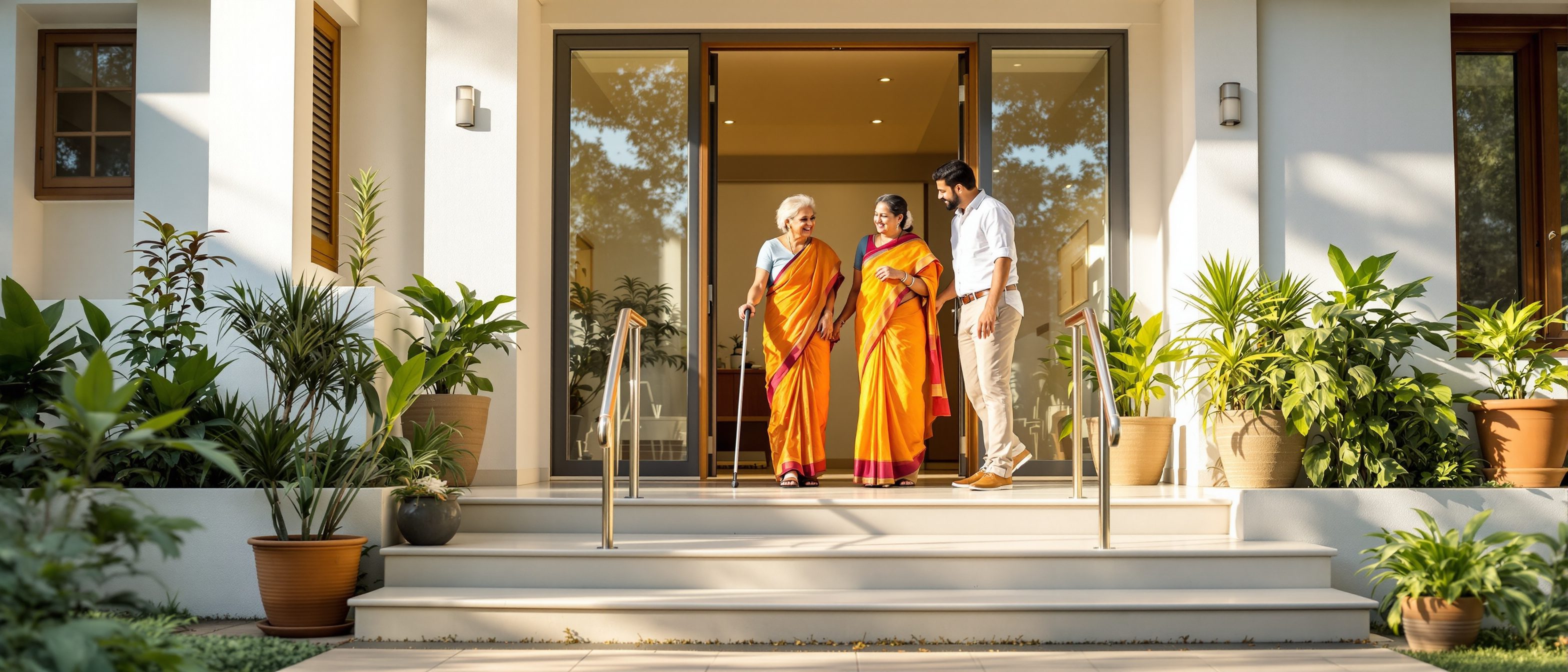
This is the idea of step-free living: a continuous, level (or gently graded) path from the gate to every room you use daily, with nothing you must lift over, squeeze through, or balance across. Even if you achieve it only on the ground floor, that single accessible level can let an elder live independently for years longer.
The entrance and approach: ramps vs steps
The journey from gate to front door is where accessibility begins. A single 150 mm step at the threshold is enough to defeat a wheelchair, a walker or a suitcase.
Ramps vs steps — you usually want both. Most people walk more comfortably on shallow steps with a handrail than on a long ramp; wheels and walkers need the ramp. The generous approach is a gentle ramp plus a parallel set of low steps with a handrail, so everyone picks what suits them that day.
Gradient — the rule of thumb. Best practice for an accessible ramp is a slope no steeper than 1:12 — that is, one unit of rise for every twelve units of length. To climb a 150 mm step you therefore need about 1.8 m of ramp. Steeper than 1:12 gets hard to push a wheelchair up and unsafe to control coming down; 1:15 or 1:20 is even kinder where space allows. Add a level landing at the top (at least the depth of an open door swing) so a wheelchair user can pause and operate the door.
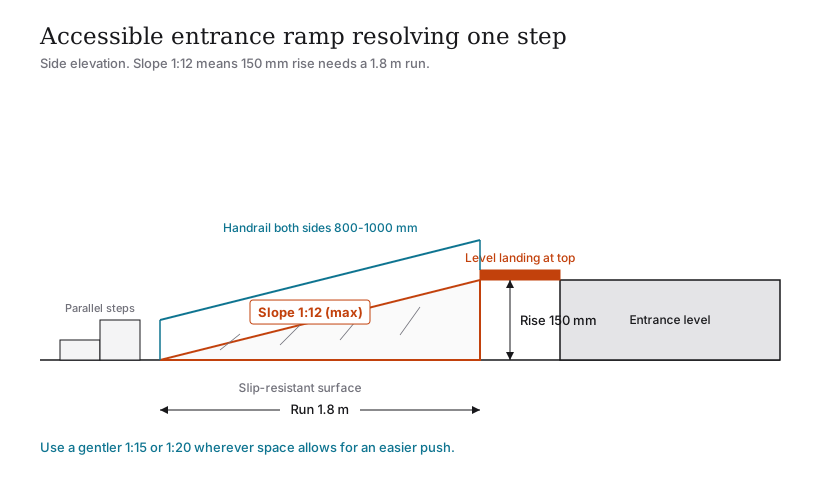
Handrails. Provide a continuous handrail, ideally on both sides, mounted 800–1000 mm above the ramp or stair surface (a second lower rail at around 700 mm helps children and shorter adults). Round the ends so sleeves and bag straps do not catch. The same 800–1000 mm benchmark from the CPWD Harmonised Guidelines applies to grab support throughout the home.
Surface and threshold. Use a slip-resistant finish that stays safe when wet — monsoon matters. At the door itself, aim for a near-flush threshold: a level change of more than about 12–20 mm is a trip hazard and a wheel-stopper. Where rain entry forces a small upstand, bevel it.
Doorways, clear widths and thresholds
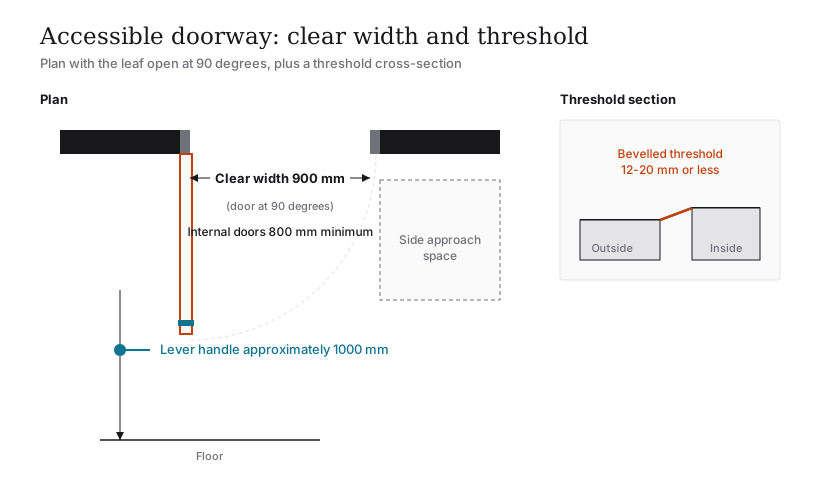
A door's clear width is the actual opening when the leaf is at 90 degrees — always less than the frame size. The accessibility benchmark from the CPWD Harmonised Guidelines is a clear width of ≥ 900 mm for a main accessible door; 800 mm is a workable minimum for internal doors, but 900 mm lets a wheelchair pass without scraping knuckles.
| Element | Best-practice benchmark | Why it matters |
|---|---|---|
| Main / accessible door clear width | ≥ 900 mm | Wheelchair + hands clear the frame |
| Internal doors | ≥ 800 mm (900 mm preferred) | Walker, pram, two people |
| Threshold level change | ≤ 12–20 mm, bevelled | Above this, wheels stop and toes catch |
| Lever handles (not knobs) | 900–1100 mm height | Usable with a closed fist or elbow |
Practical homeowner moves: swap round knobs for lever handles, which work for arthritic hands and full arms; hang doors to swing out of small bathrooms (or use a sliding/pocket door) so a fallen person does not block them; and remove or bevel the small marble/granite door sills that are so common in Indian homes.
Circulation and turning space
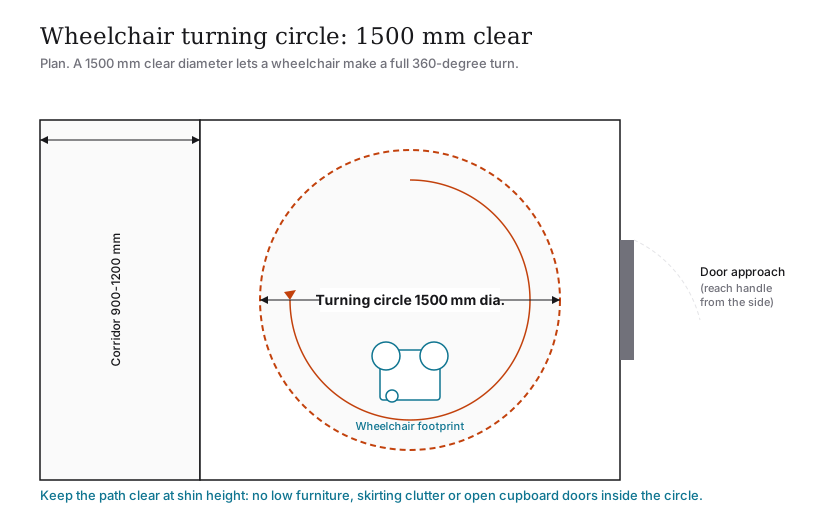
Getting through a door is only half the problem; you have to be able to turn around once inside. A self-propelled wheelchair needs a clear turning circle of roughly 1500 mm diameter to rotate 360 degrees. A walker or a person with a stick needs less, but corridors that feel generous to everyone are about 900–1200 mm wide.
When you plan or rearrange furniture, protect three things:
- A turning space (about 1.5 m clear) in the rooms used daily — at least the bedroom, the bathroom and the kitchen working zone.
- Clear corridors with nothing protruding into the path (no low shelves, open cupboard doors or trailing cables at shin height).
- Approach space beside each door, so a wheelchair user can reach the handle from the side rather than head-on.
The bathroom: the highest-risk room
If you do nothing else, fix the bathroom. It is wet, hard, small and used many times a day, and it is where most serious home falls happen. The good news is that bathroom accessibility is mostly cheap and retrofittable.
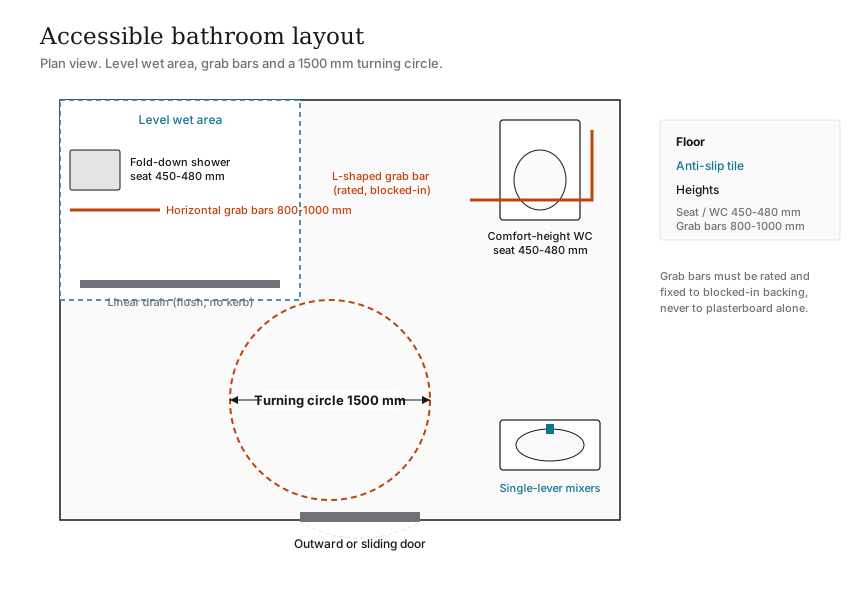
Go level (or near-level) for the shower. Replace the raised tub or the kerbed shower tray with a level / kerb-free wet area that drains to a linear or recessed gully. No step means no trip and easy wheel-in access. Slope the floor gently to the drain and use a small-format, genuinely anti-slip tile.
Grab bars are non-negotiable — and they must be real ones. A towel rail will pull out of the wall under load. Fit proper grab bars rated to take an adult's full weight, screwed into solid blocking, not into hollow tile lining:
- An L-shaped or vertical+horizontal bar beside the WC.
- A horizontal bar on the long wall of the shower, plus a vertical one at the entry.
- Mount the main horizontal bars at roughly 800–1000 mm above the floor (the same CPWD benchmark used for handrails).
Heights and seats. A comfort-height WC with the seat at about 450–480 mm (versus the old ~390 mm) is far easier to lower onto and rise from for elders and recovering patients. Provide a fold-down or fixed shower seat at a similar 450–480 mm. Keep at least 450–500 mm of clear space beside the WC for a carer or a side transfer.
Taps, doors and floor. Use single-lever mixers (graspable with one hand, and they avoid scalding fumbles), an outward-opening or sliding door, and slip-resistant flooring throughout — the wettest 600 mm around the shower is the most important patch.
Kitchen and bedroom: small tweaks, big payoff
Kitchen. You do not need to rebuild it. The high-value changes are: a section of counter at a slightly lower height (about 800 mm) with knee clearance beneath, so someone seated can work; pull-out shelves and drawers instead of deep base cupboards you have to crouch into; storing daily items between knee and shoulder height to kill the step-stool; lever or single-handle taps; and contrasting counter edges so a low-vision user can see where the worktop ends. Keep a clear turning space in front of the cooking zone.
Bedroom. Aim for a bed height of about 450–500 mm (mattress top), which makes sitting and standing easy and matches a wheelchair transfer. Leave at least 900 mm of clear space on at least one side of the bed for a transfer or a carer. Put a switched light and a phone within arm's reach of the pillow, and choose a wardrobe with a pull-down hanging rail or shelves no higher than shoulder height.
Lighting and contrast for low vision
Vision is the quiet half of accessibility. Older eyes need roughly two to three times more light than younger ones and are far more sensitive to glare and to sudden dark-to-bright changes.
- Layer the light — ambient plus task lighting at the kitchen counter, the bathroom mirror, the reading chair and the top and bottom of every stair.
- Light the journey — motion-sensor night lights along the route from bed to bathroom prevent the classic 2 a.m. fall.
- Use contrast as a tool — a WC, grab bar, light switch or door that contrasts with the wall behind it is easier to find and aim for; a contrasting strip on stair nosings marks each edge.
- Kill glare — matte (not high-gloss) floors and shielded fixtures; gloss tile plus a wet floor reads as a confusing mirror to ageing eyes.
- Big, reachable switches — rocker switches at about 900–1100 mm, ideally one beside the bed and one at each room entry, so you are never crossing a dark room to reach a switch.
Vertical movement: getting between floors
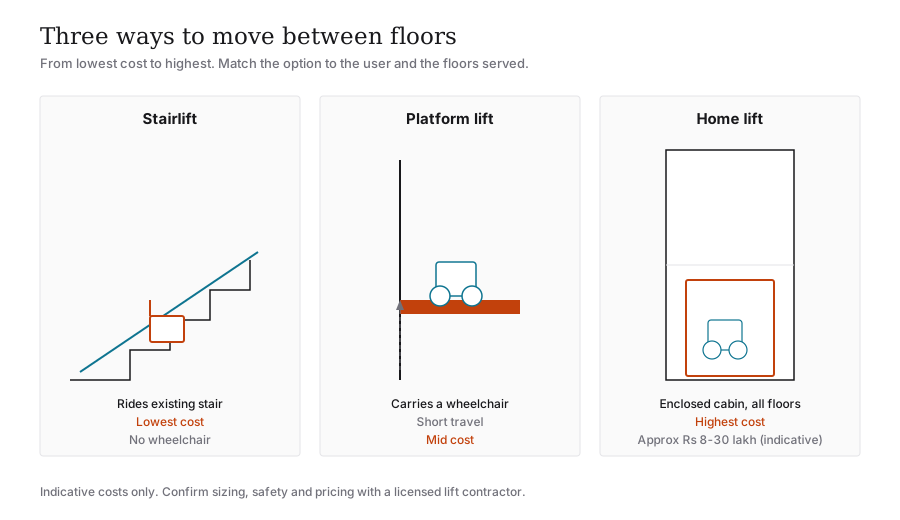
For a multi-storey home, the staircase is the great accessibility barrier. There are three realistic ways up, and they suit very different situations and budgets. (Full buyer detail lives in our pillar, the Residential Elevator Buyer's Guide for India, and the Lift Cost in India 2026 guide.)
| Option | What it is | Best when | Indicative cost | Trade-offs |
|---|---|---|---|---|
| Stairs + stairlift | A motorised chair rides a rail fixed to your existing staircase | The user can transfer to a seat and walk a little; you want a low-cost, low-disruption fix; the stair is reasonably straight | Lowest of the three (a fraction of a lift) | Does not carry a wheelchair; needs a separate chair on each landing for a full wheelchair user; one user at a time; stair must stay walkable for others |
| Platform lift | An open or part-enclosed platform that lifts a person standing or in a wheelchair, usually short travel, slow speed | A wheelchair user needs to clear a few steps or one floor; space is tight; you want wheelchair access without a full shaft | Mid-range; less than a full home lift | Slow and short-travel; needs floor footprint; less "finished" than a cabin lift |
| Home lift (elevator) | A proper enclosed cabin serving multiple floors — traction/MRL, hydraulic, screw or pneumatic-vacuum | You want full, dignified, all-ages access across the whole house and plan to stay long-term; or you are future-proofing a new build | Highest — typically ₹8–30 lakh by type, plus civil work, GST and installation (indicative — confirm with a licensed lift contractor) | Cost, civil work and a state licence in lift-regulated states; but it is the only option that carries a wheelchair user comfortably to every floor |
A pragmatic middle path many families choose: arrange daily life on the ground floor (a downstairs bedroom and accessible bathroom) so vertical movement becomes optional rather than essential. If you are building new or renovating heavily, the cheapest "lift" you will ever buy is an empty lift-ready shaft stacked through the floors that you fit out only when needed — see Lift-Ready: Future-Proofing Your Home and Future-Proof Home Design for Indian Families.
The standards that guide good practice
Private homes in India are not legally compelled to meet accessibility codes — those laws bind public buildings. But the numbers in them are the product of careful ergonomic study, and they make excellent best-practice benchmarks for a home.
- RPwD Act 2016 (Rights of Persons with Disabilities) requires public buildings to meet accessibility standards (Section 40 sets the standards; Section 44 ties them to building permission; Section 45 requires existing public buildings to be made accessible). Your home is exempt — but the spirit is sound.
- CPWD / MoHUA Harmonised Guidelines for a Barrier-Free Built Environment give the practical numbers worth borrowing: door clear width ≥ 900 mm, handrails and grab bars at 800–1000 mm, generous turning and lobby space, lever controls, and contrast/visual cues for low vision.
Treat these as targets to aim at, not a rulebook to fear. Where a number is hard to hit in an existing house, get as close as your walls allow — every centimetre of clear width and every grab bar still counts.
Room-by-room quick wins
If you are retrofitting an existing home on a budget, do these first. Most are low-cost and high-impact.
| Room / area | Quick win | Roughly how hard |
|---|---|---|
| Entrance | Add a 1:12 ramp beside the steps; continuous handrail; bevel the threshold | Moderate (civil) |
| Doorways | Lever handles; remove/bevel sills; widen the one daily-use door if feasible | Easy to moderate |
| Corridors | Clear shin-height clutter; add motion night-lights along the route | Easy |
| Bathroom | Proper grab bars (rated, blocked-in); anti-slip floor; shower seat; level/low shower | Easy to moderate — do this first |
| WC | Comfort-height seat (~450 mm) or seat riser; grab bar beside it | Easy |
| Kitchen | Pull-out drawers; lever tap; daily items at reachable height; lower work section | Easy to moderate |
| Bedroom | Bed at ~450–500 mm; 900 mm clear on one side; bedside switch + phone | Easy |
| Lighting | Add task light + night lights; matte finishes; contrasting switches | Easy |
| Stairs | Continuous handrails both sides; contrasting nosings; consider a stairlift | Easy to major |
| Between floors | Reserve a lift-ready shaft (new build) or plan a downstairs bedroom | Planning |
Start with the bathroom and the entrance — the two places where a fall or a barrier does the most damage — and let the rest follow as budget allows. For the full dimensional discipline behind these moves, keep Universal Design & Adaptable Homes in India open alongside this guide.
References
- IS 14665 — Electric Traction Lifts (Bureau of Indian Standards), Part 1 (outline dimensions) and Part 2 (installation, operation & maintenance) — referenced for the vertical-movement section.
- NBC 2016, Part 8 (Building Services), Section 5 — Installation of Lifts, Escalators & Moving Walks (BIS).
- RPwD Act 2016 — Rights of Persons with Disabilities Act, Sections 40, 44 and 45 (accessibility of buildings).
- CPWD / MoHUA Harmonised Guidelines & Space Standards for a Barrier-Free Built Environment (2016; Harmonised Guidelines 2021) — door, handrail, turning-space and visual-contrast benchmarks.
Source URLs:
- IS 14665 Part 1 (BIS): https://law.resource.org/pub/in/bis/S05/is.14665.1.2000.pdf
- IS 14665 Part 2 (BIS): https://law.resource.org/pub/in/bis/S05/is.14665.2.1-2.2000.pdf
- BIS National Building Code 2016: https://www.bis.gov.in/standards/technical-department/national-building-code/
- RPwD Act 2016 (full text, Odisha SSEPD): https://ssepd.odisha.gov.in/sites/default/files/2024-01/RPWD%20ACT.pdf
- DEPwD (Dept of Empowerment of Persons with Disabilities): https://depwd.gov.in/en/faqs-4/
- CPWD Harmonised Guidelines (CPWD): https://www.cpwd.gov.in/Publication/Harmonisedguidelinesdreleasedon23rdMarch2016.pdf
Export this guide
Related Guides — Deep-dive reading
Designing Adaptable & Universal-Design Homes
Accessibility, Aging-in-Place, and the Multi-Stage Family — Code, Anthropometrics, and Plan-Stage Discipline for Indian Residential Architects
Room PlanningUniversal Design Doors for Indian Homes: Inclusive Doors That Work for Everyone (2026)
How to design and specify doors that serve children, the elderly, pregnant women, the injured and wheelchair users by default - generous width, lever handles, near-flush thresholds, low-force closing, contrast and good lighting - without your home ever looking medical.
Home Doors & EntrancesWheelchair Accessible Doors for Indian Homes: Clear Width, Thresholds & Hardware (2026)
The exact specs that make a door usable from a wheelchair - clear opening width, near-flush threshold, lever hardware, approach clearance and low-force or auto operation, mapped to the RPwD Harmonised Guidelines 2021.
Home Doors & EntrancesRelated Tools — Try Free
Accessible Door Checker
Check a door against wheelchair-accessibility guidance — clear width, threshold, handle and closer force per RPwD 2021.
Compliance ToolAccessibility Compliance Calculator
Check a planned lift against the CPWD and RPwD accessible-lift benchmarks for a score.
Lift CheckerHome Accessibility Planner
Integrate lift, ramp, stairlift and wheelchair circulation into one accessibility plan.
Planner