
Home Office Door India: Acoustic, Glazed & Space-Saving Picks for WFH (2026)
How to choose a door for a study, home office or WFH room in an Indian home — balancing call privacy and acoustics, borrowed light and a professional on-camera look, lockable security for documents and gear, and tight-flat space-saving.
The pandemic turned a corner of the bedroom, a converted box room or the third bedroom of a 3BHK into a full-time office for millions of Indian households — and most of those rooms inherited whatever cheap hollow-core flush door the builder hung. That door is the single weakest link in your work-from-home setup: it lets the pressure-cooker whistle and the doorbell into your client call, it shows nothing of who is inside, and it offers no real lock for your laptop and documents. Choosing the right home office door is a small, one-time decision that quietly fixes call privacy, light, security and floor space all at once. This guide walks the four WFH priorities and matches each to a door solution with Indian costs. For the wider picture, see the complete guide to home doors in India and the room-by-room interior doors hub.
The four jobs a home office door must do
A study or WFH door is unusual among interior doors because it has to serve several competing demands at once, and the right answer depends on which one matters most to you:
1. Acoustic privacy — so your video calls do not leak the family's noise out, and household conversation does not hear your confidential work. This is the priority for anyone on calls all day.
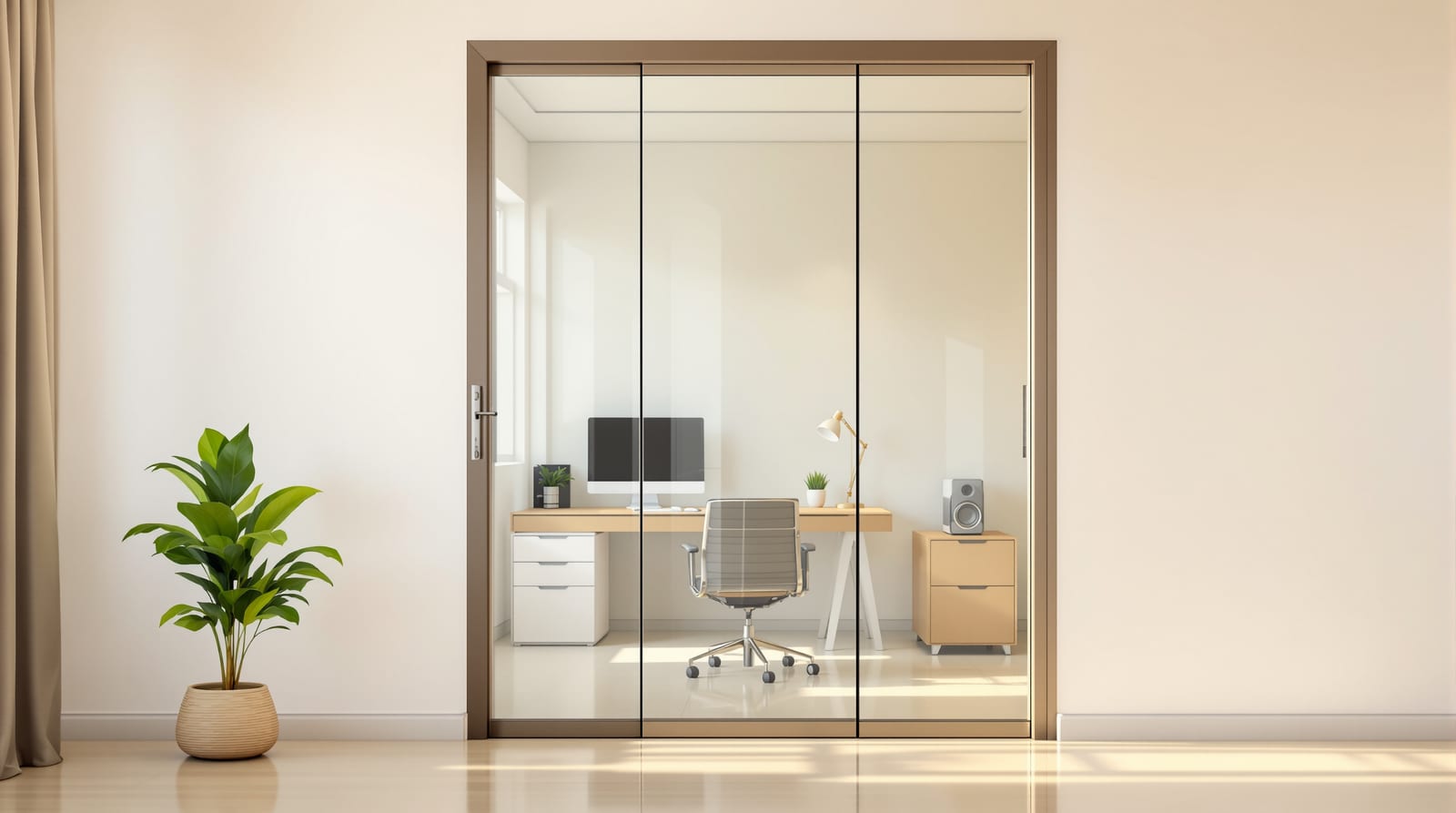
2. Borrowed light and a professional look — a glazed or part-glazed door lets daylight into an internal room (many converted office rooms have no window of their own), lets the family see at a glance whether you are mid-call before barging in, and reads tidy and "corporate" on camera.
3. Lockable security — for a work laptop, signed documents, a company phone, hard drives or design samples, especially in a joint-family home with children or domestic help moving through.
4. Space-saving — when the office is a 6x7 ft corner carved out of a small flat, a door that does not swing into the room is worth real money in usable floor.
Few doors maximise all four. The trade-off table later in this guide lets you pick the leaf that best serves your top one or two. Let us take each job in turn.
Acoustic privacy: solid core, seals and gaskets
If you are on calls for a living, this is the one to get right. The builder's standard flush door is hollow-core — a cardboard honeycomb between two thin plywood faces — and it stops almost no sound. Swapping to a solid-core door is the biggest single acoustic upgrade you can make: a particle-board or solid-timber core gives the leaf mass, and mass is what blocks airborne sound. A solid-core flush (IS 2202) or a solid panel door typically lifts the rating from a useless ~15-20 dB to a much more usable ~28-32 dB. The difference between hearing every word and hearing a muffled blur lives in those numbers. For the full method — door, gaskets, threshold drop seal and what STC actually means — see the dedicated soundproof doors guide; the points below are the home-office essentials.
The leaf is only half the job; the gaps around it leak most of the sound. Three cheap additions transform a solid-core door:
- Perimeter gaskets / acoustic seals — a compressible rubber or silicone seal pinned into the frame rebate so the closed leaf presses against it. Closes the slit gap on three sides.
- Drop-down threshold seal (automatic door bottom) — a spring-loaded strip inside the bottom edge that drops to the floor when the door shuts and lifts when it opens, sealing the worst gap of all without a permanent threshold to trip on.
- A snug, well-fitted frame — a warped or loose chowkat undoes everything. Insist on a true, plumb frame and a leaf that meets the seals all round.
A solid wood or thick engineered panel leaf with these three seals is what most Indian WFH professionals actually need — far short of a recording-studio door, but enough that the maid's vacuum and the neighbour's mixer no longer derail a client meeting. Avoid undercuts and ventilation louvers on an office door: every gap that lets air through also lets sound through, which is the opposite of what a louvered door wants to do.
Borrowed light and the on-camera look: glazed and glass-panel doors
Many home offices are internal rooms — a converted store, a passage nook, a windowless third bedroom — and they feel like a cave. A door with a glazed vision panel or full glass leaf borrows daylight from the brighter living room next door, which both lifts your mood through an eight-hour day and gives a cleaner, brighter background on video calls. A part-glazed door also signals professionalism: a slim vertical glass strip or a Crittall-style black-framed grid reads as a "real office", not a bedroom with a desk shoved in.
The privacy-versus-light trade-off is solved with the right glass:
- Frosted / acid-etched glass — passes light, blocks the view, so the family cannot read your screen but can tell the light is on. The default for most home offices.
- Reeded / fluted glass — fashionable in 2026, passes light and gives a soft, abstract blur; pairs well with modern interiors.
- Clear glass with a slim vision panel — lets the family see at a glance whether you are on a call (lit ring light, headphones on) before knocking, which cuts interruptions; keep it narrow so your screen is not on show.
- Smart / switchable (PDLC) glass — clear at the flick of a switch, opaque the rest of the time. Premium, but the elegant answer to "open-plan when free, private when on a call".
A glazed leaf does cost you acoustics — glass is a poorer sound barrier than a thick solid core, and the frame has more joints to leak — so if calls are your top priority, keep the glazing to a small laminated vision panel and rely on the solid core around it. Use toughened glass (IS 2553) for any low panel a child could walk into. For panel layouts and grid designs, see glass-panel door designs for India and the broader glass doors guide.
Lockable security for documents and equipment
A study that holds a work laptop, a company-issued phone, signed contracts or design samples needs a proper lock, not just a privacy latch. Options, cheapest first:
- Mortise lock with a key (₹1,500-8,000 hardware) — a key-operated mortise on the office door keeps it locked when you step out for lunch; the standard, reliable choice for a document room.
- Cylindrical / tubular lock — quicker to fit, fine for low-risk rooms.
- Smart lock (₹5,000-30,000 — Godrej, Yale, Qubo, Hafele, Lavna) — fingerprint or PIN entry means no fumbling for keys between meetings, an audit trail of who entered, and remote lock/unlock. Useful if you share the room or want IT-asset accountability; see smart door locks in India.
Pair the lock with a solid-core leaf — a fingerprint lock on a hollow flush door is theatre, because the leaf itself can be pushed through. For the lock and handle choices, the door hardware guide and door security guide go deeper.
Space-saving: sliding, pocket and barn doors for small flats
When the office is a corner converted out of a 2BHK living room or a tiny box room, a hinged door swinging 900 mm into the room collides with the desk and chair. Three door types remove the swing entirely:
- Pocket door — slides into a cavity inside the wall, so when open it vanishes completely and zero wall is occupied. The ultimate space-saver, but it must be planned at the masonry/partition stage and is hard to retrofit. See pocket doors in India.
- Barn door — hangs from an exposed top track and parks on the wall beside the opening; easy to retrofit onto any solid wall, no floor channel, and the matte-black-track look reads smart for a study. Needs clear flat wall beside the door to park on. See barn doors in India.
- Wall-mounted sliding door — like a barn door with a slimmer or concealed track; good where a swing door wastes a metre of floor.
The catch: sliding, pocket and barn doors are harder to soundproof than a snug hinged door, because they cannot easily take perimeter gaskets and a drop seal all round. If you slide AND need acoustics, accept a brush-seal compromise or keep a hinged solid-core door and save space elsewhere. For measuring the swing and clearance before you decide, the students' walkthrough on how to measure a small room shows the method.
Priority, solution and cost — the decision table
Pick your top priority on the left, read across to the door solution, and use the indicative India cost to budget. Costs are leaf/material only unless noted, exclude frame, hardware, fitting and 18% GST, and vary by city and vendor.
| Your top WFH priority | Best door solution | Why it wins | Indicative India cost |
|---|---|---|---|
| All-day call privacy / acoustics | Solid-core flush or solid panel leaf + perimeter gaskets + drop threshold seal | Mass blocks airborne sound; seals close the leak gaps | Leaf ₹4,000-12,000 (panel) / ₹1,200-4,000 (solid-core flush); seals & drop seal ₹1,500-4,000 |
| Borrowed light + professional on-camera look | Part-glazed door with frosted/reeded vision panel, or Crittall-style framed grid | Daylight into an internal room; signals "work zone"; cleaner video background | Framed glazed leaf ₹450-1,200/sq ft; frosted/reeded panel premium over plain glass |
| Lockable security for laptop & documents | Solid-core leaf + mortise key lock or smart lock | Locks the room; solid leaf can't be pushed through | Mortise set ₹1,500-8,000; smart lock ₹5,000-30,000 |
| Space-saving in a small flat | Pocket door (best, plan early) or barn / wall-sliding door (retrofit) | No swing into the room; reclaims ~0.6 sq m of floor | Sliding/barn track kit + leaf from ~₹450-1,200/sq ft framed; pocket adds cavity/civil cost |
| AC-room comfort + auto-close | Solid-core leaf + self-closing hinge or door closer + bottom seal | Keeps cooled air in; door never left ajar | Door closer / self-closing hinge ₹600-3,000 |
| Balanced "good enough" WFH room | Solid-core flush leaf, slim frosted vision panel, mortise lock, gasket | Covers privacy, light, security and signals work zone | Leaf ₹2,000-5,000 + panel + lock + seals |
Design that signals "this is a work zone"
A home office door is also a psychological boundary — for you and for the family. A door that visibly differs from the bedroom doors helps everyone respect the room's working hours. Cues that read "office" rather than "bedroom":
- A darker or two-tone finish — a charcoal, walnut or deep teak leaf against lighter bedroom doors marks the room as different.
- A glazed grid (Crittall-style) black-framed panel — instantly corporate, popular in 2026 Indian interiors.
- Hardware that means business — a long ladder-bar pull or a lever handle rather than a round bedroom knob.
- A discreet "on a call" indicator — even a small flip sign or a smart bulb beside the door cuts interruptions more than any lock.
For finish and colour direction that pairs with the rest of the home, the modern door designs and main door design pillars give the vocabulary, even though those cover entrance doors.
Don't forget the AC: self-closing and sealed
Most Indian home offices run an AC for the working hours, and a door left ajar bleeds cooled air and your electricity bill. Two cheap fixes:
- A self-closing hinge or a surface door closer (₹600-3,000) returns the door to shut every time, so it is never left open by a child or during a tea run.
- A bottom seal / drop threshold — the same strip that helps acoustics also stops the cooled-air draught at the floor gap, the largest leak in the room.
These two also help acoustics, which is why a solid-core, sealed, self-closing leaf is the single most efficient home-office door specification for an air-conditioned WFH room.
Inline diagram — the home office door at a glance
A solid-core leaf, a frosted vision panel for borrowed light, perimeter and drop seals for acoustics, a real lock and a self-closing hinge — that combination covers every WFH priority bar extreme space-saving.
Frequently asked questions
What is the best door for a home office in India?
For most WFH professionals, a solid-core flush or solid panel leaf with perimeter gaskets, a drop threshold seal, a slim frosted vision panel and a mortise or smart lock is the best all-round home office door. It blocks call noise, borrows light, locks your gear and signals a work zone. If your room is a tiny carved-out corner, switch the hinged leaf for a pocket or barn door and accept slightly weaker acoustics.
How do I soundproof a study door for video calls?
Start with mass: replace any hollow-core builder's door with a solid-core leaf. Then seal the gaps — perimeter acoustic gaskets in the frame rebate on three sides and a drop-down threshold seal at the bottom. Avoid louvers, undercuts and large clear-glass panels. This lifts a typical door from ~15-20 dB to ~28-32 dB. The full method is in the soundproof doors guide.
Should a home office door have glass?
A glazed vision panel is genuinely useful for an internal office room: it borrows daylight, brightens your video background, and lets the family see you are on a call before knocking. Use frosted or reeded glass so your screen stays private. Keep the glass to a slim panel if calls are your priority, because glass is a weaker sound barrier than a solid core; use toughened glass (IS 2553) for any low panel.
How much does a good home office door cost in India?
A balanced WFH door — solid-core flush leaf, slim frosted vision panel, mortise lock and acoustic gasket — typically lands around ₹6,000-15,000 in materials, plus frame, fitting and 18% GST. A smart lock adds ₹5,000-30,000; a part-glazed Crittall-style leaf or sliding/pocket hardware adds more. Figures are indicative and vary by city and vendor — see the door cost guide.
How do I save space for an office door in a small flat?
Remove the swing. A pocket door slides into the wall and disappears (plan it at the partition stage); a barn door parks on the wall beside the opening and retrofits onto any solid wall. Both reclaim roughly 0.6 sq m of floor a hinged door wastes, at the cost of slightly weaker acoustics. Measure the room first using the small-room measuring walkthrough.
Export this guide
Related Guides — Deep-dive reading
Soundproof Doors in India: How Doors Leak Sound, STC Ratings, Seals & Real Costs
A door is the weakest acoustic link in any wall - and it usually leaks through the gaps, not the panel - so here is how to actually quieten a bedroom, home theatre or street-facing room, from a 1,500-rupee seal kit to a proper acoustic door.
Home Doors & EntrancesGuest Room Door in India: Privacy, Quiet and Smart Picks Without Overspending (2026)
How to choose a guest bedroom door for an Indian home - privacy and acoustics so visitors feel comfortable, but budget-sensible for a room used only now and then: solid-core flush for quiet, panel or laminate for looks, the right privacy lock, simple soundproofing, and a finish that matches the rest of your doors - with picks ranked and indicative rupee costs.
Home Doors & EntrancesUniversal Design Doors for Indian Homes: Inclusive Doors That Work for Everyone (2026)
How to design and specify doors that serve children, the elderly, pregnant women, the injured and wheelchair users by default - generous width, lever handles, near-flush thresholds, low-force closing, contrast and good lighting - without your home ever looking medical.
Home Doors & EntrancesRelated Tools — Try Free
Acoustic Privacy (STC) Visualizer
Indian healthcare acoustic visualizer — compare wall assemblies and noise sources, see received SPL after STC attenuation, and check FGI 2018 / IS 1950 / NABH speech-privacy compliance with live dual-canvas waveform.
Acoustic ToolCross-Ventilation Analyzer
Estimate airflow and air changes per hour (ACH) from room size, window areas, layout, and local wind — with NBC 2016 Part 8 compliance check.
Ventilation CalculatorDoor Cost Calculator
Estimate the all-in cost of a door — leaf, frame, hardware, fitting and GST — by type, material and size.
Door Calculator