
Security for Women Living Alone
Practical, empowering home security for a woman living independently in India — a strong door and verify-before-open as the foundation, quiet everyday habits that are your choice not a burden, delivery and service-person safety handled calmly, personal-safety tools you own and control, a check-in network, and privacy that is yours by right. Security as freedom and confidence, never a cage.
More women in India are living independently than ever before — working professionals, students, entrepreneurs, women who have chosen a home of their own. It is a good and growing reality, and it deserves practical security, not a lecture. This guide starts from a simple belief: your home is your freedom, and security is one of the tools that lets you live in it with confidence. Nothing here is about being afraid, shrinking your life, or treating every stranger as a threat. It is about a few solid, sensible choices — most of them small, many of them things you already do — that put you firmly in control of your own front door and your own day.
The thread running through every section is autonomy. These are tools you own and you switch on when you choose. A good lock, a phone in your hand, a friend who would notice — each one widens what you can do safely, rather than fencing you in. Read this as an à-la-carte menu, not a list of rules: take what fits your home and your life, leave the rest, and never let anyone — a building, a landlord, a well-meaning relative — turn your security into a set of restrictions on how you live.
Scope & safety. This guide helps you plan, decide and coordinate — calmly and without alarm. It is never about limiting your freedom; it is about tools you control. Locks, wiring and alarm systems are safety-critical: choose them, then have a licensed professional install and certify them. Any electric or magnetic lock on an escape route must fail open in a fire so it can never trap you. You are entitled to privacy in your home — a landlord, guard or society may not over-surveil you (the DPDP Act 2023 governs cameras and personal data; there are no cameras inside your private spaces). In an emergency, contact the police and real services first — the national emergency number 112 and the women helpline 181. Nothing here replaces a site-specific assessment or professional, legal or personal-safety advice.
The foundation: a strong door and verify-before-open
If you do one thing from this guide, do this. The single most valuable piece of security for anyone living alone is a solid door with a good lock and a way to see who is outside before you open it. Everything else builds on it, and it is entirely within your control.
- A door that means it. A solid-core or metal door, a well-anchored frame, and a quality lock — ideally a deadbolt or a well-chosen smart lock — are the base layer. If your door is flimsy or the lock is old, that is the first upgrade worth making. The full selection discipline for locks is in the complete guide to smart locks, and door and frame strength are covered in the openings security library.
- See before you open. A video door phone (VDP) or, at minimum, a wide-angle peephole lets you look at a caller and decide — on your own terms — whether to open at all. A VDP is the everyday hero here: it lets you talk, verify and even receive a parcel through the intercom without opening the door. Pair it with the visitor-handling habits in visitor access management.
- "Just a minute" is a complete sentence. You never owe anyone an instant open. A calm "just a minute" gives you time to look, ask, and think. If a caller is unknown, unexpected, or their answer does not add up — you simply do not open. That is not rudeness; it is your call, every time.
- Verify, then decide — never the reverse. The rule is simple and it protects you without any drama: do not open to an unknown or unverified caller. Verify who they are and why they are there first; opening is a choice you make after, not before.
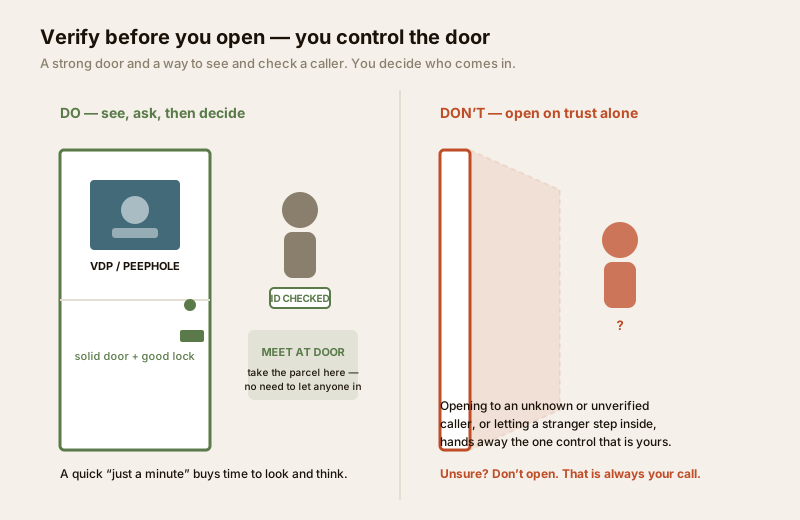
This one habit — see, ask, then decide — quietly handles the large majority of everyday situations, and it costs you nothing but a moment.
Not announcing that you live alone — your choice, not a burden
Whether you live alone is nobody's business but yours. There is a sensible, low-effort discretion here that has nothing to do with fear and everything to do with convenience: you get to control what a stranger, a caller or a delivery app knows about your household. None of this should become a chore or a worry — pick the bits that feel natural and forget the rest.
- A neutral nameplate. Many women choose a nameplate with just a surname or initials, or a shared/family name, rather than one that broadcasts a single woman lives here. It is a small, one-time choice, entirely optional, and entirely yours.
- You needn't confirm the household to strangers. If a caller, a cold-call, or a delivery agent asks "are you home alone?" or "is sir there?", a light, unbothered "someone's here, leave it at the door" or "I'll take it, thanks" answers without confirming anything. You are not lying and you are not being difficult — you are simply not handing out information you don't owe.
- The easy "just a minute" line. The same phrase that buys time at the door also lets you imply you are not the only person around, without any elaborate story. Keep it light; it is a convenience, not a performance.
- Thoughtful social-media privacy. Sharing your live location publicly, your exact address, or "home alone all weekend" posts to an open audience simply tells more people more than you'd choose. Tightening who can see your posts, and posting a trip after you're back rather than while you're away, keeps your movements yours. This is the same discretion covered for empty homes in the wider section.
The framing matters: this is discretion by choice, a few defaults you set once. It is never a reason to feel watched, restricted, or on edge in your own home.
Delivery and service people — the everyday risk, handled calmly
Deliveries, a plumber, an electrician, an appliance technician — these are the most frequent people arriving at your door, and so, handled well, they are simply routine. The one principle that covers almost all of it: verify at the door, and you rarely need to let a stranger deep into your home.
- Meet deliveries at the door. Take the parcel at the threshold through the VDP or at an opened-but-controlled door. There is almost never a reason for a delivery agent to come inside. If a package needs a signature or OTP, you can do that at the door.
- Verify a service person before they arrive and again at the door. For a plumber, electrician or technician, prefer someone known, verified, or sent by a trusted platform or your society, so a name and ID are on record before they turn up. At the door, a quick check of who sent them and an ID confirms it is the right person.
- A witnessed appointment beats a solo one. For a repair from an unknown vendor, it is entirely reasonable to schedule it when a friend, family member, neighbour or the building's staff is around, or to have someone on a call. Many women simply prefer a daytime slot with a person they trust nearby — a sensible, ordinary choice.
- Use the intercom and the building's visitor system. In a society with a guard and visitor access management, a service person is logged and announced before they reach your floor. That verification layer does a lot of quiet work for you.
- You set the terms inside. If someone does need to come in for a job, you decide where they work and you stay comfortable — door to a private room closed, phone in hand. This isn't suspicion of the worker; it's simply you being at ease in your own space.
Treated this way, the busiest "risk vector" of a home — the flow of people at the door — becomes calm and manageable, without treating any individual as a threat.
Personal-safety tools you control
Beyond the door, a small set of tools puts help within one press or one tap, whenever you decide you want it. Think of these as an everyday toolkit that travels with you — empowering, not anxious.
- Your phone, always to hand. The simplest tool. Charged, reachable, and set up so you can call or trigger help fast. Learn where your phone's built-in emergency SOS lives (many phones call for help and share your location on a few presses of the power button).
- An SOS or panic app, and the button. A dedicated SOS/panic app — or your phone's native one — can raise an alarm, message your contacts, and share your location at a tap. Some also offer a panic or duress option for when you can't make an obvious call. The hardware-button patterns and how these link to alerts are in panic buttons and personal emergency response systems.
- The real helplines. Keep the national emergency number 112 and the women helpline 181 saved and easy to reach. These are India's genuine, always-there services; a saved contact and a moment's familiarity mean you're not searching for a number when you'd rather not be.
- Trusted-contact and live-location sharing — on your terms. Sharing your live location with a friend or family member for a journey home, a late shift, or a first meeting with a new vendor is a powerful, reversible tool. You turn it on when it helps and off when it doesn't. It is a choice you control, never a leash.
- Notifications that reach you. If you add any smart device, set it so alerts come to your phone — see smart security notifications.
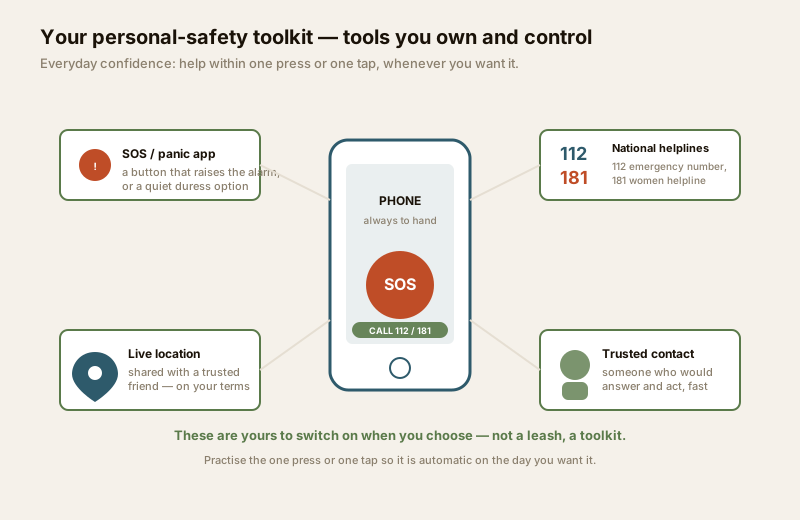
The point of the toolkit is confidence: you know help is a press away, so you can get on with your life. Practise the one press or one tap once or twice so it's automatic on the rare day you'd want it.
A check-in network — people who would notice
Living independently doesn't mean living unnoticed. A light, mutual check-in network is one of the most reassuring and least intrusive forms of security there is — and it works both ways, so it's a kindness, not a dependency.
- One or two people who would notice. A friend, a family member, or a trusted neighbour who would realise if something were off — an unanswered day, a light that never came on — is worth more than most gadgets. Pick people who'd genuinely notice and act.
- A simple daily or routine check-in. A quick "home safe" message after a late night, or a standing "we text each morning" with a friend, means someone knows your normal — and would spot the abnormal. Keep it light and reciprocal; you do the same for them.
- Shared location for the moments it helps. For a commute you'd rather not do unwatched, or a trip, sharing location with one trusted person for that window is enough. It's your switch to flip.
- A neighbour who'd answer. A good relationship with even one neighbour — someone who'd take a call, hold a spare key by agreement, or simply be aware — turns a building full of strangers into a place where you're known.
None of this trades your independence; it extends it. A safety net is what lets you move freely, not what holds you back.
Coming home safely at night
Arriving home late is a normal part of an independent life, and a few calm habits make the last hundred metres easy — most of them are about light and awareness, not vigilance.
- A well-lit approach. A lit path from the gate to your door, a working light in the lift lobby, corridor and outside your flat, matters more than almost anything else at night. If a stretch — a parking bay, a stairwell, a lift lobby — is a dark blind spot, that's worth raising with the society; the wider security and lighting angle and perimeter thinking apply here. Good lighting is a shared amenity you're entitled to.
- Keys ready before you arrive. Having your keys (or your phone for a smart lock) in hand as you reach the door means no fumbling in a doorway. It's a tiny habit that keeps you moving.
- Ordinary awareness, not hyper-vigilance. Phone not buried in your bag, a glance around as you approach, headphones at a level where you can still hear — this is just being present, the same awareness anyone uses, not a state of alarm.
- Avoid the blind spot. A lift lobby or parking area that's a genuine blind spot is a design problem to flag, not something to accept. In a good society, these are lit, sometimes covered by the building's cameras, and overlooked by a guard — see the community layer below.
The goal is that coming home feels routine, because the environment is set up well — not because you're on edge.
Your privacy — from staff, guards and landlords
Security must never cost you your privacy, and no one running the building gets to decide otherwise. You are entitled to privacy in your home, and that is not a favour — it's a right, backed by law.
- A landlord may not over-surveil you. A landlord installing a camera pointed at your door, inside your rented space, or tracking your comings and goings is over-reach, not security. The tenant's position on this is covered in security for tenants; the underlying data-protection principles — consent, notice, minimisation, and no cameras in private spaces — are in smart-home security and privacy and video door phone privacy.
- Guards and staff have limits too. A society guard or staff member logging visitors is legitimate; a guard who monitors, questions or comments on your movements, guests or timings beyond what safety needs is not doing security — and you're entitled to push back, through the RWA if needed.
- The DPDP Act 2023 is on your side. Cameras and building systems capture personal data about you. That data must rest on consent and genuine need, must not extend into your private spaces, and must not be used to watch you specifically. Knowing this makes it easier to say, calmly, "that's not okay."
- Your own devices, your own rules. Any camera or smart device you choose is yours to control — pointed outward at your own door, footage held by you, alerts to your phone alone.
Privacy and safety are not a trade-off. A good setup gives you both, and you're within your rights to insist on it.
The community layer — a good society, done respectfully
Where you live shapes how much of this you even have to think about. A well-run society or building quietly handles a lot — and the good version does it for residents, respectfully, never by surveilling them.
- A real guard and verified visitor management. A staffed gate that actually logs and announces visitors, rather than waving everyone through, is a genuine layer between the street and your door. The full picture is in the security guide for gated communities.
- Lit, overlooked common areas. Well-lit lobbies, corridors, stairwells and parking, with the building's own cameras covering shared approaches (not private doorways), make the whole journey home easier.
- A community you can raise things with. A responsive RWA or building management you can approach about a dark corner, a broken light or a lax gate is part of your security — and something you're entitled to expect.
- Respect runs both ways. A good society protects residents and respects their privacy and their staff. If yours tips into over-surveillance or treats residents or workers as suspects, that's the wrong model — the section pillar covers doing this with dignity.
Choosing, or improving, the building you live in is one of the highest-leverage security decisions available — and much of it is a shared amenity you can push to be better.
A smart system that alerts your phone
If you'd like a layer beyond the door, a modest smart setup can add real reassurance — as long as it's built around one principle: it alerts and answers to you.
- Alerts to your phone. A smart door sensor, a motion sensor, or a smart lock that notifies your phone when the door opens or someone's at the gate keeps you informed wherever you are — see the complete guide to smart-home security.
- See in when you're out. Remote security monitoring lets you check your own home from your phone — pointed at your own door and spaces, footage yours.
- Keep it simple and yours. You don't need a fortress. A good door, a VDP, a couple of sensors and clean phone alerts is plenty for most homes — and every part of it answers to you alone.
Use the home security risk scorecard to see, calmly, where your own gaps are and which small upgrade would help most.
A calm, practical checklist
Nothing here is urgent or exhaustive — it's a menu. Pick what fits, in your own time.
| Layer | What it gives you | A simple thing you control |
|---|---|---|
| The door | You decide who comes in | Solid door, good lock, VDP/peephole; "just a minute" before you open |
| Discretion | Your household is your business | Neutral nameplate; don't confirm you're alone; thoughtful social-media privacy |
| Deliveries & service | The everyday flow, handled calmly | Meet at the door; verify ID; prefer known vendors; witnessed appointment |
| Personal tools | Help one press away | Phone to hand; SOS/panic app; 112 and 181 saved; live-location when it helps |
| Check-in network | Someone would notice | One or two trusted people; a light daily "home safe"; a neighbour who'd answer |
| Coming home | An easy last hundred metres | Well-lit approach; keys ready; ordinary awareness; flag any blind spot |
| Privacy | Safety without being watched | Your right to no over-surveillance (DPDP Act 2023); your devices, your rules |
| Community | A layer before your door | A real guard, verified visitors, lit common areas, a responsive RWA |
| Smart layer (optional) | Informed wherever you are | Sensors and a lock that alert your phone; remote check-in you control |
Key takeaways
- The foundation is a strong door and verify-before-open. A solid door, a good lock, a VDP or peephole, and the habit of see, ask, then decide put you in control of who enters. Never open to an unknown or unverified caller — that is always your call.
- Discretion is your choice, not a burden. A neutral nameplate, not confirming you live alone, an easy "just a minute", and thoughtful social-media privacy are a few one-time defaults — convenience, never fear.
- Deliveries and service people are handled calmly. Meet deliveries at the door, verify who's sent, prefer known vendors, and use a witnessed appointment and the building's visitor system — no need to admit a stranger into your home.
- Your personal-safety toolkit is yours to switch on. A phone to hand, an SOS/panic app, the 112 emergency number and 181 women helpline, and live-location with a trusted contact — tools you own and control.
- A check-in network extends your independence. One or two people who would notice, a light daily check-in, and a neighbour who'd answer.
- Your privacy is a right. No landlord, guard or society may over-surveil you (DPDP Act 2023); your own devices answer to you alone.
- Security is your freedom. Every tool here widens what you can do with confidence — never a cage, never a set of restrictions on your life.
Where to go next
- The section: security for specific users and the sub-hub for tailored home security.
- Closely related: security for people living alone, security for tenants, and the security guide for gated communities.
- Foundations: the complete guide to smart locks, visitor access management, and the openings security library.
- Score your gaps calmly: the home security risk scorecard, or browse all security guides.
References
- The Digital Personal Data Protection Act, 2023 (DPDP Act) — consent, notice and minimisation governing cameras and the personal data building and home systems collect, and the basis for a resident's privacy from over-surveillance; verify the current text and rules.
- India's national emergency number (112) and the women helpline (181) — the genuine, always-available services to contact in an emergency; confirm current numbers and coverage with official sources for your state.
- The Private Security Agencies (Regulation) Act, 2005 (PSARA) — the framework for verified private security guards and agencies engaged by a society; verify current requirements.
- A licensed locksmith or security installer, your society's management/RWA, and, for any tenancy or privacy dispute, a legal professional — for door and lock work, visitor systems and enforcing your right to privacy.
This is an educational overview for planning and personal decision-making, not legal, security-assessment or personal-safety advice. It is about tools you choose and control, never about restricting how you live. Locks, wiring and alarm systems are qualified professional work — engage licensed installers for design, installation and certification; contact the police and real emergency services (112) and the women helpline (181) in any emergency; and verify any Act's or helpline's current status and coverage before relying on it.
Export this guide
Related Guides — Deep-dive reading
Security for People Living Alone in India (2026): Calm, Practical Habits When There Is No Second Person to Notice
Living alone is an ordinary and growing part of Indian life - the student in a new city, the working single, the elder whose children are abroad, the person after a separation. It does not call for fear. It calls for a few deliberate habits, because there is no second person in the home to notice trouble, raise the alarm, or catch an accident. This is calm self-reliance, layer by layer.
SecuritySecurity Guide for Senior-Citizen Homes
How to protect elderly people living independently or with family in India without stripping away their dignity or independence — verifying who is at the door, simple one-touch systems, the overlap of security with fall and medical emergencies, respectful remote reassurance for family, and honest vetting of caregivers and help.
SecurityVisitor Vehicle Management in India: A Professional Guide
The everyday weak point of every society and office gate is not the resident's car — it is the visitor, the cab, the delivery rider and the contractor who must be let in without opening the whole park to anyone. This is the process, not just the hardware: verify at the gate before the boom lifts, park visitors away from resident bays, and never jam the gate a fire tender needs.
SecurityRelated Tools — Try Free
Apartment Video Door System Planner
Enter flats, entrances, floors and guard desk for a first-pass building intercom plan — door stations, indoor monitors, guard station, the right architecture and an indicative cost band.
Building PlannerWindow Hardware Cost Calculator
Estimate window hardware cost — hinges, handles, locks, rollers and multipoint gears.
Window CalculatorSite & Perimeter Security Assessment
Rate your site across five areas — site, neighbourhood, perimeter, entry/exit and lighting — for a readiness score and prioritised fixes.
Site Assessment