
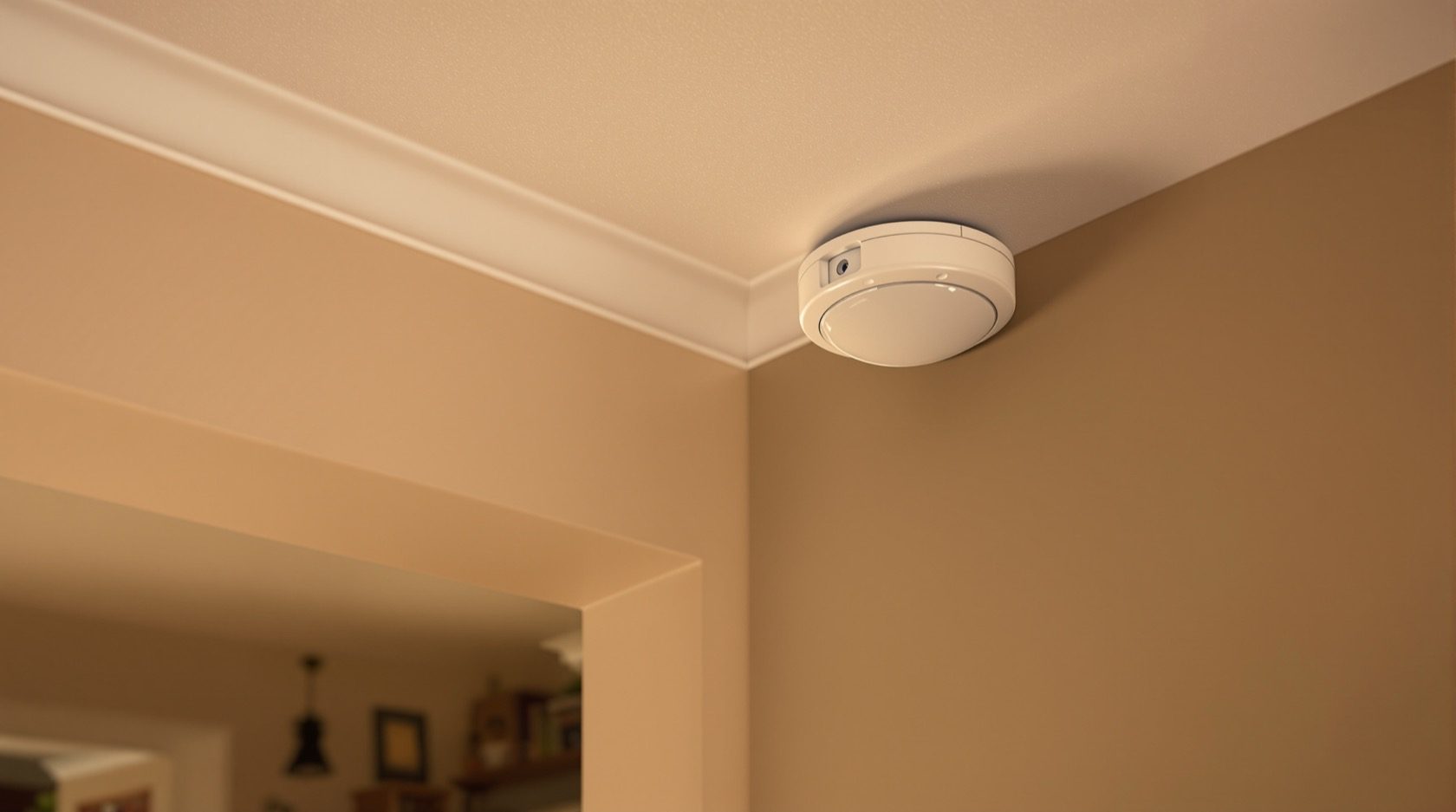
Motion Sensors for Home Security in India (2026): The Complete Guide
The umbrella guide to indoor motion detection: how PIR, microwave, dual-technology and ultrasonic sensors work, where to place them in an Indian home, and how good placement designs out false alarms from fans, AC, heat and pets.
A door contact tells you a door opened. A window sensor tells you a window moved. But once someone is inside a room, walking across the floor, only one thing notices: a motion sensor. This is the interior layer of a burglar alarm, the detector that catches movement in the volume of a room after the perimeter has been crossed, and it is the sensor most likely to cry wolf if it is placed badly.
This guide is the umbrella for the whole motion-sensor family in Studio Matrx's burglar-alarm hub. It explains the technologies at a glance, points you to the deep-dive guide for each one, and then spends most of its time on the parts that decide whether a system is trusted or ignored: the coverage shape you choose, where on the wall it goes, and how thoughtful placement quietly designs out the false alarms that plague Indian homes full of ceiling fans, air-conditioning and forty-degree afternoons.
Scope & safety. This guide helps you choose and place interior motion sensors well and hold an installer to a sensible plan. Battery-powered wireless sensors you can reach are homeowner-friendly; wiring a hardwired sensor back to a panel, working at height, or anything near the mains board is a licensed professional's job. A motion sensor's limits — a heat-reduced range, a pet threshold, a fan-affected zone — are described here only as buying and placement considerations, never as ways to evade detection. Indoor sensors also touch privacy: think about what a "motion detected" log reveals about who is home, and treat that as personal data under the Digital Personal Data Protection Act, 2023. This is educational guidance, not legal advice.
Where motion sensors sit in a layered alarm
A good alarm is not one clever device; it is layers that back each other up. Think of three rings:
- Perimeter first. Door contacts and window contacts sit on the openings and fire the instant a door or window is opened — the earliest possible warning, before anyone is inside. This is the outer ring, and it is the perimeter approach many Indian homes lean on because it can be armed while the family is asleep at home.
- Volume next. Motion sensors watch the inside of a room. If a perimeter sensor is bypassed — an intruder comes over a boundary wall and through an unmonitored opening — the motion sensor in the hall or on the stairs is the safety net that still catches the movement.
- Traps and priorities. A single sensor covering the one route almost everyone must cross (the stair landing, the central hall) is often worth more than sensors in every room.
Motion sensors are the middle ring. They are cheap, effective and easy to add to a wireless or hybrid system, and they are the layer this phase's technology guides go into in depth.
The technology family, in one view
There is no single "motion sensor." There is a small family of detection methods, each noticing movement in a different way. You do not need to memorise the physics — you need to know which one suits a room and when to spend more.
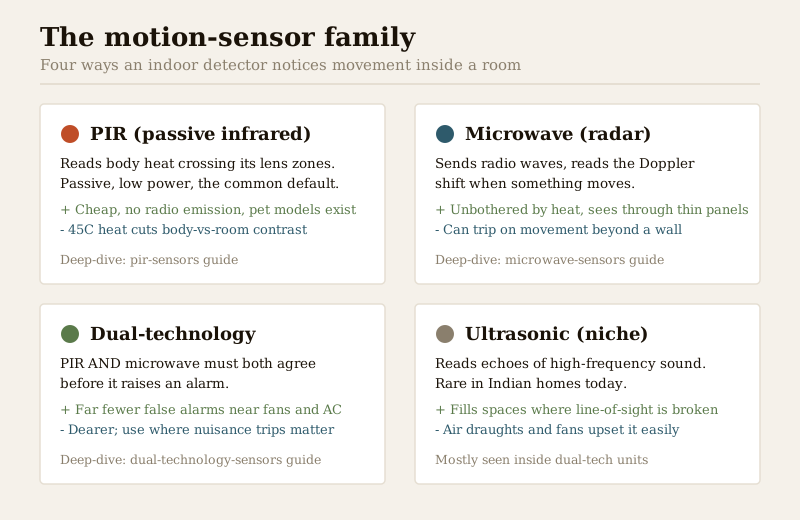
| Technology | How it detects | Best for | Watch-out | Deep dive |
|---|---|---|---|---|
| PIR (passive infrared) | Reads body heat crossing lens zones | The common default in homes | 45C heat reduces body-vs-room contrast | PIR sensors |
| Microwave (radar) | Emits radio waves, reads Doppler shift of moving objects | Rooms where heat or draughts fool PIR | Can detect movement beyond a thin wall | Microwave sensors |
| Dual-technology | PIR AND microwave must both agree before alarming | High-nuisance rooms near fans and AC | Costs more; use where it earns its keep | Dual-technology sensors |
| Ultrasonic | Reads echoes of high-frequency sound | Filling awkward line-of-sight gaps | Air draughts and fans upset it; now rare | Usually seen inside dual-tech units |
PIR is the default, and why it wobbles in India
Most motion sensors you will buy are PIR — passive infrared. They are cheap, sip battery, emit nothing, and come in pet-immune versions. Their one honest weakness matters in India: a PIR works by seeing the contrast between a warm body and a cooler background. On a forty-five-degree afternoon, when a wall or floor has soaked up the sun and sits close to skin temperature, that contrast shrinks and the effective range drops. It still works — it just does not reach as far. Where that matters (a large, sun-baked hall; a room that hits peak heat when the house is empty), that is the cue to consider microwave or dual-technology, which do not rely on heat contrast.
Microwave and dual-technology, in a sentence each
Microwave sensors send out low-power radio waves and read the Doppler shift when something moves — heat is irrelevant to them, which is exactly why they hold up in the heat. Their honest quirk is that radio can pass through thin partitions, so a poorly aimed microwave sensor may notice someone moving in the next room; that is a placement question the microwave guide covers. Dual-technology sensors put PIR and microwave in one housing and only alarm when both agree there is movement. Because a ceiling fan fools PIR but not radar, and a warm draught fools neither reliably on its own, requiring agreement collapses the false-alarm rate — which is why dual-tech is the go-to for the exact rooms that plague Indian systems.
Coverage patterns: choose the shape before the spot
Before you decide where a sensor goes, decide what shape of coverage the room needs. A sensor's lens is ground to project a particular pattern, and matching the pattern to the space is half the job.
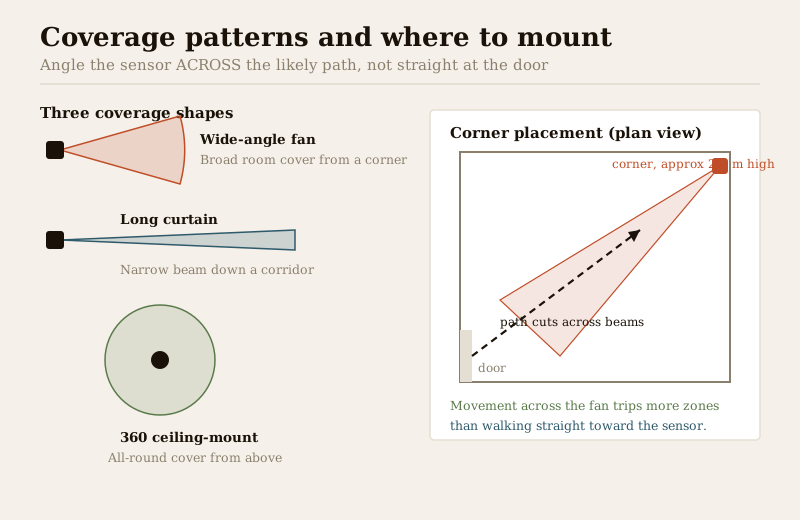
- Wide-angle "fan." The everyday pattern: a broad spread of zones from a corner covering most of a room. This is what you want for a living room, bedroom or hall.
- Long "curtain." A narrow, long throw for corridors, staircases and narrow passages, where you want reach down the length but no spill into rooms on either side.
- 360 ceiling-mount. An all-round pattern from a central ceiling point, useful for a square room, an open-plan space or a landing where a corner-mounted fan would leave gaps.
The single most useful placement principle sits inside that diagram: aim the fan so a person crosses the beams sideways, not walks straight down them. A PIR notices movement most sharply when a body passes across its zones — cutting through the fan lines one after another — and least sharply when someone walks directly toward it. So a sensor angled across the likely path into a room (across the hallway, across the landing) catches an intruder faster and more reliably than one pointed straight at the door they came through.
Placement, room by room
Coverage shape chosen, here is where the sensor actually goes. Height and corner position do most of the work.
| Location | Sensor + pattern | Mounting notes |
|---|---|---|
| Main hall / living room | PIR or dual-tech, wide fan | Corner mount ~2.2 m, aimed across the room's main path, away from fans and windows |
| Stair landing | PIR, curtain or wide fan | Covers the one route between floors almost everyone must cross — high value |
| Corridor / passage | PIR, long curtain | Mount at one end so the beam runs the length; keep spill out of side rooms |
| Bedrooms (when armed away) | PIR, wide fan | Corner away from the AC and window; pet-immune model if pets roam |
| Open-plan / large hall | 360 ceiling-mount or dual-tech | Central ceiling for even cover; dual-tech if fans or west sun cause trips |
| Garage / store / utility | PIR, wide fan | Watch for heat and insects near a light; keep the lens clear |
A few rules cut across every room:
- Mount high, in a corner. Roughly 2.2 metres on a wall, tucked into a corner, gives a PIR the widest useful spread and the cleanest downward view of the floor an intruder must cross. Too low and furniture blocks it; too high and the near-floor sensitivity suffers.
- Cover the choke point, not every square metre. One well-aimed sensor on the route everyone must use beats four sensors watching corners nobody crosses.
- Do not fight the architecture. In an apartment, the entry hall and the passage to the bedrooms are natural choke points; in a villa or independent house, the staircase and the internal lobby are the classics. Plan around them.
For a whole-home plan rather than one room, the layered-security design guide and the perimeter-vulnerability assessment show how motion sensors slot in behind the perimeter, and the apartment security guide has flat-specific placement.
Designing out false alarms — the honest bit
False alarms are the reason people switch alarms off and stop trusting them. In India the culprits are predictable, and every one of them is beaten by placement and the right technology — never by dulling the sensor down until it stops protecting you.
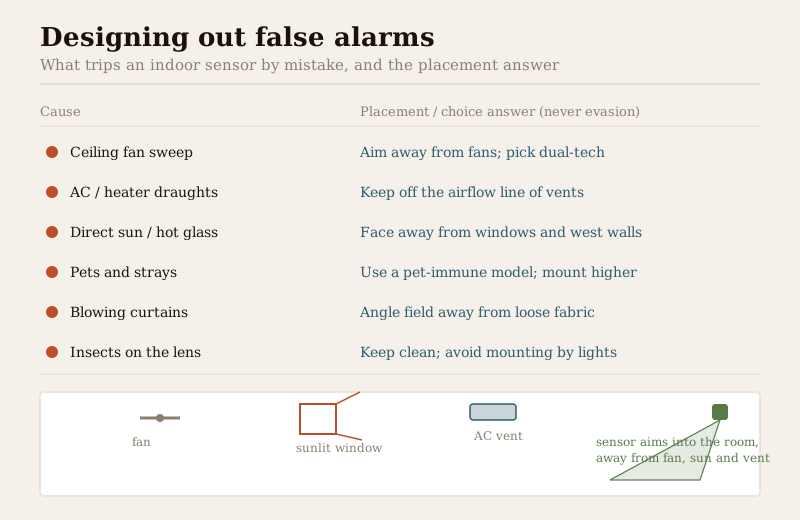
| What trips it | Why | The placement / choice answer |
|---|---|---|
| Ceiling fan | Moving blades and the warm air they push fool a lone PIR | Aim the field away from the fan; in fan-heavy rooms choose dual-technology |
| AC / heater draught | A moving front of warm or cold air reads like a moving body | Keep the sensor off the airflow line of the vent or split unit |
| Direct sun / hot glass | Sunlight sweeping a wall, or a hot west-facing window, shifts the heat picture | Face the sensor away from windows and sun-baked walls |
| Pets and strays | A dog, cat or the neighbourhood cat crossing the floor | Use a pet-immune PIR rated for the animal's weight; mount so the beam sits above pet height |
| Blowing curtains | Loose fabric moving in a breeze | Angle the detection field away from curtains and loose drapes |
| Insects / lizards | A moth or gecko crawling on the warm lens | Keep the lens clean; do not mount right beside a light that draws insects |
The through-line is simple: point the sensor at the space you want protected and away from the things that move on their own. A living-room sensor set in the corner opposite the fan and the west window, aimed into the room and slightly downward, sees an intruder crossing the floor perfectly while ignoring the fan spinning behind it. Where a room genuinely cannot avoid a fan or a sun-blasted wall in the sensor's view — a common problem in Indian homes — that is precisely the room to spend on dual-technology, which needs both radar and heat to agree and so shrugs off the fan that would trip a PIR alone.
Pets: choose the sensor, not a compromise
If pets have the run of the house, do not simply de-sensitise a normal sensor — that blinds it to a crouching person too. Buy a pet-immune PIR designed to ignore mass below a stated weight (commonly rated to around 18–25 kg depending on the model) while still catching an upright human, and mount it at the height the maker specifies. The dedicated pet-friendly motion sensors guide covers weight ratings, multi-pet homes and where these sensors reach their limits.
Layering motion with the perimeter
Motion sensors are strongest when they are the inner ring, not the only ring. Pair them with contacts on the openings so the system warns you at the boundary and again in the volume:
- Arm perimeter-only (door and window contacts, motion sensors sleeping) at night so the family can move around the house freely while the shell is watched.
- Arm perimeter plus motion when you leave, so any movement inside an empty house is caught even if a perimeter sensor is somehow missed.
- Keep at least one interior motion sensor on the main route in both modes as the safety net.
This is the same logic CCTV uses for interior cover — see how it maps to cameras in CCTV intrusion and zone detection and the CCTV motion-detection hub — and it dovetails with smart locks and access control on the doors themselves. For the big picture of how alarms, cameras and locks combine, the building security systems guide and the ultimate home-security guide tie the layers together.
Power, panels and the India reality
Two India-specific truths shape a motion-sensor install:
- Power cuts are routine, so the panel's battery backup is non-negotiable. A motion sensor is only as reliable as the panel it reports to; if that panel dies during a cut, the sensors are blind. Insist on a healthy backup battery and, for wired systems, a proper supply run by a professional — see the electrical hub.
- Most Indian alarms are self-monitored. A tripped motion sensor typically sounds a siren and pushes a GSM or app alert to you; professional monitoring with police auto-response is limited here. That makes placement quality matter even more — a false alarm you learn to ignore is a real alarm you will also ignore.
To narrow down which sensors and system suit your home and budget, the burglar-alarm system selector walks you through it, and the complete burglar-alarms guide is the pillar that ties the whole family together.
When to bring in a professional. Positioning and testing battery-powered wireless sensors you can reach is homeowner-friendly, and walk-testing coverage is something you should do yourself. Hand at-height mounting, hardwired sensor runs back to the panel, panel and mains wiring, and any work near the electrical board to a licensed installer or electrician. If a sensor keeps false-alarming after you have moved it away from fans, vents and sun, ask the installer about a dual-technology unit rather than turning sensitivity down — a dulled sensor is a false economy that can miss a real intrusion.
Key takeaways
- Motion sensors are the interior layer — they catch movement inside a room after the door and window contacts have watched the perimeter; use them as the inner ring, not the only ring.
- Know the family, then read the deep-dive: PIR is the low-power default, microwave shrugs off heat, dual-technology needs both to agree for far fewer false alarms, and ultrasonic is niche.
- Match the pattern, then place high in a corner at about 2.2 m and aim the fan across the likely path, not straight at the door — sideways movement is what a PIR notices best.
- Design out false alarms with placement, not by dulling the sensor: point it away from ceiling fans, AC vents, sunlit windows and curtains, use a pet-immune model where pets roam, and reach for dual-technology in rooms you cannot keep clear of fans or heat.
- Respect the India context: 45C heat cuts PIR range, power cuts make panel battery backup essential, and most systems are self-monitored — so trustworthy placement is what keeps the alarm believed.
References
- Manufacturer specifications and installation manuals — verify each sensor's detection technology, coverage pattern and range, mounting height, and any pet-immunity weight rating on the maker's own datasheet before buying or placing it; ranges quoted for PIR assume good heat contrast and shorten in extreme heat.
- Digital Personal Data Protection Act, 2023 — indoor motion logs and any linked camera footage are personal data; limit who can view "motion detected" records and access to the alarm app, and agree access terms with any installer in writing.
- Bureau of Indian Standards and the National Building Code of India (SP 7) for the electrical and life-safety aspects of any hardwired or mains-connected install — never let a sensor or its wiring obstruct a fire-escape route; verify the current edition via the BIS catalogue: https://www.services.bis.gov.in/
This is an educational overview, not legal or security-engineering advice. At-height mounting, hardwired runs and any mains-connected work are qualified professional tasks — engage licensed installers, and verify any standard's current status via the BIS catalogue before relying on it.
Export this guide
Related Guides — Deep-dive reading
How to Choose a Burglar Alarm in India (2026): Sensors, Alerts and What Actually Matters
A homeowner's guide to selecting an intruder alarm that fits your flat, villa or shop and alerts you the way you want — matching the sensor mix, control panel and the big siren-versus-monitored decision to your real risk, and dodging the false-alarm traps that make people switch systems off.
SecurityPIR vs Microwave Sensor (2026): Which Motion Sensor for Indian Homes?
A neutral head-to-head between passive-infrared (PIR) and microwave (radar) motion sensors for intruder detection in an Indian home — how each detects, where each false-triggers, how they cover a room, and why their opposite weaknesses make dual-technology the honest best-of-both.
SecurityFalse Alarm Prevention for Burglar Alarms in India: Causes & Fixes (2026)
Why home alarms cry wolf — ceiling fans, pets, heat, insects, weak batteries, power blips and poor door alignment — and how correct placement, the right sensors and simple upkeep keep the system trusted and armed.
SecurityRelated Tools — Try Free
Cross-Ventilation Analyzer
Estimate airflow and air changes per hour (ACH) from room size, window areas, layout, and local wind — with NBC 2016 Part 8 compliance check.
Ventilation CalculatorAccess-Control Battery-Backup Calculator
Size the standby battery so an access system keeps running through a power cut, with an egress life-safety note.
Battery BackupBurglar Alarm System Selector
Answer a few questions about your property, cabling, coverage, monitoring and power and get the right burglar alarm — wired / wireless / hybrid, self or professionally monitored — with the design non-negotiables.
Alarm Selector