
Alarm Monitoring Services in India (2026): Who Actually Watches and Responds
How professional central-station monitoring works, the honest reality of its limited reach in India, and how to decide between self-monitoring and a paid subscription for your home, shop, office or society.
When a burglar alarm goes off at 2 a.m. and no one is home, one question decides whether it matters: does anyone act on it? A siren rallies the street, an app buzzes a phone that may be on silent, but a true alarm monitoring service puts a manned control room behind the alarm — a professional Central Monitoring Station (CMS) that receives the signal, tries to verify it, and follows an agreed plan to get a response moving.
This guide is part of the Studio Matrx burglar-alarm hub and sits alongside the connectivity guides on GSM alarm systems and app-based alarm systems. It explains how professional monitoring works, and — most importantly — sets an honest picture of what it is and is not in India, so you plan a response chain that actually holds up on the night.
Scope & the honest reality. Most alarms in India are self-monitored: the alarm calls or messages you and a call-list, and a loud siren does the rest. Professional central-station monitoring exists but is limited — mainly in metros, from a handful of providers, on a paid subscription. And there is generally no automatic verified-alarm-to-police dispatch scheme in India like the UK or US. "Police response" realistically means a person verifies the alert and then calls the helpline (Dial 112 / 100). No service can promise guaranteed or automatic police arrival. Plan for siren-plus-neighbours-plus-guard first, then police. This is educational guidance, not legal advice.
What a monitoring service actually does
Strip away the marketing and a monitoring service is a chain of five steps that runs whether you are asleep, travelling, or standing in the shop next door.
1. Signal. Your alarm panel sends an event — "zone 3 triggered", "panic pressed", "mains lost", "line cut" — to the central station over its communication path: a GSM/cellular link, a broadband/IP connection, or (best) both, so one backs up the other.
2. Receive & identify. The central station's software logs the signal against your account: your name, address, system, zone map, and the plan you agreed.
3. Verify. A trained operator tries to confirm whether it is real or false — usually a phone call to you and your keyholders, sometimes by listening in on audio or looking at a linked camera view. Verification is the step that separates a professional service from a dumb auto-dialer, because it cuts the false dispatches that waste everyone's time.
4. Respond. If it cannot be dismissed as false, the station follows your written plan: keep calling keyholders, send a private response team or guard if that is part of the contract, and/or advise you so you can call the police helpline.
5. Log & report. Every event and action is time-stamped, giving you an audit trail — useful for insurance and for spotting a nuisance zone.
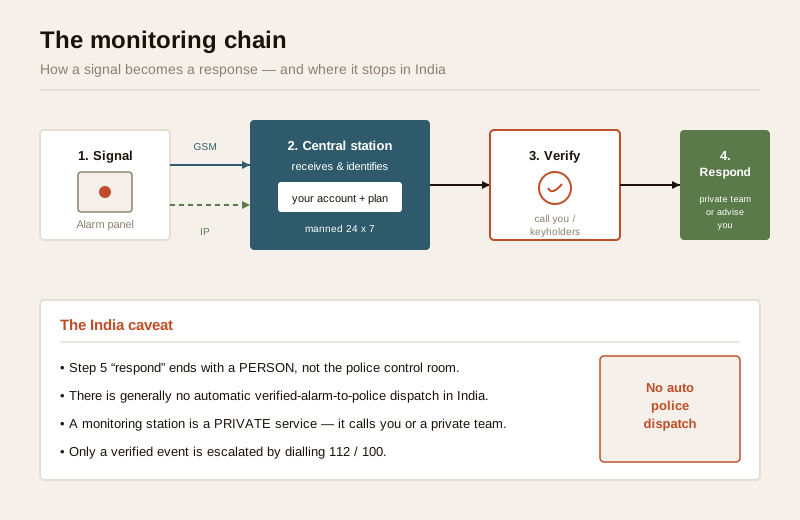
The alarm monitoring service is only ever as good as two things: the reliability of that first communication hop (a lapsed SIM or a dead router silently breaks the whole chain — see the GSM guide for the SIM-validity gotcha), and the honesty of what "respond" means in your specific contract.
Self-monitored vs professionally monitored: the real trade-off
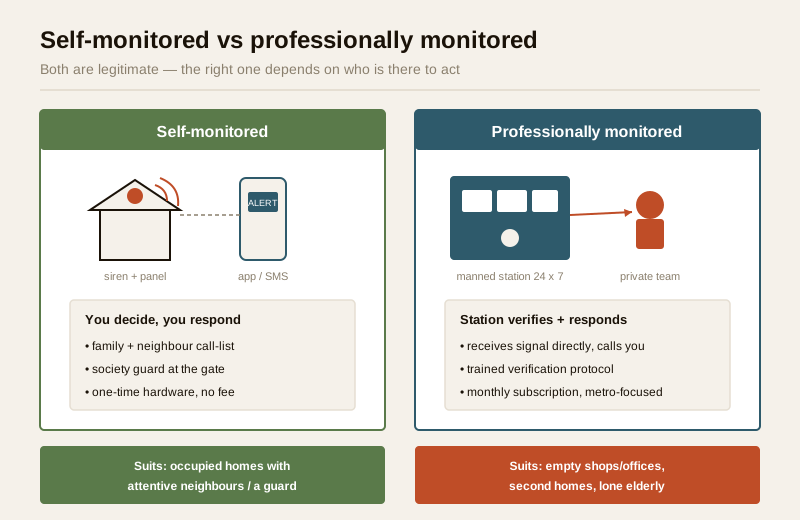
This is the decision most Indian households and small businesses actually face. Both are legitimate; the right answer depends on who is available to act and what is at stake.
| Self-monitored | Professionally monitored (CMS) | |
|---|---|---|
| Who watches | You + a call-list (family, neighbour, society guard) | A manned central station, 24×7 |
| How you learn of an alarm | GSM call/SMS or app push to your phone | Station receives the signal directly and calls you |
| Verification | You judge it yourself (or ignore a missed call) | Trained operator follows a verification protocol |
| Response | Whoever you can reach; siren rallies neighbours/guard | Per contract: keyholder calls, private guard/team, or advise-and-relay |
| Works when your phone is off/asleep | No — a missed alert is a missed alarm | Yes — the station is always staffed |
| Cost | One-time hardware only | Hardware + ongoing subscription |
| Availability in India | Everywhere | Mainly metros / larger cities, few providers |
Self-monitoring is the honest default for most Indian homes. A wireless or hybrid alarm with a loud siren, a GSM dialer and a good app, backed by a real call-list of a neighbour and the society guard, covers the large majority of break-in scenarios — deter, alert, rally help. Its weak point is obvious: if every number on the list has a phone on silent, nobody acts.
Professional monitoring earns its subscription when a missed alert is unacceptable and there is genuinely no one to rely on to pick up. It is worth a serious look for:
- A shop, showroom or office left empty overnight and on holidays, where a break-in is a direct financial loss and there is no resident to hear a siren.
- A frequently-empty home — owners who travel a lot, a second home, or a house locked up for weeks.
- Elderly residents living alone, where a panic button or duress alarm needs a guaranteed human on the other end, not a call-list that may be asleep.
- A business with insurance or compliance conditions that specify monitored protection.
The honest India picture — read this before you buy
Marketing brochures blur the line between "monitored alarm" and "police will come". Keep these facts straight:
- Professional monitoring is not the norm here. The default Indian setup is self-monitored. Central-station services exist and are growing, but coverage is concentrated in metros and larger cities, offered by a limited number of providers, and always on a paid subscription.
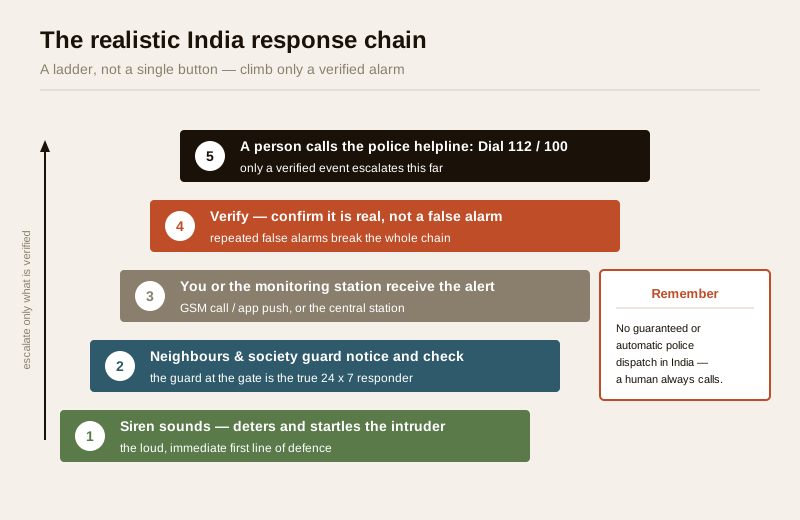
- "Monitoring" is not "police response". A central station is a private service. In India there is generally no formal verified-alarm-to-police auto-dispatch programme, so even a monitored alarm ends with a human deciding to call the police helpline. See police response integration for exactly how that hand-off works and why you should never assume automatic arrival.
- A guard is often the real responder. In a gated community or apartment block, the practical 24×7 responder is the society guard at the gate, reachable in seconds, not a distant control room. For many societies, a well-briefed guard plus a resident call-tree is a more realistic response than a subscription — see the gated-community and apartment security guides.
- False alarms erode the whole chain. Repeated false triggers train your neighbours, your guard and any responder to ignore the alarm — the "cried wolf" problem. Verification (by you or by the station) before escalating is what keeps a response credible.
So the realistic India response chain is a ladder, not a single button: the siren and neighbours/guard act first, you or the station verify, and only a verified event escalates to the police helpline.
What to check before signing with a provider
If you decide a subscription is worth it, the contract — not the sales pitch — is what you are buying. Insist these points are answered in writing before you pay.
| What to check | What good looks like |
|---|---|
| What "response" actually means | Spelled out: a verification call only? Calling keyholders? A physical private guard/team dispatched? Just relaying to you? Vague "we respond" is a red flag |
| Verification process | A defined protocol (call you, call keyholders, camera/audio check) to cut false dispatch — not a blind auto-dial |
| Response time / SLA | A written target for their action (call within X minutes, team dispatched within Y), with what happens if they miss it |
| Coverage in YOUR city | Confirm the monitoring — and any physical response team — actually covers your specific area, not just "pan-India" on paper |
| False-alarm policy | How false alarms are handled, any charges, and whether repeated ones suspend response |
| Communication paths | Dual-path (GSM + IP) and how they alert you if the alarm goes offline (line-cut / SIM-lapse / mains-loss supervision) |
| Contract & exit | Term length, notice period, and that on exit all access is revoked and your data returned |
| Data handling (DPDP) | Who at the provider can see your alarm/camera data, how it is stored, and that it is handled under the Digital Personal Data Protection Act, 2023 |
A few extra sanity checks: ask how the station itself stays up in a power cut or internet outage (a monitoring room that goes dark in load-shedding is no monitoring at all); ask whether the "response team" is their own staff or sub-contracted; and treat the connected alarm as the networked device it is — strong unique passwords, 2FA on the app, and firmware kept current, since a monitored system is only trustworthy if it cannot be tampered with remotely.
When to bring in a professional. Route any SIM, network, mains or panel wiring to your installer or a licensed electrician — see the electrical hub. Contract central-station monitoring only with a reputable, verified provider, and get the response definition, SLA, city coverage and data terms in writing. If your system covers a business or a society, have the pillar guide and the selector tool shape the brief, and fold monitoring into a wider emergency plan rather than treating a subscription as a complete answer.
Rough Indian cost bands
Subscriptions vary widely by provider, city, and whether a physical response team is included, so treat these as ballparks to sanity-check a quote, not fixed rates.
| Service level | Typical band (₹) |
|---|---|
| Self-monitored (no subscription) | one-time hardware only |
| Central-station monitoring, verify-and-relay only | ₹500 – ₹1,500 / month |
| Monitoring + private guard/team response (metro) | ₹1,500 – ₹5,000+ / month |
| Business / commercial monitored package | negotiated per site |
For a small, occupied home with attentive neighbours, the honest advice is often to spend on a good audible siren, a reliable GSM path and a real call-list rather than a monthly fee. For an empty shop, a lone-elderly household, or a high-value business, a monitored subscription with a clear response definition can be money well spent.
Key takeaways
- An alarm monitoring service is a manned central station that receives your alarm signal 24×7, verifies it, and acts on a written plan — signal, receive, verify, respond, log.
- Professional monitoring in India is limited to mainly metros and a few providers on a paid subscription; most Indian alarms are self-monitored (owner + call-list + siren), which is a legitimate default for an occupied home.
- Monitoring is not police response. There is generally no automatic verified-alarm-to-police dispatch in India — a human still verifies and calls Dial 112 / 100; never assume guaranteed arrival.
- A subscription earns its cost for empty shops and offices, frequently-empty or second homes, lone elderly residents, and businesses with insurance conditions; in a society, a briefed guard is often the real responder.
- Buy the contract, not the pitch: pin down what "response" means, the verification process, a written SLA, coverage in your city, false-alarm policy, exit terms, and DPDP-compliant data handling.
References
- National Emergency Response System — Dial 112 (and legacy Police 100). Any alarm response chain in India ends with a person calling the official police helpline; there is no automatic verified-alarm-to-police dispatch scheme nationally. Confirm your local helpline and any city-specific alert facility.
- Digital Personal Data Protection Act, 2023 — alarm, verification-call and any linked camera data are personal data; agree in writing who at a monitoring provider may access it, how it is stored, and that access is revoked on exit.
- Manufacturer specifications — verify the alarm panel's supported communication paths (4G/LTE cellular, IP), dual-path failover, and central-station reporting protocol on the maker's own datasheet before assuming a system can be professionally monitored.
- National Building Code of India (SP 7), Bureau of Indian Standards, and local bye-laws for any electrical or life-safety aspect of an install; verify the current edition via the BIS catalogue: https://www.services.bis.gov.in/
This is an educational overview, not legal advice. SIM, network, mains and panel work are qualified professional tasks — engage licensed installers, contract monitoring only with a verified provider, and confirm official emergency numbers and any standard's current status before relying on them.
Export this guide
Related Guides — Deep-dive reading
Police-Response Integration for Alarms in India (2026): The Honest Reality
What police response really means for a home or shop alarm in India: not an automatic police car, but a fast verified alert, a siren, neighbours and the guard first, then a person calling 112.
SecuritySecurity for People Living Alone in India (2026): Calm, Practical Habits When There Is No Second Person to Notice
Living alone is an ordinary and growing part of Indian life - the student in a new city, the working single, the elder whose children are abroad, the person after a separation. It does not call for fear. It calls for a few deliberate habits, because there is no second person in the home to notice trouble, raise the alarm, or catch an accident. This is calm self-reliance, layer by layer.
SecurityRemote Security Monitoring in India (2026): Watching and Responding From Anywhere
Watching your home from your phone is easy; making an alert lead to a real response is the hard part. The two honest models compared — self-monitoring by you and your family versus a paid professional monitoring centre — plus the secure tech behind remote access, the privacy stakes of a stranger watching inside your home, and why remote monitoring is only ever as good as the responder behind it.
SecurityRelated Tools — Try Free
Burglar Alarm System Selector
Answer a few questions about your property, cabling, coverage, monitoring and power and get the right burglar alarm — wired / wireless / hybrid, self or professionally monitored — with the design non-negotiables.
Alarm SelectorApartment Video Door System Planner
Enter flats, entrances, floors and guard desk for a first-pass building intercom plan — door stations, indoor monitors, guard station, the right architecture and an indicative cost band.
Building PlannerCCTV Camera Coverage & Count Calculator
Estimate how many CCTV cameras you need, the NVR channels, storage in TB for your retention period, and an indicative all-in cost with GST.
CCTV Calculator