
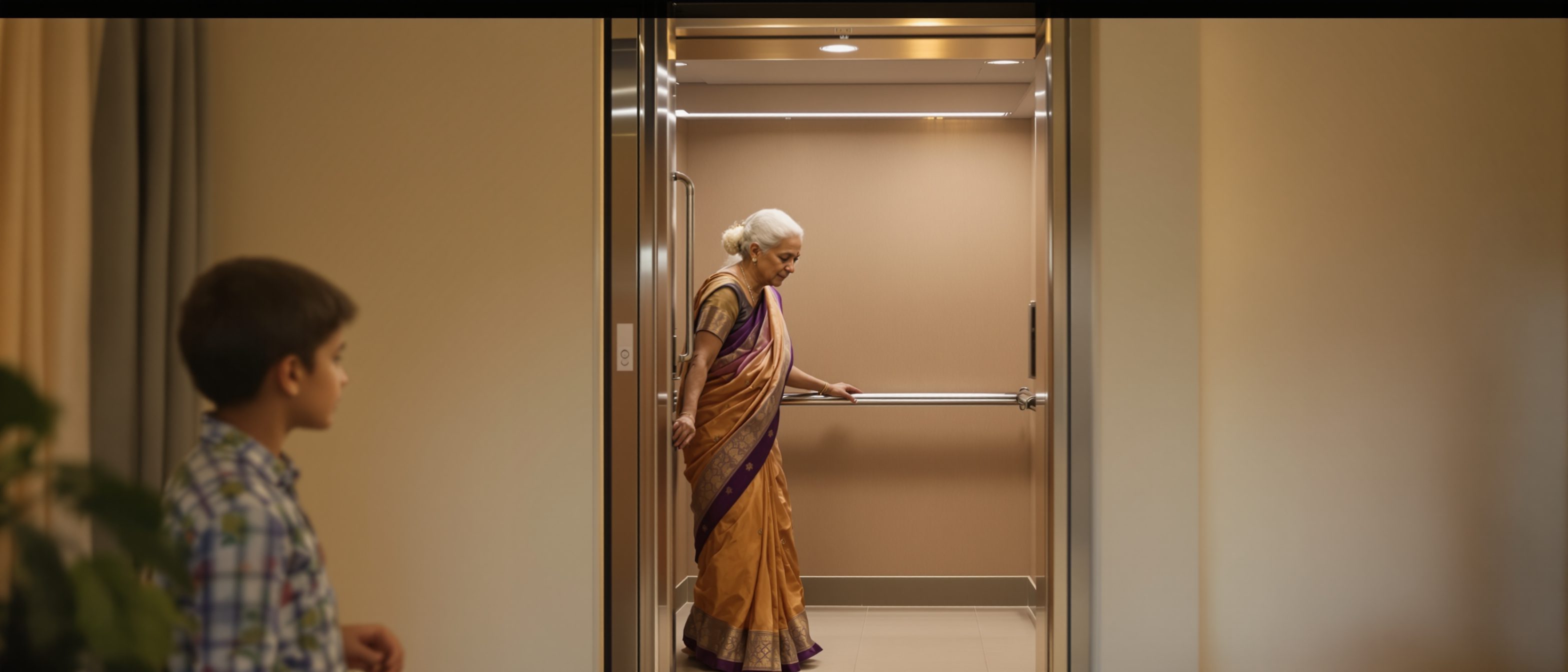
Lift Planning for Senior-Friendly Homes (India): Ageing in Place, with the Lift at the Centre
When stairs become a barrier with age, the home lift is the heart of an ageing-in-place plan. How to choose it over a stairlift, specify it for an older user, place it for daily use, and plan for a parent moving in.
There is a quiet moment in many Indian family homes when the stairs stop being a convenience and start being a barrier. A parent who once ran up two flights now pauses at the bottom, plans the trip, climbs slowly with a hand on the wall, and increasingly just stays put on whichever floor they happen to be on. The bedroom drifts downstairs, the terrace garden goes unvisited, the joint-family upstairs becomes a place they are carried up to only on festival days. When that happens, the question is rarely "should we move to a smaller place" and far more often "how do we make this house work for the rest of our lives".
For a multi-storey home, the honest answer is almost always a lift. Not as a luxury and not as an afterthought bolted into a corner, but as the centre of an ageing-in-place plan — the single element that keeps every floor reachable, every day, by someone who can no longer take stairs safely. This guide is about planning the home around that lift: when stairs become the barrier, how a lift compares with the alternatives for older people, exactly what a senior-friendly lift specification looks like, where to place it for effortless daily use, and how to plan when a parent is about to move in.
Stairs are the first thing a multi-storey home asks of you every single day. A lift is how you stop the house asking.
This is the senior-living companion to our broader accessible home design guide for India, which covers the whole-house picture — ramps, doorways, bathrooms, thresholds, lighting. We will not repeat that here. This guide stays tightly on the lift as the heart of the ageing-in-place home, and links out for the rest. For the engineering and regulation behind any home lift, the architect's residential elevator handbook is the pillar; and before you buy, read the residential elevator buyer's guide.
When stairs become a barrier
Ageing rarely announces itself. It shows up as small accommodations that quietly accumulate. Recognising them early matters, because the cheapest, least disruptive time to plan a lift is before a fall, not after one.
Watch for the pattern, not a single event:
- Trip-batching. A parent stops making separate trips up and down — they carry everything in one go, or simply do without, because each flight is now an effort to be rationed.
- The handrail becomes load-bearing. Where the rail was once reassurance, it is now genuinely taking weight on every step.
- Knees, hips, breath. Osteoarthritis, post-replacement recovery, cardiac or respiratory limits, and reduced balance all make stairs the single most dangerous architectural feature in the home.
- The world shrinks to one floor. The clearest signal: someone has effectively stopped using part of their own house.
- A fall, or a near-fall. Stair falls in older people are a leading cause of serious fracture and the loss of independence that often follows. If one has happened, treat the lift decision as urgent, not aspirational.
The crucial reframing for families: a lift is not an admission of frailty. It is the thing that prevents frailty from deciding which rooms a person is allowed to live in. A well-placed home lift lets a parent keep their upstairs bedroom, keep tending the terrace, keep being part of the household on every level instead of being marooned on the ground floor.
Lift versus stairlift versus platform lift
When stairs become the barrier, three machines compete to solve it. They are not interchangeable, and for genuine long-term ageing-in-place the differences matter a great deal.
A stairlift is a motorised chair that rides a rail bolted to the staircase. It is the cheapest and least disruptive to install — no shaft, no pit, often fitted in a day. But it carries only a seated person, not a wheelchair or a walker; the user must be able to transfer onto and off the seat unaided or with help; it does nothing for carrying luggage, laundry or a tray of tea; and it leaves the user dependent on someone else to bring their walking aid up or down. For a couple where one partner is mobile and the other has a temporary or moderate limitation, a stairlift can be reasonable. For a future that may include a wheelchair, it is a dead end.
A platform (or wheelchair) lift carries a person seated in their wheelchair on an open platform, usually over a short vertical rise or one storey, often at slow speed with hold-to-run controls. It is genuinely wheelchair-friendly and cheaper than a full lift, but it is best for short travel and limited stops, can feel institutional, and is not the elegant whole-house solution most Indian homes want for two or three full floors.
A home lift — an enclosed car running in a shaft (or, for a retrofit into an existing home, a shaftless pneumatic vacuum unit) — is the only option that serves every floor, every mobility level, for the whole life of the home. It takes a person standing, seated, on a walker, or in a wheelchair, with an attendant; it carries the shopping and the suitcase; it is the future-proof choice. It is also the most expensive and, in a new build, the most demanding spatially and structurally. For ageing in place across multiple full storeys, it is almost always the right answer.
The comparison below makes the trade-off explicit.
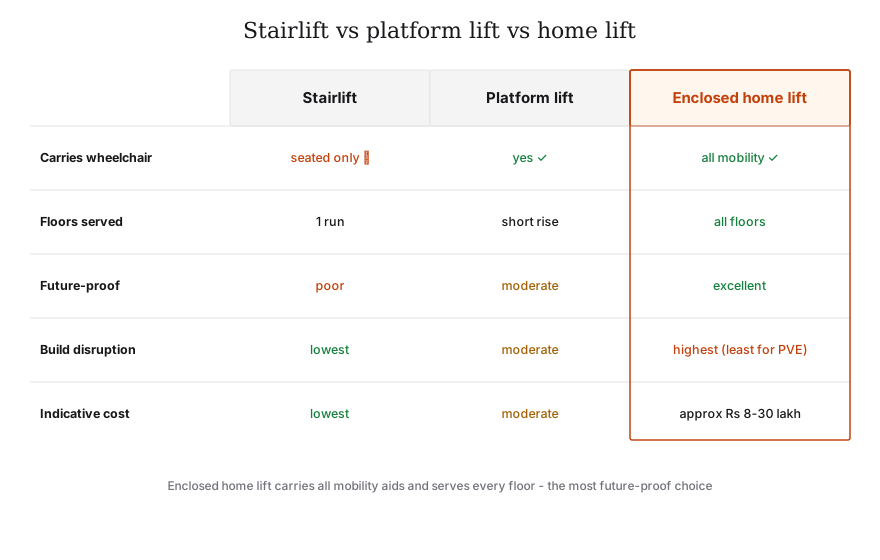
| Criterion | Stairlift | Platform lift | Home lift (enclosed car) |
|---|---|---|---|
| Carries a wheelchair | No — seated user only | Yes | Yes (with attendant) |
| Carries luggage / laundry | Awkward, on the lap | Limited | Yes |
| Floors served well | One staircase run | Short rise / 1 stop | All floors, 2–8 persons |
| Travel comfort | Slow, exposed | Slow, open platform | Smooth, enclosed, seated if needed |
| Build disruption | Lowest — fits to existing stair | Moderate | Highest (shaft/pit) — least for PVE retrofit |
| Future-proof for decline | Poor | Moderate | Excellent |
| Indicative cost (India 2026) | Lowest of the three | Below a full lift | Roughly ₹8–30 lakh by type |
The cost figures are indicative only — confirm with a licensed lift contractor and your local bye-laws. Home-lift pricing by type runs roughly: hydraulic ₹8–20 lakh, traction/gearless ₹10–25 lakh and up, pneumatic vacuum ₹11–22 lakh, screw-driven ₹14–30 lakh; GST at 18 percent applies and civil work plus installation are usually extra. The full breakdown is in our home lift cost guide for India 2026.
A stairlift solves this year's problem. A home lift solves the rest of the decade.
The senior-friendly lift specification
A home lift that is merely "a lift" is not automatically a good lift for an older person. The difference between a car a frail parent can use confidently alone and one that quietly frightens them is a handful of specification decisions — most of which cost little if you ask for them up front, and a fortune to add later.
These features draw on the CPWD / MoHUA Harmonised Guidelines for a Barrier-Free Built Environment, which set the accessibility benchmark in India even though private homes are not legally bound by the RPwD Act 2016 the way public buildings are. Treat them as the right standard to design to, not as optional extras.
The single most important one for India deserves naming first. An Automatic Rescue Device (ARD) is a battery that, on a power cut, drives the car to the nearest landing and opens the doors automatically. In a country where outages are routine, a lift without an ARD will eventually trap whoever is inside when the power drops — and for an older person alone in the house, being stuck between floors in the dark is exactly the emergency the lift was supposed to prevent. Never buy a senior's lift without an ARD. We return to how it behaves below.
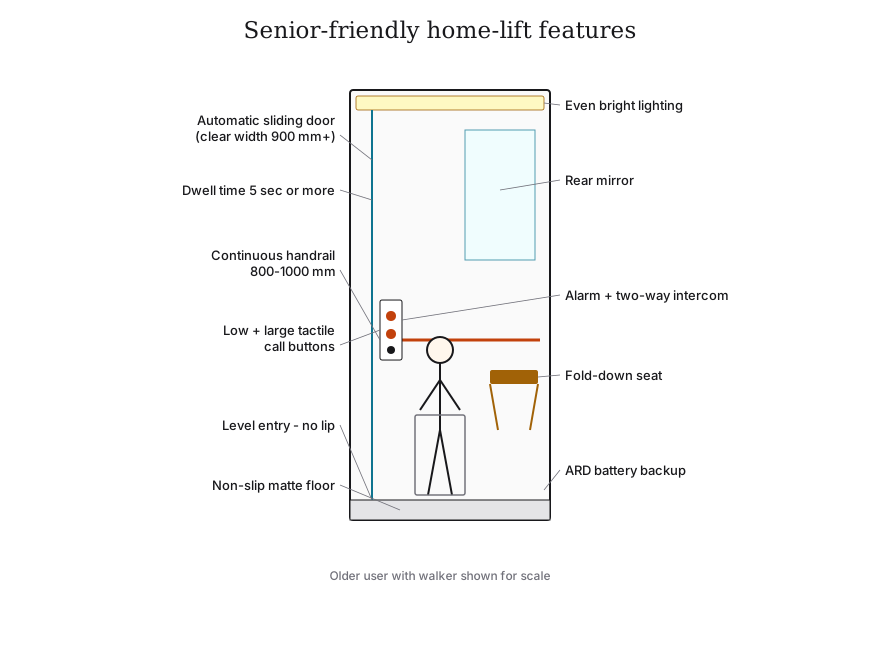
The full senior specification, with the reason for each item:
| Feature | Senior-friendly specification | Why it matters for an older user |
|---|---|---|
| Doors | Automatic telescopic/sliding, clear width 900 mm or more, dwell time at least 5 seconds | Manual swing doors are hard to pull and block a walker/wheelchair; a slow auto-close gives time to move in and out |
| Car size | Large enough for a wheelchair plus attendant — around 1100 × 1400 mm | Lets a carer travel alongside; takes a walker without folding |
| Level entry | Car floor flush with the landing, no lip or step | A 20 mm threshold is a trip hazard and a wheelchair barrier |
| Fold-down seat | Wall-mounted tip-up seat in the car | Lets a frail user sit for the ride; vital if standing or balance is poor |
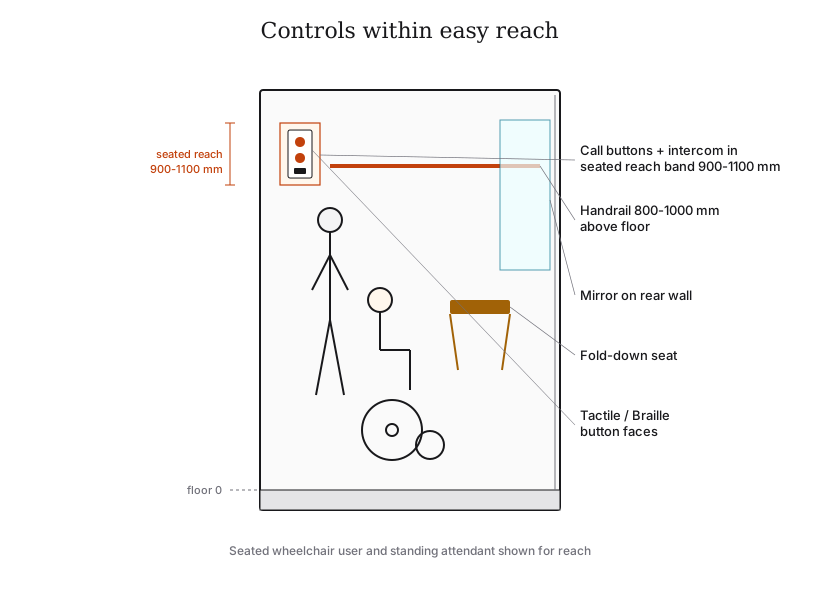
| Continuous handrail | Rail 800–1000 mm above the floor, at least 600 mm long, near the controls | Steadies the user on entry, exit and the move; a fixed point to hold |
| Call/control buttons | Mounted low and reachable from a seated position, large faces, Braille/tactile, clear tactile feedback | Reachable from a wheelchair; usable by stiff fingers and weak eyes |
| Floor finish | Non-slip, matte, no glare | Reduces slip risk; glossy floors look like steps to ageing eyes |
| Lighting | Even, bright, no dark corners or harsh shadow | Older eyes need far more light; shadows read as hazards |
| Indicators | Audio plus visual floor announcements | Serves low vision and low hearing alike |
| Mirror | On the rear wall | Lets a wheelchair user reverse out safely and see behind |
| Emergency | Alarm button plus two-way intercom, both reachable seated | Summons help without a phone; reassurance for someone alone |
| Power rescue | ARD battery backup as standard | A power cut returns the car to a floor and opens the doors |
Two car layout details are worth insisting on. First, the controls inside the car and the call buttons at each landing should sit at a height a seated person can reach — typically 900–1100 mm — not at the standing chest height vendors default to. Second, ask the vendor to confirm door dwell time can be extended; the standard five seconds suits a brisk adult, and an older user with a walker often needs more.
For the complete, vendor-ready version of this specification — the document you hand to the contractor — use our lift specification checklist for India.
How the ARD keeps a power cut from trapping anyone
Because it is the feature most often skipped and most consequential for a senior, it is worth being precise about how the Automatic Rescue Device behaves, so a family knows what they are buying and how to reassure an anxious parent.
In normal running, the lift draws from mains power. The ARD is a charged battery pack and a small controller that sit dormant in the background. The moment mains power fails — a load-shed, a tripped main, a transformer fault — the controller senses the loss and, after the car has safely stopped, drives the car at low speed to the nearest landing and opens the doors automatically. The occupant simply steps out. There is no winding handle to find, no waiting for a technician, no being stuck between floors. On most systems the rescue runs within seconds of the outage.
This is categorically different from a lift with no battery, where a power cut leaves the car frozen wherever it stopped, doors shut, until either power returns or someone performs a manual lowering from the machinery — a procedure no older person should ever depend on.
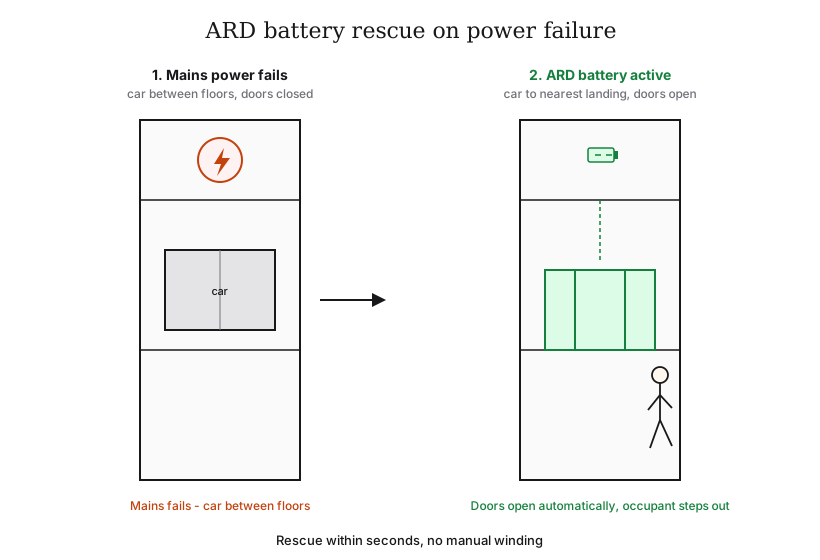
Pair the ARD with the emergency alarm and two-way intercom, both reachable from a seated position, and you have covered the two fears that keep older people from using a lift alone: being trapped, and being unable to call for help. The intercom should connect somewhere that is actually answered — a relative's phone or a monitored line — not a dead handset in a basement.
Placing the lift for easy daily use
A senior-friendly lift in the wrong place is a half-solution. The goal is that the lift becomes the natural, shortest, step-free path between the rooms an older person uses most — not a detour they have to think about and often skip.
Plan placement around the daily journeys, not the floor plan's leftover corner:
- Connect the bedroom to the living and dining floors. If the parent's room is upstairs, the lift should open close to it on one end and close to the kitchen/living area on the other, so the everyday trip — bed to breakfast — is one short, level walk and one lift ride.
- Land step-free at both ends. The approach to the lift and the exit from it must be level. This is where this guide meets the accessible home design guide: the lift only delivers a step-free home if the corridors, thresholds and the path to the front door are step-free too.
- Keep the run short and obvious. An older person should not have to navigate a long corridor or a tight turn with a walker to reach the car. Place the lift on the main circulation spine.
- Allow turning space at each landing. A wheelchair or walker needs room to approach the doors square-on and turn — a landing lobby of roughly 1800 × 1800 mm is the accessible benchmark.
- Light the approach generously, with switches at a reachable height and ideally motion sensing, so no one fumbles for a switch in a dark passage on the way to the lift.
- Sit it beside the stair, not instead of it. Younger family members and carers will still use stairs; integrating the lift next to the stair core keeps both available and is structurally efficient. See integrating a lift with the staircase.
Many Indian families will also weigh Vastu in placing the lift. The traditional guidance favours the north or north-east, accepts the south-east or north-west, and avoids the south-west, the exact centre, and a position directly opposite the main door. Treat this as a cultural preference to reconcile with the practical layout, not as engineering — where Vastu and the older person's daily convenience or safety conflict, convenience and safety should win. For the tradition itself, see lift placement and Vastu, staircase Vastu and the Vastu house plan guide.
Placed well, a senior never has to plan a trip between floors. They just go.
Planning for a parent moving in
A very common Indian scenario: a parent in their seventies or eighties is moving in with an adult child's family, often into a home that already has two or three floors. The lift decision suddenly has a name and a timeline attached. A few things change when you are planning around a specific incoming person rather than a hypothetical future self.
Decide the parent's floor first, then plan the lift to serve it. Ideally the parent's bedroom, an accessible bathroom and the main living floor are all connected by the lift with no stairs in between. If the parent's room must be upstairs, the lift becomes non-negotiable.
Time it against the move-in, not "someday". A new build can design the lift in from the start, which is far cheaper and cleaner. An existing home means a retrofit — and here the shaftless pneumatic vacuum lift is often the least disruptive option, needing no pit, no shaft and no machine room, though with a smaller car (around two to three persons). Build lead times and licensing into the plan: in the roughly ten states that regulate lifts (including Maharashtra, Gujarat, Karnataka, Kerala, Tamil Nadu, Delhi, Haryana and others), an installation licence before commissioning and periodic inspection by the state lift inspectorate are typically required — verify with your local authority.
Match the car to the parent, with headroom for decline. If the parent already uses a wheelchair or walker, the car must take it today. If they walk now but are frail, specify the wheelchair-capable car anyway — you are buying for the next ten years, not this month. Add the fold-down seat regardless.
Brief the parent and rehearse. A lift only helps if the person uses it confidently. Walk them through the buttons, the alarm, the intercom and — especially — what happens in a power cut, so the ARD is a known comfort rather than an unknown fear. Reachable, large, tactile controls and a clear intercom do most of this work.
Provision even if you cannot install yet. If the budget or timing does not allow a lift now, at least leave the structural and spatial provision so it can be added with minimal upheaval later. Our lift-ready future-proof home guide covers exactly this — a stacked cupboard column or a provisioned shaft that becomes a lift the day it is needed.
For homes where the geometry is the constraint — a duplex, a villa, or a tight urban plot — the placement logic above still holds; see lift planning for duplex homes, lift planning for villas, and lift design for narrow plots.
The short version
For a multi-storey home where someone is ageing, the lift is not an accessory — it is the device that decides whether every room of the house stays in that person's life. Choose an enclosed home lift over a stairlift or platform lift when the future may include a wheelchair and you need every floor served. Specify it for the senior, not the catalogue: automatic doors with a generous dwell, level entry, a fold-down seat, a continuous handrail, low and large tactile controls, non-slip floor, even light, audio-visual indicators, a reachable alarm and intercom, and — above all in India — an ARD battery so a power cut never traps anyone. Place it on the daily path between bedroom and living floor, step-free at both ends. And if a parent is moving in, plan the lift to the person and the move-in date, not to "someday".
Then read the accessible home design guide for everything around the lift, and the architect's residential elevator handbook for the engineering beneath it.
References
- IS 14665 — Electric Traction Lifts (Bureau of Indian Standards): outline dimensions, installation, safety rules and components for passenger lifts. Part 1: https://law.resource.org/pub/in/bis/S05/is.14665.1.2000.pdf ; Part 2: https://law.resource.org/pub/in/bis/S05/is.14665.2.1-2.2000.pdf
- National Building Code of India 2016, Part 8 (Building Services), Section 5 — Installation of Lifts, Escalators and Moving Walks (BIS): https://www.bis.gov.in/standards/technical-department/national-building-code/ ; Guide for Using NBC 2016: https://www.bis.gov.in/wp-content/uploads/2022/08/Booklet-Guide-for-Using-NBC-2016.pdf
- Rights of Persons with Disabilities (RPwD) Act 2016 — accessibility standards and obligations (binding on public buildings; the best-practice benchmark for homes): https://ssepd.odisha.gov.in/sites/default/files/2024-01/RPWD%20ACT.pdf ; Department of Empowerment of Persons with Disabilities: https://depwd.gov.in/en/faqs-4/
- CPWD / MoHUA Harmonised Guidelines and Space Standards for a Barrier-Free Built Environment — accessible-lift dimensions, door width, handrail height, tactile controls, mirror and lobby standards: https://www.cpwd.gov.in/Publication/Harmonisedguidelinesdreleasedon23rdMarch2016.pdf
- State Lift Acts (lifts are state-regulated; licence and inspection vary by state) — e.g. Maharashtra Lifts, Escalators and Moving Walks Act 2017; Karnataka Lifts, Escalators and Passenger Conveyors Act 2015; Delhi Lifts and Escalators Act 2007; Tamil Nadu Lifts Act 1997. Maharashtra licence to operate a lift: https://services.india.gov.in/service/detail/maharashtra-license-to-operate-lift ; overview of lift regulations in India: https://www.99acres.com/articles/know-all-about-the-lift-regulations-in-india.html
All dimensions, cost ranges and regulatory triggers above are indicative for India in 2026 and vary by state, vendor and year. Confirm specifications with a licensed lift contractor and your local municipal bye-laws before you commit.
Export this guide
Related Guides — Deep-dive reading
Universal Design Doors for Indian Homes: Inclusive Doors That Work for Everyone (2026)
How to design and specify doors that serve children, the elderly, pregnant women, the injured and wheelchair users by default - generous width, lever handles, near-flush thresholds, low-force closing, contrast and good lighting - without your home ever looking medical.
Home Doors & EntrancesSenior Citizen Safety Features in Home Elevators (India)
The cabin and control features that make a home lift genuinely safe and easy for an older person — automatic doors, level entry, handrail, fold-down seat, reachable contrasting controls, ARD and an alarm pendant.
Home Lifts & AccessibilityDesigning Adaptable & Universal-Design Homes
Accessibility, Aging-in-Place, and the Multi-Stage Family — Code, Anthropometrics, and Plan-Stage Discipline for Indian Residential Architects
Room PlanningRelated Tools — Try Free
Home Lift Comparison Tool
Compare hydraulic, traction, pneumatic vacuum and screw lifts side by side for your home.
Lift ComparisonAccessibility Compliance Calculator
Check a planned lift against the CPWD and RPwD accessible-lift benchmarks for a score.
Lift CheckerElevator Capacity Calculator
Pick the right home-lift capacity — 2 to 8 person — with car size and wheelchair fit.
Lift Calculator