
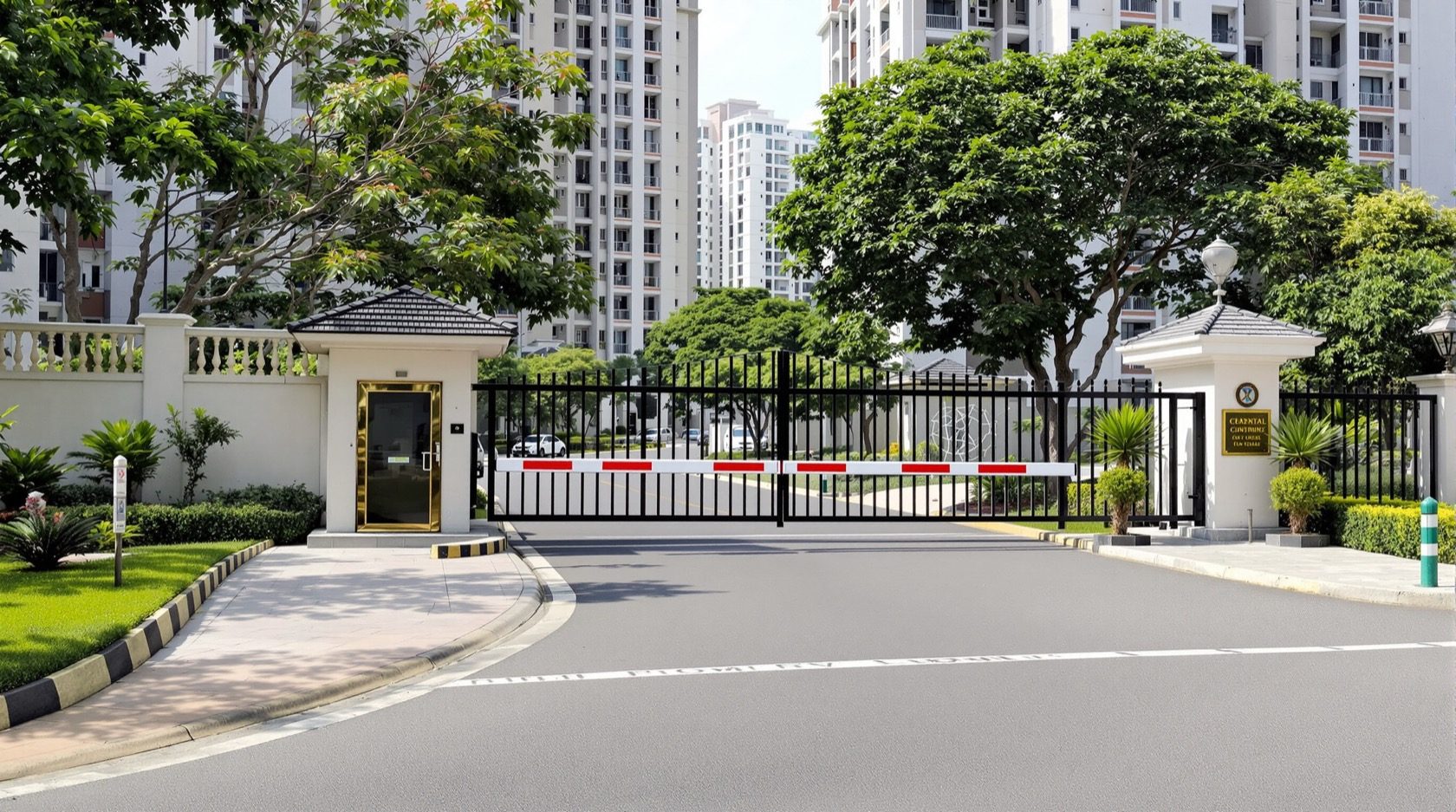
Security Guide for Gated Communities
Community-scale security for Indian gated layouts and apartment complexes — perimeter and gate integrity, RFID and app-based visitor management, boundary CCTV, guard SOPs, and the tailgating and insider-access problem that makes gated NOT the same as safe. Written for residents and RWA or management committees.
A gate at the entrance feels like security. It rarely is, on its own. Across Indian cities, the phrase "it is a gated community" does a lot of quiet reassuring — and hides the fact that most gated layouts and apartment complexes have one hardened point (the main gate) and a long, soft boundary that almost nobody is watching. The comfort of the gate is exactly what makes residents drop the ground-floor habits that actually protect a home.
This guide is for the two people who decide community security in India: the resident who wants to understand what protects their family, and the RWA or management committee member who has to budget for it, buy it, and run it. It takes the general principles from the Studio Matrx Security Knowledge Hub and makes them specific to gated layouts, high-rises and plotted enclaves.
Scope & safety. This guide helps you assess, plan, decide and coordinate community security. Fire detection and alarm, electronic access control and boom-barrier interlocks, mains electrical, and structural perimeter (gates, walls, bollards) are life-safety-critical: specify them, then engage a qualified security consultant and licensed installers to design, install and certify them. Security hardware must never obstruct a fire-escape route or a fire-tender access lane. Nothing here replaces a site-specific assessment.
"Gated" does not mean "safe"
The single most important idea in community security is that a boundary and a gate only work if entry is actually controlled and the boundary is actually watched. Two failures undo most gated communities:
- Tailgating. A vehicle or person follows an authorised one through the boom barrier or gate before it closes. A car waved through, a two-wheeler slipping behind it, a "delivery boy" walking in on the heels of a resident — the gate opened once and two entities went through. This is the most common single failure at Indian complexes, and it is a procedure problem more than a hardware one.
- Insider access. The people already inside — domestic staff, drivers, cooks, maintenance, packers, contractors, tutors — vastly outnumber outsiders, and are far more likely to be involved in a theft. Most in-community incidents trace back to someone with routine, trusted access, not a stranger scaling a wall.
Neither is solved by a taller gate. Both are solved by controlled, logged, verified entry, a watched boundary, and discipline that the RWA sets and the security agency enforces. Run your own community through the home security risk scorecard and the deeper method in the security risk assessment guide before you spend on hardware.
The community as concentric rings
Community security, like home security, works in layers — but here the layers are shared, and the argument over who owns and pays for each one is where most RWA security fails. Map your community as concentric rings, from the outer boundary inward to each front door.
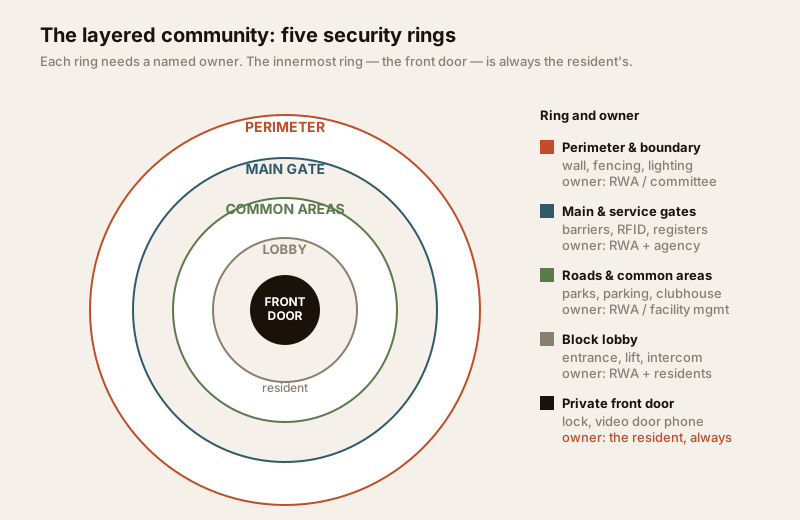
The rings only protect residents if every ring has a clear owner. Ambiguity — "the guard should have seen it", "that is the builder's wall" — is where security dies. Fix ownership in writing:
| Ring / layer | What it covers | Typical owner | Resident's own duty |
|---|---|---|---|
| Perimeter & boundary | Compound wall, fencing, wall-top deterrent, setback lighting | RWA / management committee | Report gaps, damaged walls, dark stretches |
| Main & service gates | Boom barriers, guard cabin, RFID, visitor gate, registers | RWA + security agency | Never wave in your own visitor unlogged |
| Internal roads & common areas | Roads, parks, clubhouse, parking, lifts, stairwells | RWA / facility management | Challenge unknown persons; report loitering |
| Block / building lobby | Entrance door, lobby camera, intercom, lift access | RWA (often) + residents | Do not prop open lobby doors; do not buzz strangers in |
| Private front door | Flat or villa entrance, lock, video door phone | The resident, always | Harden your own door regardless of the gate |
The lesson for residents: the innermost ring is always yours. A perfect gate does not secure a flat with a weak door left unlocked — see the apartment security guide and, for plotted enclaves, the villas and independent houses guide. The lesson for the RWA: write down who owns each outer ring, or every incident becomes a blame match.
Perimeter and main-gate integrity
The perimeter is the community's real skin, and it is almost always the neglected layer. A single hardened gate beside a low, dark, un-topped boundary wall is theatre.
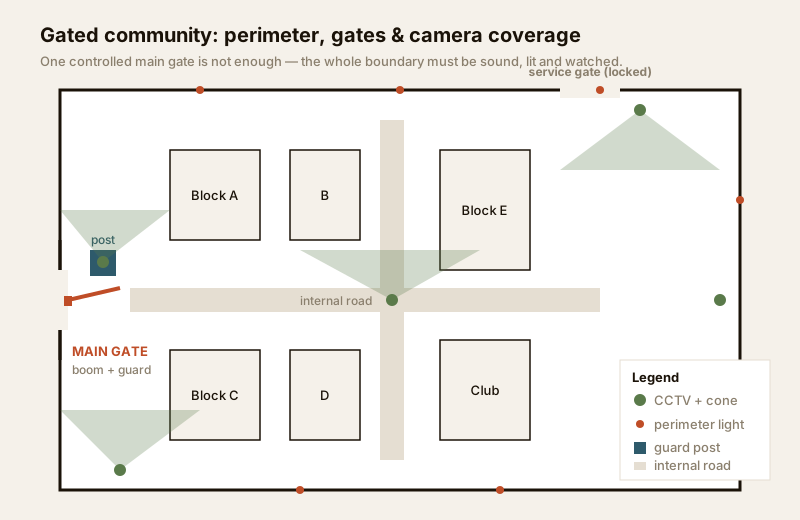
Perimeter priorities
- Continuous, sound boundary. A wall or fence high enough not to be casually vaulted, without climbing aids (parked vehicles, transformer boxes, low sheds, tree limbs) left against it, and without gaps where a compound meets a neighbour or a storm drain passes under.
- Lit setbacks. The strip just inside and outside the wall should be lit and clear — motion or dusk-to-dawn lighting removes the dark cover an intruder needs.
- Wall-top deterrent where risk warrants — but never where it blocks a fire-escape route or emergency egress. Any perimeter hardening must be coordinated with fire and life-safety, discussed in the building security systems guide.
- One controlled main entry, with service and emergency gates kept locked and opened only under supervision. Every additional open gate is another gate to staff and watch.
Main-gate integrity means the gate does what residents assume it does: nobody enters unseen, unverified or unlogged. That needs a manned guard post with clear sightlines, a boom barrier on the vehicle lane, a separate pedestrian visitor gate (so foot traffic is not squeezed past cars), and an anti-tailgating discipline — one authorised entity per gate cycle, guard confirming closure before the next. Hardware helps: RFID and boom-barrier interlocks reduce, but do not eliminate, tailgating. Only the guard's discipline closes the gap.
Visitor and vehicle management at the gate
The gate is where community security is won or lost every day. A clear, enforced flow — the same for everyone, no exceptions for the impatient — is worth more than any single gadget.
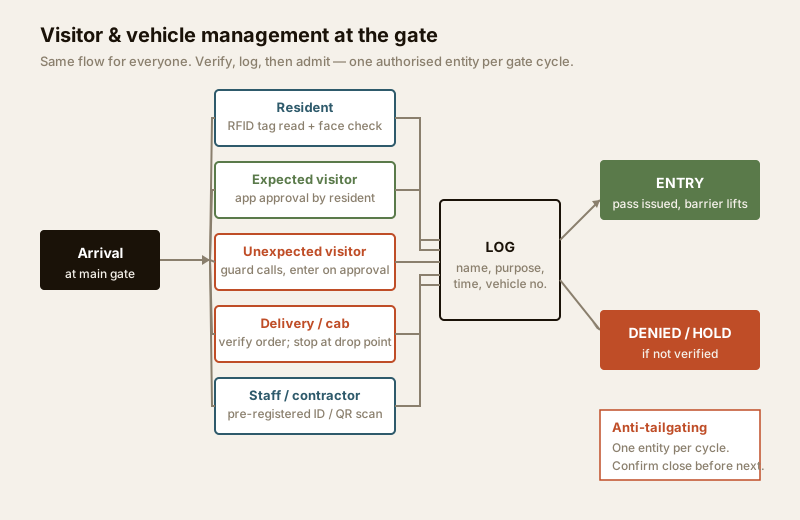
Modern Indian complexes increasingly run this through a community management app: the guard raises an entry request, the resident approves or denies it on their phone, and every entry is timestamped and logged. Used well, this is a genuine leap — it moves verification from the guard's judgement to the resident, and creates an audit trail. Used badly (residents auto-approving everything, staff pre-approved indefinitely), it becomes a rubber stamp.
Deliveries and cabs are the highest-volume, highest-tailgating category. The safest pattern is a drop-and-collect discipline: deliveries and unverified cabs stop at a gate drop point or a parcel area, and do not roam to individual doors unless the resident specifically approves a doorstep delivery. This single rule removes most stranger-at-your-door situations.
Codify the flow as a written gate SOP the agency trains every guard on:
| Arrival type | Verification step | Vehicle handling | Logging |
|---|---|---|---|
| Resident (vehicle) | RFID tag read; face check against tag | Boom lifts for ONE vehicle; confirm close | Automatic RFID timestamp |
| Resident (walk-in) | Recognised / resident ID | Pedestrian gate | Optional |
| Expected visitor | App approval from resident before entry | Park at visitor bay; escort if required | App log + visitor register |
| Unexpected visitor | Guard calls resident; enter only on approval | Hold at gate until approved | Register + app entry |
| Delivery / e-commerce | Verify order with resident; prefer drop point | Stop at parcel / drop area | Register with name, phone, purpose |
| Cab / auto | Confirm booking with resident | Drop at gate; do not roam internally | Register + vehicle number |
| Domestic staff / driver | Pre-registered ID card or app QR; daily scan | On foot / staff parking | Attendance log |
| Contractor / service | Pre-approved work order; ID recorded | Supervised; time-bound gate pass | Register + pass returned on exit |
The access control system designer helps an RWA scope RFID, barriers and app integration before briefing a vendor.
Boundary surveillance and CCTV
Cameras do two community jobs: deter at visible points, and provide evidence after an incident. They do not, by themselves, stop anything unless someone is watching a live feed — so plan CCTV around coverage and recording, not camera count.
Where cameras earn their place
- The main gate — vehicle lane and pedestrian gate, capturing faces and number plates at entry and exit. This is the single most valuable camera in the community.
- Boundary and perimeter — along the wall and dark stretches, so a breach is recorded and setbacks are covered.
- Internal roads and junctions, parking, and the approach to each block.
- Lobbies, lift cars and stairwells — high-value because insider incidents happen here, but also the most privacy-sensitive (see below).
Specify a recorder (NVR) with enough storage for a sensible retention period (commonly a few weeks, per your society policy and local guidance), reliable power backup so cameras survive the routine Indian power cut, and weatherproof housings that survive dust and monsoon. Use the CCTV camera coverage calculator to plan angles and counts, and coordinate camera power and cabling with a licensed electrician via the electrical hub. App-based monitoring and integrations are covered in the smart home guide.
Guard deployment and SOPs
Guards are the community's most expensive and most under-managed security asset. Money spent on cameras with untrained, unrotated, unsupervised guards is money half-wasted.
What good guard management looks like
- Post-specific SOPs, in writing, for the main gate, service gate and patrol — not a vague "watch the gate".
- Verified, trained personnel from a licensed agency, with the RWA checking that guards are actually background-verified, not just claimed to be.
- Anti-fatigue rostering — a guard on a 12-hour solo shift at a slow gate will wave people through by hour six. Shift length, reliefs and rotation are security decisions.
- Active patrols of the boundary and common areas on a varied schedule, logged (patrol points, app check-ins), not a predictable hourly stroll.
- Supervision and surprise checks by the agency and the RWA security committee, because an unsupervised SOP decays within weeks.
The threat and priority matrix below helps a committee spend attention where the real risk is, rather than on whatever caused the last complaint:
| Threat | Likelihood | Impact | Priority | Primary control |
|---|---|---|---|---|
| Tailgating at the gate | High | Medium | Highest | Gate SOP + guard discipline + barrier |
| Insider theft (staff / contractor) | Medium | High | Highest | Staff registration, logs, resident vigilance |
| Perimeter breach (dark / low wall) | Medium | High | High | Lighting, wall integrity, boundary CCTV |
| Unverified delivery / cab to door | High | Low-Med | High | Drop-and-collect, app approval |
| Lobby / lift crime | Low-Med | High | Medium | Lobby CCTV, no propping, intercom |
| Vehicle theft / vandalism in parking | Medium | Medium | Medium | Parking CCTV, lighting, RFID |
| Emergency (fire, medical) response gap | Low | Very High | High | Escalation plan, clear fire lanes |
Incident response and escalation
Detection is useless without a rehearsed response. A community needs a written escalation ladder that every guard, committee member and resident knows, and that lives on the notice board and in the management app — not in one person's head.
A simple, effective ladder:
1. Guard acts and contains — challenge, secure the gate, do not let anyone leave the scene, note vehicle numbers.
2. Guard alerts the supervisor and the duty committee member immediately, through a defined channel (app alert, dedicated number).
3. Escalate to police / fire / ambulance for any crime, fire or medical emergency — the local police station and fire station numbers must be posted at the gate and in the app.
4. Inform affected residents and the wider community through the official alert group, with facts, not rumour.
5. Preserve evidence — CCTV footage for the relevant window is downloaded and secured before it is overwritten.
6. Review — the committee debriefs, records the incident, and fixes the gap that allowed it.
Keeping a working relationship with the local police station — beat officers, verification drives, festival-season vigilance — is one of the highest-return, lowest-cost things an RWA can do.
Data privacy of resident and visitor logs
Community security generates a lot of personal data: visitor names and phone numbers, staff details, vehicle numbers, and hours of CCTV showing residents' comings and goings. An RWA is a custodian of that data and should treat it responsibly, both as an obligation and because leaked logs are themselves a security risk.
- Collect only what is needed for security, and say why. Avoid demanding excessive personal detail from every visitor.
- Restrict access to logs and live CCTV to authorised committee members and the agency — not a screen anyone in the clubhouse can watch, and not a WhatsApp group where footage is casually forwarded.
- Retain, then delete. Set a written CCTV and visitor-log retention period and actually purge older data, rather than hoarding footage indefinitely.
- No CCTV in genuinely private spaces — inside homes, and be careful around areas with a reasonable expectation of privacy. Cameras belong on the gate, boundary, roads, lobbies and lifts.
- Secure the systems themselves — change default passwords on NVRs and the management app, and keep them updated, so the security system does not become the breach.
Handle this in line with your society bye-laws and applicable Indian data-protection norms; where you are unsure, take advice rather than improvising.
RWA governance: budgeting, vendors and audits
Ultimately, community security is a governance problem. Good hardware under bad governance fails; modest hardware under disciplined governance protects. The committee's real job is to run security as a managed service.
- Budget it as a line item. Guards, CCTV maintenance, gate hardware, app subscription, lighting and audits are recurring costs — not one-time purchases. A rough sense of scale for an Indian complex:
| Item | Nature | Indicative scale |
|---|---|---|
| Guard agency (per guard) | Monthly, recurring | ₹18,000 - 35,000 per guard-post / month |
| CCTV system (mid complex) | Capital + AMC | ₹3,00,000 - 15,00,000 install; AMC yearly |
| Boom barrier + RFID | Capital + AMC | ₹1,50,000 - 6,00,000 per lane setup |
| Visitor-management app | Subscription | ₹15,000 - 60,000+ / year by size |
| Security audit | Periodic service | ₹15,000 - 75,000 per audit |
(Figures are indicative all-India ranges and vary widely with size, city, brand and scope — get quotes.)
- Select vendors on capability, not lowest quote. Check the guard agency's licensing and verification process, the CCTV vendor's service response, and the app's data-handling. The cheapest guard agency is often cheap because it under-pays, under-verifies and over-rosters — which is a security cost, not a saving.
- Audit regularly. Have the community's security independently reviewed — perimeter, gate SOP compliance, camera health, guard alertness, log discipline — at least annually, and after any incident. An SOP no one checks is an SOP that has quietly stopped happening.
When to bring in a professional
An RWA can and should plan, decide and coordinate all of this. But some of it is not committee work — engage the right professionals:
- A qualified security consultant for the overall risk assessment, layered plan and vendor brief on any community of scale — this is a considered field, not a WhatsApp-poll decision.
- Licensed installers for boom barriers, electronic access control and CCTV, so that gate interlocks and electric hardware are safe and reliable.
- A licensed electrician for all mains work behind cameras, gates and lighting (see the electrical hub).
- Fire and life-safety compliance — any perimeter or access hardware must comply with the National Building Code fire and life-safety provisions and local bye-laws, and must never obstruct fire-escape routes or fire-tender access. Verify with the relevant authority.
The committee's job is to assess the risk, set the brief, choose the systems, run the discipline and hold vendors to account. The professionals' job is to make it safe, compliant and reliable.
Key takeaways
- Gated is not safe by default. The two failures that undo most communities are tailgating at the gate and insider access — both are solved by controlled, logged, verified entry and discipline, not a taller gate.
- Own every ring. Write down who owns the perimeter, gate, common areas and lobby — the front door is always the resident's, no matter how good the gate is.
- The gate is a daily discipline. A written visitor and vehicle SOP, app-based approval, and drop-and-collect for deliveries beat any single gadget.
- CCTV is for coverage and evidence — plan angles, retention and power backup, not camera count; watch the gate above all.
- Run security as governance — budget it, select vendors on capability, audit annually, and protect the personal data your logs and cameras collect.
Where to go next
- Assess first: Home Security Risk Assessment Guide and the risk scorecard tool.
- Secure your own home inside the community: Apartment Security Guide or Villas & Independent Houses.
- Understand the systems: Building Security Systems Guide and the Ultimate Guide to Home Security in India.
- Scope the hardware: Access Control System Designer and CCTV Camera Coverage Calculator.
- Or browse the Security Knowledge Hub.
References
- National Building Code of India (SP 7), Bureau of Indian Standards — fire and life-safety provisions relevant to egress, fire-tender access and access hardware; verify the current edition via the BIS catalogue.
- Local municipal building bye-laws and your housing society / apartment-owners' association bye-laws — govern boundary walls, gates, common-area CCTV, guard arrangements and visitor records; check your city and society rules.
- Applicable Indian data-protection norms for handling resident and visitor personal data and CCTV footage; take advice where unsure.
- Local police station and residents' welfare association (RWA) guidance on visitor management, staff verification and neighbourhood vigilance.
This is an educational overview for planning and decision-making. Electronic access control, boom-barrier interlocks, CCTV, mains electrical work and structural perimeter elements are qualified professional work — engage a security consultant and licensed installers for design, installation and certification, ensure no measure obstructs fire egress, and verify any standard's current status via the BIS catalogue before relying on it.
Export this guide
Related Guides — Deep-dive reading
Visitor Vehicle Management in India: A Professional Guide
The everyday weak point of every society and office gate is not the resident's car — it is the visitor, the cab, the delivery rider and the contractor who must be let in without opening the whole park to anyone. This is the process, not just the hardware: verify at the gate before the boom lifts, park visitors away from resident bays, and never jam the gate a fire tender needs.
SecuritySmart Homes in Gated Communities & Apartment Complexes in India
In a Prestige or Godrej township flat you do not own the gate, the lobby or the lift — the builder and the RWA do. The art of a smart apartment is knowing exactly what you can change inside your four walls, how to work with the community's MyGate-style systems and shared infrastructure, and what to ask before you drill a single hole.
Smart HomeGate Security in India (2026): Making the Main Entrance the Strongest Point, Not the Weakest
The main gate is the one gap in every boundary and the number-one weak point of any perimeter — here is how to make the leaf, the access decision and the discipline around it as strong as the wall it sits in.
SecurityRelated Tools — Try Free
CCTV Camera Coverage & Count Calculator
Estimate how many CCTV cameras you need, the NVR channels, storage in TB for your retention period, and an indicative all-in cost with GST.
CCTV CalculatorHome Security Risk Scorecard
Score your home across six security layers — perimeter, entry points, lighting, detection, alarm and habits — and get a prioritised action plan.
Security ScorecardApartment Video Door System Planner
Enter flats, entrances, floors and guard desk for a first-pass building intercom plan — door stations, indoor monitors, guard station, the right architecture and an indicative cost band.
Building Planner