
Security for Domestic Staff in Indian Homes (2026): Protecting the Home and the Worker's Dignity Together
Millions of Indian homes employ a maid, cook, driver, nanny, caretaker or gardener. Good practice keeps the home secure AND treats the worker as a trusted, verified human being with rights - never a suspect to be spied on. Lawful verification, dignified access control, the DPDP line on cameras, trust over surveillance, and a fair exit process.
A very large number of Indian homes run on the work of people who are not family but are trusted every single day: the maid who has a key to the flat, the cook who is alone in the kitchen while the family is at work, the driver who knows the children's school route, the nanny who is trusted with a baby, the caretaker who watches an empty house, the gardener who moves freely around the compound. These are relationships of deep trust, and yet the language people reach for when they talk about "security and the maid" too often slides into suspicion - hidden cameras, secret checks, the assumption that the worker is a threat to be watched.
This guide takes a different and, we believe, a better line. Good security for a home with domestic staff does two things at once, and refuses to trade one for the other. It keeps the home genuinely secure. And it treats the worker as a trusted, verified human being with rights and dignity - not a suspect to be spied on. Those goals are not in tension. In fact the practices that respect a worker - lawful verification, a proper personal access credential, sensible protection of valuables, fair treatment - are the same practices that make a home secure. Surveillance of the vulnerable is not security; it is a failure of it. This guide sits under the security for specific users pillar and the for-users sub-hub.
Scope & safety. This is a dignity-and-rights guide as much as a security one. Three lines run through it and none of them bends. First, a worker is a person, not a suspect - security here is for a safe, fair household, never a tool to demean, trap or covertly spy on someone. Second, the law and basic decency draw hard boundaries: verification and hiring should follow the process your state requires and be done with the worker's knowledge and consent; the Digital Personal Data Protection Act, 2023 governs the ID, address, attendance and biometric data you collect; the Private Security Agencies (Regulation) Act, 2005 (PSARA) governs licensed agencies and guards. Third, there must be no cameras in private staff spaces, ever. Engage the right help - a reputable PSARA-registered agency or your local police station for verification, a competent installer for access hardware, and legal advice for any employment question. This is educational guidance, not legal advice, and standards' current status should be verified before you rely on them.
1. Verify lawfully, respectfully, and with consent
Verification is the foundation, and it is worth being clear about why you verify. You are not gathering evidence against a suspect. You are confirming that the person you are about to trust with your home is who they say they are, so that the relationship starts on an honest footing - which protects the worker as much as the household, because it means an honest person is not tarred by an anonymous, unaccountable arrangement.
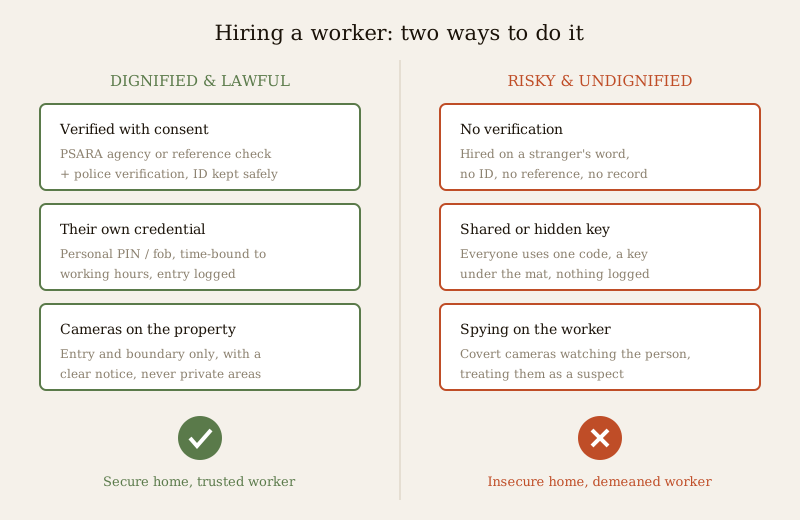
Do it through one of two respectable routes. A PSARA-registered agency for guards, drivers or placement of household staff will run its own verification, and using one shifts the checking to a licensed, accountable body - the same standard you would expect in a gated community. Or, for someone you hire directly, do proper reference checks - speak to previous employers, confirm the person's identity and current address - and complete the police verification that many Indian states require or strongly recommend for domestic workers, typically by submitting a simple form and the worker's ID and photograph at your local police station or through a state police portal. The exact requirement varies by state, so check your own.
Throughout, three principles keep verification respectful:
- Consent and knowledge. The worker knows what you are collecting and why. Verification done openly is fair; verification done secretly treats the person as a suspect and, for data collection, may not be lawful.
- Keep a proper record - and keep it safe. Retain the person's ID and address details and the verification outcome, because a record protects both sides. But that record is sensitive personal data under the DPDP Act (see section 3): store it securely, share it with no one who does not need it, and do not post a worker's ID or photo into a building WhatsApp group or a public register.
- Tie it into how people enter. Verification and daily access are two halves of one system; treat this alongside your visitor and access management, so the person who was verified is the person who is actually being let in.
2. Access control with dignity: their own credential, time-bound
How a worker gets into the home says a great deal about whether the household sees them as trusted or suspected. The dignified answer is also the secure one: give each staff member their own access credential - a personal PIN, a fob, or an app entry - rather than sharing your own code or, worst of all, hiding a key under a mat or a pot.
An individual credential is better on every axis. It is more respectful, because it treats the worker as a trusted keyholder in their own right rather than a borrower of the family's secret. And it is more secure, for four concrete reasons:
- Accountability without surveillance. Entry is logged to a person, so you know the house was opened at 8 a.m. and closed at 1 p.m. - not because you are watching the worker, but because a logged, revocable credential is simply sound practice. It protects the worker too: if something is ever questioned, the log shows an honest pattern.
- Time-bounding to working hours. A good smart lock lets you restrict a credential to the days and hours the person actually works, so access matches the job and nothing more - a clean, minimal arrangement rather than an open-ended key.
- No shared secrets to leak. A shared family PIN spreads with every guest and every month; a personal credential does not. A hidden key is the least secure option of all - anyone can find it, and it can be copied.
- Instant, clean revocation. When the working relationship ends, you revoke that one credential and change any shared codes - covered fully in the exit process below - without re-keying the whole house or leaving a stray key in circulation. This is the same per-person, revocable model used across the security-for-specific-users approaches.
The principle is simple: entry that is personal, logged and revocable is both kinder and safer than a shared key or a hidden one.
3. The dignity, privacy and DPDP line - and it does not move
This is the section that matters most, and it is written plainly on purpose.
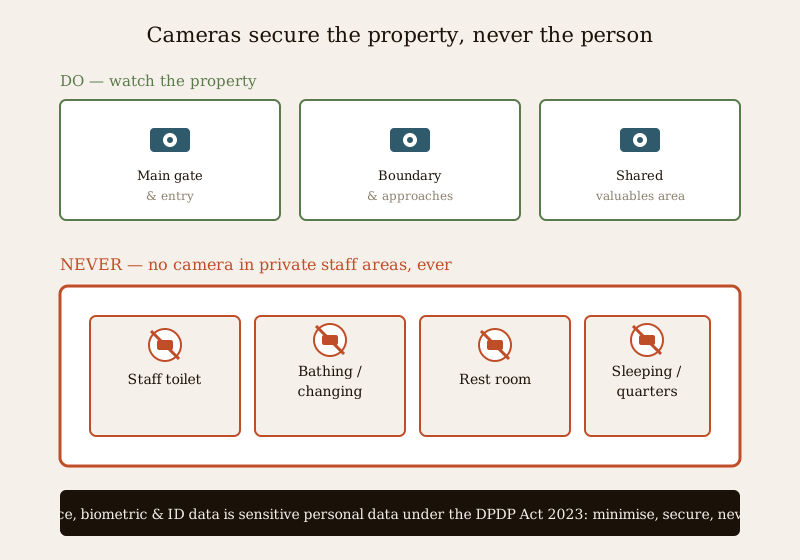
Cameras are for securing the property, never for spying on the people who work in it. There must be no cameras in staff toilets, bathing, changing or rest areas - ever. Covert surveillance of a worker in their private moments is a violation of their dignity and their privacy, and no security goal justifies it. Attendance, biometric and identity data about a worker is sensitive personal data under the Digital Personal Data Protection Act, 2023: collect only what you genuinely need, secure it, and do not misuse it or share it. A domestic worker is entitled to privacy and to respect.
Unpack that into the working rules you can actually apply:
- Cameras watch the property, not the person. Point them at the things you are protecting - the main gate, the entry doors, the boundary, a shared area where valuables are kept. That is legitimate property security. A camera positioned to follow a worker through their day, or trained on where they rest or wash, is not security; it is surveillance of a person, and it is wrong. Where a camera in a shared space could incidentally capture a private zone, mask it out - see CCTV privacy masking.
- Private spaces are absolutely off-limits. No camera, hidden or open, in any toilet, bathroom, changing space, rest area or the room where live-in staff sleep. There is no version of this that is acceptable. Covert recording of someone in these spaces is among the gravest violations of privacy there is.
- Be open about the cameras that do exist. Tell the worker where cameras are and what they cover, and put up a simple notice. Openness is both the lawful posture and the respectful one; hidden cameras signal suspicion and corrode the trust the whole relationship runs on. The wider principles are in smart security and privacy.
- Treat the worker's data as sensitive - because it is. ID copies, address, photographs, attendance records and any biometric (a fingerprint on an attendance device) are personal data under the DPDP Act, 2023. Collect only what you need, keep it securely, use it only for the purpose you collected it, do not share it, and do not keep it forever after the person has left. Minimisation is the rule.
If a proposed "security" measure only makes sense as a way to watch a person rather than protect a place, that is the signal to stop. The line here is not a grudging compromise; it is what separates a secure, decent home from an abusive one.
4. Trust over suspicion: the security that actually works
Here is the honest, practical heart of it. The single most effective security strategy in a home with domestic staff is not more cameras - it is a well-run relationship. Fair, respectful treatment and stability produce loyalty and security far more reliably than surveillance ever will. A worker who is treated well, paid fairly, spoken to with respect and trusted to do their job has every reason to protect the household. A worker who is watched, suspected and demeaned has none.
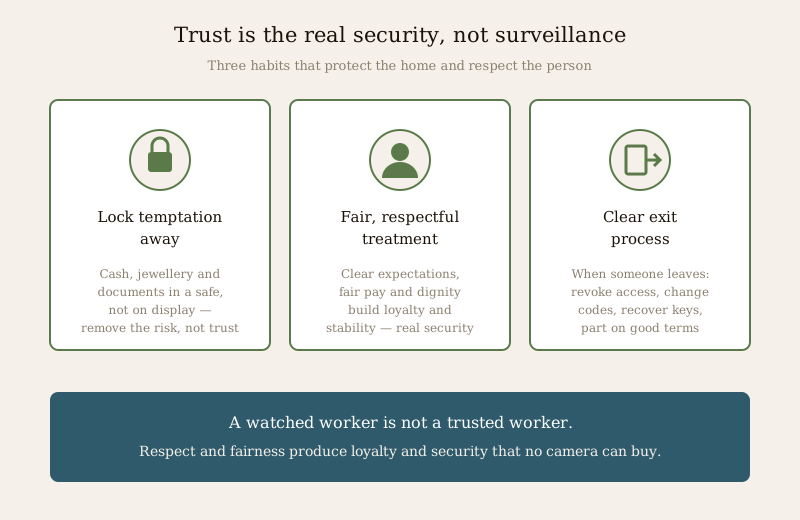
Three habits make trust the load-bearing part of your security:
- Lock temptation away rather than surveil. The sensible response to worrying about valuables is not a camera trained on the housekeeper; it is a safe. Keep cash, jewellery, spare keys and important documents locked away and out of sight. This removes the risk at source, it removes any temptation, and it protects the worker from suspicion if something is ever mislaid. Reducing what is exposed beats watching who is near it.
- Set clear, fair expectations. Ambiguity breeds the friction that curdles into suspicion. Agree the work, the hours, the pay and the boundaries plainly and up front, ideally in writing. A worker who knows exactly what is expected, and who is treated fairly, is a stable and trustworthy part of the household.
- Treat people well, and value stability. Long-tenured staff who feel respected are the strongest security a home has - they know the household, they notice when something is off, and they have every incentive to keep it safe. The turnover and resentment created by suspicion are themselves security risks. Trust, built and maintained, is not naive; it is the most effective control you have.
5. The exit process: revoke, change, recover, hand over
Most avoidable security gaps in a staffed home appear at the moment someone leaves - a code that is never changed, a key that is never returned. Handle departures with a short, consistent process, carried out with respect rather than drama.
- Revoke their credential. Remove or disable the person's individual PIN, fob or app access on their last working day. With per-person credentials (section 2) this is one clean action.
- Change any shared codes. If any code was shared - a common gate PIN, an alarm code - change it, so nothing the departing person knew still opens the home.
- Recover keys and credentials. Collect back every physical key, fob, access card or device. If a physical key cannot be recovered, treat the lock as compromised and re-key or replace it.
- Hand over cleanly. Confirm what the person held and return anything of theirs. Where a replacement is starting, hand over information about the home in a considered way, not the outgoing person's private data.
- Part on good terms. A fair, respectful exit - dues settled, a reference honestly given - is not only decent, it is good security. People treated fairly on the way out have no grievance to carry.
This mirrors the disciplined offboarding used everywhere access is managed; the smart-lock and credential mechanics are in the complete guide to smart locks.
6. Safety for the staff too: they are part of the household
Security in a staffed home is not only about protecting the family from some imagined risk in the worker. The worker is part of the household's safety, and their safety matters in its own right.
- Give staff a way to raise the alarm. A live-in caretaker or a worker alone in the house during the day should be able to summon help in an emergency - a fire, a medical episode, an intruder, a threat at the gate. A panic button or a simple agreed alert path protects them and, through them, the home.
- Never let security trap anyone. Any lock or access control on an escape route must let a person out freely in an emergency; a worker must never be locked in. Egress and fail-safe release always win over any security convenience.
- Fair, safe conditions. For live-in staff especially, a private, secure and decent space to rest - free of cameras, as section 3 insists - is both a dignity issue and a safety one. A household that looks after the safety of the people who work in it is a safer household.
The practice versus the anti-pattern to avoid
Every good practice in this guide has an abusive shadow that some homes fall into. Naming both makes the line unmistakable.
| Do this (secure and dignified) | Never this (abusive anti-pattern) |
|---|---|
| Verify openly through a PSARA agency or reference and police checks, with consent | Hire on a stranger's word with no checks, or run secret background snooping without consent |
| Give each worker their own time-bound, logged, revocable credential | Share a family PIN, hide a key under the mat, or leave access open-ended |
| Point cameras at the property - gate, entry, boundary, valuables - with a clear notice | Point cameras at the worker, or hide covert cameras to watch them |
| Keep all camera coverage out of toilets, bathing, changing, rest and sleeping areas, always | Place any camera, hidden or open, in a private staff space |
| Collect only the ID and attendance data you need, secure it, do not share it | Over-collect, post a worker's ID or photo publicly, or misuse their data |
| Lock valuables away and treat people fairly to build trust | Leave valuables out and surveil the worker as the "control" |
| Revoke access, change codes and recover keys when someone leaves | Let a departed worker's code or key keep working indefinitely |
| Give staff a panic path and fail-safe egress; never lock them in | Treat the worker as only a risk, with no thought for their safety |
Run your own home against the home security risk scorecard to see where these practices are strong and where a gap - a shared code, an un-recovered key - is quietly waiting.
Key takeaways
- Two goals, held together. Good security for a staffed home protects the property AND respects the worker as a trusted, verified person with rights - never a suspect. The respectful practices are the secure ones.
- Verify lawfully and openly. Use a PSARA agency or proper reference plus the police verification your state expects, with the worker's consent, and keep the resulting ID and address data secure and private.
- Access with dignity. Give each worker their own time-bound, logged, revocable credential instead of a shared PIN or a hidden key - kinder and safer at once.
- The line that does not move. Cameras secure the property, never the person; no cameras in staff toilets, bathing, changing, rest or sleeping areas, ever; attendance, biometric and ID data is sensitive personal data under the DPDP Act, 2023 - minimise it, secure it, never misuse or share it.
- Trust beats surveillance. Lock temptation away, set fair expectations, treat people well; loyalty and stability protect a home far better than watching a worker ever could.
- Exit cleanly, and protect the worker's safety too. Revoke access, change codes, recover keys and part fairly; give staff a panic path and fail-safe egress - they are part of the household's safety.
Where to go next
- Security for specific users - the pillar that tailors home security to who lives and works in the home.
- Visitor and access management - the wider system your verified staff access plugs into.
- Gated community security - agency-verified guards and how a community handles staff and visitor entry.
- Complete guide to smart locks - the credentials, time-bounding and revocation that make dignified access work.
- Smart security and privacy and CCTV privacy masking - the DPDP-grounded rules for cameras and personal data.
- Panic buttons - a help path for staff who are alone in or watching the home.
- Home security risk scorecard - test your own staffed home against the practices here.
References
- Digital Personal Data Protection Act, 2023 - the identity, address, photograph, attendance and biometric data you collect about a domestic worker is personal, some of it sensitive; collect only what is needed, with consent and notice, secure it, use it only for the stated purpose, and do not share or over-retain it.
- Private Security Agencies (Regulation) Act, 2005 (PSARA) - the framework licensing private security agencies and the verification and training of guards; using a PSARA-registered agency shifts staff verification to an accountable, licensed body. Verify a given agency's current registration before relying on it.
- State police verification requirements for domestic workers - many Indian states require or recommend police verification of domestic staff, submitted through the local police station or a state police portal; requirements and forms vary by state, so confirm your own state's current process.
- National Building Code of India (SP 7), Bureau of Indian Standards - the egress and life-safety provisions that any lock or access control affecting a worker's escape route must respect; verify the current edition via the BIS catalogue: https://www.services.bis.gov.in/
This is an educational overview, not legal advice. Verification, data-handling, employment and camera decisions in a home with domestic staff should be confirmed against your state's current requirements and, where needed, with a reputable PSARA-registered agency, a competent installer, and legal advice - and any standard's current status verified via the BIS catalogue before you rely on it.
Export this guide
Related Guides — Deep-dive reading
Domestic Worker Privacy in India (2026): Security With Dignity
Maids, cooks, drivers, nannies and live-in help are people with rights, not permanent suspects to be watched. Use home cameras for real security, and never as a tool to monitor, control, shame or pressure the person who works in your home.
SecuritySecurity for Landlords in India (2026): Protect the Property, Respect the Tenant's Privacy
How an Indian landlord can lawfully secure a rented property - the exterior, boundary, entrance, common and shared areas - while never crossing the hard line into a tenant's private home. Verification done respectfully, agreement clauses that hold, rekeying between tenants, and common-area CCTV run within the DPDP Act.
SecuritySecurity for People Living Alone in India (2026): Calm, Practical Habits When There Is No Second Person to Notice
Living alone is an ordinary and growing part of Indian life - the student in a new city, the working single, the elder whose children are abroad, the person after a separation. It does not call for fear. It calls for a few deliberate habits, because there is no second person in the home to notice trouble, raise the alarm, or catch an accident. This is calm self-reliance, layer by layer.
SecurityRelated Tools — Try Free
Home Security Risk Scorecard
Score your home across six security layers — perimeter, entry points, lighting, detection, alarm and habits — and get a prioritised action plan.
Security ScorecardCCTV Camera Coverage & Count Calculator
Estimate how many CCTV cameras you need, the NVR channels, storage in TB for your retention period, and an indicative all-in cost with GST.
CCTV CalculatorStamp Duty Calculator — All Indian States
Stamp duty + registration charges for all 28 states and 8 UTs — gender concessions, urban/rural variants, metro cess built in.
Stamp Duty