
Security Guide for Children's Safety
A warm, practical, protective guide to keeping children safe at home in India — controlling who gets in, teaching age-appropriate safe habits, window and balcony fall-safety that never blocks fire escape, gate, driveway and pool care, respectful monitoring of shared spaces, and knowing your child's whereabouts.
Keeping a child safe is the oldest kind of security there is. Long before cameras and smart locks, families protected children the same way we still do best: by controlling who comes close, teaching a few calm habits, and removing the hazards a small person cannot yet judge. This guide brings that instinct together with the home-security thinking in the rest of the Studio Matrx hub, and keeps it firmly where it belongs — protective, never fearful, and never anything that could be used to track, target or frighten a child.
The goal is a home where a child can be a child — curious, playful, sometimes alone in a room — while the grown-ups quietly hold the edges safe. That means two jobs running at once: keeping danger out, and keeping ordinary household hazards from reaching a child who does not yet know better.
Scope & safety. This guide helps you plan, decide and coordinate. Balcony and window guards, stair gates, pool fencing, gas and smoke detection, and any electric locks or access control are life-safety-critical: egress always wins — no grille or guard may ever block a fire-escape route. Specify these, then have a competent fabricator or licensed professional install and certify them. Nothing here replaces adult supervision.
Start with who gets in
Most of a child's day is spent inside a home whose door opens many times — for family, neighbours, domestic help, drivers, deliveries and service people. Good child safety begins by making that flow deliberate rather than casual.
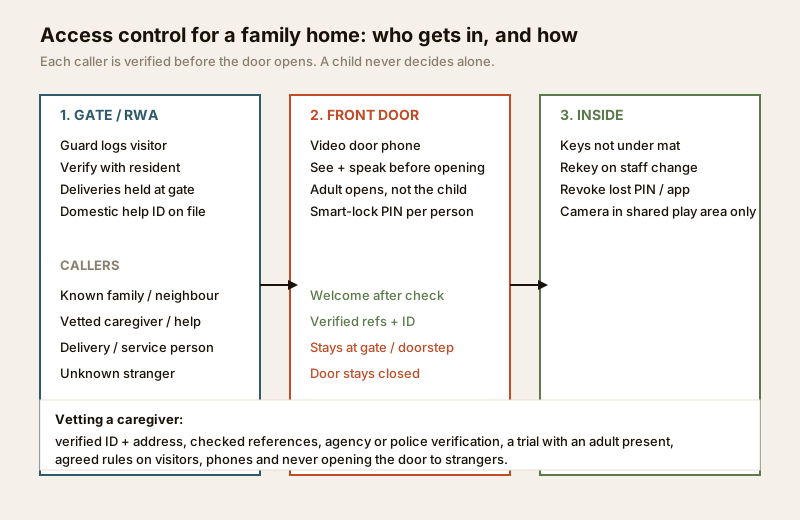
The front door is an adult's decision, never a child's. The single most useful upgrade for a family is a video door phone so anyone at home can see and speak to a caller before opening. Pair it with a simple household rule that children do not open the main door to anyone when alone — not for a delivery, not for a familiar face, not for someone who says a parent sent them. This is defensive and non-negotiable, and it is best taught as a calm routine rather than a scary warning.
Vetting the people who care for your child deserves real time. A caregiver, maid, cook or driver spends unsupervised hours near your child, so verify properly:
- Identity and address — a verified government ID and a real, checkable address.
- References — speak to two previous employers, not just read a note.
- Police or agency verification — use police verification (many states offer it for domestic workers) or a reputable agency that does background checks.
- A supervised trial — the first days with an adult present, watching how they behave with the child.
- Clear house rules — agreed limits on visitors, phone use around the child, and the standing rule that the caregiver never lets a stranger in.
Deliveries and service people should stay at the gate or doorstep, received by an adult. In an apartment or gated layout, the gated communities security guide covers visitor logs and guard verification, and the apartments security guide covers the shared lobby and lift that your child moves through daily. Coordinating those shared layers with your RWA is part of child safety, not separate from it.
Teach a few calm, age-appropriate habits
Children are safest when a small number of habits are so familiar they need no thought. Teach them the way you teach crossing a road — matter-of-fact, rehearsed, and praised — so they feel capable, not anxious. Everything here is defensive: knowing how to stay safe and how to call for help, never how to confront anyone.
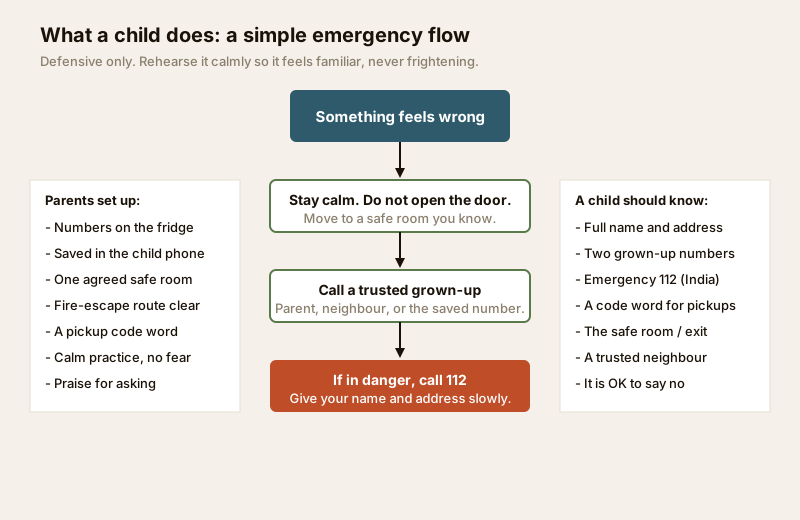
Every child old enough to speak should gradually learn:
- Their full name, parents' names, and home address.
- Two trusted grown-up phone numbers — memorised, and also saved in any phone they carry and stuck on the fridge.
- The emergency number 112 (India's single emergency number) and how to say their name and address slowly.
- A family code word for pick-ups — if someone new comes to collect them, that person must know the word.
- It is always okay to say no, to leave, and to tell a parent about anything that felt wrong — with no fear of being scolded for it.
The measures should track a child's age. Younger children need the environment made safe for them; older children can take on real judgement and independence.
| Age stage | What they can understand | Safety measures that fit |
|---|---|---|
| Infant / toddler (0-3) | Nothing yet — the home must be made safe around them | Socket covers, corner guards, stair gates, window and balcony guards, locked-away chemicals and medicines, constant supervision near water |
| Pre-school (3-5) | Simple rules, names, "ask a grown-up" | Learns full name and a parent's name; never opens the door; stays with an adult near gates, roads and water; knows the safe room |
| Early school (6-9) | Phone basics, address, stranger-smart | Memorises address and two numbers; can dial 112; knows the pick-up code word; supervised walk to school bus / gate |
| Pre-teen (10-12) | Independence with check-ins | Carries emergency contacts; short solo movement in a gated layout with check-in; basic online-safety rules; knows neighbours to go to |
| Teen (13+) | Real judgement and digital life | Shares location with parents by agreement; understands digital privacy and phishing; house keys / PIN with responsibility; agreed check-in habits |
Notice that monitoring a teen is by agreement, not by stealth. Location-sharing works when it is a mutual family habit that keeps everyone reachable, not a secret watch — that trust is what makes it stick, and it keeps the tool protective rather than controlling.
Make falls impossible before they happen
In Indian homes with balconies, terraces and multi-storey stairwells, falls are the hazard that turns serious fastest — and they intersect directly with the grilles and guards we install for security. The two goals must be solved together, and one rule sits above everything else: a guard that stops a fall must never trap a child in a fire.
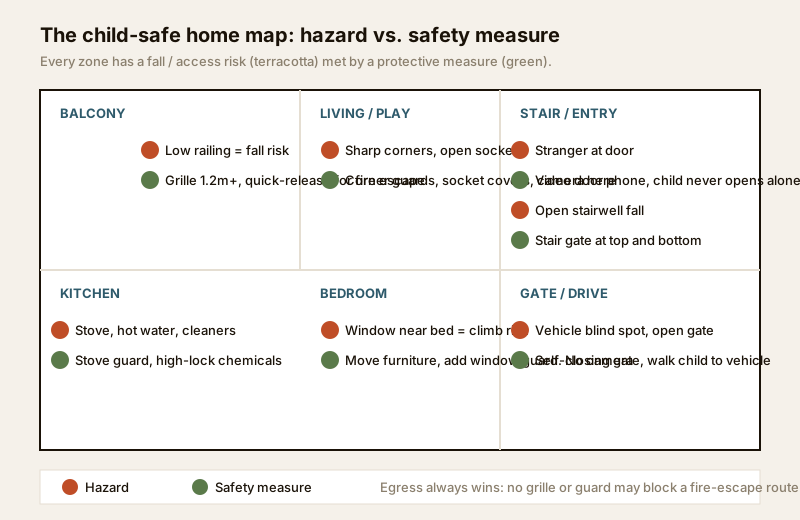
Practical fall-safety that respects escape:
- Balcony and window grilles should be tall enough that a child cannot climb over (well above a small child's reach) with vertical bars spaced so a head cannot pass through — narrow gaps, no horizontal "ladder" bars a child can climb.
- Any grille on a designated fire-escape window must be quick-release — openable from inside without a key, by an adult, in seconds. Egress always wins. Route this detail through a competent fabricator and read the ultimate home security guide for how grilles fit the wider security plan.
- Keep furniture away from windows and railings — a bed, sofa or planter under a window becomes a climbing step.
- Stair gates at the top and bottom of internal stairs for toddlers, removed as the child grows.
- Balcony rule: children on a balcony only with an adult until they are old enough to judge the edge.
Zone-by-zone: the child hazard and security checklist
Walking the home zone by zone is the fastest way to see both the safety hazards and the security gaps together. Use this as a room-by-room sweep.
| Zone | Main hazards | Protective measures |
|---|---|---|
| Main door / entry | Stranger access, child opening alone | Video door phone; adult-only door rule; smart-lock PIN per person; child never opens when alone |
| Balcony / windows | Falls, climbing, low railings | Tall guards with narrow bars; quick-release on fire-escape window; furniture kept clear |
| Stairs | Falls, open stairwells | Stair gates for toddlers; handrail at child height; good lighting |
| Kitchen | Stove burns, hot water, cleaners | Stove/hob guard; chemicals and knives locked high; child-free zone while cooking |
| Bathroom | Drowning, slips, medicines | Never leave a young child near water; non-slip mat; medicines locked away |
| Living / play area | Sockets, sharp corners, small objects | Socket covers; corner guards; heavy furniture anchored to the wall |
| Gate / driveway | Vehicles, wandering out, road | Self-closing, child-proof gate latch; adult walks child to vehicle; no play behind reversing cars |
| Pool / water tank | Drowning (fast and silent) | Four-sided child fence with self-latching gate; covered tanks and sumps; adult eyes on water at all times |
Two of these deserve extra emphasis. Water is the quietest danger — drowning happens in seconds and in very little water, so pools, buckets, tanks and sumps all need covers, fencing and unbroken adult attention. And the driveway and gate are where a child meets vehicles: a self-closing gate with a latch a toddler cannot work, plus the habit of an adult walking the child to and from the car, prevents the most common front-of-home injuries.
Monitoring shared spaces — with privacy first
Cameras can genuinely help a parent — an eye on a child playing in a hall or common area while you cook, or a record of who came to the gate. But with children, privacy is a safety measure, not an afterthought.
- Cameras belong only in shared, public-feeling spaces — living room, play area, entrance, gate, driveway.
- Never place a camera in a bathroom, a bedroom, or any changing area — full stop. This protects the child's dignity and prevents footage that could ever be misused.
- Secure the footage — a camera stream is only as safe as its password. Change default passwords, keep firmware updated, and treat any cloud footage of a child as sensitive. The smart home privacy and security guide covers locking down cameras and accounts properly.
- Tell the family — caregivers and older children should know where cameras are; open monitoring builds trust, hidden monitoring erodes it.
In a shared building, cameras in the lift, lobby and play area are usually the society's, governed by RWA rules — a good thing for child safety when handled with the same privacy discipline.
Knowing where your child is — safely
Knowing a child's whereabouts is reassurance, not surveillance, when it is built on routine and agreement.
- Safe school pick-up — agree exactly who collects the child and from where, and use the family code word so a child never leaves with someone who does not know it. Tell the school in writing who is authorised.
- Gated-community movement — a gated layout lets an older child move between home, park and a friend's block with a simple check-in habit. Coordinate with the RWA and guards on where children play and who is on the visitor list.
- Check-ins over tracking — for pre-teens and teens, a "text when you arrive" habit and agreed location-sharing beats covert tracking, and keeps the relationship one of trust.
- Never publish a child's routine — avoid posting school names, timings, uniforms or live locations publicly; a predictable, published routine is exactly what protective planning removes.
For the wider household plan behind all of this — safe rooms, drills and who to call — see the emergency preparedness guide, and score your home's gaps with the home security risk scorecard.
A brief word on digital safety
A child's online life is now part of their security. The same warmth applies: teach, do not merely restrict. Keep devices in shared spaces for younger children, agree on rules and screen time, talk openly about not sharing name, school, address or photos with strangers online, and use the privacy and account-security steps in the smart home privacy and security guide. Digital safety is defensive by nature — its whole purpose is helping a child recognise and step away from anything that feels wrong.
When to bring in a professional
Plan and decide these yourself — but do not design, wire or certify the life-safety pieces alone:
- Balcony, window and stair guards — must stop a fall and release for fire escape; have a competent fabricator work to a proper, egress-safe detail.
- Pool fencing and covers — four-sided, self-latching, to a standard height; get it installed correctly, because a gap defeats the whole fence.
- Gas, smoke and CO detection and any electric locks or access control — life-safety-critical; specify, then use a licensed professional. A poorly installed electric lock can trap a child in a fire.
- Anchoring heavy furniture and TVs, and any mains electrical near a child's spaces — use the electrical hub trades.
Your job is to spot the hazard, set the brief and choose the measure. Their job is to make it safe, code-compliant and reliable — and to keep every escape route open.
Key takeaways
- Control who gets in first. A video door phone, an adult-only door rule, and real vetting of caregivers and help protect a child more than any gadget.
- Teach calm, defensive habits — name, address, two numbers, 112, a pick-up code word, and that it is always okay to say no and to tell a parent.
- Solve falls and fire escape together — tall, narrow-barred guards that a child cannot climb, with quick-release on any fire-escape window. Egress always wins.
- Watch the quiet dangers — water and driveways cause the fastest injuries; fence, cover and supervise.
- Monitor with privacy — cameras only in shared spaces, never bathrooms, bedrooms or changing areas, and always secured and disclosed.
- Prefer trust over tracking — check-ins, code words and agreed location-sharing keep older children both safe and free.
Where to go next
- Start with the big picture: The Ultimate Guide to Home Security in India.
- Protect other loved ones: Security Guide for Senior Citizen Homes.
- Your building's shared layers: Apartments and Gated Communities.
- Be ready: Emergency Preparedness Guide and the risk scorecard.
- Or browse the Security Hub and all guides.
References
- National single emergency number 112 (Emergency Response Support System), Government of India — for police, fire and medical emergencies.
- National Building Code of India (SP 7), Bureau of Indian Standards — fire, life-safety and egress provisions relevant to grilles, guards and escape routes; verify the current edition via the BIS catalogue.
- Local municipal building bye-laws and your housing society bye-laws — govern balcony railings, guard heights, pool fencing and CCTV in common areas; check your city and society rules.
- State police domestic-worker / tenant verification services and your RWA guidance on visitor logs and verified staff.
This is an educational overview for planning and decision-making, and it is protective by design. It never replaces adult supervision. Balcony, window and stair guards, pool fencing, gas and smoke detection, electric locks and mains electrical work are qualified professional work — engage licensed professionals for design, installation and certification, keep every fire-escape route clear, and verify any standard's current status via the BIS catalogue before relying on it.
Export this guide
Related Guides — Deep-dive reading
Security for People Living Alone in India (2026): Calm, Practical Habits When There Is No Second Person to Notice
Living alone is an ordinary and growing part of Indian life - the student in a new city, the working single, the elder whose children are abroad, the person after a separation. It does not call for fear. It calls for a few deliberate habits, because there is no second person in the home to notice trouble, raise the alarm, or catch an accident. This is calm self-reliance, layer by layer.
SecuritySecurity Guide for Senior-Citizen Homes
How to protect elderly people living independently or with family in India without stripping away their dignity or independence — verifying who is at the door, simple one-touch systems, the overlap of security with fall and medical emergencies, respectful remote reassurance for family, and honest vetting of caregivers and help.
SecurityCo-Living Security in India: Safe Shared Living for Young Residents
The co-living and managed-PG format is booming in Indian cities, packing many unrelated residents into one shared building with common amenities and constant churn. This guide shows how to hold open community and individual privacy together — layered access, visitor control, common-area CCTV that stops at the bedroom door, and life-safety for a building full of sleepers.
SecurityRelated Tools — Try Free
Home Security Risk Scorecard
Score your home across six security layers — perimeter, entry points, lighting, detection, alarm and habits — and get a prioritised action plan.
Security ScorecardApartment Interior Planning Checklist
51-item checklist across structural, ceiling, lighting, furniture, storage, electrical, kitchen, bathroom.
ChecklistApartment Video Door System Planner
Enter flats, entrances, floors and guard desk for a first-pass building intercom plan — door stations, indoor monitors, guard station, the right architecture and an indicative cost band.
Building Planner