
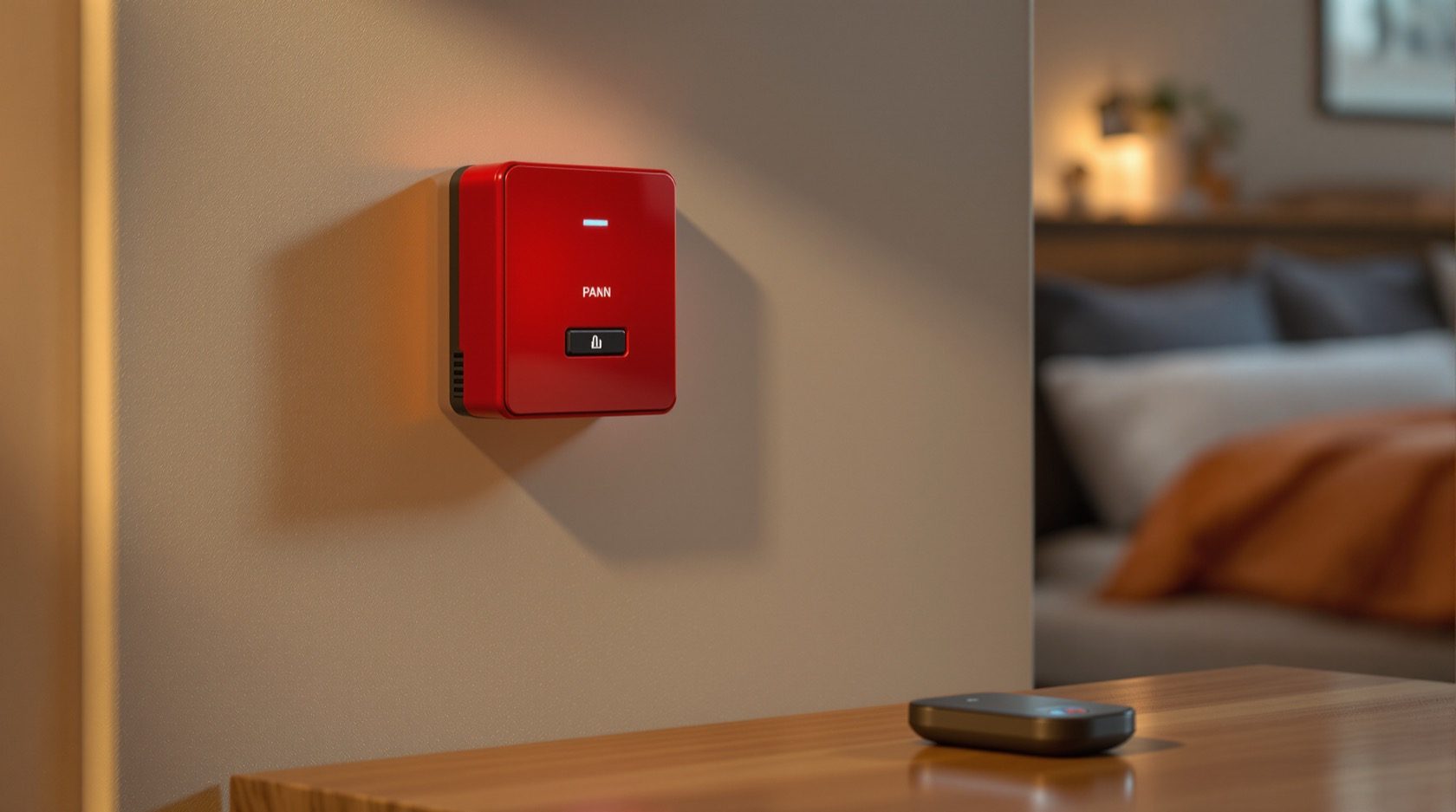
Panic Buttons for Indian Homes (2026): One Press for Help in Any Emergency
A panic button is one manual control that instantly raises the alarm and summons help — for an intrusion, a medical collapse, a fire, or a threat at the door. This guide covers the types, where to place them, and how to build the response plan that makes them actually work in India.
Most home security is built around sensors that watch for a break-in. But emergencies do not wait for a door to be forced. An elderly parent has a fall in the bathroom. A child home alone hears someone rattling the gate. A shopkeeper faces a hold-up at the counter. A woman living alone senses a threat on the landing. In every one of these, the person is awake, aware, and needs help now — and no motion sensor is going to summon it.
A panic button is the answer to exactly that gap: one manual control that, with a single press, instantly raises the alarm and calls for help in any emergency — intrusion, medical, fire, or a threat at the door. It puts the decision to summon help in a human hand instead of leaving it to a sensor. This guide is part of Studio Matrx's burglar and intrusion alarm library and sits alongside the main alarm pillar; it explains the types of panic button, what actually happens when one is pressed, where to place them, and — most importantly for India — how to build the response plan that decides whether a press brings help or brings nothing.
Scope & safety — read this first. A panic button is only ever as good as who actually responds to it. Pressing it does not, on its own, summon the police. Most systems in India are self-monitored: the button alerts your circle — a family member, a neighbour, the society guard — by siren, call, SMS or app. If no one is set up to respond, a silent alert does nothing. This guide is written purely to help you and vulnerable people in your home get help fast; it never explains how to defeat or silence an alert. A panic device must also never block a fire-escape route. This is educational guidance, not legal advice.
What a panic button actually does
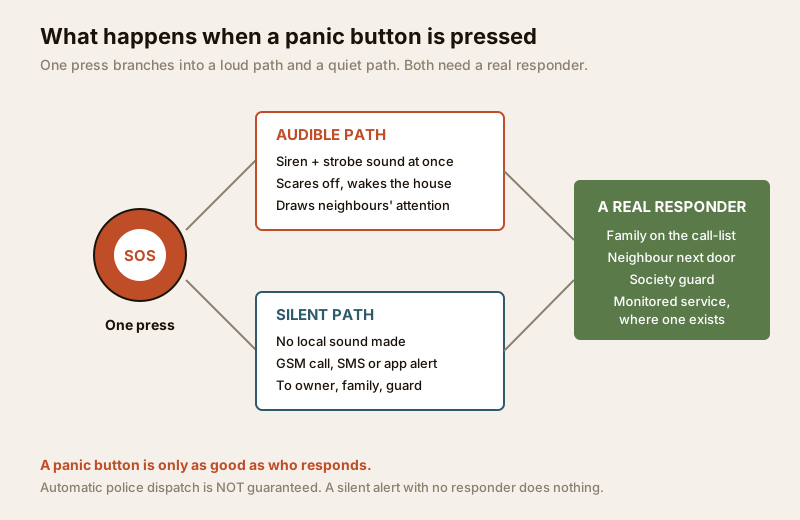
Strip away the marketing and a panic button does one or both of two things the instant it is pressed:
- It makes noise (audible). It triggers a loud siren or sounder, often with a flashing strobe, to scare off an intruder, wake the household, and draw the neighbours' attention. This is the right choice for most home and medical emergencies, where you want to be loud.
- It sends a quiet message (silent). It fires a discreet silent alert — a GSM call, an SMS, or an app notification — to one or more people, without any local sound. This is the right choice for a hold-up or a threat where making noise could make the aggressor act, and it overlaps closely with duress alarms, which do the same thing under coercion.
Many panic buttons let you choose per button: the bedside one is audible, the shop-counter one is silent. Some do both at once — sound the siren and message the owner. What matters is that you decide this deliberately for each button, matched to the emergency it is there for, and matched to who will respond.
The four types of panic button
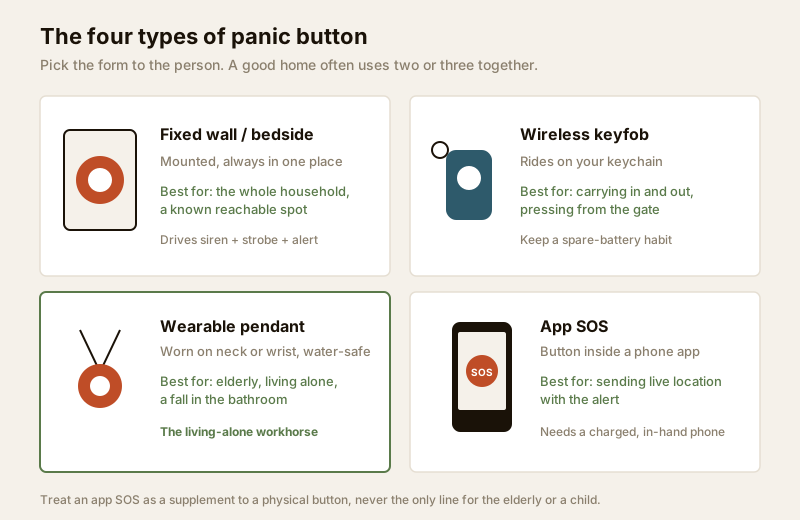
There is no single "panic button." There are four physical forms, each suited to a different person and situation. A good home often uses two or three of them together.
| Type | What it is | Best for | Rough India price |
|---|---|---|---|
| Fixed wall / bedside button | A hard-wired or battery button mounted on a wall, under a desk, or on the bedside | The whole household; a known, reachable spot | ₹300 – ₹2,500 per button (plus panel) |
| Wireless keyfob | A small remote on your keychain with an SOS button | Carrying it in and out; pressing from the gate or driveway | ₹500 – ₹2,500 |
| Wearable pendant / wristband | A button worn round the neck or wrist, often water-resistant for the bathroom | Elderly, someone living alone, medical-fall risk | ₹1,500 – ₹8,000 (standalone medical alert) |
| App SOS | An SOS button inside a phone app or a dedicated safety app | Anyone with a phone; sends location with the alert | Often free with the alarm app; standalone apps free–₹1,000/yr |
Fixed wall and bedside buttons
The classic panic button: mounted where it is always in the same place, so in a panic you do not have to hunt for it. It wires (or pairs wirelessly) into your alarm panel, so one press can drive the house siren, the strobe, and a GSM/app alert together. Because it never moves, it is the most reliable button for the household — but it only helps if you can reach it, which is why placement (below) matters so much.
Wireless keyfobs
A keyfob rides on your keychain, so the button comes with you — to the gate, the car, the terrace. It is the answer to "the fixed button was in the bedroom and I was at the front door." Keyfobs pair to the same panel as your other wireless alarm devices. Keep a spare battery habit: a fob is only useful with a live cell, and a dead fob is a false sense of safety.
Wearable pendants and wristbands — the elderly and living-alone answer
For an elderly parent, someone recovering from illness, or anyone living alone, the wearable pendant is the single most valuable form. Worn round the neck or on the wrist and usually water-resistant, it covers the two moments a fixed button cannot: a fall in the bathroom and a collapse away from any wall button. A press sends a medical alert to family, a neighbour or a monitored service. This is exactly the scenario our security guide for senior-citizen homes is built around — read the two together when you are setting up an older relative's home. Choose a pendant that is comfortable enough to be worn all day, every day; the best device is worthless in a drawer.
App SOS
Almost every alarm app now has an SOS button, and dedicated personal-safety apps do too. Their advantage is that they can attach your live location to the alert — invaluable when the person needs help but cannot say where they are. Their weakness is that they depend on a charged, unlocked, in-hand phone and a working network, so treat an app SOS as a supplement to a physical button, especially for the elderly or a child, never the only line.
Where to place fixed panic buttons
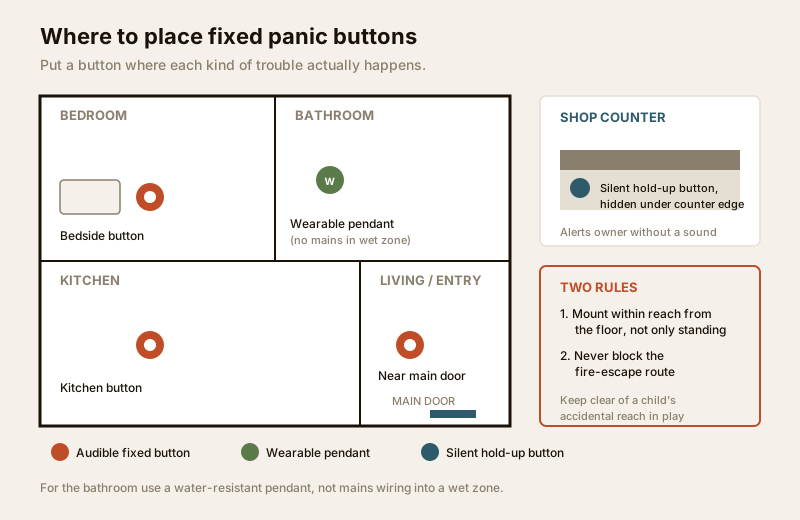
A fixed button is only useful if it is within reach at the moment of the emergency. Think about where each kind of trouble actually happens, and put a button there — mounted low enough to reach from the floor if someone has fallen, and clear of where a child might set it off in play.
| Location | Why a button belongs here |
|---|---|
| Bedside | Night intrusion or a medical event in sleep; the first place you wake |
| Near the main door / gate | A threat at the door; press before you open, or as you retreat inside |
| Kitchen | The room people spend most waking hours in; fire, burns, medical |
| Bathroom (wearable, not fixed wiring) | Highest fall risk for the elderly — use a water-resistant pendant here, not a mains button |
| Shop counter (hold-up button) | A retail hold-up — a discreet, silent button under the counter edge |
| Child's reach, if home alone | A clearly explained button a child knows summons a named adult |
Two rules run through all of these. First, height and reach: mount fixed buttons where they can be pressed from a fallen or seated position, not only standing. Second, never on the escape path in a way that blocks it — a panic device must summon help, not slow down getting out in a fire. For the bathroom, do not run mains wiring to a wet zone; a water-resistant wearable pendant is both safer and more useful there.
The India reality: a button is only as good as the response
This is the part that decides everything, and the part most sellers skip. A panic button does not summon the police. In India, automatic police dispatch from a home alarm is not a given — most home systems are self-monitored, meaning the button alerts your people, not a control room. So before you buy a single button, answer one question: when this is pressed at 2 a.m., whose phone rings, and will they come?
Build the response plan first, then buy the hardware to serve it:
- Set a clear call-list. Two or three names, in order — a family member, a next-door neighbour, the society guard's mobile — programmed into the panel's GSM dialler so a press calls or messages them automatically. Tell each of them they are on the list and what to do.
- Lean on the guard and the neighbours. In most Indian homes and colonies, the real first responder is the society guard or the family next door, not a distant agency. A press that rings the guard's gate phone and the neighbour's mobile is worth more than a silent alert into the void. Our gated-community security guide covers wiring the guard into this loop.
- Consider a monitored service where one genuinely exists. In some cities, professional alarm-monitoring or medical-alert services will take the alert and act on an agreed protocol. Where that is real and reliable, it is the strongest option for an elderly person living alone — but verify it actually operates in your area and get the response protocol in writing.
- Match audible vs silent to the responder. A silent button only makes sense if a named person or service receives and acts on the quiet alert. If there is no one to receive it, use an audible button so at least the neighbours hear it. A silent alarm with no responder does nothing at all.
Everything about the "silent" and "discreet" features only earns its place once a real responder sits behind it. Tie the two together and revisit the plan whenever a neighbour moves or a guard changes.
Power cuts, batteries and keeping it alive in India
An emergency device that dies in a power cut is worse than none, because you think you are covered. India's load-shedding makes this a first-order design point, not a footnote:
- Insist on battery backup. The panic panel and its GSM dialler must have a rechargeable backup battery that keeps them alive through a cut — typically several hours. Check the backup runtime on the datasheet before buying, and test it by pulling mains for a few minutes each quarter.
- A self-powered wearable keeps working. A pendant or keyfob runs on its own cell, so it is unaffected by a mains cut — one more reason the wearable is the elderly-living-alone workhorse. Set a fixed day each month to check and change its battery.
- The GSM alert needs signal and balance. A GSM dialler needs a live SIM with network coverage and, if prepaid, enough balance to place the call or SMS. A dead SIM is a silent failure. Keep it topped up and test the alert path monthly.
- Test the whole chain, not just the button. Once a month, press a test button (in test mode) and confirm the intended phone actually rings and the siren actually sounds. The button, the panel, the SIM and the responder are one chain; it fails at its weakest link.
Real situations a panic button is built for
- Elderly medical alert. A parent living alone wears a pendant all day; a fall in the bathroom presses it, and family plus a neighbour are alerted at once. Pair with the senior-citizen home security guide.
- Women's safety. A discreet keyfob or bedside button that raises a loud siren and messages trusted contacts turns a moment of threat into an immediate, visible call for help.
- A child home alone. A clearly explained, reachable button — with the household's audible siren and a call to a named parent and neighbour — gives a child a single, rehearsed action. See the children's safety guide.
- A shop hold-up. A silent button under the counter alerts the owner and the market's other shopkeepers without provoking the aggressor — but only where those contacts will actually respond.
- A general household emergency. Fire, a fall, a break-in — one press wakes the house and draws the neighbours, which is often exactly the help that is nearest.
Fit these into your wider emergency-preparedness plan so the button is one rehearsed step in a household everyone knows, not an isolated gadget. To match a specific set of buttons and a panel to your home, the burglar-alarm system selector walks you through the options.
When to bring in a professional. You can plan the response list, choose the button types, and site a battery pendant yourself. Bring in a licensed installer or electrician for mains-connected panels and sirens, any wiring near the board, and mounting fixed buttons and strobes at height — see the electrical hub. If you rely on a professional monitoring or medical-alert service, get the response protocol, the coverage area and who receives the alert in writing before you depend on it. Alert data — who pressed, when and where — is personal information under the DPDP Act, 2023; agree who can see it.
Key takeaways
- A panic button is one press for help in any emergency — intrusion, medical, fire, or a threat at the door — putting the decision to summon help in a human hand, not a sensor.
- Pick the form to the person: fixed bedside/wall buttons for the household, a keyfob to carry, an app SOS for location, and a water-resistant wearable pendant as the workhorse for the elderly and anyone living alone.
- Place fixed buttons where trouble happens — bedside, near the main door, the kitchen, the shop counter — mounted within reach from the floor and never blocking a fire-escape route.
- A panic button is only as good as who responds. Most Indian systems are self-monitored; build a real call-list of family, neighbours and the guard first, and only use a silent button where a named responder will act.
- Keep it alive in India: insist on battery backup for power cuts, keep the GSM SIM live and topped up, change wearable batteries on a fixed day, and test the whole chain — button, panel and responder — every month.
References
- Manufacturer specifications — verify each panic device's alert method (audible, GSM call/SMS, app), battery-backup runtime, water resistance rating and wireless range on the maker's own datasheet before buying; a stated backup runtime and IP rating are the numbers that matter for Indian power cuts and bathroom use.
- Digital Personal Data Protection Act, 2023 — panic-alert data (who pressed a button, when and where, and any location shared) is personal data; agree in writing who may receive and store it, especially with a monitoring or medical-alert service.
- National Building Code of India (SP 7), Bureau of Indian Standards, and local municipal bye-laws for any mains-electrical, siren or life-safety aspect of an install, and to ensure no device obstructs a means of escape; verify the current edition via the BIS catalogue: https://www.services.bis.gov.in/
This is an educational overview, not legal advice. Mains wiring, panel and siren installation, and work at height are qualified professional tasks — engage licensed installers and verify any standard's current status via the BIS catalogue before relying on it.
Export this guide
Related Guides — Deep-dive reading
Personal Emergency Response Systems for Indian Homes (2026): The Help Button When a Phone Is Out of Reach
A personal emergency response system is the wearable or bedside help button that lets an elder living alone, or anyone with a medical condition or disability, summon help fast when they cannot reach a phone. This guide covers how it works, what to choose, and the honest truth: it is only as good as the response behind it.
SecurityParking Panic Buttons in India: Fixed Help Points for the Walk to the Lift
A parking area — especially an enclosed basement or an unmanned stilt at night — is exactly where someone is alone, out of sight, and often out of mobile signal. A fixed, lit, well-marked help point turns the lonely walk from car to lift into a place where help is one press away.
SecuritySecurity for People Living Alone in India (2026): Calm, Practical Habits When There Is No Second Person to Notice
Living alone is an ordinary and growing part of Indian life - the student in a new city, the working single, the elder whose children are abroad, the person after a separation. It does not call for fear. It calls for a few deliberate habits, because there is no second person in the home to notice trouble, raise the alarm, or catch an accident. This is calm self-reliance, layer by layer.
SecurityRelated Tools — Try Free
Burglar Alarm System Selector
Answer a few questions about your property, cabling, coverage, monitoring and power and get the right burglar alarm — wired / wireless / hybrid, self or professionally monitored — with the design non-negotiables.
Alarm SelectorChild & Elder Home-Safety Audit
Room-by-room safety audit for households with children or seniors — 10 categories, 70+ checkpoints tagged by audience.
Safety AuditFull-Room BOQ — Living, Bedroom, Kitchen, Bath
Room-wise BOQ across living, bedrooms, kitchen, utility, and bathrooms with line-item pricing.
Full-Room BOQ