
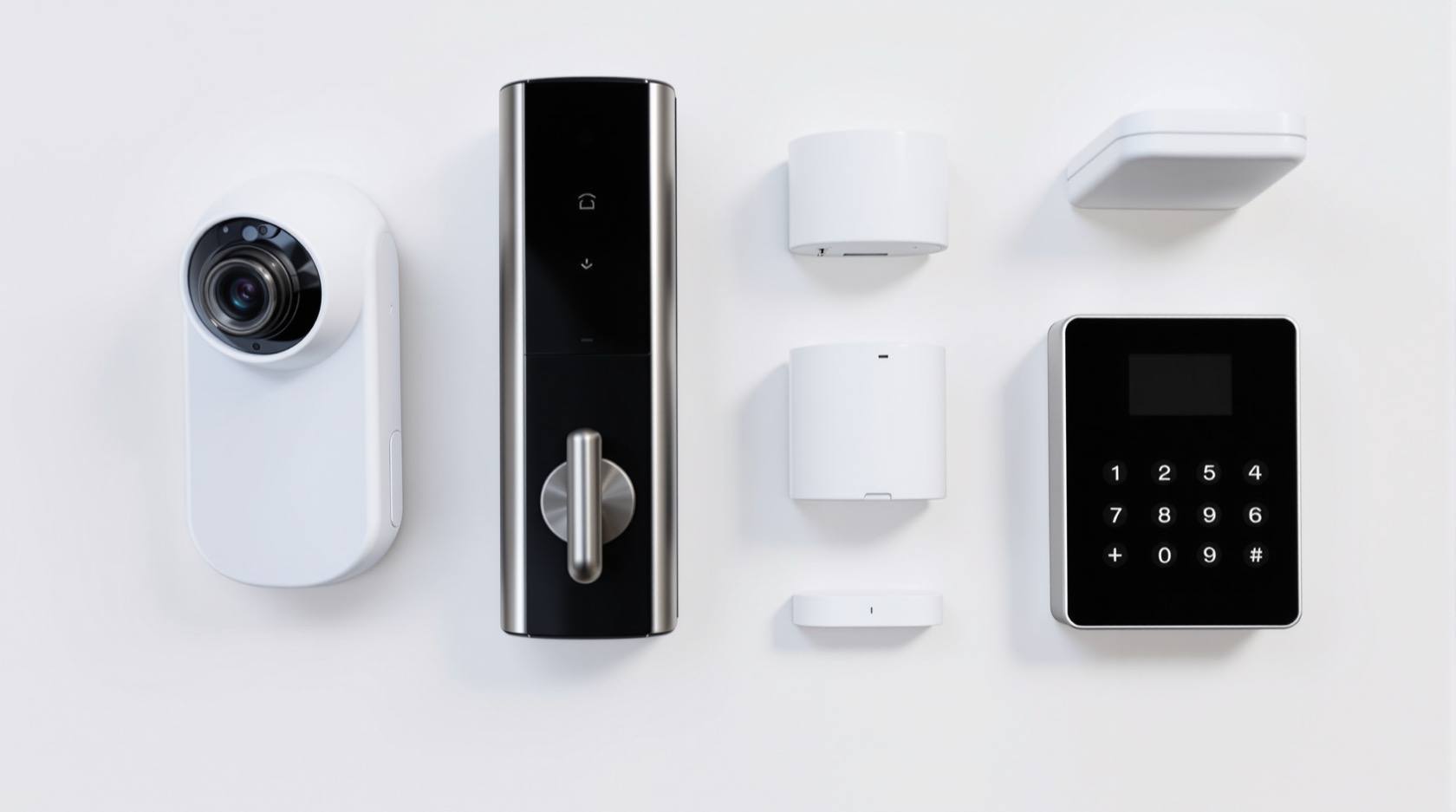
How to Choose a Security System (2026): The Master Buying Guide for Indian Homes and Buildings
The mental model that ties the whole buying decision together: start from your own risk, not a product; build the layers your situation actually needs; make the big architecture choices (wired vs wireless, local vs cloud, DIY vs professional); tell real product quality from marketing; and choose a vendor you can trust.
Most people buy home security backwards. They start at a product — a camera that caught their eye, a bundle a neighbour swears by, a shop's "complete kit" — and work outward, hoping the box happens to match their house. The result is predictable: money spent on cameras pointed at nothing that matters, a shiny app, and the actual weak points left exactly as they were. A security system is not a thing you buy; it is a set of decisions you make about your own risk, in the right order, and then hand to someone competent to install.
This guide is the umbrella over the whole buying library. It does not tell you which brand to buy — no honest guide can, because the right answer depends entirely on your home, your threat, who lives with you and what you can spend. What it gives you is the mental model: how to assess your situation, how to see security as layers and choose only the ones your risk needs, how to make the handful of big architecture choices that shape everything else, how to tell a genuinely good product from a well-marketed one, and how to pick and brief the vendor who fits it all together. Get the thinking right and every specific choice downstream gets easier.
Scope and how to use this. This is a selection and specification guide, not an installation manual and not a price list. It helps you decide what to buy and brief a licensed professional to fit it — it does not teach you to run cabling or mount detectors yourself. For actual numbers, see the home security system cost guide and the wider security costs library; this guide uses only a light budget, mid and premium framing. And one line is never negotiable: life-safety equipment — smoke and fire detection above all — is chosen on certification and fitness for purpose, never on price or looks. Everything else can be right-sized; that cannot.
Start from your need, not a product
Before you look at a single camera, answer five questions about yourself. They decide everything that follows.
- What is the real threat? A ground-floor flat in a busy city, an independent house on a quiet lane, a farmhouse left empty on weekdays and a rented apartment face different risks. Opportunistic entry through an unwatched back gate is common; a targeted, sophisticated burglary is rare. Design for what is likely, not for a film plot.
- What is the property like? Boundary wall or none, number of entry points, floors, blind corners, whether there is a compound and a gate, how much of the perimeter is overlooked by neighbours. The building shapes the system far more than the brand does.
- Who lives there? Children, elderly parents, domestic staff who come and go, tenants, someone home all day versus a house empty on weekdays. A system for a family with a live-in grandparent and a maid is a different system from one for a couple who travel constantly — and privacy of the people inside is itself a design factor.
- What is your budget tier? Not a precise figure yet, but honestly: are you at a budget, mid or premium level? This decides how many layers you cover now versus later, and it is far better to do a few things properly than everything cheaply.
- What must never fail? Fire and smoke detection protect life, not property. That layer is decided first and separately, on safety grounds, before any cost trade-off touches it.
Write the answers down. They become your brief — the thing you hand a vendor so that they design for your home instead of selling you their standard kit.
See it as layers — and choose only the ones your risk needs
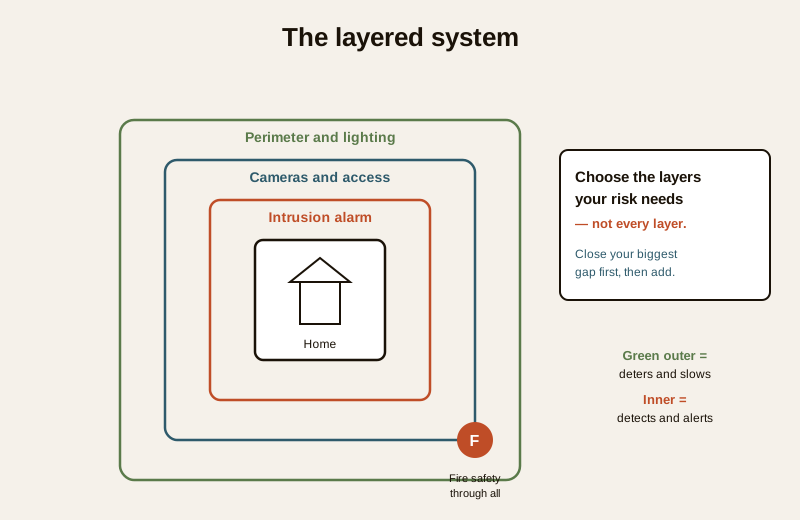
A security system is not one product; it is a set of layers, each doing a different job. The single most useful idea in this whole guide is this: you do not need every layer — you need the layers your risk actually calls for. A quiet gated flat may need only a good door, a doorbell camera and a smoke detector. A standalone house on a dark lane needs the outer layers too. Understanding the full set lets you choose deliberately.
| Layer | What it does | Who genuinely needs it |
|---|---|---|
| Perimeter | Stops or slows entry at the boundary — wall, gate, fencing | Independent houses, farmhouses, corner plots with long dark edges |
| Lighting | Removes the dark that intrusion relies on; helps cameras see | Almost everyone with an outdoor approach or boundary |
| Cameras (CCTV) | Deters, and records what happened for evidence | Most homes; siting matters far more than count |
| Entry and access control | Controls who opens doors and gates — locks, video door phone, access | Every home at the front door; gated homes at the gate |
| Intrusion alarm | Detects a break-in and raises a response | Homes left empty, or wanting active alerting, not just recording |
| Fire and smoke detection | Protects life from fire and gas — non-negotiable | Every single home, without exception |
| Monitoring | Someone or something responds to an alert | Homes where a local siren alone is not enough |
Read that table as a menu you order from, not a bill you must pay in full. The security hub maps how these layers fit together across a building. The discipline is to spend on the layer that closes your biggest gap first — usually the front door, the boundary and lighting — before adding cameras that merely watch a weakness you never fixed.
The three big architecture choices
Before products, three high-level choices shape the whole system. Decide these consciously; do not let a salesperson decide them for you by default.
Wired versus wireless
Wired equipment (cameras, sensors, alarm panels on cable) is reliable and hard to jam, but intrusive to install — best decided during construction or renovation when walls are open. Wireless is quick to fit into a finished home and easy to expand, but depends on batteries you must maintain and a signal that can be interfered with. Many good homes are hybrid: wired where it is easy to run cable and reliability matters, wireless for the awkward corners. There is no universally right answer; there is a right answer for your building's stage and layout.
Local versus cloud
Where does the footage and the intelligence live? Local recording (an on-site recorder or card) keeps data in your house and works without internet, but you manage the storage and access it yourself. Cloud gives remote viewing, off-site backup an intruder cannot smash, and easy alerts — but it means your footage sits on someone's server, carries a subscription, and depends on your connection. This is not only convenience: cameras and biometrics capture personal data, and under the DPDP Act 2023 where and how that data is stored is a genuine buying criterion, especially for a home with staff, tenants or neighbours in frame.
DIY versus professional
A plug-in doorbell camera you set up yourself is fine. A whole-home alarm, access control, wired cameras and — above all — fire detection are not DIY territory. The plan-decide-coordinate approach this hub takes is deliberate: you specify what you need, then a licensed installer fits it and certifies it. Self-installed life-safety equipment that is wrongly placed or never tested is worse than none, because it breeds false confidence. Decide honestly which parts you can handle and which must be professional — and put the boundary in writing.
Telling real quality from marketing
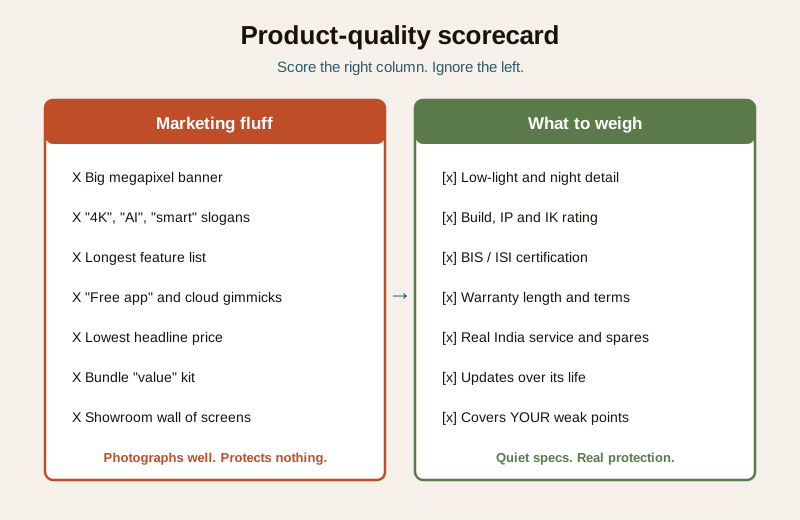
This is where money is won or lost. A product's marketing shouts about the numbers that photograph well; quality lives in the numbers that do the actual work. Learn to read past the fluff.
| Marketing tends to shout | What actually matters to you |
|---|---|
| Huge megapixel numbers on a camera | Low-light and night performance, lens field of view, real detail at the distance you need |
| "4K", "AI", "smart" as slogans | Whether the feature works reliably and earns its keep, not the label |
| Long spec sheets of features | Build quality, weather sealing (IP rating) and impact rating (IK) for anything outdoors |
| "Free app" and cloud gimmicks | Certification — BIS / ISI mark where it applies, and mandatory certification for fire and life-safety devices |
| Lowest headline price | Warranty length and terms, and whether service and spares actually exist in India |
| Bundle "value" kits | After-sales support you can reach, and firmware or security updates over the product's life |
A few specifics worth internalising. For anything mounted outdoors, an IP rating (ingress protection against dust and water) and, for anything reachable, an IK rating (impact resistance) tell you whether it survives an Indian monsoon and a determined hand. For fire and smoke detection, certification is the whole point — an uncertified detector is a decoration. Look for the BIS / ISI mark where a product category carries one, and treat a missing or vague certification claim as a red flag, not a detail. And read the warranty and the support reality: a two-year warranty from a brand with service centres in India is worth more than a five-year promise from a name you cannot reach after the sale. To go deeper on any single product category, the dedicated guides cover how to choose a CCTV camera, how to choose a burglar alarm, how to choose a fire alarm, how to choose access control and how to choose security lighting.
Match it to your situation
The same layered thinking produces very different systems for different homes. A few honest archetypes:
- City apartment, gated society. The society handles the perimeter and often the gate. Your job is usually the front door — a good lock and a video door phone — a smoke detector, and perhaps one doorbell or entrance camera. Do not buy a boundary system you do not own.
- Independent house on a quiet street. You own the whole stack. Prioritise the boundary and gate, lighting that removes the dark approach, a couple of well-sited cameras at entry points, a door and window alarm for when the house is empty, and smoke detection. This is where layers earn their keep.
- Home empty on weekdays. Detection and monitoring matter more than a passive record — you want to know an intrusion is happening, not merely review it later. Weight the budget toward the alarm and a monitoring arrangement.
- Home with children, elderly or live-in staff. Life-safety and dignity lead. Fire and smoke detection is essential; cameras must respect the privacy of people who live and work there, kept to shared and boundary areas, never private ones.
The right system is the one that fits the archetype you actually are — not the biggest one the shop can sell.
Red flags — of a product, a quote and a vendor
Walk away from any of these. A quote with no site visit — nobody who has not seen your home can design its security. A single suspiciously cheap "everything" price with no line items. Pressure to decide today, or a "festival offer" that expires this evening. A vendor who cannot show a licence, references or GST registration. Fire or life-safety devices sold with no certification, or with a certification claim they cannot evidence. Cameras aimed to impress you rather than to cover your real weak points.
Two traps deserve their own names. The first is the buy-cheap-pay-twice trap: the lowest quote wins the order, the gear fails in two monsoons, the "warranty" turns out to be unreachable, and you buy the whole system again at full price. Cheap security that does not work is not a saving — it is money spent to feel protected while being exposed. The second is buying the demo, not the design: a slick app and a wall of screens in the showroom tell you nothing about whether the cameras will cover your blind gate. Judge the design for your home, not the theatre in the shop.
Choosing and briefing the vendor
The installer matters as much as the equipment, because a good product badly fitted is a bad system. Choose the vendor with the same care as the hardware, and brief them with the notes you wrote at the start.
- Insist on a site visit and a written design before any quote — the visit is where a competent vendor earns trust.
- Ask for itemised quotes so you can compare like with like, and get two or three. A single lump sum hides everything.
- Check credentials — licensing, GST registration, references you can actually call, and for any guarding service, PSARA 2005 registration.
- Agree the boundary of responsibility in writing — who installs, who certifies, who maintains, and what the warranty and service response actually promise.
- Hand them your brief, not a blank sheet — your risk, your property, who lives there, your tier. A vendor who designs around your brief is a partner; one who ignores it and quotes their standard kit is a salesperson.
The security vendor and installer evaluation guide works through this in detail, and the buying library collects the per-product decisions this pillar points to.
The buying sequence — and a checklist
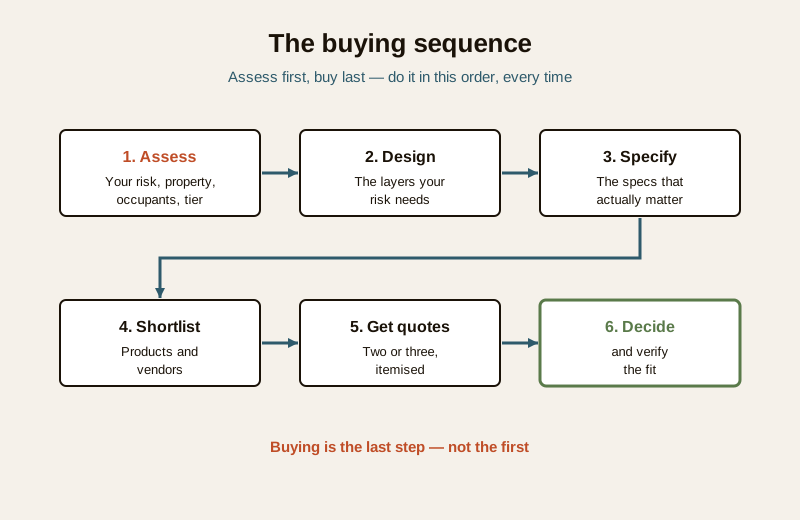
Do it in this order, every time: assess your risk, design the layers, specify what matters, shortlist products and vendors, get comparable quotes, then decide and verify. Buying is the last step, not the first. A short checklist to carry into the decision:
- [ ] I wrote down my threat, property, occupants, tier and non-negotiables before shopping.
- [ ] I identified my biggest gap and I am spending there first.
- [ ] I chose only the layers my risk needs — not a full-house kit by reflex.
- [ ] I made the wired-versus-wireless, local-versus-cloud and DIY-versus-professional choices deliberately.
- [ ] Every outdoor product has a stated IP rating; reachable ones have an IK rating.
- [ ] Every fire and life-safety device is properly certified — chosen on safety, never price.
- [ ] I checked BIS / ISI certification, warranty terms and real India service before build slogans.
- [ ] I got a site visit, a written design and two or three itemised quotes.
- [ ] I verified the vendor's licence, references and GST, and PSARA for any guards.
- [ ] The whole design closes my real weak points — not just the ones easy to photograph.
Key takeaways
- Start from your risk, not a product. Assess threat, property, occupants, budget tier and what must never fail before you look at anything to buy.
- See it as layers, and buy only the ones your risk needs. Close your biggest gap first; a full-house kit bought by reflex wastes money on weaknesses you never fixed.
- Make the three architecture choices consciously — wired versus wireless, local versus cloud, DIY versus professional — instead of letting a salesperson default them.
- Tell quality from marketing. Weigh low-light performance, build, IP / IK ratings, BIS / ISI certification, warranty and real India support — not megapixels and slogans.
- Life-safety is non-negotiable. Fire and smoke detection is chosen on certification and fitness for purpose, first and separately, never on price or looks.
- Choose the vendor as carefully as the hardware — site visit, written design, itemised quotes, verified credentials — and beware the buy-cheap-pay-twice trap.
Where to go next
- The per-product decisions this pillar points to: how to choose a CCTV camera, how to choose a burglar alarm, how to choose a fire alarm, how to choose access control and how to choose security lighting.
- For the money: the home security system cost guide and the security costs library.
- For the people who fit it: the security vendor and installer evaluation guide.
- The buying library and the main security hub for the whole picture.
References
- Bureau of Indian Standards (BIS) — the ISI mark and IS product standards that indicate a certified product; verify a specific product category's certification and the current standard via the BIS catalogue: https://www.services.bis.gov.in/
- National Building Code of India (SP 7), Bureau of Indian Standards — fire-safety and means-of-egress provisions that govern life-safety choices in a building; verify the current edition (SP 7:2026).
- Digital Personal Data Protection Act, 2023 — cameras and biometric access capture personal data; where footage is stored and who can view it is a genuine buying criterion, particularly in homes with staff, tenants or neighbours in frame.
- Private Security Agencies (Regulation) Act, 2005 (PSARA) — any guarding service must be supplied through a PSARA-registered agency; verify licensing before contracting.
This is an educational buying-decision overview for homeowners and building owners — not legal advice, an installation manual or a price list. Life-safety and fire provisions take priority over any cost or convenience trade-off; choose certified life-safety equipment, engage a licensed installer to design and fit the system, deploy any guards only through PSARA-registered agencies, and verify any standard's current status via the BIS catalogue before relying on it.
Export this guide
Related Guides — Deep-dive reading
How to Choose a CCTV Camera (2026): The Homeowner's Decision Guide for India
Cut through the spec-sheet noise and choose the right CCTV camera for each spot around an Indian home. What actually matters — sensor and low-light performance, lens and field of view, form factor, IP and IK ratings, honest smart features — and the marketing claims to ignore.
SecurityComplete Guide to Security System Cybersecurity in India (2026): Protecting the Systems That Protect You
The cameras, locks, alarms and door phones you install to feel safer are internet-connected computers that can themselves be attacked, and an insecure one is worse than none. This pillar maps the whole attack surface — devices, network, accounts and data, operations — and points to every guide that hardens it.
SecurityHow to Choose a Burglar Alarm in India (2026): Sensors, Alerts and What Actually Matters
A homeowner's guide to selecting an intruder alarm that fits your flat, villa or shop and alerts you the way you want — matching the sensor mix, control panel and the big siren-versus-monitored decision to your real risk, and dodging the false-alarm traps that make people switch systems off.
SecurityRelated Tools — Try Free
Home Security Risk Scorecard
Score your home across six security layers — perimeter, entry points, lighting, detection, alarm and habits — and get a prioritised action plan.
Security ScorecardSecurity Vendor Evaluation Scorecard
Rate a CCTV/security installer or guarding agency across eight weighted criteria for a hire / negotiate / walk-away verdict.
Vendor ScorecardApartment Video Door System Planner
Enter flats, entrances, floors and guard desk for a first-pass building intercom plan — door stations, indoor monitors, guard station, the right architecture and an indicative cost band.
Building Planner