
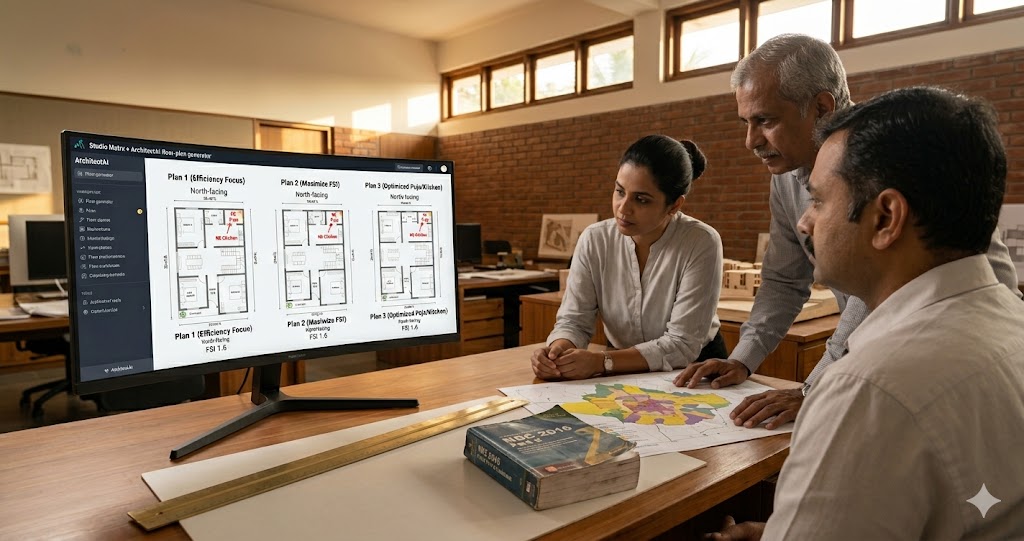
AI Floor Plan Generator — Plot-to-Plan + Sketch-to-Plan AI for India (2026)
NBC 2016 + state DCR · Vastu-aware · 30x40 N-facing worked example · ArchitectAI plan-gen
AI floor plan generators turn a brief, a sketch, a photo, or a LiDAR scan into a measured, code-aware floor plan in minutes — not the two weeks a junior architect needs. In 2026 India, the better ones also check NBC 2016 setbacks, your municipality's FSI ceiling (BBMP, MCGM, DDA, PMC, CMDA), and the cardinal-direction rules a Vastu-aware homeowner will ask about anyway. The catch: most "AI floor plan" tools shipping in India are still glorified template libraries. A genuine generator reasons about plot, programme, and code together.
For a 30×40 ft North-facing plot in Bengaluru — the single most common middle-class plot in India — an AI floor plan generator should hand you three to six viable G+1 layouts within an hour, each tagged with its built-up area, FSI consumption, setback compliance, and approximate construction cost. Then it should let you pull one of those layouts into a photoreal render, a BoQ, and an architect handoff. That last step is where most of the tools we benchmark here quietly fall over.
"A floor plan is a hypothesis about how a family will live for thirty years. AI's job isn't to replace that hypothesis — it's to test fifty of them before you commit to one."
If you want the wider context, read AI home design, the AI architecture software landscape, our AI architecture in India deep-dive, and the room-level companion AI room planner. For Vastu-grounded plan work, pair this with Vastu house plan India and North facing house Vastu.
This guide refreshes every 12 months. Last verified: May 2026 · Next verify: May 2027.
What AI Floor Plan Generator Actually Means (and What It Doesn't)
An AI floor plan generator is software that takes one of four inputs — a natural-language brief, a hand sketch, a photo of an existing space, or a 3D scan (LiDAR/photogrammetry) — and produces a dimensioned 2D floor plan, optionally with a 3D massing, room schedule, and code-compliance report. The better systems in 2026 combine three model families: a layout-generation model (often a diffusion or graph-neural network that has learned thousands of plan precedents), a constraint solver (which enforces hard rules like "kitchen must be ≥7 sq m per NBC 2016"), and a critique loop (which re-scores each candidate plan against the brief and the codes).
The category has matured fast since 2024 — Maket raised a Series A on it, Finch3D became Spacemaker-adjacent, Autodesk Forma absorbed parametric layout into Revit's pre-design workflow, and a wave of India-specific tools (ours included) layered NBC, state DCR, and Vastu logic on top of generic Western generators.
Five things "AI floor plan generator" is NOT:
1. A house plan library. Browsing 1,000 prebuilt 30×40 plans on a real-estate site is search, not generation. Generation means a new plan synthesised from your specific constraints — plot shape, orientation, programme, budget, code.
2. A CAD drafter. AutoCAD and Revit are drafting tools; the human decides the plan. An AI generator decides candidate plans; the human picks and refines.
3. A renderer. Tools that take an existing plan and render it in 3D (Coohom, Planner 5D's render mode, Lumion's plan-import) are visualisers, not generators.
4. A code compliance checker alone. Solibri, BIM Track, and Visoplan check existing plans against codes. A generator must produce plans and check them, in a loop.
5. A municipal-approved drawing. No AI plan in 2026 is automatically accepted by BBMP, MCGM, or DDA for sanction. The architect-of-record stamp and signature is still mandatory; AI gets you to the 80% draft an LBE/RCC consultant then finalises.
Why AI Floor Plan Generators Matter in 2026 India
India approves roughly 11 million housing units a year (CREDAI 2025 estimate), of which 60% are individual builder-floor or own-plot constructions — exactly the segment where a homeowner pays a junior architect ₹25,000–₹1.5 lakh just for plan options before sanction drawings even start. AI generation collapses that loop. A 2025 KPMG India PropTech survey found 71% of self-built-home owners in Bengaluru, Hyderabad, and Pune had considered "AI plan tools" but only 9% had used one — the gap is awareness and trust, not demand.
Three forces are converging in 2026:
Plot scarcity drives optimisation pressure. A 30×40 plot in BTM Layout costs ₹1.5–2 crore. Every wasted square foot of circulation costs the owner ₹15,000–₹30,000 in unbuilt land value. AI plan generators that explore 50 layouts in an hour pay for themselves in the first iteration.
State DCRs are getting fragmented and stricter. BBMP revised its zoning regulations in 2024; MCGM's DCPR 2034 now governs Mumbai; DDA's MPD 2041 is in draft. No single architect remembers every state's FSI premium, setback, and ground-coverage rule. AI is faster at lookup, and the better tools encode the current rule set.
Vastu is no longer optional in mass-market middle India. 78% of buyers in Tier 1 cities (Anarock 2025) list "Vastu-compliant" as a top-five filter. AI plan generators that can constrain a layout to North-East kitchen, South-West master bedroom, and centre brahmasthan ship more sellable plans than those that can't.
The seam Studio Matrx and our sibling ArchitectAI fill is the India-grounded one: NBC 2016 + state DCR + Vastu + Bengaluru/Mumbai cost reality, all reasoning together. Most Western generators (Maket, Finch3D, Hypar) are powerful but India-blind; most Indian tools are template browsers, not generators. We sit in between.
The Six Capabilities That Matter
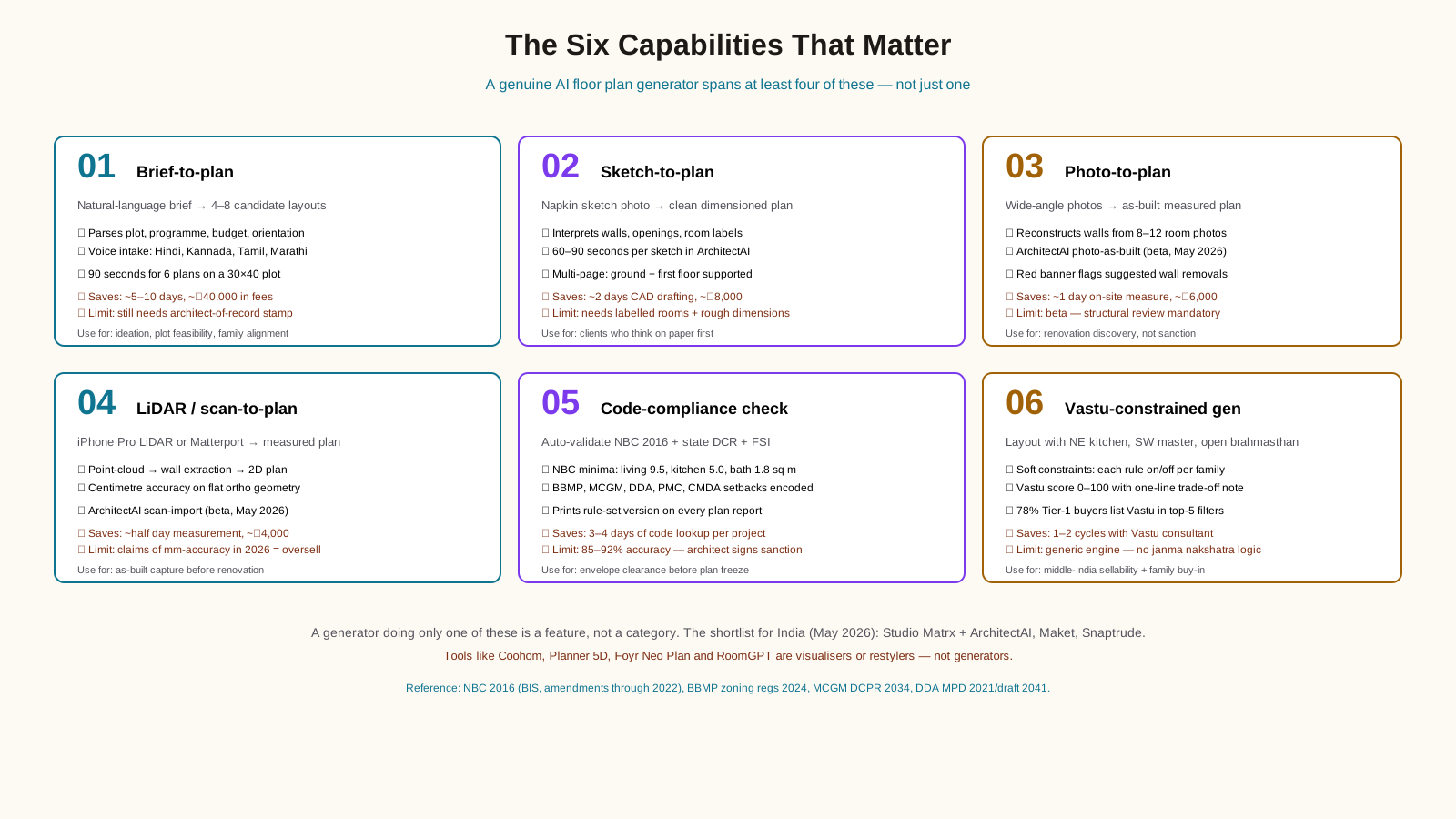
Not all "AI floor plan" features are equal. Below is the capability stack we benchmark, with the Studio Matrx flow that delivers each.
| Capability | What it does | Time / cost saved vs traditional | Studio Matrx / ArchitectAI flow |
|---|---|---|---|
| Brief-to-plan | Natural-language brief ("3BHK, 30×40 N-facing, ₹85L budget, parents bedroom on ground") → 4–8 candidate plans | 5–10 days of architect ideation, ~₹40,000 in fees | ai-onboarding + ArchitectAI plan-gen |
| Sketch-to-plan | Hand-drawn napkin sketch (uploaded photo) → clean dimensioned plan | 2 days of CAD drafting, ~₹8,000 | ArchitectAI sketch-import |
| Photo-to-plan | Wide-angle photos of an existing room → dimensioned as-built plan | 1 day on-site measure, ~₹6,000 | ArchitectAI photo-as-built (beta) |
| LiDAR/scan-to-plan | iPhone Pro LiDAR or matterport scan → measured floor plan | Half-day measurement, ~₹4,000 | ArchitectAI scan-import (beta) |
| Code-compliance check | Auto-validate against NBC 2016, state DCR, FSI, setbacks | 3–4 days of code lookup per project | setback-visualizer + state DCR engine |
| Vastu-constrained generation | Constrain layout so kitchen is NE, master is SW, etc. | 1–2 revision cycles with Vastu consultant | Vastu-aware layout engine |
A generator that does only one of these is a feature, not a category. The ones we recommend — and the one we built — span at least four.
How Studio Matrx Does AI Floor Plans — End-to-End Walkthrough
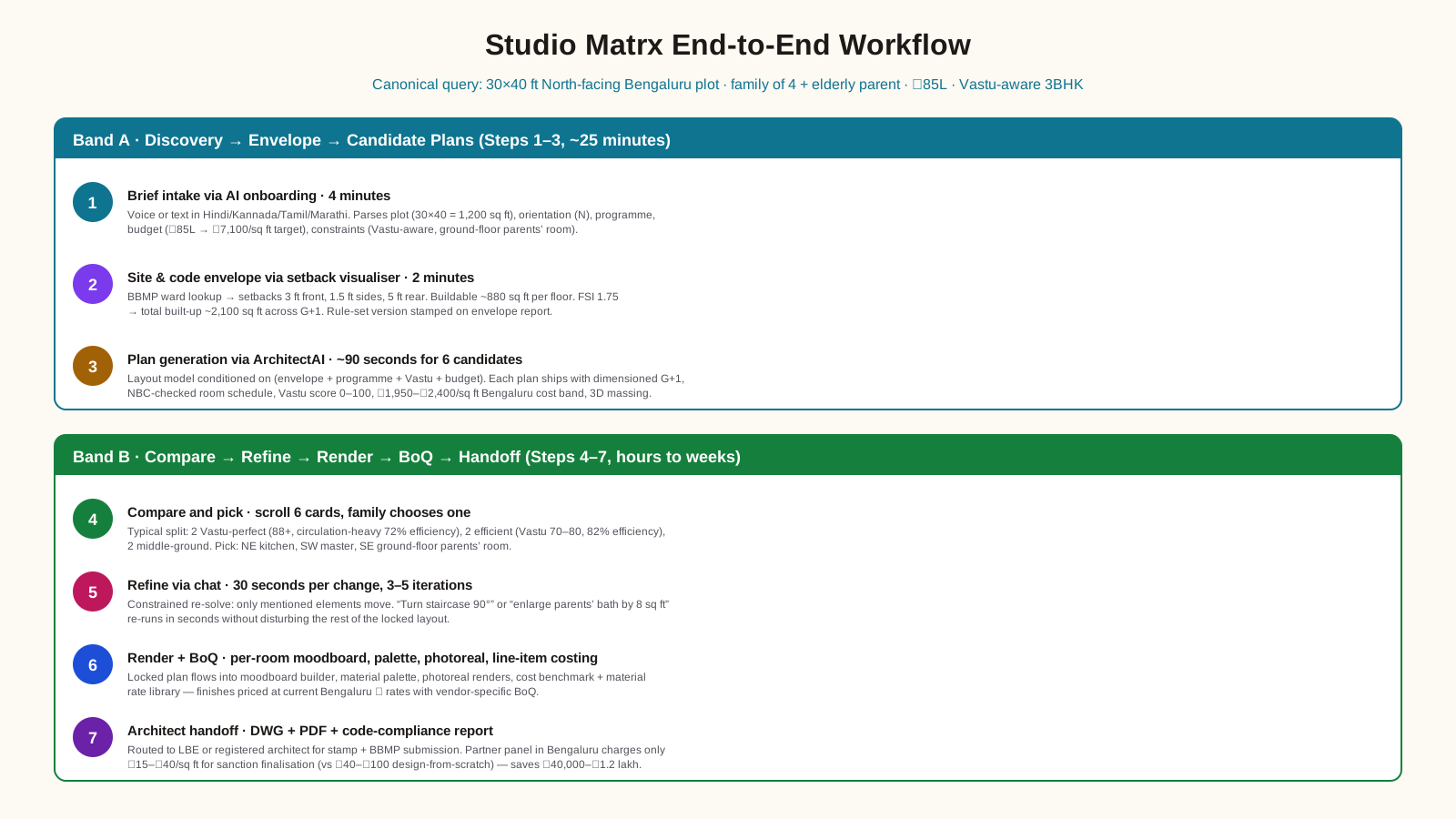
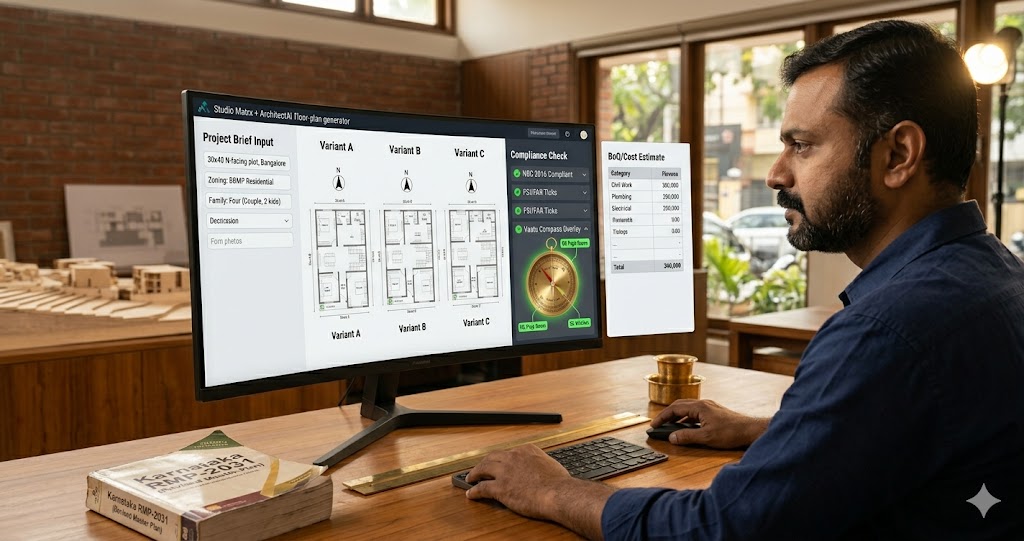
Here's the actual flow for the canonical query: "I have a 30×40 ft North-facing plot in Bengaluru, family of four with one elderly parent, ₹85 lakh construction budget, want a 3BHK with one bedroom on the ground floor for my mother, and I want it Vastu-aware. What does AI give me?"
Step 1 — Brief intake via AI onboarding. You type or speak the brief. The intake parses out plot (30×40 ft = 1,200 sq ft), orientation (N), programme (3BHK + ground-floor parents' room), budget (₹85L → ₹7,100/sq ft target), and constraints (Vastu-aware). Voice intake supports Hindi, Kannada, Tamil, and Marathi. Takes 4 minutes.
Step 2 — Site & code envelope via setback visualiser. We look up BBMP zoning for your ward (you give us the ward name or PIN code), apply the relevant setbacks (typically 3 ft front, 1.5 ft sides, 5 ft rear for residential ≤1,200 sq ft), and compute your allowable ground-coverage footprint. Result: ~880 sq ft buildable per floor. FSI = 1.75 for that lot class, so total built-up ~2,100 sq ft across G+1. The envelope and BBMP-specific notes are written into the brief.
Step 3 — Plan generation via ArchitectAI. Our sibling product runs the layout-generation model conditioned on (envelope + programme + Vastu + budget). It produces 6 candidate plans in roughly 90 seconds. Each plan ships with:
- Dimensioned 2D layout, ground + first floor
- Room schedule with areas (verified against NBC 2016 minima: living ≥9.5 sq m, bedroom ≥9.5 sq m, kitchen ≥5.0 sq m, bath ≥1.8 sq m)
- Vastu score (0–100, with a one-line explanation of any compromise)
- Estimated built-up cost using current Bengaluru rates (₹1,950–₹2,400/sq ft for basic-to-mid finish, May 2026)
- 3D massing preview
Step 4 — Compare and pick. You scroll the 6 options as cards. Typical pattern: 2 options are "Vastu-perfect but circulation-heavy" (Vastu score 88+, built-up efficiency ~72%), 2 are "circulation-efficient but Vastu-compromised in one room" (Vastu 70–80, efficiency ~82%), 2 are middle-ground. You pick one — say the middle-ground plan with kitchen NE, master SW, parents' room on the ground floor SE.
Step 5 — Refine via chat. "Can the staircase be turned 90 degrees and the parents' bathroom enlarged by 8 sq ft?" The generator runs a constrained re-solve — only the elements you mentioned move, everything else stays. 30 seconds. You iterate 3–5 times until the plan feels right.
Step 6 — Render and BoQ. Once locked, the plan flows into Studio Matrx's interior pipeline: per-room moodboard builder, material palette, photoreal renders, and a line-item BoQ via the cost benchmark and material rate library. You see the interior of the plan you just generated, with finishes priced in Bengaluru ₹ rates.
Step 7 — Architect handoff. The final DWG + PDF package — plan, elevations, sections, code compliance report — is exported for your LBE (Licenced Building Engineer) or registered architect to stamp and submit to BBMP. We integrate with five Bengaluru architecture firms who accept Studio Matrx briefs for direct sanction-drawing work; if you want one introduced, we route the brief.
Honest caveat: Steps 1, 2, 4, 6, 7 are fully shipped in Studio Matrx. Step 3 (the multi-option plan generator) is live in ArchitectAI for firm-tier accounts and in beta for direct homeowner use as of May 2026 — public GA is on the 2026 H2 roadmap. The single-plan generator is live for homeowners now. LiDAR scan-to-plan and photo-to-plan are in alpha; brief-to-plan and sketch-to-plan are GA. If a tool tells you photo-to-plan is fully GA in May 2026 with millimetre accuracy, they're overselling.
AI Floor Plan Generation vs Traditional Architect-Drawn Plans
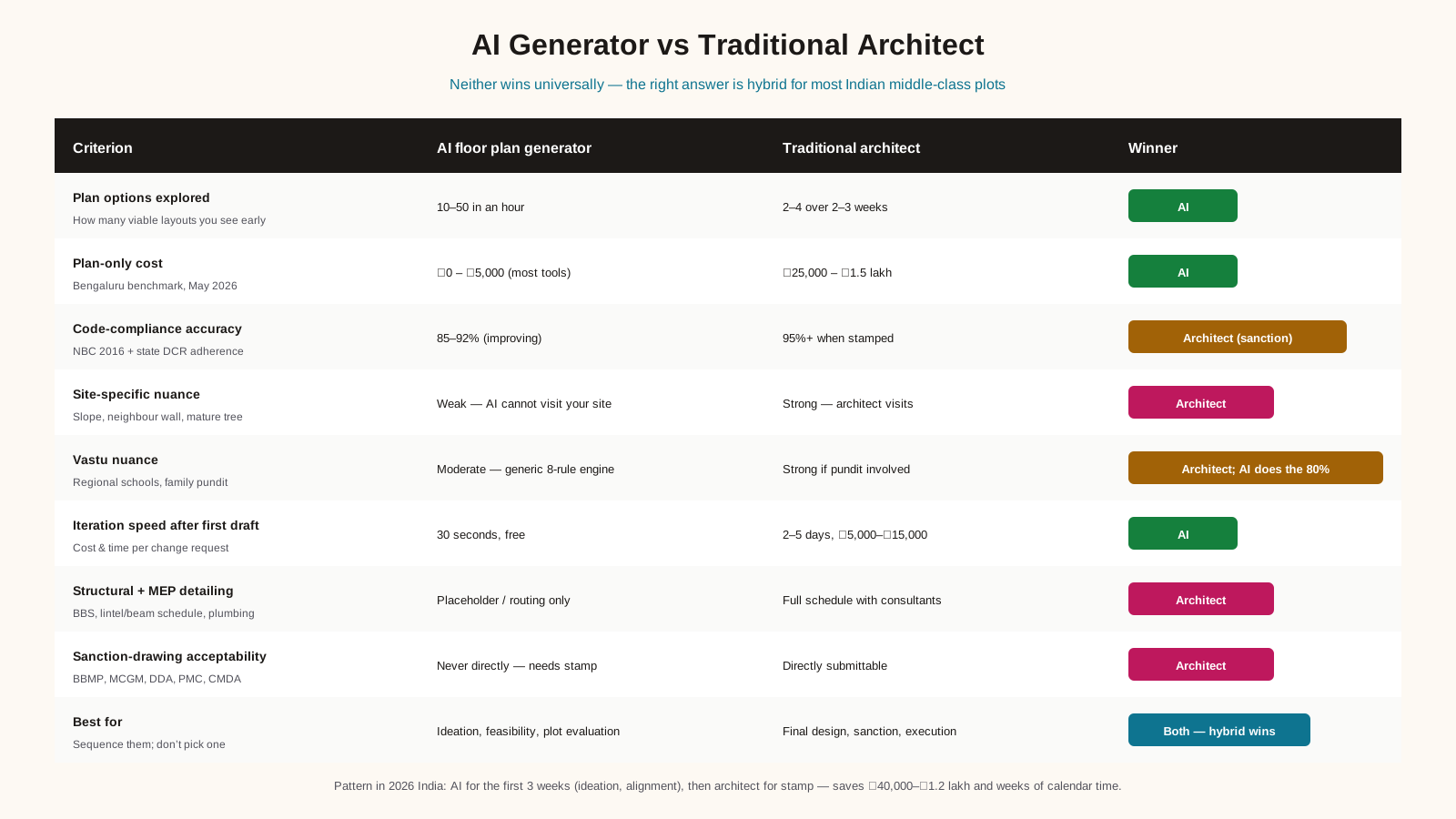
The honest comparison — neither approach wins universally. The right answer is hybrid for most middle-class plots, AI-led for early ideation, architect-led for sanction and structural.
| Criteria | AI floor plan generator | Traditional architect plan | Winner + caveat |
|---|---|---|---|
| Plan options explored | 10–50 in an hour | 2–4 over 2–3 weeks | AI — but quality of any single AI plan still needs review |
| Time to first viable layout | 30 minutes | 7–14 days | AI |
| Cost for plan-only | ₹0–₹5,000 (most tools) | ₹25,000–₹1.5 lakh | AI |
| Code-compliance accuracy | 85–92% (improving) | 95%+ when a qualified architect signs | Architect for sanction; AI as draft |
| Site-specific nuance (slope, neighbour wall, tree) | Weak — AI can't see your site | Strong — architect visits | Architect |
| Vastu nuance (regional schools, family traditions) | Moderate — generic Vastu engine | Strong if architect knows your family pundit | Architect; AI does the 80% |
| Iteration speed (after first draft) | 30 seconds per change | 2–5 days per revision | AI |
| Structural detailing | Approximate / placeholder | Full BBS, lintel, beam schedule | Architect |
| MEP (plumbing, electrical) | Routing only, not full schedule | Full schedule with consultant | Architect / MEP consultant |
| Sanction-drawing acceptability | Not directly — needs architect stamp | Directly submittable | Architect |
| Cost per iteration | Free | ₹5,000–₹15,000 | AI |
| Best for | Ideation, plot feasibility, "should I buy this plot?" | Final design, sanction, execution | Both — sequence them |
The pattern we see in 2026: smart homeowners use AI for the first three weeks (ideation, plot feasibility, family alignment on layout), then engage an architect with the AI-generated brief already filtered down to one or two preferred plans. The architect's fee drops because the discovery and option-generation work is done; the homeowner saves ₹40,000–₹1.2 lakh and gets to design freeze faster.
Tool Landscape 2026
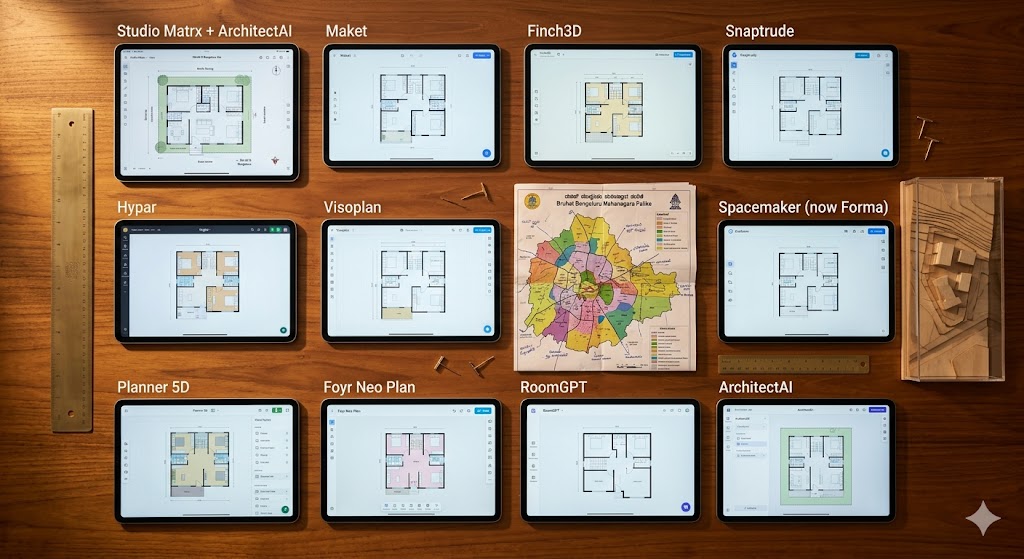
A snapshot of the global and India-relevant floor plan AI tools as of May 2026. Pricing in ₹ where India billing exists; USD otherwise.
| Tool | Primary input modes | India context | NBC / DCR aware | Vastu aware | Pricing (May 2026) | Best for |
|---|---|---|---|---|---|---|
| Studio Matrx + ArchitectAI | Brief, sketch, scan (beta) | Native — Bengaluru/Mumbai/Delhi NCR/Pune; rupee BoQs | Yes (NBC 2016 + BBMP, MCGM, DDA, PMC, CMDA) | Yes — explicit Vastu score + constraints | Free tier + ₹2,499/mo Pro + ArchitectAI firm tier | India homeowners + small firms |
| Maket | Brief, sketch | None — North America-default | Partial (NBC/IBC US-leaning, can custom-rule) | No | $59/mo Pro, $199/mo team | International firms, fast option-gen |
| Finch3D | Parametric brief, Rhino/Grasshopper | None — Nordic origin | Partial — custom rules | No | €99/mo solo, €299/mo team | Parametric-fluent architects |
| Snaptrude | BIM-first browser modeller | India team, Bengaluru office; partial DCR | Improving (Pune, parts of Bengaluru) | No native | Free tier + paid from $25/seat | India firms wanting BIM + AI |
| Hypar | Computational generators (custom) | None | Custom-build only | No | Enterprise — usage-based | Firms building their own generators |
| Visoplan | BIM coordination + clash | None | Partial (Eurocode-leaning) | No | €49/mo from | Coordination, not generation |
| Autodesk Forma (ex-Spacemaker) | Site-massing brief, urban scale | Limited — global codes | Partial — site/zoning focus | No | $85/mo + Revit ecosystem | Site-massing, multi-block plots |
| Coohom | Imported plan + render | India reseller presence | No | No | Free tier + ₹4,500/yr Pro | Render existing plans, not generate |
| Planner 5D | Drag-drop layout | India users, INR billing | No | No | Free + ₹599/mo Premium | DIY hobbyist, kitchen/room |
| Foyr Neo Plan | Drag-drop + render | India HQ, India billing | Limited | Limited | Free + ₹2,499/mo | India SMB designers |
| RoomGPT (and Promeai, REimagine Home) | Photo style-transfer | Global | No | No | $19–$29/mo | Render restyle, not plan generation |
| ArchitectAI (standalone) | Brief, sketch, scan | Native India — multi-tenant firms | Yes — NBC + 5 state DCRs | Yes | From ₹14,999/mo per firm | Architecture firms in India |
A few honest reads:
- Maket is the cleanest pure-play global generator. If you have an Indian context layer of your own (or your architect handles code translation), Maket's option-explosion is exceptional. We use it as a benchmark for our own model quality.
- Finch3D is best for architects who already think parametrically. Steep learning curve for homeowners.
- Snaptrude is the closest India-native BIM-first peer. They don't do Vastu, and their generation is more "constraint solver on a manually started plan" than "brief to plan from zero," but for firms wanting BIM + AI in India they're worth a serious look.
- Coohom, Planner 5D, Foyr Neo Plan are visualisers / drag-drop tools, not generators. Useful, but not the same category.
- RoomGPT and clones restyle a photo — they don't produce plans at all. Marketing language often conflates the two.
If you're an India homeowner, the realistic shortlist for floor plan generation in May 2026 is: Studio Matrx + ArchitectAI, Maket (with a code-translation step), or Snaptrude (if you're comfortable in a BIM tool). For everything else, you're either visualising or doodling — both fine, but call it what it is.
Eight Risks, Pitfalls and Honest Limits
1. Plot-shape oversimplification. Most generators assume rectangular plots. Trapezoidal plots, irregular corner plots, and plots with diagonal frontage break naive generators or produce sub-optimal layouts. Mitigation: upload an actual plot survey (DWG or CSV of corner coordinates) — Studio Matrx, ArchitectAI, Maket, and Finch all accept polygon inputs. Don't trust a generator that only asks "width × depth."
2. Setback rule lag. State DCRs change. BBMP revised premium FSI rules in late 2024; MCGM tweaked DCPR 2034 amendments mid-2025. A generator using a 2023 rule set will silently mis-compute your envelope. Mitigation: every plan should print the rule version it used (we date-stamp ours). If you can't see "Rule set: BBMP zoning rules, last updated
3. Vastu "score" hand-waving. Some tools surface a Vastu score that's actually just a checklist of 4–5 rules (kitchen direction, entrance direction, master bedroom direction). Real Vastu reasoning involves brahmasthan, marma, the 8-direction grid, the family deity placement, and your specific janma nakshatra in some traditions. Mitigation: if a Vastu score is critical to your family, treat AI scores as a draft and review with a human Vastu consultant before sanction.
4. Room-area minima inflation. A bedroom that's 9.5 sq m exactly clears NBC but feels claustrophobic with a queen bed. Generators optimise to the minimum, not to lived experience. Mitigation: set your own minima in the brief — "no bedroom under 12 sq m," "kitchen counter run ≥3.6 m."
5. Phantom load-bearing assumptions. Brief-to-plan generators don't know what's load-bearing on a renovation. If you're working with an existing structure (photo-to-plan or scan-to-plan input), the AI will happily delete a wall the building needs to stand. Mitigation: any wall change on an existing building must be reviewed by a structural engineer. Studio Matrx adds a red banner on suggested wall removals in photo/scan flows.
6. MEP routing fantasy. AI plans typically draw plumbing risers in convenient places, ignoring the fact that your sewer line exits the East side of your plot at a specific depth. Mitigation: a Plumber/MEP consultant validates pre-sanction. Generators are getting better at this (we integrate basic sewer-line constraints), but it's still a 70% problem in 2026.
7. Cost estimates that don't match your contractor. Our cost engine uses average Bengaluru/Mumbai/Delhi-NCR rates. Your specific contractor may quote 15–25% over, especially for non-standard finishes or premium fittings. Mitigation: treat AI cost estimates as ballpark; use Studio Matrx's cost benchmark for category-level checks and get three real quotations before signing.
8. Sanction-drawing acceptability. No AI floor plan is municipally accepted on its own. You need an architect or LBE stamp. Some homeowners assume "AI plan → BBMP submission" works; it doesn't. Mitigation: always plan for an architect-of-record. Many firms accept AI-generated plans as the brief and charge only for sanction-drawing finalisation (typically ₹15–₹40/sq ft in Bengaluru as of May 2026), down from ₹40–₹100/sq ft for design-from-scratch.
India-Specific Considerations
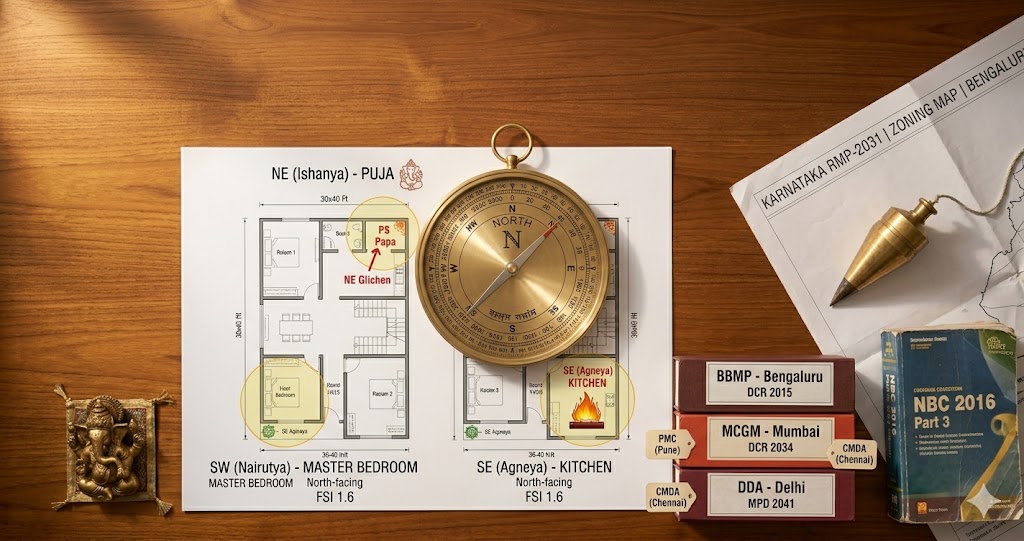
NBC 2016 compliance. The National Building Code 2016 (Bureau of Indian Standards, last amendment 2022) sets the floor of any plan. Key clauses your AI generator must respect: minimum room dimensions (Part 3, Section 3 — habitable room 9.5 sq m / 2.4 m min dimension; kitchen 5.0 sq m; bath 1.8 sq m), light and ventilation (Part 8 — minimum window area 1/8th of floor area, openable 1/16th), corridor and staircase widths (Part 4 — residential staircase ≥0.9 m clear), and fire safety setbacks for buildings >15 m. A generator that doesn't print an NBC compliance report is unfinished.
State DCRs (the part Western generators get wrong). Each state and many municipalities maintain their own Development Control Regulations on top of NBC. Karnataka (BBMP, BDA), Maharashtra (MCGM via DCPR 2034, MMRDA, PMC), Delhi NCR (DDA MPD 2021, draft MPD 2041), Tamil Nadu (CMDA, DTCP), Telangana (HMDA) — each has its own FSI rules, premium FSI mechanisms, setback formulas, and ground-coverage limits. Studio Matrx encodes five state DCRs as of May 2026 (Karnataka, Maharashtra, Delhi NCR, Tamil Nadu, Pune-PMC); Telangana and Hyderabad's HMDA rules ship in Q3 2026.
IS codes. IS 875 (loads), IS 456 (concrete), IS 1893 (seismic), IS 1905 (masonry) — these enter the picture at the structural-drawing stage, not the floor plan stage, but a good generator should respect seismic zone constraints (Zone III/IV/V for most Indian cities) when sizing column grids.
DPDP Act 2023 — what about your data? When you upload a plot survey, family photos, or LiDAR scan of your existing home, you're sharing personal data under India's Digital Personal Data Protection Act 2023. Any India-operating generator must (a) take explicit consent, (b) name a Data Fiduciary, (c) allow you to delete data on request, (d) restrict cross-border transfer unless the destination is in the government's permitted list. Ask any tool you use to point you to their DPDP-aligned privacy policy. Studio Matrx's is at /privacy; we use India-region storage (AWS Mumbai) for all customer data.
Vastu compatibility — the real Indian seam. A floor plan generator that ignores Vastu is unsellable in 70%+ of Indian middle-class housing. Vastu rules that should be encoded as soft constraints (not hard, because every family weighs them differently):
- Main entrance: North, East, or North-East preferred; SW avoid
- Kitchen: South-East ideal; NW acceptable; NE/SW avoid (NE especially)
- Master bedroom: South-West
- Pooja room: North-East or East
- Brahmasthan (centre): keep open / no toilet / no staircase
- Staircase: South/West preferred; not in NE
- Septic tank: NW preferred; not NE/SE
A good generator lets you select which Vastu rules to enforce strictly vs which to relax — not every family follows every rule. See Vastu house plan India for a full treatment, and North facing house Vastu for the specific case of north-facing plots.
Regional vendor reality. A plan that calls for 4×8 ft IPS-finished kota in Pune is buildable in two days; the same plan in Coimbatore needs special order. Your generator should be aware of regional material availability. We tag plans with "regional fit" notes for Bengaluru/Mumbai/Delhi/Pune/Hyderabad/Chennai; vendor sourcing flows into the vendor comparison tool.
Climate zones. India spans five climate zones per NBC: hot-dry (Jaipur, Ahmedabad), warm-humid (Mumbai, Chennai), composite (Delhi NCR, Bengaluru), temperate (Bengaluru, Pune higher altitudes), cold (Shimla, Srinagar). A floor plan generator that doesn't ask your zone is missing one of the strongest design drivers. Cross-ventilation orientation, courtyard depth, jaali-wall placement, balcony shading — all change by zone. We use cross-ventilation analyzer, daylight factor, and brise-soleil visualizer to climate-tune generated plans.
Language. Voice intake in Hindi, Tamil, Kannada, Marathi, Bengali, and Telugu is now table stakes for any India-serving generator. Studio Matrx supports Hindi, Tamil, Kannada, and Marathi at launch quality; Bengali and Telugu ship in Q4 2026.
The /house-plans library. Alongside the generator, Studio Matrx maintains an editorial library at /house-plans — 100 curated, hand-detailed plans organised by climate zone, FSI category, and Vastu orientation. Two anchors are live (Hot-Dry G+1 and Warm-Humid courtyard); the rest stub out through 2026. The library complements the generator: use the generator when you want a layout tuned to your exact plot; use the library when you want to study a known-good archetype before briefing the generator.
The Studio Matrx Stack for AI Floor Plans
The tools and flows that make floor plan generation work end-to-end in Studio Matrx and ArchitectAI:
- AI onboarding — brief intake in Hindi/Tamil/Kannada/Marathi, voice or text, with structured extraction into a plan brief.
- Client discovery — for professional users running the flow with a client; deeper-than-brief discovery via guided questions.
- Project feasibility — plot envelope, FSI consumption, budget-to-built-up reconciliation before the generator runs.
- Setback visualiser — interactive 2D envelope showing front/side/rear setbacks per your municipality, with the rule citation printed.
- Furniture planner — once a plan is locked, drop furniture into each room and check circulation.
- Dimension handbook — every minimum dimension (door, corridor, stair tread, counter height) per NBC + ergonomic best practice; the generator references this internally.
- Daylight factor — analyse natural light in each room of the generated plan; flag rooms with sub-NBC daylight.
- Cross-ventilation analyzer — opening-to-opening airflow check; particularly useful in warm-humid coastal plans.
- Brise-soleil visualizer — shade-overhang design for South and West facades.
- Staircase calculator — NBC-compliant rise/tread/landing for the staircase the generator placed.
- Seismic zone checker — sanity-check column grid feasibility for your zone (III/IV/V).
- Cost benchmark — ₹/sq ft for the generated plan in your city, with finish-grade slider.
- Material rate library — line-item rates for the BoQ generated from the locked plan.
- Material palette and moodboard builder — interior of the generated plan, room by room.
When NOT to Use AI Floor Plan Generators
AI floor plan generation is wrong (or partially wrong) for these situations:
Heritage and conservation projects. A 1920s bungalow in Bandra or a Chettinad mansion in Karaikudi needs preservation-first thinking — material continuity, façade rhythm, original room volumes. AI generators will optimise these away. Use the AI for new additions on the same plot, not to re-plan the heritage shell.
Plots with severe slope. Hill stations (Coorg, Ooty, Mussoorie, Shimla) have plots with 15–30% slopes where the plan is dictated by the contour. Brief-to-plan generators assume flat sites. Use site-aware tools (Autodesk Forma's terrain reader) or work with a local architect from the start.
Highly custom programmes. If your brief is "a home + a 12-seat private cinema + a 200-sq-ft pottery studio with kiln + a wine cellar," AI generators trained on standard housing data will return mediocre layouts. Custom programmes need custom architects.
Already-architect-engaged projects. If you've already hired an architect, running AI generators in parallel often creates conflict and dilutes their design. Better: ask your architect if they use AI internally (many top India firms do, including some via ArchitectAI), and let them lead.
Renovations of complex existing buildings. Photo-to-plan and scan-to-plan are still beta in 2026. For a renovation, hire a surveyor for measured drawings; then run AI on the measured plan, not on photos directly.
When the plot decision is more important than the plan decision. If you haven't bought the plot yet, AI generation can help you evaluate plots (use project feasibility) but is overkill for plan-detail. Decide plot first; generate plans after.
The 5-Year Trajectory: AI Floor Plans in 2030
By 2030, three shifts will reshape the category:
Plot-to-construction-set in one platform. The fragmentation between plan generation, structural drawings, MEP, and sanction-drawing handoff will collapse. A single platform will produce a sanction-ready DWG set, e-signed by a licensed architect, submitted to BBMP/MCGM/DDA via their (likely existing by then) digital sanction portals. India's National Single Window System is already pushing toward this; Karnataka's Nadakacheri-style integration for building plan approval is in pilot in Bengaluru as of mid-2026.
Real-time code reasoning, not lookup. Today's tools encode rule sets as JSON. By 2030, they'll reason from rule documents directly — paste the latest DCR PDF and the generator updates overnight. Foundation models with longer context and better tool use will make this practical.
Embodied carbon as a first-class constraint. The Indian Green Building Council (IGBC) and GRIHA 2030 targets will push embodied carbon into mandatory disclosure for any building >500 sq m. AI generators will optimise plans on a fourth axis (after area, cost, code, Vastu): kg CO2e per sq m. We're already pre-positioning this; full GRIHA integration is on our 2027 roadmap.
Hyper-local language and Vastu fluency. Voice intake will handle every Indian language at native fluency. Vastu engines will encode regional schools (North Indian, South Indian, Bengali, Maharashtrian variants) and recommend per-region. The generic Vastu engine of 2026 will look as crude as 2020 Google Translate looks now.
The architect's role shifts (but doesn't go away). The work that survives is structural reasoning, site judgement, family-and-culture sensitivity, and the legal stamp. The work that AI absorbs is option generation, code lookup, drafting, and routine BoQ. Junior architects will pivot toward design-critic and site-supervisor roles earlier in their careers. Senior architects who embrace AI ship 3–5x more projects per year by 2030 — the ones who don't will compete only on heritage and ultra-luxury.
Frequently Asked Questions
Can AI generate a floor plan from my 30x40 plot?
Yes. A 30×40 ft plot (1,200 sq ft, the most common middle-class plot in India) is well within scope for any serious AI floor plan generator. You'll typically get 4–8 candidate plans in 90 seconds to a few minutes, each respecting the setbacks for your municipality (BBMP, MCGM, DDA, PMC, CMDA) and an FSI ceiling of 1.5–2.0 depending on your zone. Studio Matrx + ArchitectAI handles 30×40 N/E/S/W orientations as a first-class case study — we trained extensively on this plot size because it's the dominant Bengaluru/Hyderabad/Chennai/Pune lot. Expect built-up areas of 1,800–2,100 sq ft across G+1 and a ₹65L–₹1.1Cr construction-cost range depending on finish grade.
Does AI check NBC 2016 / state DCR rules?
The good ones do; the bad ones don't. NBC 2016 (Bureau of Indian Standards, last revised 2022) covers minimum room sizes, light/ventilation, corridor widths, fire-safety setbacks, and a hundred other rules — all of which a serious generator should enforce. State DCRs (BBMP zoning for Bengaluru, DCPR 2034 for Mumbai, MPD 2021 for Delhi, CMDA for Chennai, PMC for Pune) layer on top with FSI, ground-coverage, premium-FSI, and setback rules specific to your municipality. As a buyer, ask any tool to show you a code-compliance report on every generated plan and to print the rule-set version it used. Studio Matrx ships this report by default; Maket, Finch, and Snaptrude offer it as configurable; Coohom, Planner 5D, and Foyr Neo Plan generally don't.
Will AI plans be Vastu-compliant?
Vastu-aware, yes; Vastu-compliant always, no. AI generators encode a finite set of Vastu rules (entrance direction, kitchen direction, master bedroom direction, brahmasthan rule, staircase placement). They cannot reason about your family deity placement, your janma nakshatra-specific preferences, or regional Vastu schools. For most middle-class Indian homeowners, AI Vastu reasoning catches 80–90% of the rules that matter and is a strong draft. If Vastu is critical, treat the AI plan as a starting point and review with a Vastu consultant before sanction. See Vastu house plan India for the rule catalogue and North facing house Vastu for the orientation-specific guide.
Can I upload a sketch and get a clean plan?
Yes, in most modern generators. ArchitectAI, Maket, and Finch3D all accept sketch upload (photograph or scan of a hand drawing). The generator interprets walls, openings, room labels (if you've labelled), and dimensions, then re-draws as a clean dimensioned plan. Quality depends on sketch clarity — labelled rooms with rough dimensions get best results. A sketch with no labels and ambiguous lines forces the AI to guess. In Studio Matrx the sketch-to-plan flow takes 60–90 seconds per sketch and supports multi-page sketches (ground + first floor).
How does Studio Matrx differ from Maket for floor plans?
Three big differences. (1) India context — Studio Matrx + ArchitectAI is built around NBC 2016, state DCRs, Vastu, ₹ rate libraries, and Indian regional vendor reality. Maket is North-America-default. You can configure Maket with custom rules but you're doing the India work; in Studio Matrx it's pre-loaded. (2) Integrated downstream — Studio Matrx flows from plan into moodboard, render, BoQ, vendor sourcing, and architect handoff in one place. Maket stops at the plan; you re-platform for rendering and BoQ. (3) Pricing model — Studio Matrx has a free tier and ₹2,499/mo Pro; ArchitectAI is a firm-tier subscription starting ₹14,999/mo. Maket's solo plan is $59/mo (≈₹5,000), team $199/mo (≈₹17,000). For India users, Studio Matrx is the natural fit; for international firms that want pure plan-gen power, Maket is excellent.
Are AI-generated plans accepted by municipal commissioners?
Not directly, no. As of May 2026, no Indian municipality (BBMP, MCGM, DDA, PMC, CMDA, HMDA, GHMC) accepts a raw AI-generated floor plan for sanction. You need a licensed architect or LBE (Licenced Building Engineer) to stamp and sign the plan, sections, elevations, and accompanying drawings. The good news: most architecture firms now happily accept AI-generated plans as the design intent and charge only for sanction-drawing finalisation (typically ₹15–₹40/sq ft in Bengaluru, ₹20–₹55/sq ft in Mumbai). This is 40–70% less than design-from-scratch fees. Studio Matrx integrates with a panel of architects in Bengaluru, Mumbai, Delhi NCR, and Pune for direct handoff.
Can AI generate elevations and sections too?
Partially. Most generators produce 3D massing alongside the 2D plan, which gives you indicative elevations. Full dimensioned elevations with material annotations and detailed sections (showing slab thickness, lintel levels, plinth heights) typically still need an architect or the generator's "elevation finishing" module. ArchitectAI ships indicative elevations for free; detailed sanction-ready elevations are a paid add-on or are handled by your architect-of-record. Don't trust an AI elevation as construction-grade without architect review.
How long does it take to go from brief to a plan I can build?
Brief to first viable AI-generated plan: 15–30 minutes in Studio Matrx. Plan to refined-and-locked plan with 3–5 iterations: 2–4 hours total active time, often across 2–3 days as you sit with family and decide. Locked plan to architect-stamped sanction drawing: 2–4 weeks via a Studio Matrx partner architect, or 3–8 weeks if you take it to an architect cold. Sanction drawing to BBMP/MCGM/DDA approval: 30–90 days depending on city. Total: 6–14 weeks plot-to-sanction, versus 4–9 months for traditional architect-led design.
What's the difference between AI floor plan generation and AI room planning?
Floor plan generation works at the building scale: walls, rooms, circulation, the relationship between spaces. Room planning works at the room scale: furniture placement, lighting layout, finish selection in a single room. They're complementary: the generator gives you the plan; the room planner styles each room inside it. See AI room planner for the room-level companion guide.
Where can I see ready-made plans rather than generate new ones?
Studio Matrx's /house-plans library is our editorial collection of 100 hand-detailed plans, organised by climate zone, FSI bucket, and Vastu orientation. Two anchors are live as of May 2026 (Hot-Dry G+1 and Warm-Humid courtyard); the remaining 98 stub out through 2026. Browse the library when you want a known-good archetype; use the generator when you want a plan tuned to your exact plot. Many homeowners do both — start with a library plan that's close to your needs, then run it through the generator with your specific constraints to fine-tune.
References
1. Bureau of Indian Standards. National Building Code of India 2016 (with amendments through 2022). New Delhi: BIS, 2022. https://www.bis.gov.in
2. BBMP (Bruhat Bengaluru Mahanagara Palike). Bengaluru Zoning Regulations and Building Bye-laws, latest amendments 2024. https://bbmp.gov.in
3. MCGM (Municipal Corporation of Greater Mumbai). Development Control and Promotion Regulations 2034. Mumbai, 2018 (amendments through 2025).
4. DDA (Delhi Development Authority). Master Plan for Delhi 2021 and Draft MPD 2041. New Delhi: DDA, 2021/2024.
5. Ministry of Electronics and IT, Government of India. Digital Personal Data Protection Act, 2023. https://www.meity.gov.in
6. KPMG India and NASSCOM. India PropTech Report 2025: AI in Residential Design and Construction. New Delhi: KPMG India, 2025.
7. CREDAI and Anarock. India Real Estate Outlook 2025-26: Residential Trends and Buyer Preferences. Mumbai: Anarock Research, 2025.
8. Indian Green Building Council (IGBC). IGBC Green Homes Rating System v3.0. Hyderabad: IGBC, 2024. https://igbc.in
9. GRIHA Council. GRIHA v2019 for Residential Buildings and GRIHA 2030 Vision Document. New Delhi: GRIHA Council, 2024.
10. Statista. Smart Home and PropTech Market in India 2026 Forecast. Statista Research, 2026. https://www.statista.com
11. IBEF (India Brand Equity Foundation). Real Estate Industry Report India, April 2026 edition. https://www.ibef.org
12. Houzz. India Renovation Trends Study 2025. Houzz Research, 2025.
13. Maket. Maket Generative Design Platform: Technical Whitepaper 2025. https://www.maket.ai
14. Snaptrude. BIM-First Design for Indian Practice: Product Documentation 2026. https://snaptrude.com
15. Vaastu Shastra: V.K. Subramanian, Vastu Shastra: The Science of Indian Architecture. New Delhi: Abhinav Publications, 2003 (reference for Vastu rule catalogue).
16. Auroville Earth Institute. Climate-Responsive Design for Indian Housing. Auroville: AVEI, 2022.
17. Autodesk. Forma (formerly Spacemaker) Product Documentation: Site Analysis and Massing. Autodesk, 2026. https://www.autodesk.com/forma
18. Karnataka Real Estate Regulatory Authority (K-RERA). RERA Guidelines for Plan Disclosure, 2024. https://rera.karnataka.gov.in
Related Guides
- AI home design — the wider category of AI in home design end-to-end
- AI architecture software — the landscape of AI tools across architecture practice
- AI architecture in India — India-specific deep dive on AI architecture
- AI room planner — room-scale AI planning companion to floor-plan-scale generation
- North facing house Vastu — Vastu for the most common Indian plot orientation
- Vastu house plan India — comprehensive Vastu plan rules and worked examples
Export this guide
Related Guides — Deep-dive reading
AI Architecture Software — Firm-Level Comparison for Indian Practice (2026)
ArchitectAI vs Forma vs TestFit · Pre-design · Code compliance · BIM integration
Design StylesAI Architecture India — The 2026 India Market Cornerstone for AI in Architecture
NBC 2016 · State DCRs · ECBC zones · Indian materials · Vastu · Multilingual NLU
Design StylesAI Render Generator — Photoreal AI Rendering for Indian Architects + Designers (2026)
Sketch/photo/white-box → photoreal · 12 min vs V-Ray 4 hr · Studio Matrx + Lumion + D5 + Twinmotion + Enscape
Design StylesRelated Tools — Try Free
Brise-Soleil Visualizer
Interactive horizontal-louvre cut-off angle calculator — sun altitude, louvre depth, and spacing inputs with a live shadow preview. Computes θ = arctan(spacing/depth) for façade shading, ECBC envelope compliance, hospital daylight design, and tropical sun-control detailing.
Sun Shading ToolCross-Ventilation Analyzer
Estimate airflow and air changes per hour (ACH) from room size, window areas, layout, and local wind — with NBC 2016 Part 8 compliance check.
Ventilation CalculatorProperty Tax Calculator — 10 Indian Cities
Estimate annual municipal property tax across BBMP / MCD / MCGM / GHMC / GCC / KMC / PMC / AMC / TMC / PCMC — with self-occupied, tenanted, and age-rebate adjustments.
Property Tax