
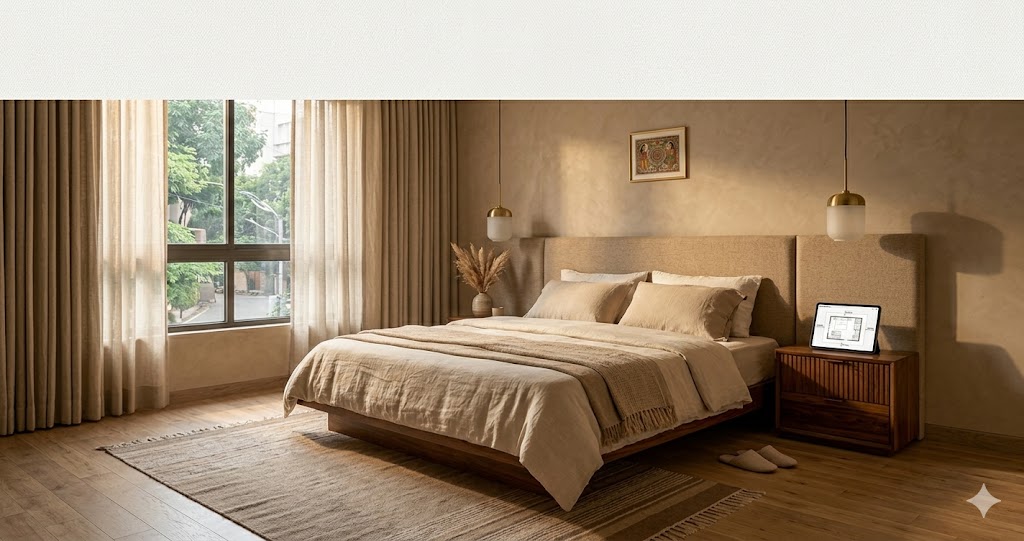
AI Room Planner — Single-Room Layout AI for Indian Homes (2026)
Furniture placement · Ergonomic minima · Vastu placement · 6-room playbook
You don't need to plan the whole house. You need to plan one room — your 11x13 master bedroom that has to fit a king bed, two wardrobes, a study nook, and somehow leave 600mm of walkway on both sides of the bed. An AI room planner is the tool that does exactly that single-room layout work — placing furniture, validating clearances, checking Vastu directionality, and showing you the trade-offs of three or four genuinely workable arrangements in the time it takes to brew filter coffee. For Indian homes, where rooms are tight, plumbing walls are fixed, and the same 130 sq ft has to do double duty as bedroom-cum-study, this single-room focus is where AI design earns its keep.
Most people don't actually want "AI for my whole 3 BHK". They want help with one stubborn room — the kitchen that refuses to accommodate a tandoor and a microwave, the kids' room that needs to grow from toddler to teen, the living room where the TV wall and the puja unit are fighting for the same corner. Studio Matrx's room planner is built around that single-room intent: pick a room, enter dimensions, lock fixed elements (plumbing stack, beam, window, door swing), and the AI returns three to five layouts ranked by circulation efficiency, ergonomic compliance, and Vastu alignment.
"The hardest part of a 3 BHK is not the floor plan. It's the master bedroom that has to be a bedroom, a wardrobe room, a dressing area, a reading corner, and occasionally a baby's room — all in 140 square feet. AI doesn't make the room bigger. It makes the math honest."
This guide is the single-room companion to our whole-home AI work — pair it with ai-interior-design, ai-home-design, ai-floor-plan-generator, and the bedroom-specific vastu-for-bedroom to see how the room-level planner sits inside the larger Studio Matrx stack. This guide refreshes every 12 months. Last verified: May 2026 · Next verify: May 2027.
What AI Room Planner Actually Means (and What It Doesn't)
An AI room planner is a software system that takes a single room's geometry — length, width, ceiling height, door positions, window positions, fixed plumbing stacks, beams, and columns — and computationally generates furniture layouts that satisfy three layered constraints: dimensional ergonomics (can a human actually walk, sit, sleep, cook there?), functional adjacency (TV faces sofa, bed faces away from door, hob is next to sink), and cultural/regional fit (Vastu directionality for Indian users, modesty patterns for bathrooms, joint-family seating arrangements).
The "AI" part is doing three jobs at once: (1) constraint satisfaction — placing rectangles inside a polygon without overlaps and respecting clearances; (2) preference learning — figuring out which of the 200 possible valid layouts you actually want, based on a short brief and quick A/B picks; (3) generation — producing 3D-rendered visualisations of the top three layouts so you can see, not just read, what changes when the bed shifts 18 inches east.
A modern room planner like Studio Matrx ingests a 12x10 bedroom and outputs: a top-down 2D plan with every dimension annotated, a 3D walk-through render of the highest-ranked layout, a furniture BoQ with Indian-market SKU suggestions (₹ totals, not USD), a Vastu compliance score with specific deltas ("bed headboard 14 degrees off true south — acceptable"), and a clearance audit showing every walkway, swing arc, and approach distance.
Five things an AI room planner is NOT:
1. It is not a whole-home floor plan generator. That's a different tool — see ai-floor-plan-generator. Room planners assume the walls are already drawn; they work inside them.
2. It is not a structural design tool. It will not tell you whether a beam can be removed or a wall is load-bearing. It treats fixed elements as immovable inputs.
3. It is not a manufacturer-bound catalogue. Tools like IKEA Home Planner only place IKEA items. A real AI room planner like Studio Matrx works with generic furniture archetypes (king bed, three-seater sofa, six-seater dining) and lets you swap in vendor SKUs later.
4. It is not a substitute for site measurement. Garbage-in-garbage-out applies. A 12x10 room that is actually 11'7" x 9'10" will produce layouts that don't fit. Use a measuring tape or the MagicPlan-style AR capture before you trust the output.
5. It is not a final construction drawing. The 2D plan is design-stage. For carpenter handoff you need MEP overlays, finish callouts, and a section drawing — Studio Matrx exports a starter set, but a contractor still needs to convert it.
Why AI Room Planner Matters in 2026 India
Three forces have converged in the last 24 months to make single-room AI planning genuinely useful for Indian homes — not just a Western export.
Force one: room sizes shrunk. A 2024 PropEquity report on the top eight Indian metros showed that average bedroom areas in new 3 BHK launches dropped from 138 sq ft (2018) to 116 sq ft (2024) — a 16% compression. Master bedrooms in Bengaluru's Whitefield and Sarjapur ORR corridors now routinely arrive at 11x10 or 11x11. Mumbai's 1 BHK reality is harsher — sub-90 sq ft bedrooms are normal. At these sizes, every inch of furniture clearance matters, and visual intuition fails. AI's clearance math doesn't.
Force two: furniture choice exploded. A 2023 Pepperfry trend report counted over 40 distinct sofa archetypes in active circulation in India — three-seaters, sofa-cum-beds, modular L-shapes with reversible chaise, recliner sectionals, daybeds, diwans, low-floor majlis-style seating. The combinatorial explosion of "which sofa fits which living room" is genuinely hard for a homeowner to hold in their head. AI enumerates the options that fit; humans pick.
Force three: Vastu is mainstream again. A 2024 Anarock buyer-sentiment survey found 61% of Indian homebuyers in the 28-45 age band reported Vastu as a "non-negotiable" or "strong preference" factor in interior layout — up from 47% in 2019. AI room planners that bake Vastu directionality into the constraint solver (bed headboard south or east, no mirror facing bed, kitchen hob in south-east) are doing what previously required a separate consultation.
The seam Studio Matrx fills is specifically Indian: a planner that knows a diwan is 75x36 inches (not a Western daybed at 80x40), that knows a typical Indian wardrobe shutter swing is 600mm (not the 24-inch Western default), that knows Bengaluru flats often have a beam dropping 200mm below ceiling level along one wall, and that knows the puja unit needs 18 inches of clear approach. International tools — Planner 5D, Roomstyler, IKEA Home Planner — get the geometry right but miss the local-context constraints. Indian tools historically got the context right but had clunky 2D-only interfaces. Studio Matrx is built for the intersection.
The Six Room Types That Matter
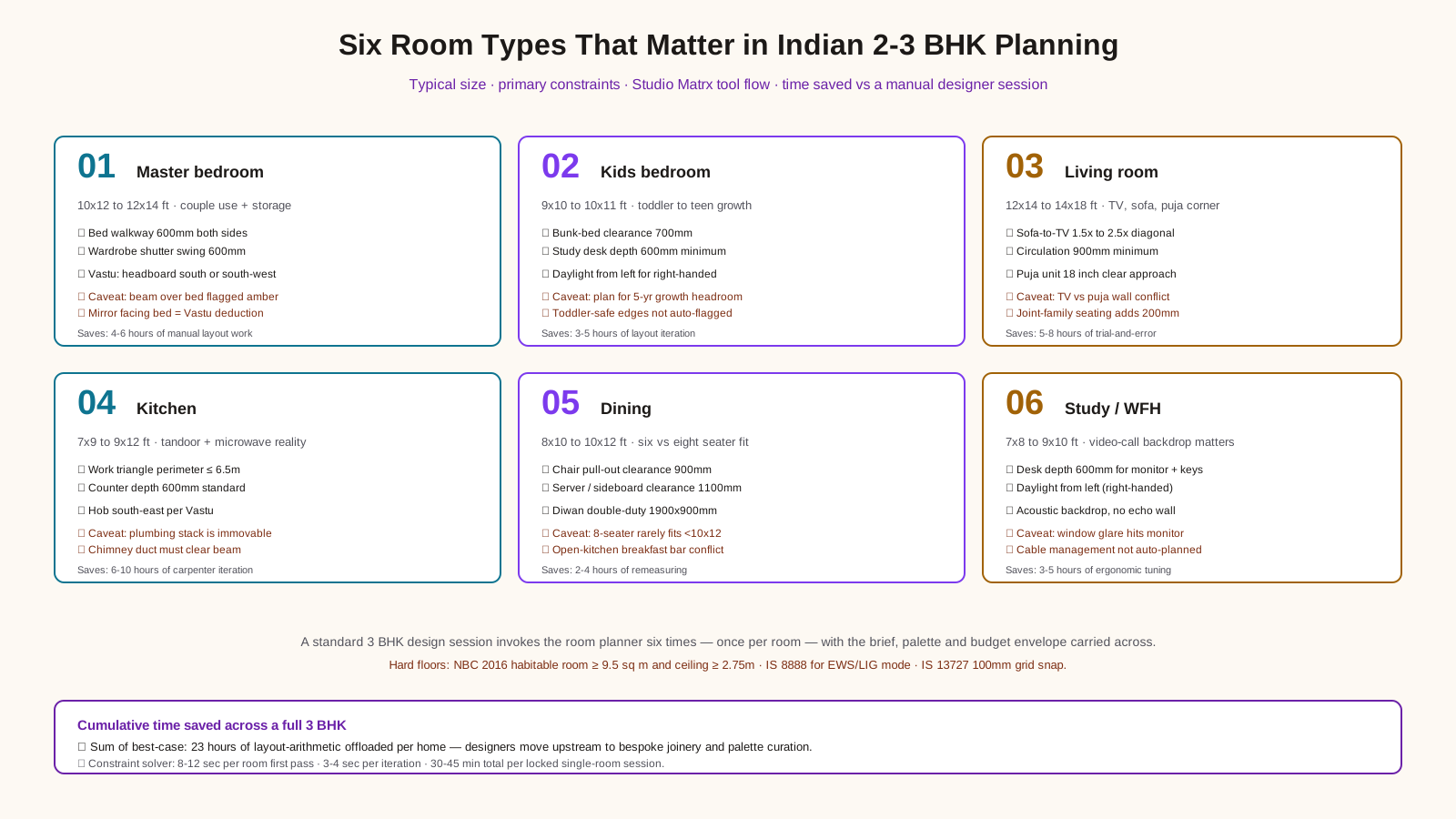
Indian 2-3 BHK reality settles into six recurring room-planning queries. Each has its own constraint set, ergonomic minima, and Vastu pattern. The table below shows what an AI room planner does for each.
| Room type | Typical India size | Primary constraints | Studio Matrx flow | Time saved vs manual |
|---|---|---|---|---|
| Master bedroom | 10x12 to 12x14 ft | Bed clearance 600mm both sides, wardrobe shutter 600mm swing, Vastu (head SW/W) | furniture-planner + vastu-for-bedroom overlay | 4-6 hours |
| Kids bedroom | 9x10 to 10x11 ft | Bunk-bed clearance 700mm, study desk 600mm depth, growth flexibility | furniture-planner + ergonomics-guide | 3-5 hours |
| Living room | 12x14 to 14x18 ft | Sofa-TV distance 1.5x to 2.5x screen diagonal, circulation 900mm, puja corner | furniture-planner + moodboard-builder | 5-8 hours |
| Kitchen | 7x9 to 9x12 ft | Work triangle ≤6.5m, counter depth 600mm, hob south-east per Vastu | kitchen-rulebook + dimension-handbook | 6-10 hours |
| Dining | 8x10 to 10x12 ft | Chair pull-out 900mm, server clearance 1100mm, six-vs-eight seater fit | furniture-planner + dimension-handbook | 2-4 hours |
| Study / WFH | 7x8 to 9x10 ft | Desk depth 600mm, video-call backdrop, daylight from left (right-handed) | furniture-planner + daylight-factor | 3-5 hours |
A real 3 BHK design session walks through all six. Studio Matrx's room planner is built to be invoked six times, one per room, with shared brief carrying across — so the moodboard, palette, and budget envelope you set in the master bedroom don't have to be re-entered for the kitchen.
How Studio Matrx Does AI Room Planning — End-to-End Walkthrough
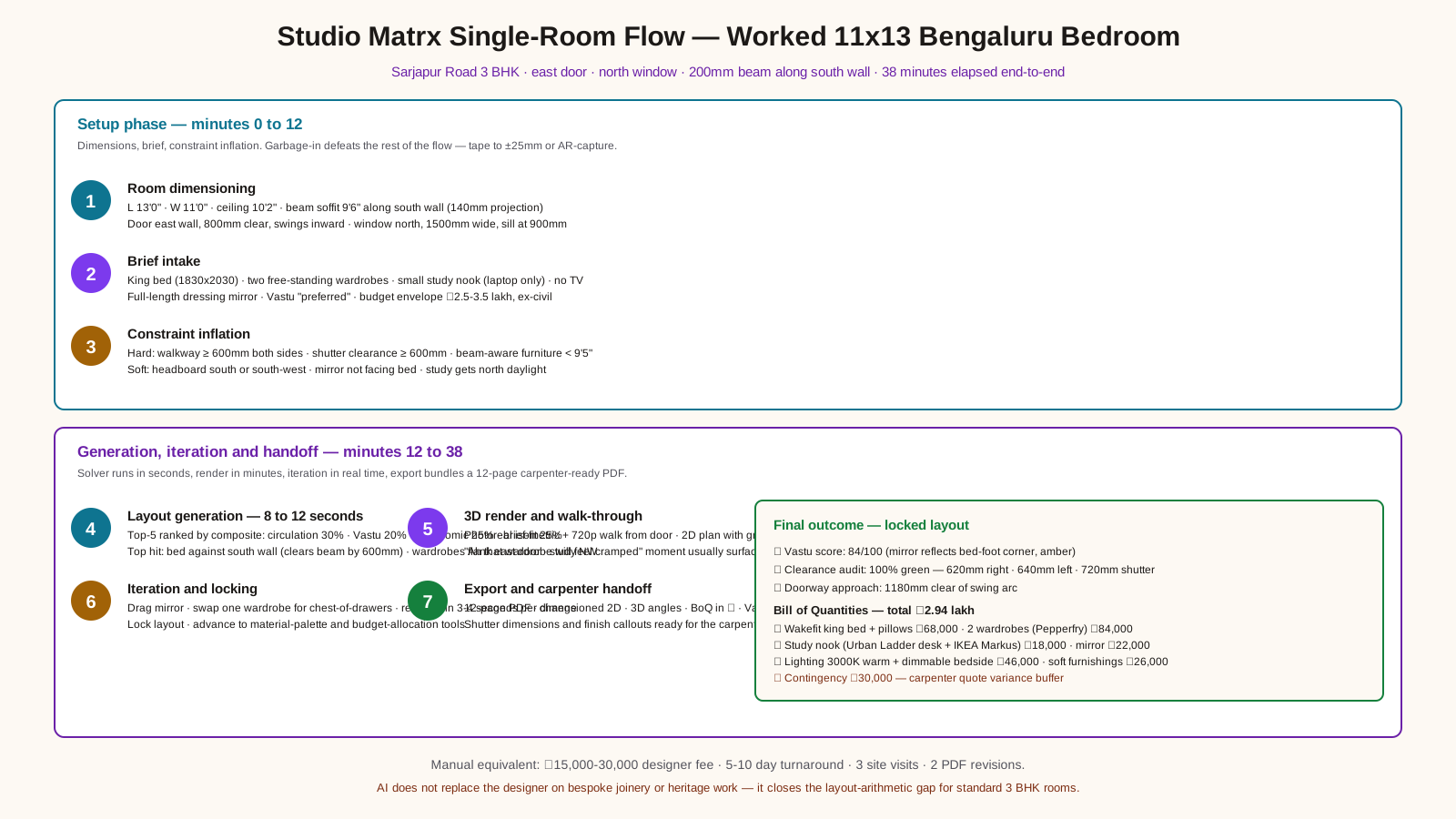
Here is the actual single-room flow inside Studio Matrx, as it runs today. We'll use a worked example: an 11x13 master bedroom in a Bengaluru 3 BHK on Sarjapur Road, ORR-facing, with the door on the east wall, a window on the north wall, and a 230mm beam dropping 200mm along the south wall.
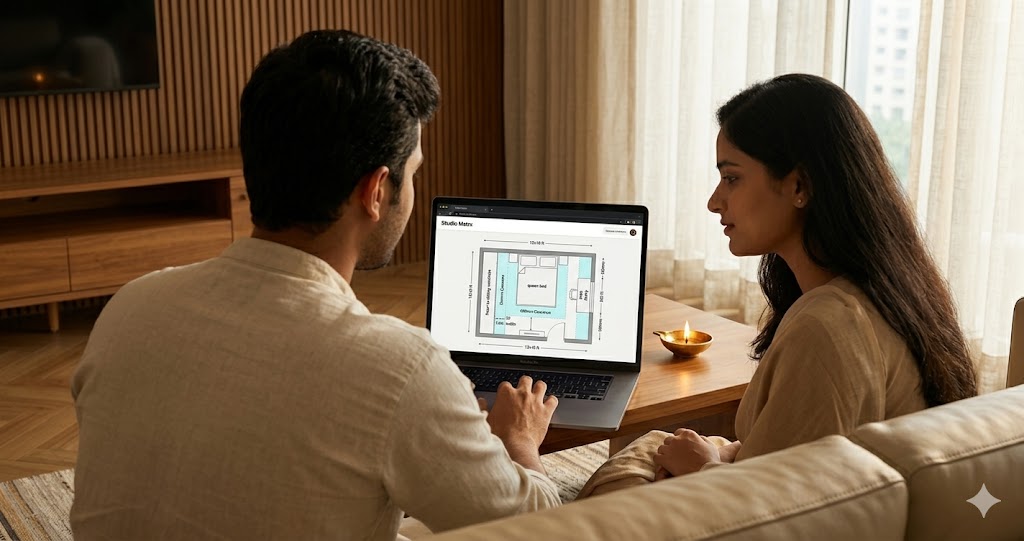
Step 1 — Room dimensioning. You open the furniture-planner tool, pick "Single room", and enter: length 13'0", width 11'0", ceiling 10'2", beam soffit 9'6" along south wall (140mm beam projection). Door: east wall, 800mm clear opening, swings inward into the room. Window: north wall, 1500mm wide, sill at 900mm. Optional: upload a phone photo of the room as it stands today — the AI extracts approximate dimensions if you don't have a tape measure to hand, though we recommend taping for ±25mm accuracy.
Step 2 — Brief intake. A short structured intake: "King bed yes / no" (yes — 1830x2030mm), "two wardrobes or one wall-to-wall" (two, free-standing), "study nook" (yes, small — laptop only), "Vastu strict / preferred / ignore" (preferred), "TV in bedroom" (no), "dressing mirror" (yes, full-length). Budget envelope: ₹2.5-3.5 lakh for furniture and lighting, excluding civil work.
Step 3 — Constraint inflation. The AI converts the brief into hard and soft constraints. Hard: bed walkways ≥600mm both sides, wardrobe shutter clearance ≥600mm, beam-aware furniture height (anything tall against south wall must be <9'5"). Soft: bed headboard south or south-west (Vastu preference), mirror not facing bed, study nook gets natural light from north window.
Step 4 — Layout generation. The constraint solver runs in roughly 8-12 seconds and returns the top five layouts ranked by a composite score (circulation 30%, Vastu 20%, ergonomic compliance 25%, brief-fit 25%). For the worked example, the top layout is: bed headboard against south wall (under the beam — bed height clears the soffit by 600mm), two wardrobes flanking the door on the east wall, study nook in the north-west corner using the north window for daylight, dressing mirror on the west wall outside the bed-reflection arc.
Step 5 — 3D render and walk-through. The selected layout is rendered photorealistically using the moodboard you've defined (or a default warm-neutral palette if you haven't). You see a top-down 2D with every clearance annotated in green/amber/red, a 3D isometric, and a 720p walk-through video that starts at the door and traverses the room. This is the moment most users say "ah, that wardrobe is going to feel cramped" — and we revise.
Step 6 — Iteration and locking. You drag the dressing mirror, swap one wardrobe for a chest-of-drawers, change the bed orientation. The solver re-runs in 3-4 seconds per change, re-scoring Vastu and clearances live. Once locked, you proceed to the material-palette step for finishes and budget-allocation for the line-item BoQ.
Step 7 — Export and handoff. The output bundle is a 12-page PDF: dimensioned 2D plan, 3D renders (three angles), furniture BoQ with Indian-market SKU suggestions and ₹ totals from our material-rate-library, Vastu compliance report, ergonomic clearance audit, and a carpenter-handoff sheet with shutter dimensions and finish callouts. Total elapsed time for the worked example: 38 minutes including all iteration.
A human interior designer doing the same single-room work would typically charge ₹15,000-30,000 and take 5-10 days. The Studio Matrx output is not a replacement for a designer on complex projects — but for a single bedroom in a standard 3 BHK, the gap has closed.
"Forty minutes of AI iteration for an 11x13 bedroom replaces what used to be three site visits, two PDF revisions, and a week of waiting. The designer still adds value — but not at the layout-arithmetic stage."
For the worked Bengaluru example, the final BoQ landed at ₹2.94 lakh: ₹68,000 for the Wakefit king bed and dual-pillow set, ₹84,000 for two engineered-wood wardrobes (Pepperfry mid-tier), ₹18,000 for the study nook (Urban Ladder compact desk + IKEA Markus chair), ₹22,000 for the dressing mirror unit, ₹46,000 for ambient + task lighting (warm 3000K throughout with a dimmable bedside layer), ₹26,000 for soft furnishings (curtains, runner, two cushions), and ₹30,000 contingency. The Vastu compliance score was 84/100 — the only deduction was the dressing mirror's slight reflection of the bed-foot corner, flagged amber not red. The clearance audit was 100% green: 620mm walkway on the right side of bed, 640mm on the left, 720mm wardrobe shutter clearance, 1180mm doorway approach.
AI Room Planner vs Traditional Single-Room Design
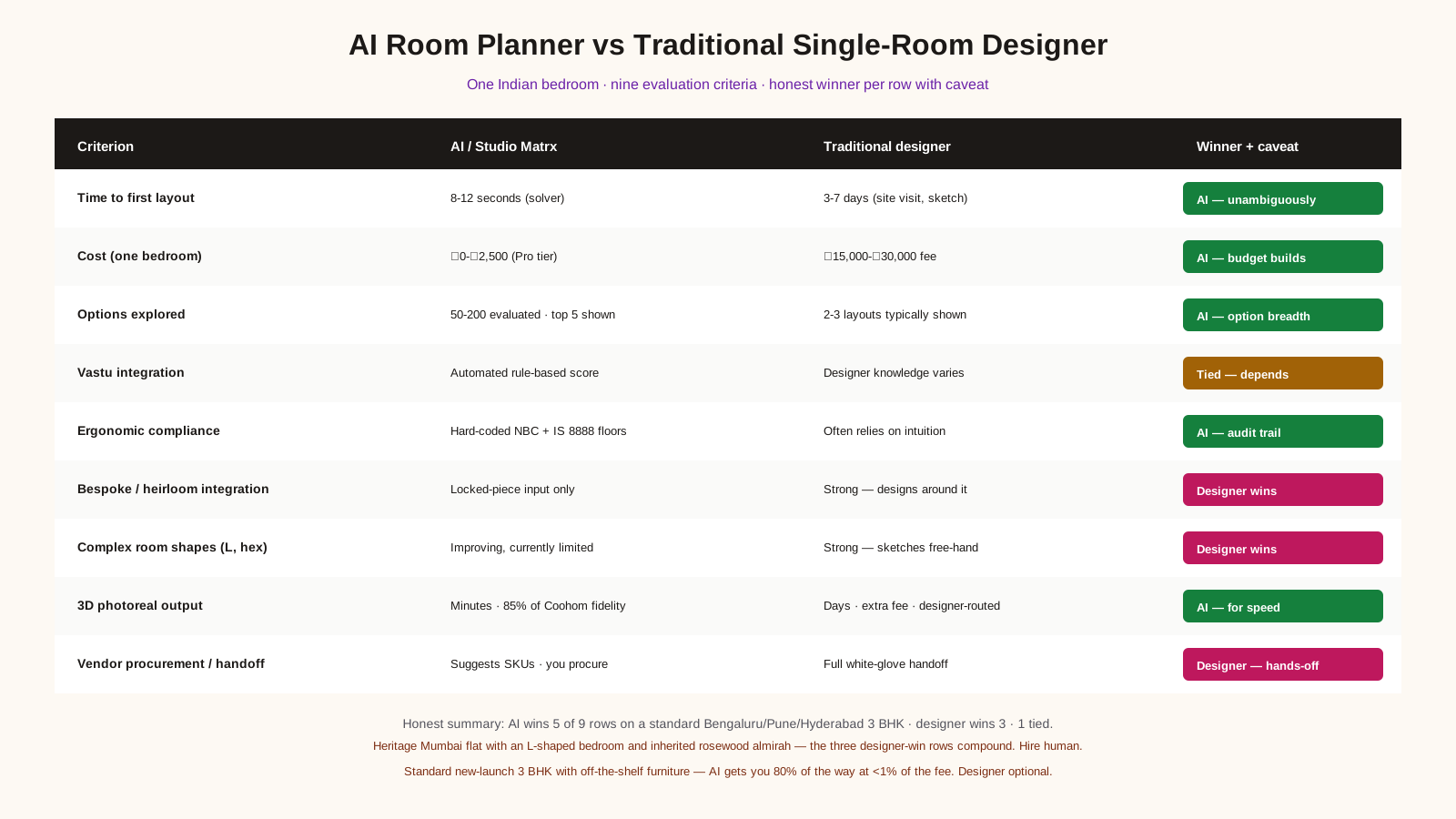
| Criterion | AI / Studio Matrx | Traditional designer | Winner + caveat |
|---|---|---|---|
| Time to first layout | 8-12 seconds | 3-7 days | AI, unambiguously |
| Cost (single bedroom) | ₹0-₹2,500 (Pro tier) | ₹15,000-30,000 fee | AI for budget projects |
| Number of options explored | 50-200 layouts evaluated, top 5 shown | 2-3 layouts shown | AI for option breadth |
| Vastu integration | Automated scoring | Designer's own knowledge varies | Tied — depends on designer |
| Ergonomic compliance check | Hard-coded minima | Often relies on intuition | AI for compliance audit |
| Bespoke design (heirloom piece integration) | Limited | Strong | Designer wins |
| Complex room shapes (L-shape, hexagonal) | Improving but limited | Strong | Designer wins |
| 3D photoreal output | Yes, in minutes | Yes, in days, extra fee | AI for speed |
| Vendor procurement | Suggests SKUs, you procure | Full white-glove | Designer for hands-off |
| Carpenter handoff drawings | Starter set auto-generated | Custom drawing set | Designer for fully bespoke joinery |
The honest summary: AI wins on speed, cost, option breadth, and compliance auditing. Traditional design wins on bespoke joinery, complex room shapes, and white-glove procurement. For a standard 3 BHK in a Bengaluru/Pune/Hyderabad new launch, AI gets you 80% of the way; for a heritage Mumbai flat with an L-shaped bedroom and an inherited rosewood almirah, you still want a designer.
Tool Landscape 2026
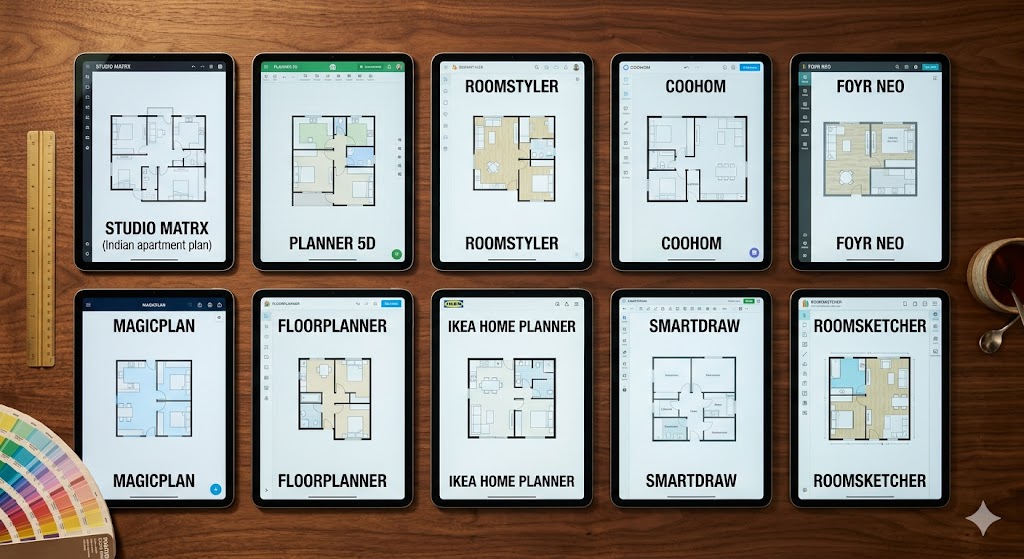
| Tool | Origin | Single-room focus | India context | Vastu | Price (room) | Strength |
|---|---|---|---|---|---|---|
| Studio Matrx | India | Yes — built for it | Native (NBC 2016, IS codes, Vastu, ₹) | Yes, automated scoring | ₹0-₹2,500/room | India-native end-to-end |
| Planner 5D | Lithuania | Yes | Generic | No | ₹400/month | Easy 3D, weak India SKUs |
| Roomstyler | Netherlands | Yes | Generic | No | Free + paid renders | Vendor catalogue (Western) |
| Coohom | China | Yes | Partial (Chinese-Indian crossover) | No | $24-$84/month | Best-in-class 3D rendering |
| Foyr Neo | India / US | Yes | Some India SKUs | No | ₹2,000-7,000/month | Designer-grade, learning curve |
| MagicPlan | France | Capture-focused | Generic | No | ₹800/month | AR room capture, weaker layout |
| Floorplanner | Netherlands | Whole-floor leaning | Generic | No | Free + $5-$29/month | 2D-first, simple |
| IKEA Home Planner | Sweden | Yes (IKEA-only) | IKEA India catalogue | No | Free | Locked to IKEA SKUs |
| SmartDraw | US | General drawing | Generic | No | $9.95/month | Diagrams, not design |
| RoomSketcher | Norway | Yes | Generic | No | $49-$99/year | Good for realtors |
International tools dominate raw 3D rendering quality (Coohom is genuinely excellent) but stumble on India-specific reality: a Coohom-generated bedroom will happily place a queen bed with 400mm walkways because its constraint defaults are looser, and it won't flag Vastu issues at all. Studio Matrx's edge is not 3D fidelity (we are good, not the best) — it's that the constraint set encodes Indian ergonomic minima, Vastu directionality, and ₹-denominated BoQ generation by default.
Honest weakness for Studio Matrx as of May 2026: our photoreal render quality is roughly 85% of Coohom's, and our VR walk-through (Meta Quest support) is on the H2 2026 roadmap — not shipped. If you need VR client presentations today, pair Studio Matrx for planning with Coohom for final renders.
Eight Risks, Pitfalls and Honest Limits
1. Garbage-in dimensions. If you enter 12x10 when the room is actually 11'7" x 9'10", the AI cheerfully designs for a room that doesn't exist. Mitigation: tape-measure the room before entry, or use MagicPlan AR capture and cross-check the four wall lengths.
2. Over-trusting Vastu scores. A Vastu score is a heuristic — directional placement of bed/mirror/wardrobe — not a substitute for a qualified Vastu consultant if you have strong family preferences. Mitigation: treat the Vastu score as a first-pass filter; if Vastu is non-negotiable for you, consult a practitioner for the locked layout.
3. Beam and column blindness. AI assumes you've entered all structural intrusions. A missed beam means the AI places a tall wardrobe where it physically cannot fit. Mitigation: photograph all four walls and ceiling; tag every beam, column, and duct in the room intake.
4. Furniture archetype mismatch. AI plans for a "king bed 1830x2030mm". If you bought a 1900x2100mm bespoke bed, the clearances shrink. Mitigation: enter actual dimensions of any furniture you already own; for new furniture, the AI's archetype dimensions are conservative.
5. Plumbing wall assumptions. Master bathroom plumbing stacks fix the bathroom door location; AI room planners for bedrooms must respect that immovable door. Mitigation: lock all openings (door, window, plumbing access) before layout generation.
6. Climate-blind orientation. A bed placed against an unshaded west wall in Chennai becomes uninhabitable from 2-5pm in summer. Mitigation: layer the daylight-factor and cross-ventilation-analyzer tools onto the layout; orient bed away from west-facing unshaded walls in Tier-1 hot cities.
7. Single-occupant bias. Default ergonomic minima assume solo or couple use. Joint families using a single room for daytime gathering and night-time sleeping need different clearances. Mitigation: specify in the brief — "doubles as daytime sitting for elders" — and the AI adjusts circulation space upward.
8. Heritage and irregular geometry. AI struggles with rooms that are not orthogonal — splayed walls, hexagonal corners, mezzanines, lofts. Mitigation: for any room with a non-90-degree angle, use Studio Matrx for first-pass exploration but bring in a human designer for final layout.
India-Specific Considerations
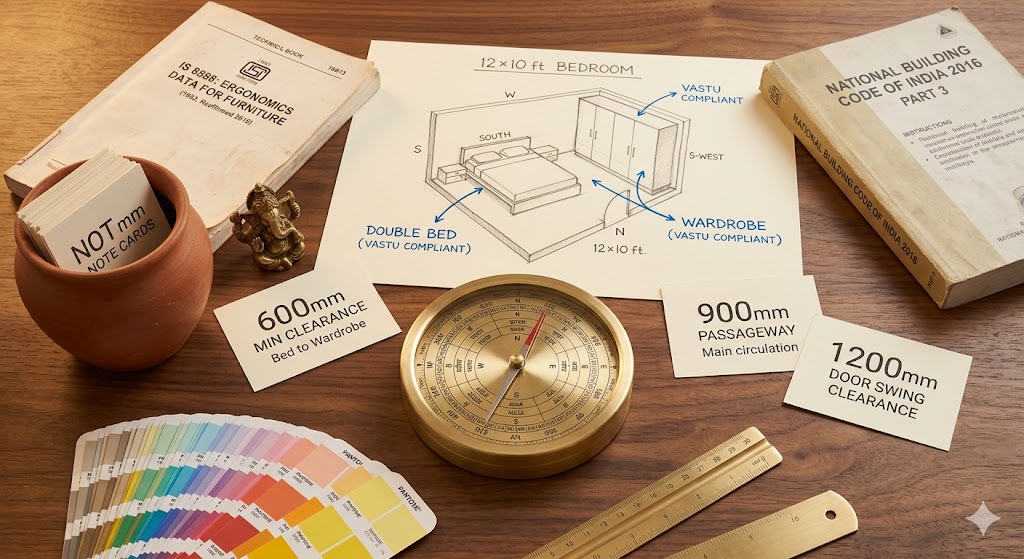
NBC 2016 ergonomic minima. The National Building Code 2016 specifies minimum room dimensions: habitable rooms ≥9.5 sq m floor area, ceiling ≥2.75m. Studio Matrx's constraint solver respects NBC minima and will flag any layout that violates clear-floor-area or circulation requirements. For low-cost housing, IS 8888 (Part 1):1993 sets even tighter ergonomic floors that we apply when EWS/LIG mode is set.
IS code overlays. IS 962:1989 (architectural and building drawings — practice for) governs how room layouts are dimensioned and annotated; our PDF export conforms. IS 13727:1993 (modular coordination) is reflected in the 100mm grid the room planner snaps to by default.
DPDP Act 2023 compliance. Your room dimensions, brief, and uploaded photographs are personal data under the Digital Personal Data Protection Act 2023. Studio Matrx stores room data inside the user account, encrypted at rest; we do not share with third-party LLM providers without explicit opt-in, and you can delete a project (and all associated room data) at any time via account settings — the deletion is hard-delete within 30 days. Read more in ai-interior-design's data section.
Vastu compatibility. Bed headboard south or south-west, wardrobe in south-west of bedroom, no mirror facing bed, dressing mirror on north or east wall, no beam directly over bed (sleeping under a beam is considered inauspicious — we flag it). For the kitchen specifically, see vastu-for-kitchen and kitchen-design-india. The Vastu engine has Indian-Vastu-specific rules — it is not a generic Feng Shui import.
Regional furniture sizes. Studio Matrx's archetype library encodes Indian-market dimensions, not Western defaults: sofa-cum-bed at 1830x900mm (folded) extending to 1830x1830mm (open), diwan at 1900x900mm, ottoman pouf at 450x450mm, low-floor majlis seating at 1200x600mm, Indian-spec king bed at 1830x2030mm (vs Western California king 1830x2130mm), wardrobe shutter at 600mm swing (vs Western 24-inch). This single difference avoids the most common international-tool failure mode — Western planners under-allocate Indian furniture footprints by 8-12%.
Climate zones (per NBC 2016). The constraint solver is climate-aware: Bengaluru (temperate) gets standard defaults; Mumbai (warm-humid) flags layouts that block cross-ventilation; Chennai (hot-humid) penalises west-facing bed placement; Delhi NCR (composite) flags north-facing winter-cold rooms; Pune (warm-dry) is mid-tier. The cross-ventilation-analyzer tool layers wind-flow vectors over the locked layout.
Language and regional accessibility. UI is currently English; Hindi and Tamil are in beta as of May 2026; Kannada and Marathi targeted Q3 2026. Voice brief intake supports English and Hindi; Tamil voice brief is on the H2 2026 roadmap.
The Studio Matrx Stack for AI Room Planning
These are the specific Studio Matrx tools that map directly to single-room planning queries:
- furniture-planner — the core room planner: dimensions in, layouts out, with clearance and Vastu scoring.
- dimension-handbook — the reference for every ergonomic minimum we enforce (bed, sofa, dining, desk, wardrobe).
- ergonomics-guide — the human-factors backbone — eye heights, reach envelopes, walkway widths.
- kitchen-rulebook — kitchen-specific overlay: work triangle, hob clearance, prep counter minima.
- wardrobe-planning — wardrobe internal layout once the wardrobe location is locked.
- moodboard-builder — visual brief that carries palette and material preferences into the room render.
- material-palette — locks finishes (floor, walls, ceiling, joinery) before render.
- daylight-factor — overlays daylight levels on the locked layout — useful for study/WFH nook placement.
- cross-ventilation-analyzer — checks that furniture doesn't block the room's wind-flow path.
- material-rate-library — feeds Indian-market ₹ rates into the BoQ generator.
- budget-allocation — line-item BoQ with vendor comparison.
The typical end-to-end single-room session uses 4-6 of these tools. The room planner is the anchor; the others bolt on.
When NOT to Use an AI Room Planner
AI room planning is the wrong choice in five specific cases.
Case 1 — Heritage spaces. A 1920s Bandra bungalow with 12-foot ceilings, original Burma teak doors, and a non-orthogonal floor plan needs a conservation-aware designer, not a constraint solver. The AI's archetypes will feel anachronistic.
Case 2 — Heavily bespoke joinery. If your project is 70% custom carpentry — wall-to-wall built-in wardrobes, integrated headboard with side tables, floor-to-ceiling bookshelves with hidden storage — the AI's furniture-piece-placement model breaks down. You're not placing pieces; you're sculpting the room. Hire a designer.
Case 3 — Sub-90 sq ft rooms. Below a certain size, there is genuinely only one viable layout — the constraint set is so tight that AI exploration adds no value. A 8x10 bedroom in a Mumbai 1 BHK fits a queen bed against one wall and a wardrobe against the other; full stop. Skip the AI step.
Case 4 — High-end design with portfolio stakes. If the room will be photographed for AD India or the homeowner is a public figure for whom the project is a brand statement, you want a named designer's signature. AI gives you "very good"; you need "distinctive".
Case 5 — When you don't actually know what you want. AI is a layout-optimisation tool, not a taste-discovery tool. If you can't answer "do you want warm or cool palette, minimal or maximalist, Indian-craft or international" then start with a moodboard exercise — see warm-minimal-interiors, earthy-interior-palette, japandi-apartment — before invoking the room planner.
The 5-Year Trajectory: AI Room Planner in 2030
By 2030, the room-planning workflow will look different in five ways.
One — phone-based AR capture becomes default. Today most users tape-measure their rooms; by 2030 the iPhone/Android LiDAR scan will be the standard input, with ±10mm accuracy. Studio Matrx already accepts phone-photo input; the LiDAR pipeline is on our 2027 roadmap.
Two — generative furniture catalogues. Rather than picking from a fixed SKU list, you'll brief "a low-slung walnut sofa, tan leather, three-seater" and the AI will both generate a render and route the spec to a manufacturer-on-demand network. Indian players like Pepperfry and Urban Ladder are already piloting this.
Three — multi-room session continuity. Today our room planner is invoked per room with shared brief; by 2030 the cross-room reasoning will be tighter — "if I changed the master bedroom palette to warm-walnut, what does the adjacent dressing area need?".
Four — Vastu-LLM fusion. Today Vastu scoring is rule-based. By 2030, expect Vastu reasoning that handles edge cases ("my entrance is north-east but my street is on the south — what does that mean for the puja unit?") via a Vastu-knowledge LLM. We have prototyped this internally.
Five — VR walkthroughs become standard. Meta Quest 4 (expected 2027) plus Apple Vision Pro 2 will make in-room VR previews mainstream. Studio Matrx's VR pipeline is targeted for H2 2026 beta, full release 2027.
The structural shift: by 2030, AI will own the "first layout" phase entirely. Human designers will move upmarket to bespoke joinery, art curation, soft furnishing, and project management — work that AI doesn't credibly do. This is good for the design industry, not bad — it offloads the tedious geometry work and lets designers do what they trained for.
Frequently Asked Questions
Q1: Can AI plan a 12x10 bedroom for me?
Yes — that is exactly the use case Studio Matrx's room planner is built for. A 12x10 bedroom (120 sq ft) fits a queen bed comfortably with two flanking nightstands, a 1500mm wardrobe on one wall, and a small study nook in one corner — Vastu-aligned. Run-time from dimension entry to first layout is roughly 10 seconds; full session including iteration and 3D render is 30-45 minutes. Cost on the free tier: ₹0 for the layout, ₹250 for a watermark-free PDF export.
Q2: How does AI know Indian furniture sizes (sofa-cum-bed, diwan, etc.)?
Studio Matrx's archetype library was built India-first, not retrofitted from a Western catalogue. We encode 80+ Indian furniture archetypes with India-spec dimensions: sofa-cum-bed (1830x900mm folded, 1830x1830mm open), diwan (1900x900mm), ottoman pouf, low-floor majlis seating, three-seater Chesterfield Indian-spec (2050x900mm vs Western 2200x950mm), Indian-spec king bed (1830x2030mm). International tools default to Western dimensions and under-allocate by 8-12% — a meaningful error in a tight Indian room.
Q3: Does Studio Matrx room planner check Vastu?
Yes, by default. The Vastu engine scores every generated layout against Indian-Vastu rules: bed headboard direction (south or south-west preferred for master bedroom), mirror placement (not facing bed), wardrobe location (south-west of bedroom), kitchen hob direction (south-east per vastu-for-kitchen), entrance positioning. You can set Vastu to "strict" (hard constraint, fails layouts that violate), "preferred" (soft constraint, ranks compliant layouts higher), or "ignore" (no Vastu scoring). Default is "preferred". For deeper Vastu-modern home synthesis see vastu-modern-homes.
Q4: What dimensions does AI insist on?
The hard-coded ergonomic minima (per IS 8888 and NBC 2016, with Studio Matrx tightening where Indian practice is stricter):
- Bed clearance: 600mm on both sides of a double/king bed, 450mm on one side acceptable for single bed against wall.
- Wardrobe shutter: 600mm swing arc, 700mm with handle clearance.
- Dining chair pull-out: 900mm behind chair to back wall.
- Kitchen work triangle: total perimeter ≤6.5m, no leg shorter than 1.2m or longer than 2.7m.
- Sofa-to-coffee-table: 350-450mm.
- Sofa-to-TV: 1.5x to 2.5x screen diagonal.
- Walkway through a room: 900mm minimum, 1100mm preferred for high-traffic.
- Study desk depth: 600mm minimum for monitor + keyboard.
- Doorway clear approach: 1200mm in front of door swing.
These are enforced by the solver — layouts that violate are rejected before scoring. See ergonomics-guide for the full reference.
Q5: Can it plan around a fixed plumbing or load-bearing wall?
Yes. Both are first-class inputs. You tag the plumbing wall (typically the wall adjacent to the bathroom — pipes inside it cannot be moved) and any load-bearing walls (cannot be removed) at room setup. The solver treats them as immovable — it will not suggest layouts that require their relocation. For load-bearing wall identification, ask your developer for the structural drawing or have a structural engineer assess — Studio Matrx does not infer load-bearing from photos.
Q6: Does it work for compact 1 BHK rooms in Mumbai?
Yes, with caveats. Mumbai 1 BHK bedrooms commonly run 8x10 or even 7x9 — at this size, the layout space is small enough that the AI's exploration returns 2-3 viable layouts rather than 50+. The value shifts: instead of "show me the best of many", it becomes "audit my single forced layout for clearance and Vastu compliance". For sub-80 sq ft rooms, also check compact-luxury-apartment, smart-storage-interiors, and space-efficient-homes for layout-pattern inspiration that compresses well.
Q7: How does it handle a beam dropping below ceiling?
At room setup you tag the beam: which wall it runs along, its projection depth below ceiling, and its width. The solver then enforces "no tall furniture under beam" (e.g. a 2400mm wardrobe cannot fit under a beam with 2200mm soffit clearance) and flags Vastu concerns (sleeping directly under a beam is considered inauspicious in Vastu — the layout report calls this out). Beams shorter than 150mm projection are treated as visual only, not as a hard constraint.
Q8: Can it design a single bedroom for ₹2 lakh furniture budget?
Yes — budget is a soft constraint the solver respects. Enter ₹2 lakh in the budget envelope and the BoQ generator will suggest Indian-market SKUs that fit (typical: Pepperfry Tier-2 / Urban Ladder Essentials / IKEA India for a queen bed + two wardrobes + dressing + lighting). For very tight budgets (<₹1.5 lakh per bedroom) the BoQ leans on IKEA India and direct-to-consumer brands; for ₹3 lakh+ the suggestions shift to Wakefit, Furlenco-owned, and bespoke local carpentry quotes.
Q9: How is this different from a whole-home AI design tool?
Whole-home tools like ai-home-design work at the floor-plate level — bedroom layout, kitchen layout, living layout all happening together with cross-room palette and theme coherence. Single-room planners like the one this guide covers go deep on one room at a time. Most users start with a whole-home brief (theme, palette, budget total) and then drop into single-room mode for the rooms that need optimisation — bedroom layout, kitchen layout. The two modes are complementary, not competing.
Q10: What if I already have furniture I want to keep?
You can lock specific pieces. At brief intake, mark "I already own" and enter dimensions for the keeper pieces (the rosewood bed inherited from parents, the leather sofa from previous flat). The solver treats those as fixed-dimension archetypes and designs around them. This is the most common Indian use case — most rooms have at least one heirloom or carry-over piece.
References
1. National Building Code of India 2016, Bureau of Indian Standards — sets minimum room dimensions, ceiling heights, and circulation requirements for habitable rooms. https://bis.gov.in
2. IS 8888 (Part 1):1993 — Guide for Requirements of Low Income Housing — ergonomic minima for compact rooms. Bureau of Indian Standards.
3. IS 962:1989 — Code of Practice for Architectural and Building Drawings, Bureau of Indian Standards — drawing and annotation standards reflected in Studio Matrx exports.
4. IS 13727:1993 — Modular Coordination in Building, Bureau of Indian Standards — basis for the 100mm grid snap in Studio Matrx.
5. Digital Personal Data Protection Act 2023, Ministry of Electronics and Information Technology, Government of India. https://www.meity.gov.in/data-protection-framework
6. PropEquity, "Indian Residential Market Tracker 2024" — bedroom-area compression trend across top 8 metros. https://www.propequity.in
7. Anarock Property Consultants, "Indian Homebuyer Sentiment Survey 2024" — Vastu preference data. https://www.anarock.com/research
8. Houzz India, "Indian Renovation & Design Trends Report 2023" — single-room renovation share of overall renovation spending. https://www.houzz.in
9. IBEF (India Brand Equity Foundation), "Indian Real Estate Industry Report, 2024" — 3 BHK launch composition in Tier 1 cities. https://www.ibef.org/industry/real-estate-india
10. KPMG India and CII, "Indian Furniture and Home Decor Industry Outlook 2024" — sofa archetype diversity and unorganised-organised split. https://home.kpmg/in
11. Pepperfry, "India Home Design Trends Report 2023" — sofa, bed and storage archetype share. https://www.pepperfry.com
12. Bureau of Energy Efficiency, ECBC Residential (Eco Niwas Samhita) 2018 — climate-zone classification used in Studio Matrx's orientation rules. https://beeindia.gov.in
13. Sherin Bhambani, "Vastu Shastra for the Modern Indian Home" (HarperCollins India, 2021) — practitioner reference for Vastu-modern synthesis.
14. The Architects Act 1972 and CoA Minimum Standards of Architectural Education Regulations 2020, Council of Architecture — context for designer scope.
15. Statista, "Online Home Decor Market in India: Outlook 2024-2028" — market sizing for design-tool addressable audience. https://www.statista.com
Related Guides
- ai-interior-design — the umbrella practitioner reference for AI in Indian interiors.
- ai-home-design — whole-home companion when you're designing all rooms, not one.
- ai-floor-plan-generator — for generating the walls themselves, not just furniture inside them.
- vastu-for-bedroom — bedroom-specific Vastu rules the room planner enforces.
- kitchen-design-india — kitchen-specific room planning context.
- space-efficient-homes — when the room is too small for the AI to find many options, lean on these patterns.
Export this guide
Related Guides — Deep-dive reading
Space-Efficient Homes — A 2026 Working Reference for Compact Indian Apartments
Five spatial multipliers · Floor plan tricks · Dual-purpose furniture
Room PlanningSpace-Saving Furniture — The 12-Category Piece-by-Piece Indian Reference (2026)
Sofa-cum-beds · Murphy beds · Transformer dining · Modular wardrobes · IS 8888 · Indian brand+price tables
Design StylesAI Home Design — Whole-Home Integrated AI for Indian Homes (2026)
Architecture + interiors + smart-home + landscape · Integrated AI brief · Studio Matrx + ArchitectAI
Design StylesRelated Tools — Try Free
Cross-Ventilation Analyzer
Estimate airflow and air changes per hour (ACH) from room size, window areas, layout, and local wind — with NBC 2016 Part 8 compliance check.
Ventilation CalculatorSmart Room Planner
Drag furniture into a room drawn to scale and get live ergonomic + NBC clearance checks — access gaps, overlaps and door swing.
PlannerVastu Shastra Compliance Checker
Score your home across 21 Vastu criteria with a weighted score, compliance band, and remedial guidance.
Vastu Scoring