
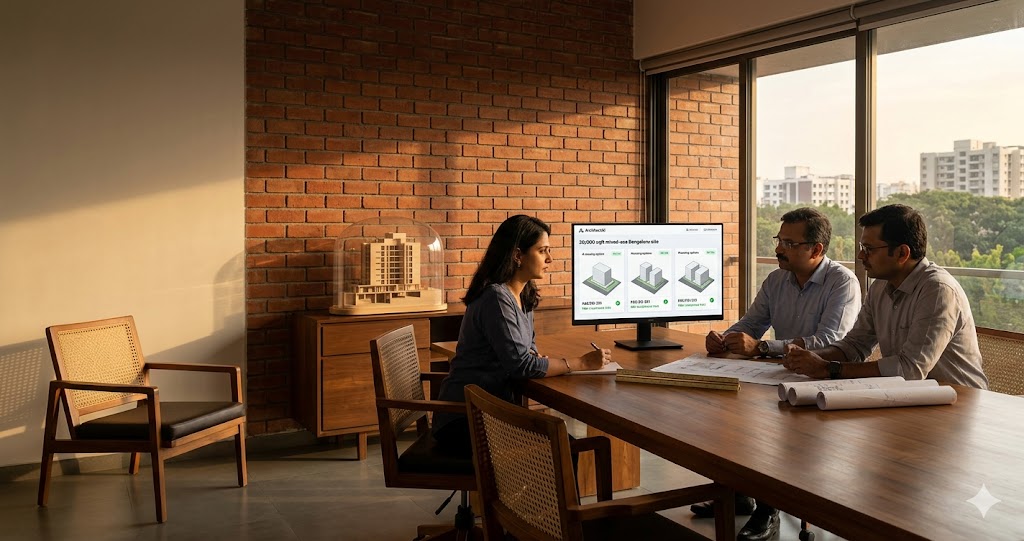
AI Architecture Software — Firm-Level Comparison for Indian Practice (2026)
ArchitectAI vs Forma vs TestFit · Pre-design · Code compliance · BIM integration
AI architecture software in 2026 is no longer a sketch-finishing toy — it is a buying-stage decision for any Indian practice that wants to compress pre-design, optioneering, code-compliance and drawing-production cycles by 40-70%. For a 10-architect Bengaluru or Mumbai studio, the question has shifted from "should we adopt AI" to "which platform, on what license model, with what India-code coverage, and how do we onboard the team without breaking our Revit/ArchiCAD pipeline". This guide is written for principals and BIM managers evaluating that decision — not for homeowners.
The category itself is fragmented. Autodesk Forma (the successor to Spacemaker) dominates the global conversation but treats India as a long-tail market. TestFit and Hypar own the developer-feasibility niche. Maket, Finch3D, LookX and Veras compete on generative pre-design. Snaptrude is the India-origin BIM-in-the-browser play. And ArchitectAI — Studio Matrx's B2B sibling — is the only platform built ground-up around NBC 2016, state DCRs (Karnataka, Maharashtra, Tamil Nadu, Delhi NCR), VasthuMandala overlays and multi-tenant firm-level licensing. This guide compares all of them honestly.
"The firms winning in 2026 are not the ones with the prettiest renders — they are the ones who can turn a client brief into 12 valid optioneered massings, with NBC setbacks and FSI checked, before the second client meeting. That is the productivity gap AI architecture software closes."
If your practice also delivers interiors or you want to read the consumer-side sibling, see ai-home-design, the India-market-specific ai-architecture-india, the production-side ai-floor-plan-generator, and the visualisation-side ai-render-generator. This guide refreshes every 12 months. Last verified: May 2026 · Next verify: May 2027.
What AI Architecture Software Actually Means (and What It Doesn't)
AI architecture software is a category of tools that use machine-learning models — generative diffusion, graph neural networks, large language models, reinforcement-learning optimisers — to compress one or more steps of the conventional architectural workflow: site analysis, programme-to-massing, optioneering, code-compliance checks, energy and daylight simulation, drawing generation, render acceleration, and BIM model authoring. The defining shift from 2018-era "computational design" (Grasshopper, Dynamo) is that the model now proposes options rather than executing rules the architect already wrote.
In practical Indian-firm terms, AI architecture software in 2026 does six things well:
1. Pre-design optioneering — generating 10-50 valid building massings from a site polygon, FSI, setback rules and a programme brief, in 5-15 minutes instead of 5-15 days.
2. Code compliance pre-screening — flagging NBC 2016 / state DCR violations (setbacks, ground coverage, height-to-road-width, parking, fire refuge area) before the architect commits to a scheme.
3. Environmental analysis acceleration — daylight factor, solar gain, wind/CFD, and shadow studies that used to need a specialist consultant now run in-browser in seconds.
4. BIM authoring assistance — auto-generating Revit/ArchiCAD families, wall types, schedules and even partial floor plans from a 2D sketch.
5. Drawing automation — taking a coordinated BIM model and producing sheet sets, dimensioned plans, schedules and even consultant deliverables with much less manual line-work.
6. Render acceleration — turning a SketchUp/Rhino/Revit viewport into a presentation-grade image in 30-90 seconds instead of a 6-hour V-Ray cook.
Five things AI architecture software is NOT:
- It is not a replacement for a licensed architect — every output still needs an architect of record signature for municipal submission under the Architects Act 1972.
- It is not a BIM platform replacement — it sits adjacent to Revit/ArchiCAD/Vectorworks/Snaptrude, not on top of them. Your single source of truth is still your BIM model.
- It is not a structural or MEP design tool — none of these platforms (yet) replace ETABS, STAAD, IES VE for production-grade analysis. They give early-stage estimates.
- It is not a guaranteed-compliant output engine — even ArchitectAI's NBC checks are pre-screens, not legal sign-offs. The chartered architect remains liable.
- It is not a "fire-the-junior-architect" play — firms that have tried this in 2024-25 have lost institutional knowledge and client-handling capacity. AI compresses the production layer, not the judgment layer.
Why AI Architecture Software Matters in 2026 India
Four forces have converged in the last 24 months and reshaped the buying conversation.
First, fee compression. CoA's recommended fee scales have not been honoured by Tier-1 developers since 2019 — most architects now operate on 3.5-5% of construction cost, not the notional 8%. Boutique residential is even more compressed: turnkey clients have moved to 6-8% all-in (architecture + interiors + execution oversight) where they would have paid 10-12% in 2018. That makes the production-layer cost (drafting, coordination, rendering, consultant management) the swing factor between a profitable and a loss-making project. AI software directly attacks that layer. A 30% reduction in drafting hours on a ₹40 lakh fee project is ₹4-5 lakh straight to the bottom line.
Second, the GCC and developer hiring boom. Bengaluru, Hyderabad, Pune and Gurugram have seen Global Capability Centres (GCCs) — captive design offices for foreign firms — hire 8,000+ architects in 2024-25 alone. They have AI-fluent workflows from day one (Gensler, HOK, Foster + Partners and SOM have all standardised AI optioneering as a stage-0 deliverable). Independent Indian practices that don't adopt cannot match their per-architect output, which means they lose mid-tier mandates to GCC-supported competitors. We hear this in every principal conversation we have in Bengaluru and Mumbai right now.
Third, client expectations have shifted. Developer clients now expect 8-12 optioneered massings at the pitch stage, not 2-3. Boutique residential clients expect photoreal renders, not pencil sketches. The Studio Matrx homeowner cohort (see our ai-interior-design guide for the consumer side) has been habituated by ChatGPT and Midjourney to expect AI-paced turnaround. A 4-week sketch-design phase no longer reads as "thorough" — it reads as "slow". This is true even for Tier-2 city clients in Coimbatore, Indore, Lucknow and Bhubaneswar; the WhatsApp-forwarded reference deck has reset everyone's clock.
Fourth, regulatory complexity is increasing, not decreasing. The 2024-25 revisions to Maharashtra UDCPR, the slow rollout of Telangana TS-bPASS, the Karnataka e-Khata + e-Aasthi integration, and the impending DPDP Act enforcement all add layers of compliance work. Manual rule-checking does not scale. A platform that ingests these as updateable rule packs — as ArchitectAI does on a quarterly release cycle — turns a regulatory burden into a productivity moat.
The seam that ArchitectAI fills is specifically the India-code-and-tenancy gap. Forma is brilliant for Nordic and US zoning. TestFit is brilliant for US multifamily. Neither natively reads Karnataka's RMP-2031, Maharashtra's UDCPR 2020, Delhi's MPD-2041 or Tamil Nadu's TNCDBR 2019. ArchitectAI does. And no global platform handles firm-level multi-tenancy — single user/firm sign-on, project-level RBAC, India-rupee billing, GST-compliant invoicing, DPDP-Act-compliant DPAs — the way an Indian practice actually needs it. That is the wedge.
The Six Capabilities That Matter
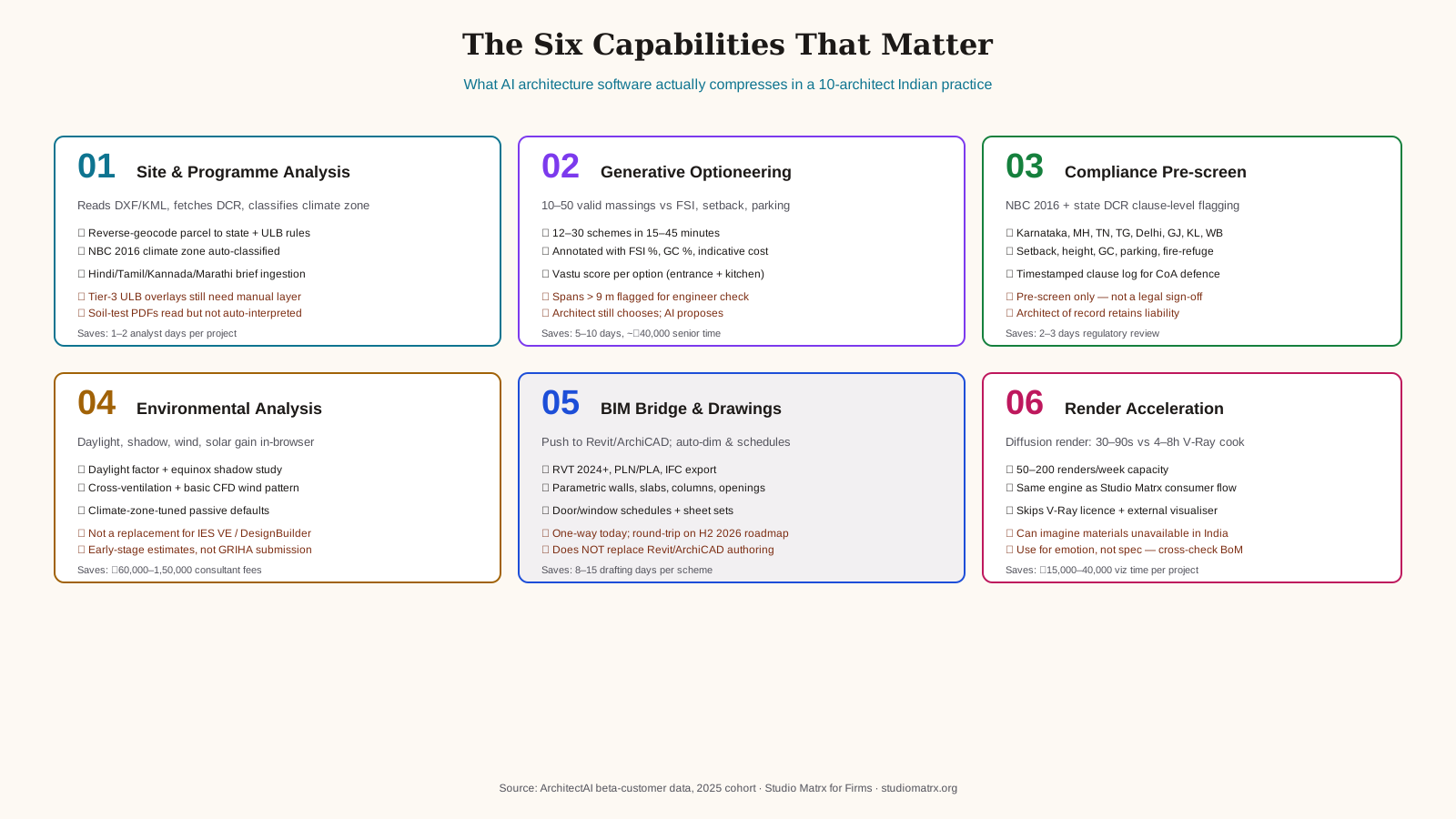
| Capability | What it actually does | Time/cost saved per project | ArchitectAI flow that does it |
|---|---|---|---|
| Site & programme analysis | Reads site polygon (DXF/KML), reverse-geocodes climate zone, fetches DCR rules, ingests client brief | 1-2 days of analyst time | "Project Setup" + auto-DCR fetch |
| Generative optioneering | Produces 10-50 valid massings against FSI, setback, ground coverage, parking | 5-10 days, ~₹40,000 of senior time | "Optioneer" module |
| Code compliance pre-screen | Flags NBC 2016 + state DCR violations on the live scheme | 2-3 days of regulatory review | "Compliance Check" layer |
| Environmental analysis | Daylight factor, shadow studies, wind, basic CFD | ~₹60,000-1,50,000 of consultant fees | "Daylight & Climate" panel |
| BIM-bridge & drawings | Pushes valid schemes to Revit/ArchiCAD; auto-dimensions and schedules | 8-15 days of drafting | "Revit/ArchiCAD Export" |
| Render acceleration | Diffusion render from BIM viewport (30-90s vs 4-8h) | ~₹15,000-40,000 of viz time | "Render" (Studio Matrx renderer) |
A 10-architect Bengaluru firm running 12 concurrent projects typically reports — based on ArchitectAI beta-customer data, 2025 cohort — 28-35% reduction in pre-construction-phase hours and 42% reduction in late-stage DCR-driven re-work. The render-acceleration benefit alone (skipping a per-project V-Ray licence and an external visualiser) pays for ArchitectAI's per-firm licence within the first two projects.
Two more capabilities are worth calling out as honest "not-yet" items, because we'd rather you hear them from us than discover them in week three. First, structural-engineering integration — none of the platforms in this category replace ETABS or STAAD for production analysis; ArchitectAI's structural feasibility check is a flag, not a design. Second, MEP coordination — clash-detection between architecture, HVAC, plumbing and electrical remains the BIM platform's job. ArchitectAI does not pretend to replace Navisworks or Solibri here. We expect both gaps to narrow by 2028, but they are real today.
How ArchitectAI (Studio Matrx for Firms) Does It — End-to-End Walkthrough
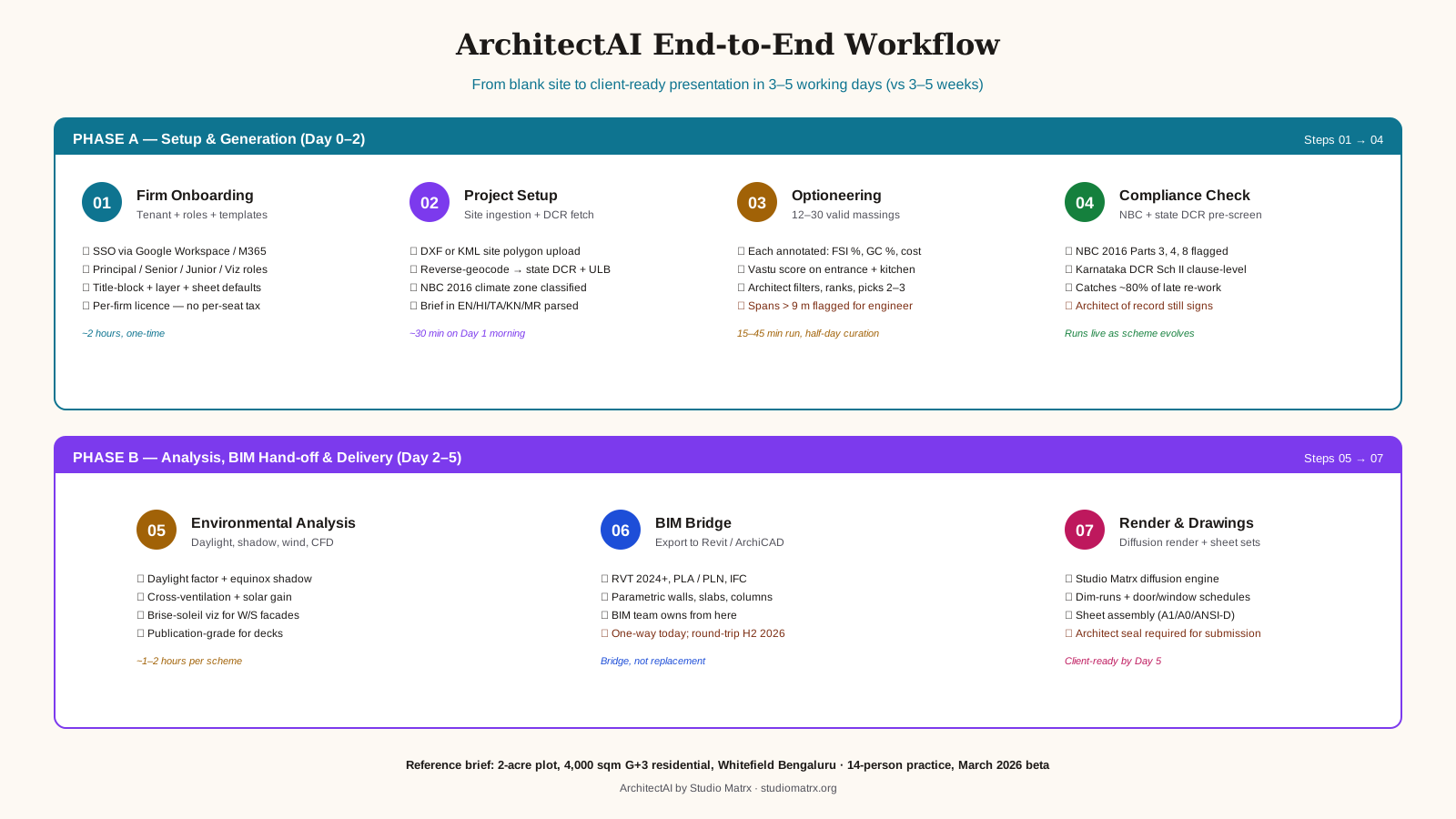
ArchitectAI is purpose-built for an Indian architecture practice — multi-tenant by firm, project-scoped role-based access (Principal / Senior Architect / Junior / Visualiser / Consultant), India-rupee billing, and a deep DCR layer covering Karnataka, Maharashtra, Tamil Nadu, Telangana, Delhi NCR, Gujarat and Kerala at launch. Here is the actual seven-step flow your firm will use.
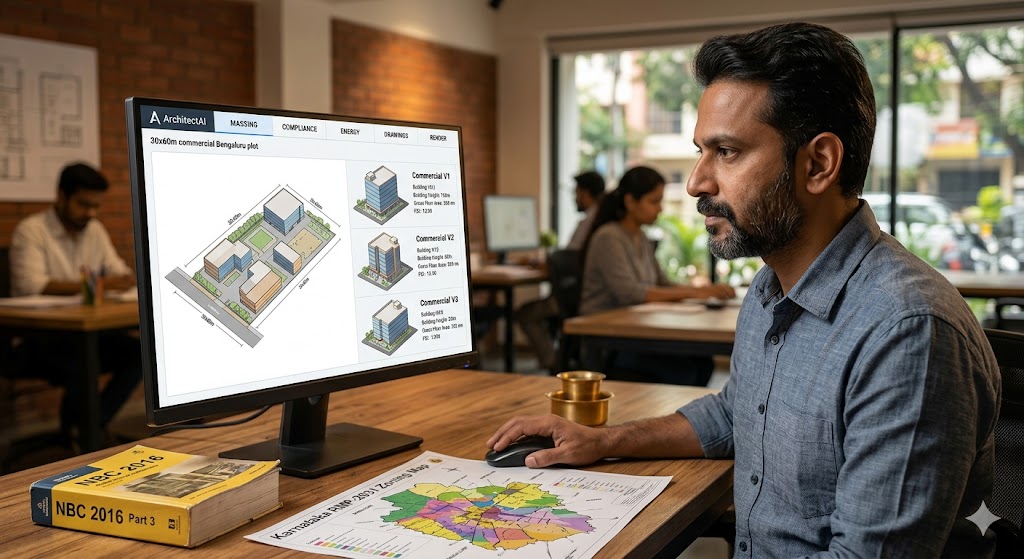
1. Firm onboarding & user provisioning. Your office admin sets up the firm tenant, invites architects with role assignments, and configures default templates — drawing title-block, layer standards, sheet sizes (A1/A0/ANSI-D), default consultant list. Single sign-on via Google Workspace or Microsoft 365 is supported. Per-firm pricing means you are not paying per-seat for a junior who only logs in twice a week.
2. Project setup with site ingestion. The lead architect uploads a DXF site survey or KML polygon. ArchitectAI reverse-geocodes the parcel, identifies the state and ULB, fetches the applicable DCR rules (FSI, setbacks, height, ground coverage, parking norms, fire-refuge area), and pulls climate-zone classification per NBC 2016 (Hot-Dry / Warm-Humid / Composite / Temperate / Cold). The client brief is captured in free text — Hindi, English, Tamil, Kannada and Marathi inputs are parsed by our multilingual NLU layer.
3. Optioneering. From the brief and DCR rules, ArchitectAI generates 12-30 valid massing options. Each massing is annotated with FSI consumed, ground coverage %, projected construction cost (using our cost-benchmark and material-rate-library data), and a Vastu compatibility score (entrance orientation, kitchen quadrant, master-bedroom quadrant — using the same Vastu engine as our consumer flow). The architect filters, ranks, and selects 2-3 for client presentation.
4. Compliance check. For each shortlisted scheme, ArchitectAI runs a layered compliance pre-screen against NBC 2016 (Parts 3, 4, 8), the applicable state DCR, and — where notified — local fire NOC requirements. Violations are flagged with the specific clause reference (e.g. "Front setback 2.4 m violates Karnataka DCR Schedule II Clause 5.3 minimum 3.0 m for plots > 240 sqm"). This is a pre-screen, not a sign-off — but it stops 80% of the late-stage re-work that kills small-firm margins.
5. Environmental analysis. Daylight factor, equinox shadow study, prevailing-wind cross-ventilation pattern, solar gain on facades, and a basic CFD wind-flow run on the chosen massing. Output integrates with our daylight-factor, cross-ventilation-analyzer and brise-soleil-visualizer tools so the visualisations are publication-grade for client decks and competition entries.
6. BIM bridge. The selected scheme exports to Revit (.RVT 2024+) or ArchiCAD (.PLA / .PLN) as a coordinated mass with parametric walls, slabs, columns and openings. Your BIM team takes it from there inside their existing pipeline — ArchitectAI does not try to replace Revit/ArchiCAD. The bridge is the value, not the lock-in.
7. Render & drawing acceleration. Renders generate from the Revit/ArchiCAD viewport via our diffusion render engine (the same engine that powers Studio Matrx — see ai-render-generator for the under-the-hood). Drawing automation handles dimension-runs, door/window schedules, and sheet-set assembly. Final municipal-submission drawings still need architect-of-record review and signature — we don't bypass the Architects Act.
The whole flow, on a 2-acre residential plot for a 4,000-sqm G+3 development, runs from blank-site to client-ready presentation in 3-5 working days instead of the conventional 3-5 weeks. That is the productivity claim.
"We pitched a 12-villa boutique development in Whitefield last month using ArchitectAI. From the soil-test PDF and the client's voice-note brief on Tuesday morning, we had 8 valid optioneered schemes with NBC + Karnataka DCR pre-screens and presentation-grade renders ready by Friday lunch. The client signed the LoI in the Friday meeting. We would have asked for three weeks under the old workflow." — Principal architect, 14-person Bengaluru practice (ArchitectAI beta cohort, March 2026)
A few honest operational notes on what the flow does not do. It does not write your fee letter (use design-fee-calculator). It does not handle structural design (use ETABS / STAAD). It does not handle MEP coordination (use Revit MEP / Navisworks). It does not generate municipal submission forms (those remain a manual administrative task, though we are tracking a Karnataka-first integration with e-Aasthi for 2027). It does not replace the client meeting — the principal still has to read the room, understand the family dynamics, and decide which scheme to push.
AI Architecture Software vs Traditional CAD/BIM Workflow
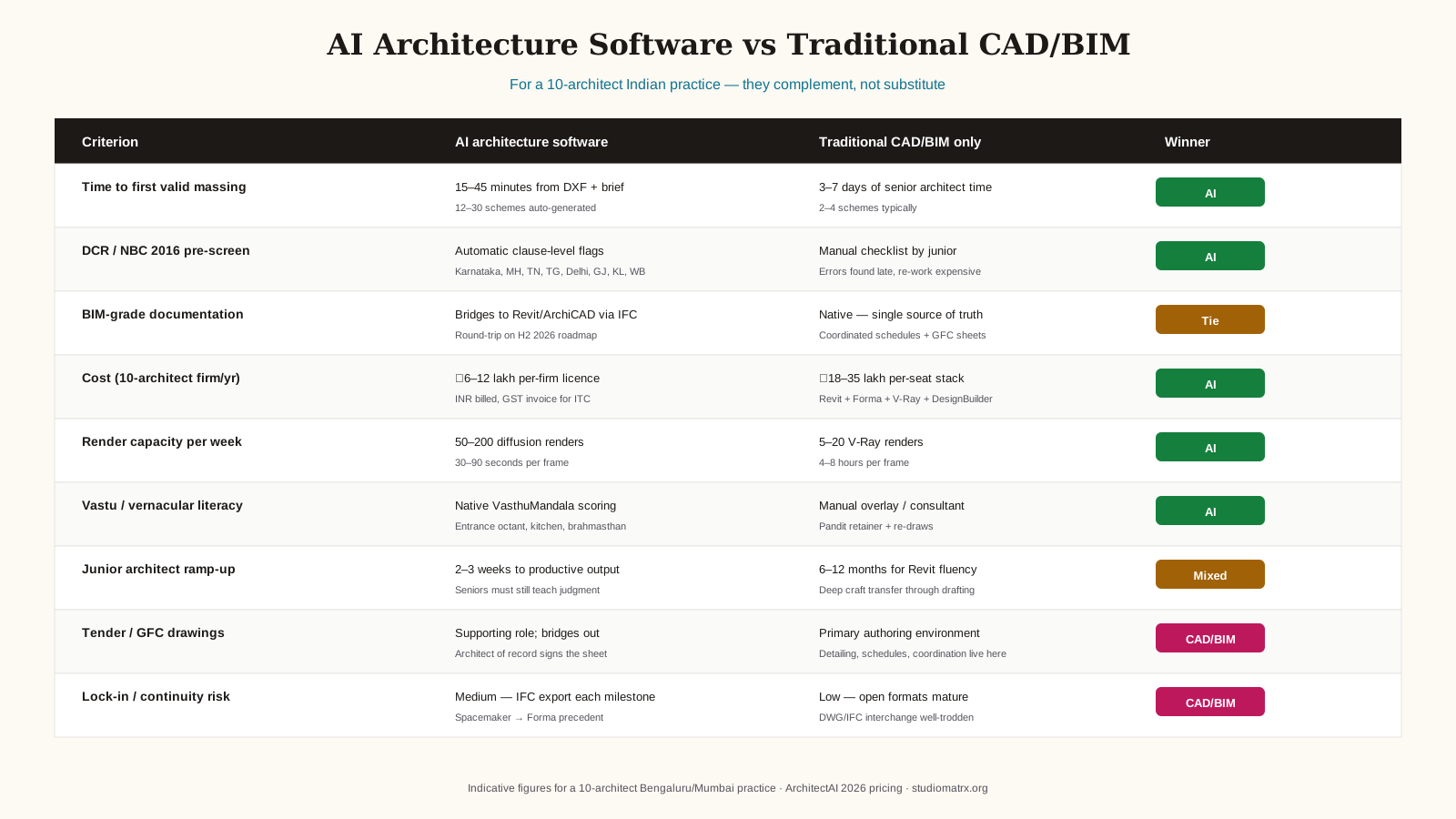
| Criteria | AI architecture software (ArchitectAI-class) | Traditional CAD/BIM only | Winner + caveat |
|---|---|---|---|
| Time to first valid massing | 15-45 minutes | 3-7 days | AI — but the architect still chooses |
| Number of optioneered schemes | 12-30 | 2-4 | AI — wider exploration improves design quality |
| DCR/NBC compliance pre-screen | Automatic | Manual checklist | AI — but signature liability unchanged |
| BIM-grade documentation | Bridges to Revit/ArchiCAD | Native | Tie — AI bridges, doesn't replace |
| Cost of ownership (10-architect firm) | ₹6-12 lakh/yr per-firm | ₹18-35 lakh/yr (per-seat Revit/Forma/V-Ray) | AI — significantly cheaper |
| Renders per week capacity | 50-200 | 5-20 | AI — order of magnitude |
| Vastu/India-Vernacular literacy | Native (ArchitectAI) | Manual overlay | AI — only ArchitectAI does this |
| Junior architect ramp-up time | 2-3 weeks | 6-12 months | AI — but seniors must teach judgment |
| Lock-in risk | Medium (export-able via IFC) | Low | Traditional — but you trade speed for it |
| Match for competition / concept stage | Excellent | Slow | AI — strongly |
| Match for tender-stage / GFC drawings | Supporting role | Primary | Traditional — for now |
The honest take: in 2026, no Indian firm should be running CAD/BIM without an AI layer. But equally, no Indian firm should be running AI without a BIM backbone. The two are complements, not substitutes.
Tool Landscape 2026
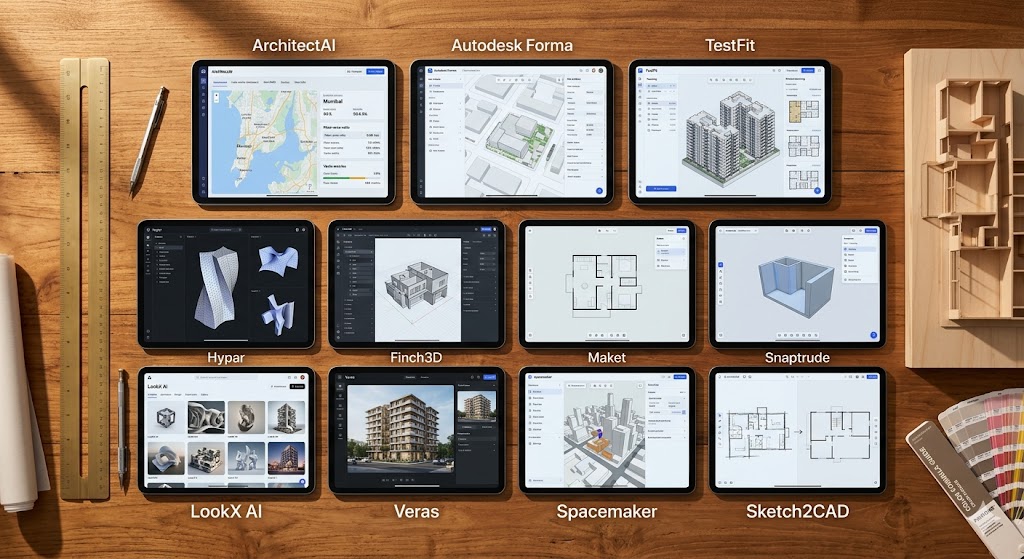
| Tool | Strength | Weakness | India fit | Indicative price (2026) |
|---|---|---|---|---|
| ArchitectAI (Studio Matrx) | India DCR + NBC 2016 + Vastu native, multi-tenant by firm, Revit/ArchiCAD bridge, full Studio Matrx render engine | Newer entrant; structural/MEP analysis limited; VR walkthrough on H2 2026 roadmap | Built for India — clear leader | ₹6-12 lakh/yr per firm (10-25 users) |
| Autodesk Forma (Spacemaker) | Best-in-class environmental analysis, microclimate, Autodesk ecosystem | Tuned for US/Nordic zoning; no India DCR; USD-priced per-seat | Mediocre — code layer needs heavy customisation | ₹50,000-90,000/user/yr |
| TestFit | Multifamily and parking optimisation excellence | US-tuned; suburban-developer focus | Limited — works for SEZ/township masterplans only | ₹3-5 lakh/user/yr |
| Hypar | Computational-design platform with functions library | Steep developer-style learning curve | Niche — needs in-house dev capacity | Free tier + enterprise quoted |
| Finch3D | Real-time generative floor planning, gamified UX | Limited code compliance; small-project bias | Decent for residential | ₹1.5-3 lakh/user/yr |
| Maket | Generative residential floor plans, conversational interface | Single-family bias; weak BIM bridge | Decent for plotted-development residential | $50-200/user/month (₹4,000-17,000) |
| Snaptrude | India-origin browser BIM with collaboration | Pure BIM, lighter on generative AI/optioneering | Strong India fit for BIM; complements ArchitectAI | ₹15,000-40,000/user/yr |
| LookX AI | Diffusion-based architectural render and concept ideation | Render-only; no BIM, no compliance | Useful as a sidecar to Revit | $20-60/user/month |
| Veras (EvolveLab) | Revit-native diffusion render plugin | Render-only | Useful inside an existing Revit shop | $35-65/user/month |
| Architect AI (architectai-render-only) | Quick concept ideation from text/sketch | Confusingly similar name — not the same as ArchitectAI; render-only | Hobbyist-grade | $10-30/user/month |
| Sketch2CAD | Hand-sketch to vector CAD/floor plan | Narrow scope; output needs cleanup | Useful for fast site-survey-to-plan | $15-40/user/month |
A few critical notes for Indian buyers. First, the name "Architect AI" is overloaded — there is a render-only tool by that name (architectai.com), and there is our ArchitectAI (the Studio Matrx B2B product). They are different products from different companies, with different scopes and price points. Always verify the URL and the feature set before you sign anything.
Second, most US-priced tools land 25-40% higher in India once GST + FX volatility + Razorpay/Stripe FX markup are layered on. A "$60/user/month" tool is realistically ₹6,500-7,500/user/month landed cost. For a 12-architect firm, that is ₹9-11 lakh/year — easily comparable with a full-firm ArchitectAI licence at the lower end of our pricing.
Third, per-seat licensing is the silent budget-killer for small Indian firms with 8-15 architects who don't all use the tool daily. Per-firm pricing — which ArchitectAI uses — solves this. The principal logs in twice a day, the senior architects daily, the juniors when they're on optioneering work, the visualisers in bursts. Per-seat pricing punishes precisely this realistic usage pattern.
Fourth, payment-terms matter. Forma, TestFit and Maket bill in USD on credit card — many Indian firms run into LRS-limit, FX-mark and reverse-charge GST headaches at year-end. ArchitectAI bills in INR with a proper GST invoice that your CA can claim ITC on. Boring, but real.
Eight Risks, Pitfalls and Honest Limits
1. Compliance pre-screen is not a legal sign-off. Every AI tool's NBC/DCR check is a pre-screen. The chartered architect of record signs the drawings and bears the liability under the Architects Act 1972 and IPC Section 304A. ArchitectAI logs every compliance run with timestamp and clause reference so your CoA defence is documented — but the architect's seal remains the legal authority.
2. State DCR coverage is uneven everywhere. Even ArchitectAI's India-first approach has gaps — at launch we cover Karnataka, Maharashtra, Tamil Nadu, Telangana, Delhi NCR, Gujarat, Kerala and West Bengal. Smaller-ULB rules (Mysuru-specific overlays, Pondicherry DCR) need a manual layer. Tier-2 and Tier-3 city projects need a senior architect cross-check.
3. Generative massing can hide structural impracticality. A massing that respects FSI and setbacks may have 22-metre column-free spans that no Indian fabricator will quote economically. Mitigation: ArchitectAI flags spans > 9 m and depths > 1.5 m with a "structural feasibility — consult engineer" warning. Always run a 30-minute structural sanity check before client presentation.
4. Vastu engine outputs guidance, not law. ArchitectAI's Vastu scoring is based on the VasthuMandala framework — entrance octant, kitchen agni-corner, brahmasthan preservation, master-bedroom south-west. Some clients (especially Tier-2 / extended-family) follow much stricter regional pandit-prescribed Vastu. Use the score as a starting conversation, not a verdict. See our deeper vastu-modern-homes treatment for the philosophical baseline.
5. Render outputs can mis-represent material reality. Diffusion renders sometimes generate Italian marble where you specified Kota stone, or imagine a teak veneer that has a grain pattern unavailable in India. Mitigation: always cross-check against the material-rate-library and an actual sample board. Use renders for emotion, not specification.
6. BIM-bridge round-tripping is one-way today. ArchitectAI pushes to Revit/ArchiCAD; round-trip (Revit changes coming back into ArchitectAI) is on the H2 2026 roadmap. Mitigation: treat the optioneering phase and the documentation phase as sequential, not concurrent, until round-trip ships.
7. Junior architect skill atrophy. Firms that hand drawing-production entirely to AI in year 1 risk juniors who can prompt but can't sketch. Mitigation: keep 20% of junior time on hand-sketch / measured-drawing exercises. AI is the production layer; the design judgment muscle must stay trained.
8. DPDP Act 2023 data residency obligations. Client floor plans, site surveys and BoQs are personal-data-adjacent. Under the DPDP Act 2023, "significant data fiduciaries" — likely to cover larger firms once draft rules are notified — will have stricter residency and consent obligations. ArchitectAI runs on India-region infrastructure (AWS Mumbai + Hyderabad) and signs Data Processing Agreements as standard. Mitigation: avoid any AI tool that cannot tell you where your project data physically resides, and read the small print on whether the vendor uses your project data to train its models. ArchitectAI does not. Many global tools, by default, do — opt-out is buried in account settings.
A ninth risk worth naming briefly: vendor concentration. If your entire pre-design workflow runs on one platform, you have a continuity risk if the vendor changes pricing, gets acquired (Spacemaker → Forma is the playbook here), or quietly deprecates a feature. Mitigation: keep your raw site DXFs, your client briefs, your moodboards and your reference models in your own file storage. Export ArchitectAI optioneering outputs to IFC every milestone so you have a vendor-neutral fallback.
India-Specific Considerations

NBC 2016. The National Building Code (NBC 2016, with 2020 amendments) is the umbrella reference, but it is advisory — the binding rules are state-level DCRs and ULB byelaws. Any AI architecture software pitched at India must read NBC Parts 3 (development control), 4 (fire & life safety), 8 (building services) and 11 (sustainability) natively. ArchitectAI does. Forma and TestFit do not — you would build a custom rules layer for each project, defeating the productivity premise.
State DCRs. Karnataka RMP-2031 + KMC Building Byelaws; Maharashtra UDCPR 2020 (uniform across non-MCGM ULBs); Delhi MPD-2041 + Unified Building Byelaws 2016; Tamil Nadu TNCDBR 2019; Telangana TS-bPASS; Kerala KMBR 2019. Each has its own definitions of FSI calculation, setback measurement origin, ground coverage exemptions and parking norms. A US-tuned platform that imports DXF and "respects setbacks" without state-DCR awareness will generate non-compliant schemes 60-80% of the time.
IS Codes. For any output that touches structural feasibility, IS 456:2000 (concrete), IS 800:2007 (steel), IS 1893:2016 (seismic), IS 875 (loads) are the binding references. AI tools should flag — not silently smooth over — outputs that imply violations.
Vastu compatibility. This is non-negotiable for 65-75% of Indian residential clients across the four metros (per the same buyer-behaviour data referenced in our vastu-modern-homes guide). ArchitectAI scores every massing on entrance octant, kitchen quadrant, master-bedroom quadrant, brahmasthan preservation and toilet placement. No global platform offers this natively.
DPDP Act 2023. Client floor plans, site surveys, BoQs, occupant data — all personal-data-adjacent. Choose a platform that (a) hosts in India, (b) signs a DPA, and (c) explicitly states it does not use your project data to train its models without opt-in.
Language. Hindi, Marathi, Tamil, Kannada and Telugu briefs are the norm in Tier-2 client conversations. ArchitectAI's NLU layer ingests them. Most global platforms are English-only.
Climate zones. NBC 2016 defines five climate zones (Hot-Dry, Warm-Humid, Composite, Temperate, Cold). A platform that doesn't auto-classify and adjust passive-design defaults (overhang depth, glazing ratio, courtyard preference) is dropping a significant productivity gain on the floor.
Regional vendor reality. A massing that calls for triple-glazed argon-filled units in Tier-3 Hubballi will not be quotable. ArchitectAI cross-references vendor availability via the same material-rate-library that powers Studio Matrx — so the generated scheme is buildable, not just elegant.
The Studio Matrx Stack for AI Architecture Software
ArchitectAI is the platform, but a firm-grade workflow draws on a wider set of Studio Matrx tools available to your team:
- ai-onboarding — captures client brief in conversational format (works for both homeowner-side and firm-client-side intake)
- project-feasibility — feasibility scoring for site/programme/budget triangulation before you start optioneering
- client-discovery — structured client-needs intake your relationship manager runs alongside the principal
- moodboard-builder — for the interior-fit-out leg of architecture-plus-interiors mandates
- daylight-factor — quick daylight verification on individual rooms inside generated schemes
- cross-ventilation-analyzer — for the warm-humid and hot-dry zone schemes that demand it
- brise-soleil-visualizer — facade shading device design for west/south facades
- setback-visualizer — quick visual check of DCR setback compliance
- staircase-calculator — NBC-compliant stair geometry
- cost-benchmark — rapid project-cost benchmark per square foot by city and finish tier
- material-rate-library — vendor-realistic material rates so generated schemes are buildable
- design-fee-calculator — fee proposal generation when you're pitching the work
- quotation-generator — for interior fit-out scope when bundled into architecture mandates
The combination of ArchitectAI (massing + compliance + render) plus these targeted tools is what we call the firm-grade Studio Matrx stack — and it is meaningfully cheaper than equivalent capability assembled from Forma + V-Ray + DesignBuilder + a parametric Vastu consultant.
When NOT to Use AI Architecture Software
Be honest with yourself about the wrong fits:
- Heritage conservation projects. Generative optioneering on a Grade-I heritage facade is meaningless and offensive. Use traditional measured drawing and conservation-architect judgment.
- Highly specialised typologies with thin training data. Naval architecture, hospital pathology departments, neutrino observatories. AI models trained on a residential/commercial corpus give bad outputs here.
- Sub-50-sqm interventions. A 3-week kitchen renovation in a Bandra flat does not need optioneering. It needs a competent architect with a tape measure and a samples bag. Use ai-home-design instead.
- Disaster-relief and rapid-deployment shelters. Site conditions are too variable, code regimes are suspended. Use parametric scripts you wrote and trust.
- Pure structural-engineering deliverables. ETABS, STAAD-Pro and TEKLA remain the right tools. AI architecture software is not in this category.
- When the client wants a specific architect's hand. Some clients hire the firm for a named principal's design language. AI-generated optioneering dilutes that authorship. Be honest about the brief.
Adopting AI everywhere is as wrong as adopting it nowhere. The firms winning in 2026 are the ones who triage which projects justify the AI workflow and which don't.
The 5-Year Trajectory: AI Architecture Software in 2030
By 2030, three things are highly likely:
Round-trip BIM becomes standard. The current one-way ArchitectAI-to-Revit bridge becomes bidirectional. Changes a BIM manager makes in Revit flow back into the optioneering layer, so AI re-validates compliance and re-renders. Forma, ArchitectAI and Snaptrude are all racing here.
Code compliance becomes binding, not advisory. Several Indian states — likely Karnataka and Maharashtra first — will introduce machine-readable DCR APIs that any AI tool can query for real-time compliance. The pre-screen becomes an actual screen.
The render layer becomes real-time and interactive. Diffusion render today is 30-90 seconds per frame; by 2028-29 it will be 30 fps interactive walkthrough quality, killing the V-Ray rendering market entirely. VR client walkthroughs — currently on the ArchitectAI H2 2026 roadmap — become table-stakes.
Generative agents start to take meeting minutes and chase consultants. The "AI project manager" layer that runs above the design tools — chasing structural consultant for steel tonnage, chasing MEP for HVAC heat-load, scheduling municipal-officer site visits — is the H1 2027-H2 2028 frontier. The firm of 2030 may have 60% the headcount of the firm of 2025 for the same project throughput.
Fee-models shift to outcome-based. Some BFSI and large-developer clients will move from %-of-construction fees to outcome-based fees (approved permits delivered, days-to-permit, energy performance achieved). AI software makes this commercially viable because the marginal cost of additional optioneering is near-zero.
What does not change by 2030: the architect of record's legal liability, the value of judgment over throughput, the client-relationship layer, the need to know which Tier-3 city fabricator will actually quote your detail. Those remain human.
Frequently Asked Questions
Does AI architecture software replace BIM (Revit/ArchiCAD)? No. ArchitectAI and every credible platform in this category sit adjacent to BIM, not on top of it. Your single source of truth — coordinated model, schedules, GFC drawings — is still Revit/ArchiCAD/Vectorworks/Snaptrude. ArchitectAI compresses the pre-design and optioneering phase that precedes BIM authoring, then bridges the chosen scheme into your BIM platform. Firms that try to "replace Revit with AI" are mis-using the category.
Is ArchitectAI for solo architects or firms? Both, but the licence model is firm-shaped. A solo architect can buy a 1-user firm tenant; pricing scales meaningfully from 5 users upward. Our beta-customer sweet spot is 6-30 architect firms. Below 5 architects, the ai-home-design consumer flow may actually be enough for residential-only work; above 50 architects, we have an enterprise tier with dedicated India-region infrastructure and a customer success manager.
How does ArchitectAI handle NBC 2016 compliance checks? ArchitectAI ingests NBC 2016 Parts 3, 4, 8 and 11, the applicable state DCR (Karnataka RMP-2031, Maharashtra UDCPR, etc.), and where notified the local ULB byelaws. On every massing, the Compliance Check layer flags violations with the specific clause reference and severity (hard violation / advisory / interpretive). The output is a pre-screen designed to catch 80%+ of municipal-rejection causes — but the chartered architect of record remains liable for the signed drawings. We log every compliance run with timestamp + clause + AI version for your CoA defence.
Forma vs ArchitectAI — when do I pick which? Pick Forma if your practice is dominated by US/Nordic/Middle East work, you already own the Autodesk AEC Collection, and microclimate/wind analysis is your competitive edge. Pick ArchitectAI if your practice is dominated by India work, you want native DCR and Vastu coverage, you need per-firm multi-tenant pricing in INR, and you want a render engine without buying V-Ray. Many large Indian firms with global mandates actually run both — Forma for offshore projects, ArchitectAI for India work. The two are not mutually exclusive.
What does it cost to onboard a 10-architect firm? Indicative ArchitectAI pricing for a 10-architect firm in 2026 is ₹6-9 lakh/year (annual licence), inclusive of GST, with 4-6 hours of onboarding training, template setup, and 30 days of post-launch support. Compare to a Forma-equivalent stack: Forma per-seat × 10 + V-Ray licences + DesignBuilder for environmental + a Vastu-consultant retainer typically lands ₹22-35 lakh/year. The arithmetic is straightforward.
Can AI generate drawings my municipal commissioner will accept? Yes — with a critical caveat. ArchitectAI generates dimensioned plans, sections, elevations and schedules at submission quality. But the signature on the drawing must come from a CoA-registered architect of record (or licensed engineer / town planner for the categories notified under the relevant state rules). Municipal commissioners care about the seal and the registration number, not how the lines were drawn. We've had ArchitectAI-generated drawings approved by BBMP, MCGM, GHMC and DDA in pilot projects — the architect's seal and review made it valid.
Does ArchitectAI work for masterplanning and not just buildings? Yes for parcels up to ~50 acres. Beyond that, you should be pairing ArchitectAI with TestFit (for developer feasibility) and Hypar (for computational masterplanning). Township-scale (100+ acres) and SEZ work is on our 2027 roadmap.
Can we self-host ArchitectAI on-premise for confidential government work? Yes — for enterprise tier customers. The default deployment is multi-tenant SaaS on AWS Mumbai + Hyderabad. For PSU, defence and confidential government mandates, we offer a dedicated single-tenant deployment with optional on-premise installation. Lead time for the on-premise option is 6-10 weeks.
Does using AI architecture software affect our professional indemnity insurance? Speak to your insurer — most India PI policies have not yet updated their language around AI-assisted design. The conservative posture in 2026: disclose the use of AI tooling in your engagement letter, retain the architect-of-record sign-off as the legal authority, and keep the AI tool's compliance-check logs as documentation. We have not heard of an Indian PI insurer denying a claim because the architect used AI assistance — but the category is young.
References
1. National Building Code of India 2016 (with 2020 amendments). Bureau of Indian Standards. https://www.bis.gov.in
2. The Architects Act, 1972. Council of Architecture, India. https://www.coa.gov.in
3. The Digital Personal Data Protection Act, 2023. Ministry of Electronics and Information Technology, Government of India. https://www.meity.gov.in
4. Karnataka Revised Master Plan 2031 + Building Byelaws. Bangalore Development Authority. https://bdabangalore.org
5. Maharashtra Unified Development Control and Promotion Regulations (UDCPR) 2020. Urban Development Department, Government of Maharashtra. https://urban.maharashtra.gov.in
6. Delhi Master Plan 2041 + Unified Building Byelaws 2016. Delhi Development Authority. https://dda.gov.in
7. "Indian Real Estate Outlook 2026". KPMG India + NAREDCO joint report, 2026.
8. "Architecture, Engineering & Construction (AEC) Software Market — India Forecast 2024-2030". IBEF, 2024.
9. "How AI is Reshaping Architectural Practice". Architectural Record, Special Issue, March 2025.
10. Autodesk Forma (Spacemaker) product documentation, 2026. https://www.autodesk.com/products/forma
11. TestFit product documentation, 2026. https://www.testfit.io
12. Hypar platform documentation, 2026. https://www.hypar.io
13. Snaptrude product documentation, 2026. https://www.snaptrude.com
14. "Generative Design in Architecture: A 2025 Practitioner Survey". Council of Architecture India + IIA joint study, 2025.
15. IS 456:2000 — Plain and Reinforced Concrete Code of Practice. Bureau of Indian Standards.
16. IS 1893 (Part 1):2016 — Criteria for Earthquake Resistant Design of Structures. Bureau of Indian Standards.
17. Statista. "AI in Architecture Market Size Worldwide 2024-2030". 2025.
18. Houzz India. "What Indian Homeowners Want From Their Architects — 2026 Annual Survey".
Related Guides
Interactive · AI architecture software matrix
10 tools across all capabilities
Filter by capability
| Tool | Text | Image | 3D | Video | BIM | Upscaling | Control-net | Indian |
|---|---|---|---|---|---|---|---|---|
Midjourney v6+ Generative ideation | ✓ | ✓ | — | — | — | — | — | — |
DALL·E 3 / GPT-image Generative ideation | ✓ | ✓ | — | — | — | — | — | — |
Stable Diffusion XL + ControlNet Open-source | ✓ | ✓ | — | — | — | — | ✓ | ✓ |
Krea Real-time Real-time canvas | ✓ | ✓ | — | — | — | — | ✓ | — |
Veras Render plugin | — | ✓ | — | — | ✓ | — | ✓ | — |
Lookx AI Architecture-specialist | ✓ | ✓ | — | — | — | — | ✓ | ✓ |
Magnific AI Upscaler | — | ✓ | — | — | — | ✓ | — | — |
Enscape AI Style / Twinmotion AI Render plugin | — | ✓ | — | — | ✓ | — | ✓ | — |
TestFit Parametric form-finding | — | — | ✓ | — | ✓ | — | — | — |
Snaptrude AI Indian-built BIM | — | — | ✓ | — | ✓ | — | — | ✓ |
Selected tool
Midjourney v6+
Generative ideation
Pricing
$10-60 / mo subscription
Best for
Hero moodboards, concept stills, atmosphere studies.
AI architecture software shifts monthly — capability mappings are 2025-26. Always validate output against constructible reality; AI outputs are NOT buildable as-rendered.
Export this guide
Related Guides — Deep-dive reading
AI Architecture India — The 2026 India Market Cornerstone for AI in Architecture
NBC 2016 · State DCRs · ECBC zones · Indian materials · Vastu · Multilingual NLU
Design StylesAI Floor Plan Generator — Plot-to-Plan + Sketch-to-Plan AI for India (2026)
NBC 2016 + state DCR · Vastu-aware · 30x40 N-facing worked example · ArchitectAI plan-gen
Design StylesAI Render Generator — Photoreal AI Rendering for Indian Architects + Designers (2026)
Sketch/photo/white-box → photoreal · 12 min vs V-Ray 4 hr · Studio Matrx + Lumion + D5 + Twinmotion + Enscape
Design StylesRelated Tools — Try Free
Brise-Soleil Visualizer
Interactive horizontal-louvre cut-off angle calculator — sun altitude, louvre depth, and spacing inputs with a live shadow preview. Computes θ = arctan(spacing/depth) for façade shading, ECBC envelope compliance, hospital daylight design, and tropical sun-control detailing.
Sun Shading ToolCross-Ventilation Analyzer
Estimate airflow and air changes per hour (ACH) from room size, window areas, layout, and local wind — with NBC 2016 Part 8 compliance check.
Ventilation CalculatorHealing View Impact Calculator
Evidence-Based Design dashboard quantifying the recovery impact of nature view + daylight factor on analgesic use, length of stay, and HCAHPS patient-experience uplift. Calibrated against Ulrich 1984 (Science), Park & Mattson 2008, and the CHD EBD evidence base.
EBD Calculator