
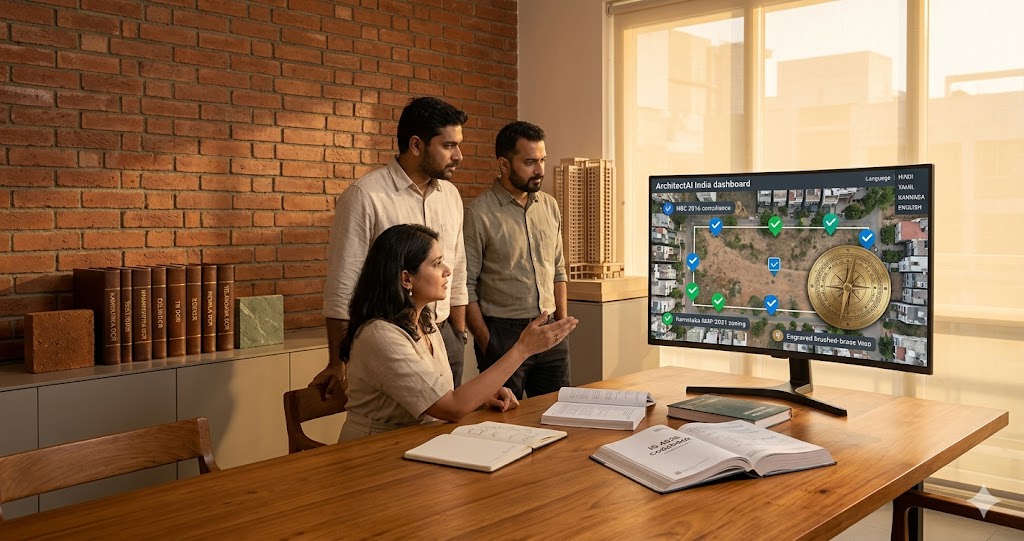
AI Architecture India — The 2026 India Market Cornerstone for AI in Architecture
NBC 2016 · State DCRs · ECBC zones · Indian materials · Vastu · Multilingual NLU
AI architecture in India is not a Western product with a Hindi menu — it is a different problem. A tool that does not know what an FSI of 1.75 means in Bengaluru, that cannot read Karnataka's RMP 2031, that thinks "Vastu" is a vibe rather than a compass-anchored ruleset, and that has never heard of Athangudi tiles is not an architecture tool for India. It is a demo. In 2026, the gap between US-built AI tools and the working reality of a Pune row-house plot, a Chennai composite-climate apartment, or a Jaipur hot-dry villa has become impossible to paper over — and that gap is exactly what Studio Matrx and our B2B sibling, ArchitectAI, were built to close.
This guide is the India market cornerstone of our AI-in-architecture series. It is written for homeowners who are about to spend ₹15 lakh to ₹3 crore on a build or interior, and equally for the ~85,000 COA-registered architects and the ~12,000 architecture firms who are deciding whether to adopt AI in the next 18 months. Both audiences hit the same wall: the international tooling does not know India, and the Indian tooling has historically been thin. That is changing.
"Forma can generate a beautiful massing study for a Bay Area lot. Ask it about TS-bPASS approval, Athangudi flooring lead times, or whether your toilet can sit in the brahmasthan, and it goes silent. India needs an India-native AI."
If you want the broader practitioner reference, start with AI in interiors; for the software comparison view read AI architecture software; for the homeowner-centric pre-design conversation read AI home design and our Vastu house plan deep-dive; for the human-loop step that closes every AI project see choosing an interior designer in India.
This guide refreshes every 12 months. Last verified: May 2026 · Next verify: May 2027.
What AI Architecture India Actually Means (and What It Doesn't)
"AI architecture India" is the application of generative and analytical AI — large language models, diffusion image models, parametric solvers, computer-vision plan readers, and code-compliance reasoners — to the specific constraints of designing buildings in India. The keyword is specific. An AI architecture tool earns the "India" label only when it can reason about the National Building Code 2016 (NBC), Indian Standard (IS) codes, state development control regulations (DCRs), Council of Architecture (COA) rules, India's five ECBC climate zones, regional vendor ecosystems, India-specific materials, the linguistic reality of seven major design-relevant languages, and Vastu Shastra as a compass-anchored client requirement rather than a cosmetic preference.
Practically, an India-aware AI architecture stack covers four working layers. The brief-capture layer translates a homeowner or developer brief — possibly in Hindi, Tamil, Kannada, Marathi, Telugu, Bengali, or English — into a structured program with rooms, areas, adjacencies, budget, and Vastu and climate constraints. The pre-design layer generates massing, FSI compliance, setback compliance, and ground-coverage compliance against the right state DCR. The detailed-design layer produces plans, sections, BoQs, and renders that respect Indian construction realities — RCC frame, brick infill, vitrified-tile assumptions, AAC vs red-brick choices, monsoon detailing. The compliance and handoff layer outputs drawings in the format the local authority will actually accept (PWD-style line weights, AutoCAD-compatible DWG, TS-bPASS-uploadable PDFs).
Five things AI architecture in India is not:
1. It is not Forma or Maket with a translated interface. Translating "wall" to "deewar" does not give the model knowledge of Maharashtra's UDCPR 2020 setback table or Karnataka's parking norms.
2. It is not a replacement for COA-registered architects. Section 37 of the Architects Act 1972 reserves the title "Architect" for COA registrants, and most approval authorities require a registered architect's stamp on submission drawings. AI accelerates pre-design; it does not sign drawings.
3. It is not a Vastu generator. True Vastu compliance needs a magnetic-north compass reading on the actual site, a brahmasthan offset, and zone-wise placement against the eight cardinal directions. A pattern-matched "Vastu-friendly" template is not Vastu.
4. It is not a one-click building permit. TS-bPASS, BBMP, MCGM, and DDA all have human review steps. AI can pre-fill, pre-check, and reduce iteration, but it cannot promise an approval.
5. It is not a render-only toy. Indian buyers increasingly distrust hero renders that do not match the eventual build. An India-native AI stack ties the render back to a real BoQ, real vendor SKUs, and real costs in ₹ per square foot.
Why AI Architecture India Matters in 2026 India
The Indian construction market crossed ₹2.4 lakh crore in formal architectural-services revenue in 2026 (IBEF construction sector report, March 2026), with residential at roughly 62% of that. Real estate as a whole — KPMG India and Knight Frank both estimate — is on a path to USD 1 trillion by 2030, with the architect-served segment growing fastest in tier-1 and tier-2 cities. Against that volume, the country has roughly 85,000 COA-registered architects — a density of about 1 architect per 16,500 people, against ~1:1,600 in the US and ~1:2,300 in the UK. There simply are not enough architects to do every project the traditional way.
AI adoption among Indian architecture firms sat at roughly 12% as of the JLL India PropTech survey (Q1 2026), concentrated in tier-1 cities and the larger firms (50+ staff). The remaining 88% are either evaluating, piloting, or actively skeptical. The skepticism is rational: most of what was marketed as "AI architecture" in 2023–24 was diffusion-rendered moodboards that ignored every Indian constraint. The 2026 inflection is that India-native stacks have begun to ship.
Three forces are pushing adoption now:
- Approval-cycle pressure. TS-bPASS in Telangana, NOC-via-SAKALA in Karnataka, and the AutoDCR rollouts in Maharashtra mean that machine-readable drawings get faster turnaround. Firms that can output clean DWG/PDF with checked setbacks save 6–10 weeks per project.
- Cost pressure on the homeowner. A 2BHK apartment fitout in Bengaluru ranges ₹8–25 lakh; a villa interior runs ₹25 lakh to ₹2 crore. Homeowners walk in with Pinterest boards and want a render-quality preview before signing. The traditional 3-week brief-to-moodboard cycle is no longer competitive.
- The Vastu reality. Roughly 60–70% of buyers in north and west India, and a similar share in Karnataka and Andhra/Telangana, treat Vastu as a hard constraint. International AI tools cannot satisfy that constraint. Indian ones must.
The seam Studio Matrx fills is precisely here: an AI stack that produces homeowner-facing moodboards, renders, and budget-realistic BoQs in 30–90 minutes, with Vastu and NBC reasoning baked in, in the languages the customer actually thinks in. ArchitectAI extends the same intelligence into the firm workflow — multi-tenant by firm, with the optioneering, DCR-checking, and BoQ-export needs a practice actually has.
The Eight Capabilities That Matter
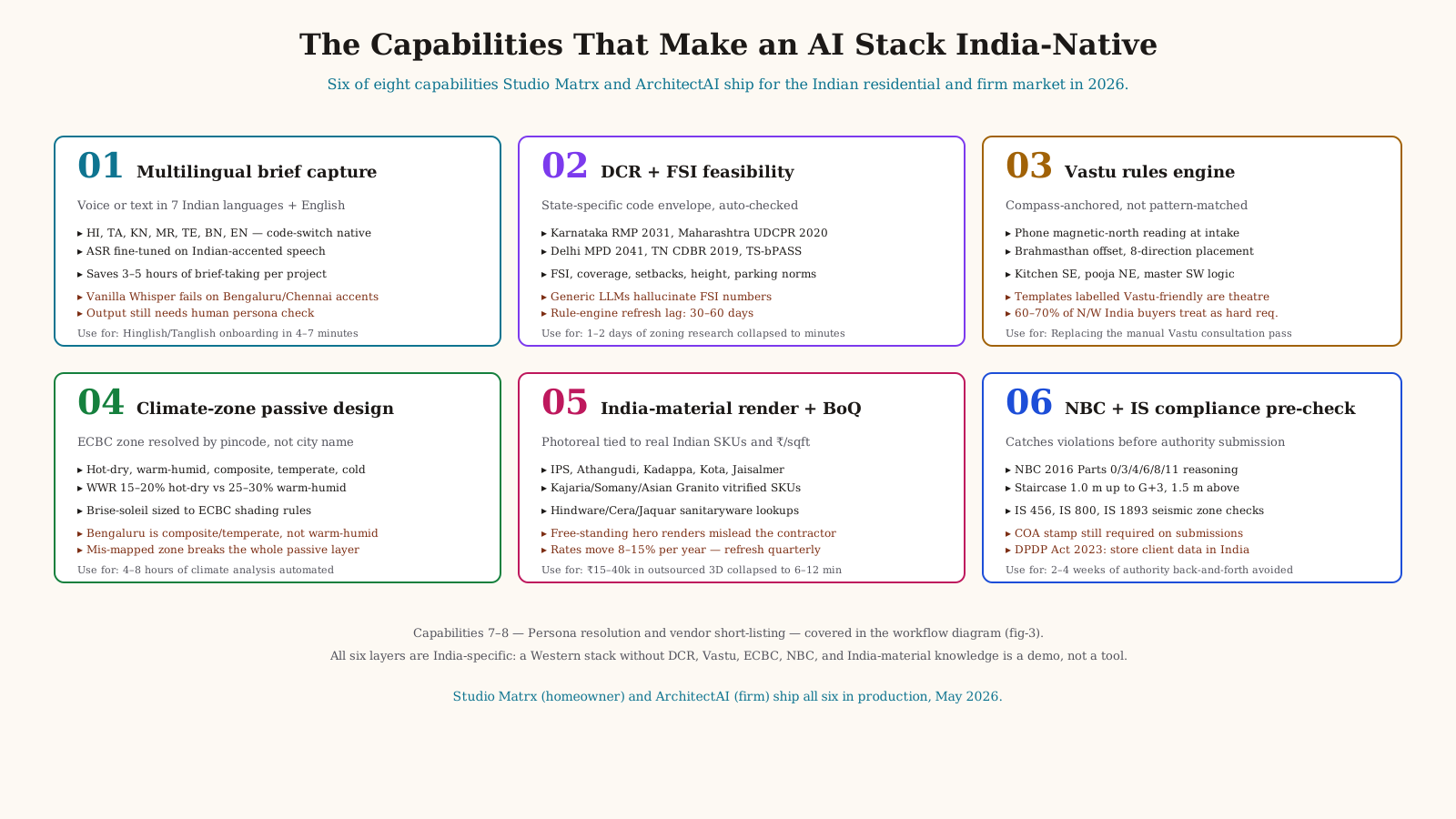
| Capability | What it does | Time / cost saved | Studio Matrx flow that does it |
|---|---|---|---|
| Multilingual brief capture | Converts spoken or typed brief in 7 Indian languages + English into structured program | 3–5 hours of brief-taking per project | AI onboarding + client discovery |
| Persona + lifestyle mapping | Resolves "modern but traditional" type ambiguity into concrete style choices | 1–2 client meetings | Lifestyle persona mapping |
| Feasibility against plot | Reads FSI, coverage, setbacks against state DCR | 1–2 days of zoning research | Project feasibility + setback visualizer |
| Vastu-aware plan generation | Places kitchen SE, master bed SW, pooja NE etc. against measured compass | 1 expert consultation | Vastu rules engine inside moodboard builder |
| Climate-zone passive design | Adjusts WWR, shading, orientation per ECBC zone | 4–8 hours of analysis | Daylight factor + cross-ventilation analyzer + brise-soleil visualizer |
| BoQ + ₹ per sqft estimation | Generates BoQ tied to real Indian rates and vendor SKUs | 2–3 days per project | Cost benchmark + material rate library + budget allocation |
| Photoreal render with India materials | Generates 4–8 photoreal interiors using Indian material library | ₹15,000–₹40,000 in 3D outsourcing | Material palette + color scheme |
| Compliance pre-check | Pre-validates NBC ventilation, staircase, parking before submission | 2–4 weeks of authority back-and-forth | Staircase calculator + NBC checker inside ArchitectAI |
How Studio Matrx Does AI Architecture India — End-to-End Walkthrough
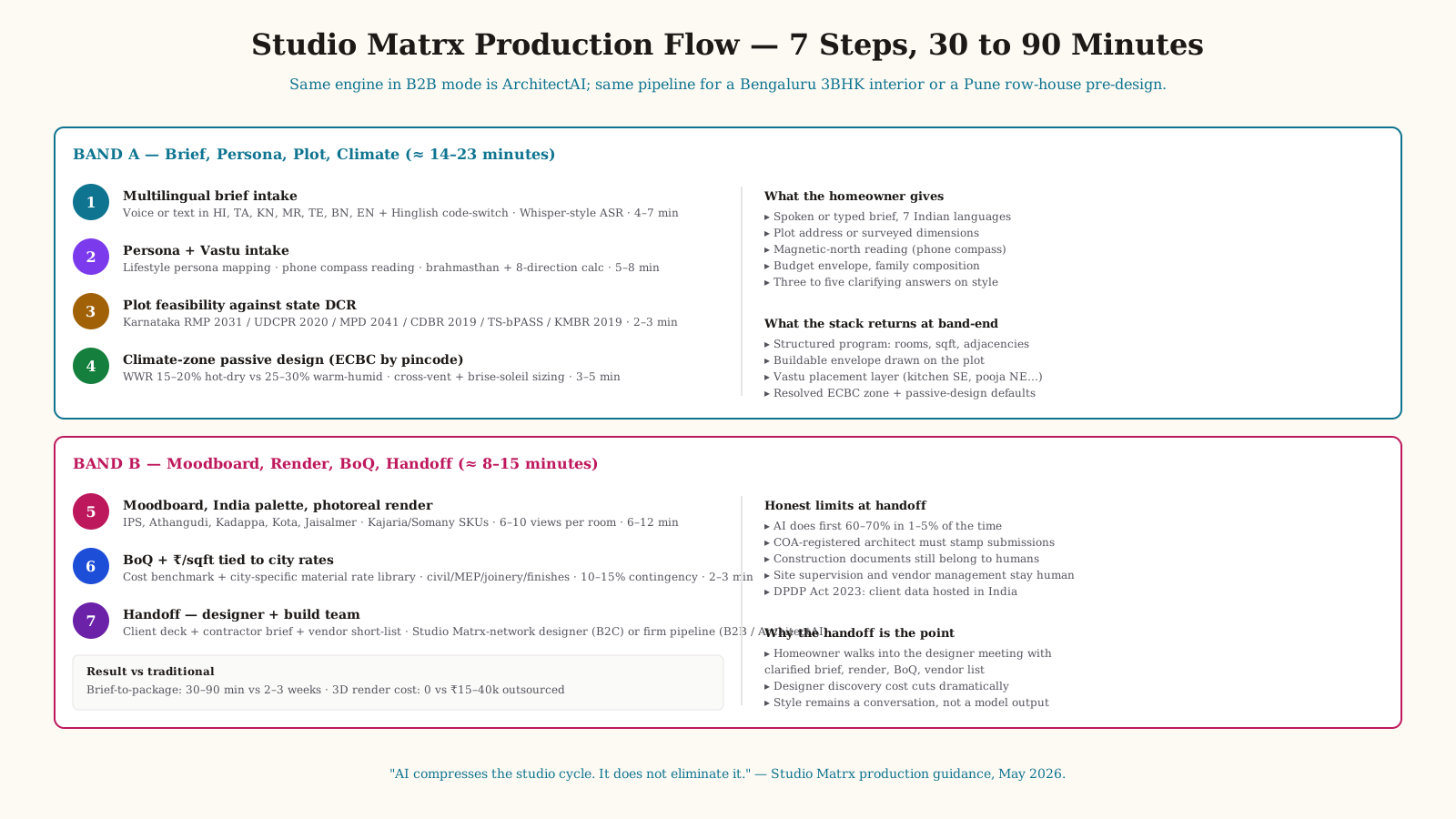
Here is the actual Studio Matrx flow as it runs in production for a Bengaluru 3BHK interior or a Pune row-house pre-design. The same engine, in B2B mode as ArchitectAI, runs the firm workflow.
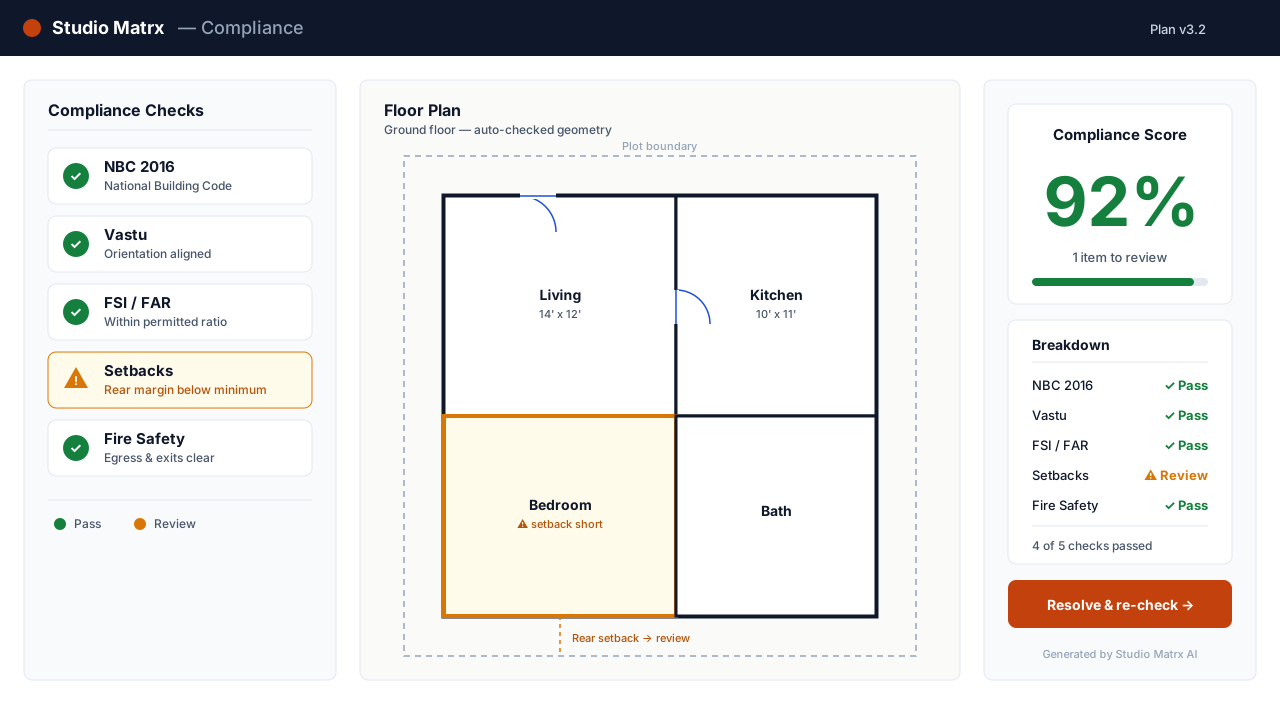
Step 1 — Multilingual brief intake. The homeowner opens AI onboarding and speaks or types a brief. "Mujhe 3 bedroom chahiye, warm minimal style, ₹18 lakh budget, North-facing plot." The system handles code-switching (Hinglish, Tanglish, Kanglish) natively, and runs Whisper-style ASR fine-tuned on Indian-accented English plus the seven major Indian languages. The output is a structured program: rooms with target sqft, adjacency preferences, budget envelope, plot orientation, family composition. Time: 4–7 minutes.
Step 2 — Persona resolution and Vastu intake. Lifestyle persona mapping resolves the brief into a sharper design persona — say, "Warm Minimal + Bengaluru-modern + light-Vastu-observance" — and asks three to five targeted questions to pin down style ambiguities. For Vastu-observant clients, the system asks for a magnetic-north compass reading (the user can take it on their phone) and applies the brahmasthan calculation. Plots fall into one of eight orientation categories (N/NE/E/SE/S/SW/W/NW), and the rules engine adjusts kitchen, pooja, master bedroom, and entry placements accordingly. Time: 5–8 minutes.
Step 3 — Plot feasibility and code envelope. Project feasibility ingests the plot address (or surveyed dimensions), pulls the right state DCR — Karnataka RMP 2031 for Bengaluru, Maharashtra UDCPR 2020 for Pune, Delhi MPD 2041 for Delhi NCR, TN CDBR 2019 for Chennai, Telangana TS-bPASS norms for Hyderabad, Kerala KMBR 2019 for Kochi — and computes the buildable envelope: ground coverage %, FSI/FAR, front/side/rear setbacks, height limit, parking norm. Setback visualizer draws the envelope on the plot. Time: 2–3 minutes.
Step 4 — Climate-zone passive design layer. The system maps the project pincode to one of the five ECBC climate zones: hot-dry (Jaipur, Ahmedabad), warm-humid (Chennai, Mumbai coastal, Goa), composite (Delhi NCR, Bengaluru), temperate (Bengaluru core, Pune highlands), or cold (Shimla, Gangtok). Daylight factor sets the right window-to-wall ratio (typically 15–20% for hot-dry south, 25–30% for warm-humid east/north). Cross-ventilation analyzer checks for prevailing-wind through-flow. Brise-soleil visualizer places horizontal shades on south and west exposures using ECBC sizing rules. Time: 3–5 minutes.
Step 5 — Moodboard, material palette, photoreal render. Moodboard builder outputs 4–8 reference moodboards. Material palette selects from an India-specific library — IPS flooring, Athangudi tiles, Kadappa stone, Jaisalmer yellow, Kota brown, laterite cladding, teak, Indian rosewood, cane, terrazzo, vitrified tile SKUs from Kajaria/Somany/Asian Granito, sanitaryware from Hindware/Cera/Jaquar, paints with Asian Paints / Berger / Nerolac codes. Color scheme tunes the palette for the warm-light reality of Indian interiors. The diffusion render engine then produces 6–10 photoreal views per room — kitchen, living, master bed, guest bed, pooja, bath — using the actual material picks rather than generic textures. Time: 6–12 minutes.
Step 6 — BoQ and ₹ per sqft budget. Cost benchmark ties each material pick to a city-specific rate from material rate library — Bengaluru rates differ from Mumbai rates differ from Kochi rates. Budget allocation splits the envelope into civil, electrical, plumbing, joinery, finishes, furniture, lighting, soft-goods, and contingency. Output is a working BoQ with vendor SKUs, ₹ per sqft, and a 10–15% contingency band. Time: 2–3 minutes.
Step 7 — Handoff to a human and to the build team. The output package — moodboards, renders, plans, BoQ, material schedule, vendor short-list via vendor comparison — exports as a sharable client deck and a working contractor brief. The homeowner is then handed off to a Studio Matrx-network designer for execution (see choosing an interior designer in India) or, in the B2B ArchitectAI case, into the firm's working drawing pipeline. Total elapsed time from brief to package: 30 to 90 minutes depending on complexity, versus 2–3 weeks traditionally.
AI Architecture India vs Traditional Indian Practice
| Criteria | AI / Studio Matrx flow | Traditional Indian practice | Winner + caveat |
|---|---|---|---|
| Brief-to-moodboard time | 30–90 min | 2–3 weeks | AI — but human refinement still needed for emotional nuance |
| Cost to client (pre-design) | ₹0 (Studio Matrx) to ₹5–15k for premium | ₹25k–₹2 lakh designer retainer | AI — caveat: traditional retainer often includes execution |
| Vastu compliance | Compass-anchored, rules-engine | Manual by Vastu consultant | Tie — AI is faster, traditional consultant has nuance |
| DCR / FSI compliance | Auto-checked against state DCR | Architect's manual reading | AI for speed, architect's stamp still required |
| Drawing quality (working drawings) | Pre-design / schematic level | Construction-document level | Traditional — AI does not yet output sign-off-ready CDs |
| Render quality | Photoreal in 6–12 min | 2–5 day 3D outsource at ₹15–40k | AI for speed and cost |
| Material/vendor knowledge | India-specific library, city rates | Architect's relationship network | Tie — AI gives breadth, relationships give terms |
| Approval handling | Pre-check, not submission | Architect liaises with authority | Traditional — COA-registered architect must submit |
| Iteration cost | Near-zero per iteration | ₹5–15k per major revision | AI |
| Trust + accountability | Lower (new) | Higher (decades of practice) | Traditional — for now |
The honest reading: AI does the first 60–70% of the work in 1–5% of the time, but the last 30–40% — construction documentation, authority liaison, site supervision, vendor management — still belongs to the registered architect and the human design team. This is why Studio Matrx is built as a homeowner-to-designer handoff, not a designer replacement.
Tool Landscape 2026
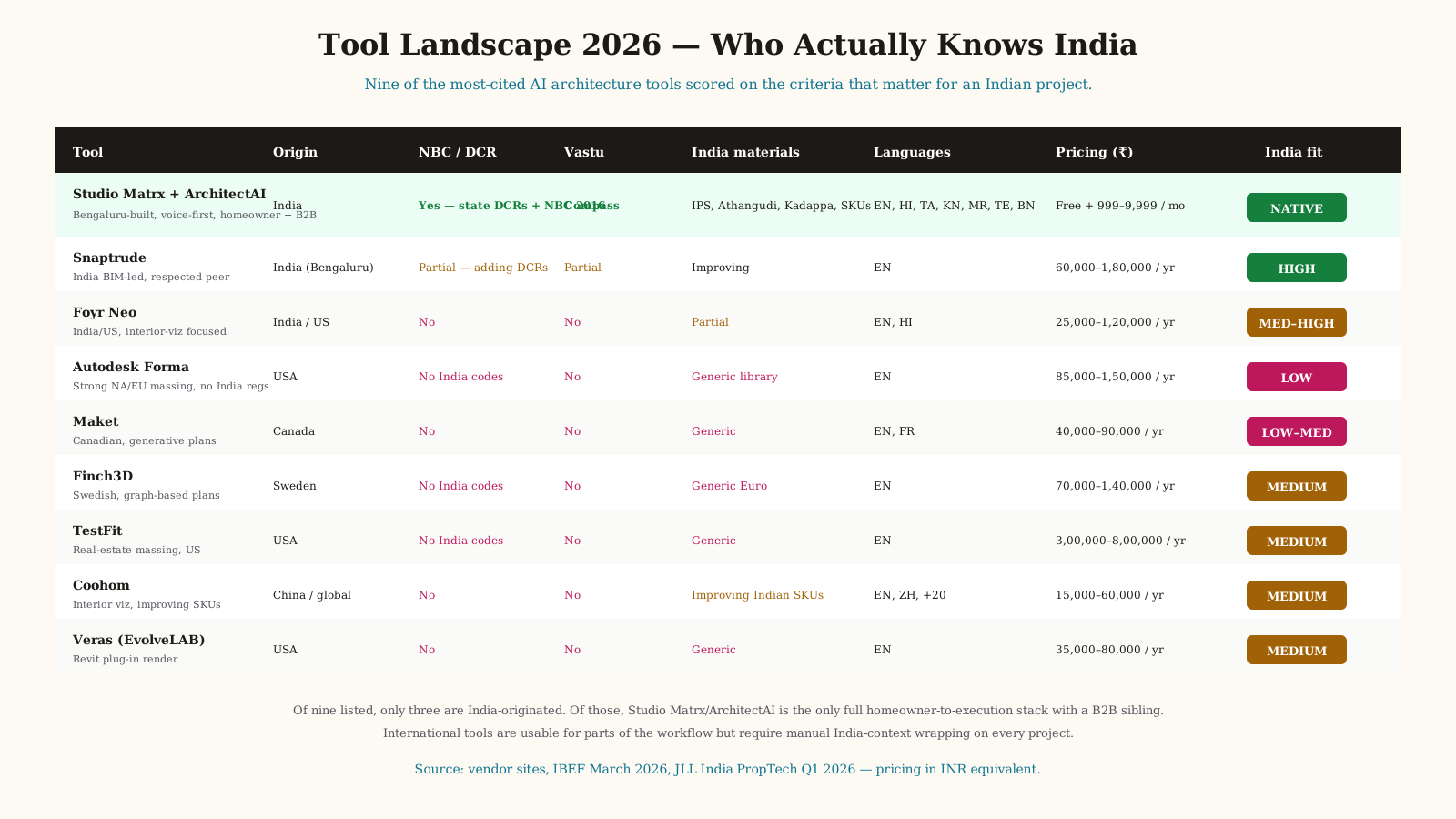
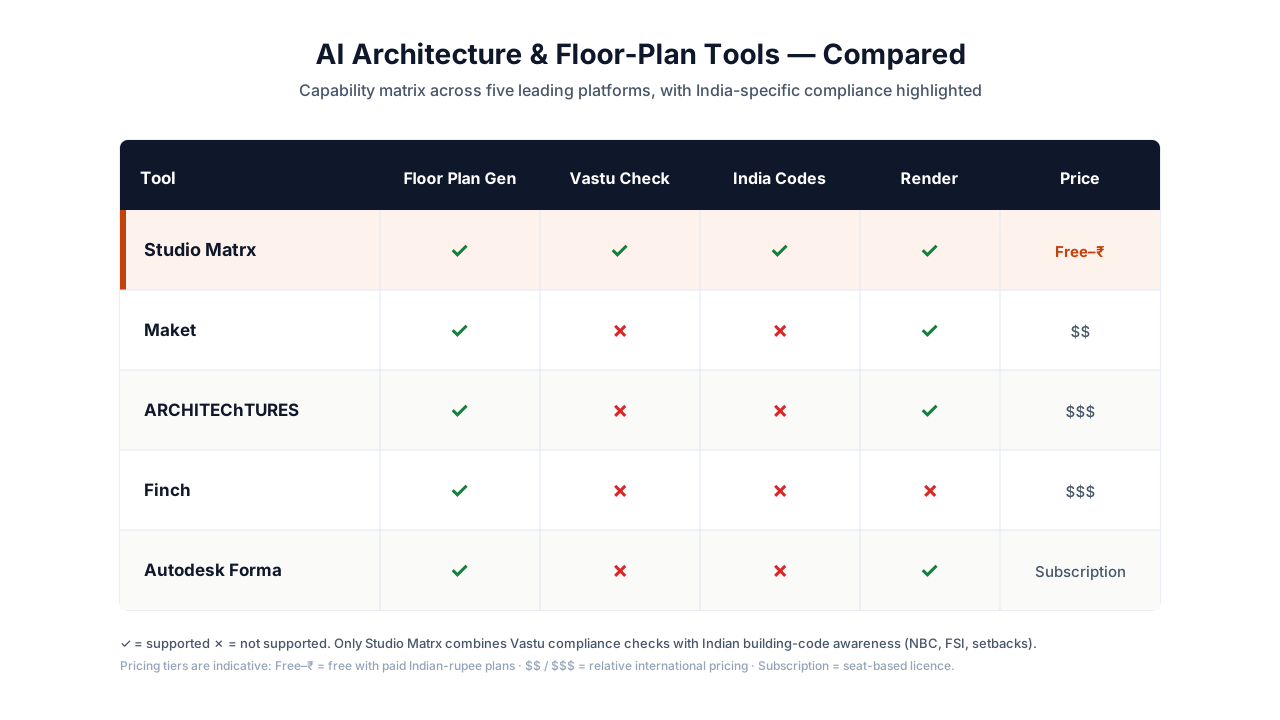
| Tool | Origin | India fit | NBC / DCR | Vastu | Indian materials | Languages | Pricing (INR equiv.) |
|---|---|---|---|---|---|---|---|
| Studio Matrx + ArchitectAI | India (Bengaluru) | Native | Yes — state DCRs + NBC 2016 | Yes — compass-anchored | Yes — IPS, Athangudi, Kadappa, Kota, vitrified SKUs | EN, HI, TA, KN, MR, TE, BN | Free tier + ₹999–₹9,999/mo |
| Autodesk Forma | USA | Low | No India codes | No | Generic library | EN | ₹85,000–₹1,50,000/yr |
| Maket | Canada | Low–medium | No | No | Generic | EN, FR | ₹40,000–₹90,000/yr |
| Snaptrude | India (Bengaluru) | High (BIM-led) | Partial — adding DCRs | Partial | Improving | EN | ₹60,000–₹1,80,000/yr |
| Finch3D | Sweden | Medium | No India codes | No | Generic Euro | EN | ₹70,000–₹1,40,000/yr |
| Hypar | USA | Low | No | No | Generic | EN | Custom enterprise |
| TestFit | USA | Medium (real-estate massing) | No India codes | No | Generic | EN | ₹3–8 lakh/yr |
| Spacemaker (now Forma) | Norway (Autodesk) | Low | No | No | Generic | EN | bundled with Forma |
| Coohom | China / global | Medium (interior viz) | No | No | Improving Indian SKUs | EN, ZH, +20 | ₹15,000–₹60,000/yr |
| Foyr Neo | India / US | Medium-high (interior viz) | No | No | Yes — partial | EN, HI | ₹25,000–₹1,20,000/yr |
| LookX AI | China / global | Medium (render-first) | No | No | Generic | EN, ZH | ₹12,000–₹50,000/yr |
| Veras | USA (EvolveLAB) | Medium (Revit plug-in render) | No | No | Generic | EN | ₹35,000–₹80,000/yr |
The structural point: of the twelve, only Studio Matrx/ArchitectAI, Snaptrude, and Foyr Neo are India-originated. Of those three, Snaptrude is the strongest BIM-side competitor (and a respected peer), Foyr Neo is interior-visualisation-focused, and Studio Matrx is the only one with a full AI-native homeowner-to-execution pipeline plus a B2B sibling. Forma, Maket, Finch3D, Hypar, TestFit, Spacemaker, Coohom, LookX, and Veras are usable for parts of the workflow but require manual India-context wrapping for every project.
Eight Risks, Pitfalls and Honest Limits
1. Hallucinated regulations. General-purpose LLMs invent FSI numbers and setback rules that do not exist. Mitigation: use only tools with a published, dated DCR rule-source (Studio Matrx and ArchitectAI cite the DCR clause; cross-check against the local sanctioning authority before submission).
2. Render-to-build mismatch. Diffusion models produce beautiful images that the contractor cannot build to a budget. Mitigation: insist on renders that are tied to BoQ line items and ₹/sqft rates, not free-standing hero images. Studio Matrx ties every render to its material palette and cost benchmark.
3. Vastu theatre. Generic templates labelled "Vastu-friendly" without compass alignment are decorative, not compliant. Mitigation: require a measured magnetic-north reading and brahmasthan calculation. Read our Vastu house plan deep-dive.
4. COA exposure. Submitting AI-generated drawings without a registered architect's stamp is a regulatory violation. Mitigation: AI is for pre-design and ideation; final submissions go through a COA-registered architect.
5. Climate-zone mis-mapping. Bengaluru is sometimes mapped as warm-humid; it is actually composite/temperate. Mis-mapping breaks passive design. Mitigation: verify the ECBC zone against the BIS climatic-zone map; our system maps by pincode rather than by city name.
6. DPDP Act 2023 exposure. Uploading client floor plans, family details, or budgets to non-India-located servers is a Digital Personal Data Protection Act 2023 issue if not consented. Mitigation: use providers with India-located data residency and explicit consent flows. Studio Matrx hosts client data in India and surfaces consent at the onboarding step.
7. Vendor-rate staleness. Material rates move 8–15% per year. Mitigation: use a rate library that publishes its last-updated date per city and category. Our material rate library refreshes quarterly per metro.
8. Over-automation of taste. Style is not a model output; it is a conversation. Mitigation: every AI moodboard should be reviewed by a human designer who knows the client. Studio Matrx hands off into a designer relationship for this reason.
India-Specific Considerations
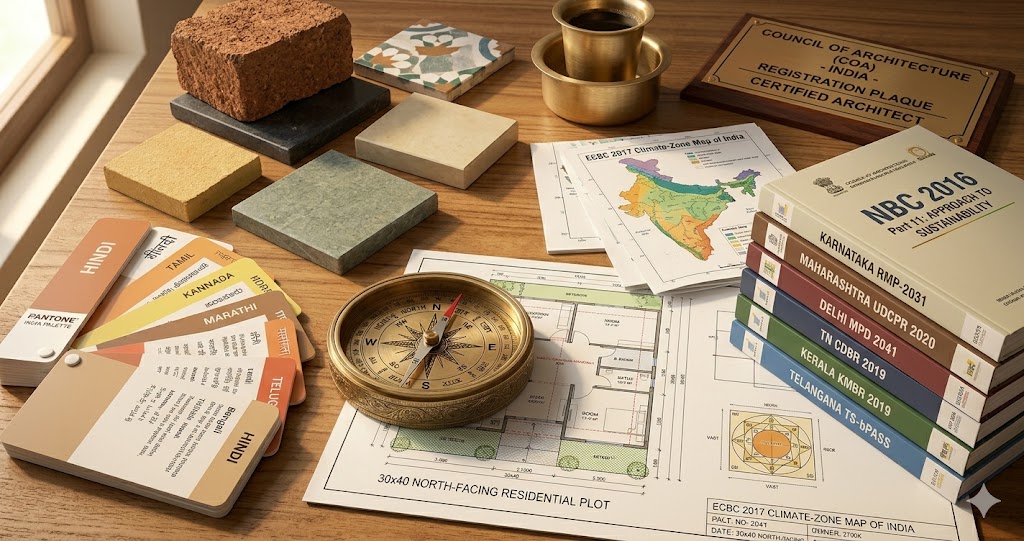
NBC 2016. The National Building Code of India 2016 is the umbrella document. The parts that an India-aware AI must reason about include Part 0 (foundational definitions), Part 3 (development control and general building requirements — setbacks, coverage, FSI), Part 4 (fire and life safety — refuge area, staircase widths, travel distances), Part 6 (structural design — IS 456 for RCC, IS 800 for steel, IS 1893 for seismic), Part 8 (building services — HVAC, lighting, plumbing), and Part 11 (sustainability, including ECBC integration). Part 4's staircase rule — minimum 1.0 m width for dwellings up to G+3, 1.5 m above — is one of the most-violated rules in AI-generated plans by tools that have not been India-tuned.
State DCRs. NBC is the umbrella; each state and many municipalities issue their own DCR. The ones an India-aware AI must know are at minimum: Karnataka RMP 2031 (Bengaluru BBMP/BDA), Maharashtra UDCPR 2020 (replaced the city-by-city DCRs in 2020), Delhi MPD 2041 (DDA), Tamil Nadu CDBR 2019 (Chennai CMDA + TCP), Telangana TS-bPASS (Hyderabad GHMC, self-certification regime), Kerala KMBR 2019. Add Greater Noida, Gurugram (Haryana DTCP), Pune PMC variants, and the Tier-2 cities and the working set is closer to 30 documents. Studio Matrx and ArchitectAI maintain a versioned DCR index — when Karnataka updates parking norms, the rule-engine updates within 30–60 days.
COA realities. The Council of Architecture is the statutory body under the Architects Act 1972. Two things matter for AI: first, Section 37 reserves the title "Architect" for COA registrants — AI cannot be branded as the architect. Second, most municipalities require a registered architect's COA number and stamp on submission drawings. AI accelerates ideation and pre-design; the licensed architect signs.
Climate zones. ECBC defines five zones: hot-dry, warm-humid, composite, temperate, cold. WWR (window-to-wall ratio) targets differ — typically 15–20% for hot-dry, 25–30% for warm-humid, 20–25% for composite. Shading depth differs. Insulation U-values differ. An India-aware AI maps the project's pincode to the right zone and changes its passive-design defaults accordingly. Our daylight factor, cross-ventilation analyzer, and brise-soleil visualizer tools all branch on ECBC zone.
Indian materials. A material library that lists only oak, walnut, marble, and granite will lose every Indian project. The minimum India-native palette includes: laterite (Kerala, Goa, Karnataka coast), Athangudi handmade tiles (Chettinad), IPS — Indian patent stone flooring — in oxide colours, Kadappa black limestone, Jaisalmer yellow, Kota brown, Cuddapah, Banswara white, terrazzo, mosaic, exposed brick, fly-ash brick, AAC block, teak, Indian rosewood (sheesham), mango wood, cane, rattan, jute, cotton dhurries, handloom upholstery, and vitrified-tile SKUs from Kajaria, Somany, Asian Granito, RAK Ceramics India, and Orientbell. Sanitaryware: Hindware, Cera, Jaquar, Parryware. Paints: Asian Paints, Berger, Nerolac, Dulux India.
Vastu integration. Vastu Shastra is not optional in most of India for residential projects. The core ruleset is compass-anchored: brahmasthan (centre, kept open), NE (puja, water source), E (entry preferred for many configurations), SE (kitchen), S (master walls), SW (master bedroom), W (children/study), NW (guest, store). Studio Matrx asks for a magnetic-north reading via the user's phone compass, calculates plot orientation, and applies the rules. For deeper reading: Vastu house plan India, entrance Vastu, Vastu for kitchen, Vastu for bedroom, north-facing house Vastu.
Regional vendor reality. South India's vendor ecosystem is materially different from north India's. Bengaluru and Chennai have a strong granite, IPS, and modular-kitchen ecosystem (Hettich, Hafele, Sleek). Mumbai and Pune lead in joinery and high-end finishes. Delhi NCR leads in marble (Rajasthan supply chain) and large-format slabs. Kolkata and the east have heritage-restoration crafts. An India-aware AI must surface vendors by metro, not by a single national list.
Languages and DPDP Act 2023. Studio Matrx supports brief intake in Hindi, Tamil, Kannada, Marathi, Telugu, Bengali, and English. ASR is fine-tuned on Indian-accented speech. Outputs (BoQ, renders, decks) are bilingual on request. All personal data — names, phone numbers, plot details, financial information — is stored in India-located infrastructure, with explicit consent captured at onboarding, in line with the DPDP Act 2023.
City pricing snapshot (2026). For a 2BHK 1,000 sqft interior: Bengaluru ₹10–22 lakh, Mumbai ₹14–30 lakh, Delhi NCR ₹11–25 lakh, Pune ₹9–20 lakh, Chennai ₹9–18 lakh, Hyderabad ₹9–19 lakh, Kochi ₹8–17 lakh. For a 1,500–2,000 sqft villa pre-design (architect fees): typically 5–8% of build cost, with build cost ranging ₹2,200–₹4,500/sqft for standard, ₹4,500–₹8,500/sqft for premium.
"The India-native question is not 'can the AI render?' — it's 'does the AI know that Kadappa stone needs a sealer in Mumbai monsoon, that Bengaluru's BBMP parking norm is 1 ECS per dwelling, and that the SW bedroom is not a stylistic preference but a hard requirement for half my clients?'"
The Studio Matrx Stack for AI Architecture India
The end-to-end stack for an Indian architecture or interior project, mapped to specific Studio Matrx tools:
- AI onboarding — multilingual brief intake (7 Indian languages + English).
- Client discovery — clarifying questions to resolve brief ambiguities.
- Lifestyle persona mapping — converts persona to concrete style direction.
- Project feasibility — FSI / coverage / setback against state DCR.
- Setback visualizer — draws buildable envelope on the plot.
- Soil bearing capacity + seismic zone checker — IS 1893 zone V/IV/III/II checks.
- Daylight factor + cross-ventilation analyzer + brise-soleil visualizer — ECBC-zone-aware passive design.
- Moodboard builder + material palette + color scheme — India-material-aware visualisation.
- Kitchen rulebook + wardrobe planning + furniture planner — joinery and modular planning.
- Dimension handbook + ergonomics guide + staircase calculator — NBC Part 4 compliant.
- Cost benchmark + material rate library + budget allocation + vendor comparison — India-rate BoQ.
- Stamp duty calculator + home loan affordability + property tax calculator — homeowner financial layer.
Pair the platform with the human handoff to a vetted designer (choosing an interior designer in India) for execution.
When NOT to Use AI Architecture India
There are cases where the right answer is to skip the AI layer or use it only minimally.
Heritage and conservation work. Restoration of a Chettinad mansion, a Goa Indo-Portuguese villa, a Mumbai mill-land redevelopment with heritage components, or a Lutyens-era bungalow needs craft, archival research, and conservation-architect judgement. AI moodboards add nothing here and can mislead.
Disputed-title or unclear-plot situations. If the plot has title issues, encroachment disputes, or unclear setbacks pending litigation, no amount of AI feasibility helps. Resolve title first.
Highly bespoke high-budget villas (₹5 crore+). At this tier, the design conversation is heavily relational — multiple site visits, custom joinery prototyping, dedicated architect attention. AI can still help with options and renders, but the centre of gravity is the human designer.
Code-sensitive industrial, healthcare, or institutional projects. Hospitals (NABH norms), schools (CBSE/state board norms), industrial (factory acts, pollution control board norms), and high-rise (>15 m needs additional fire NOC) projects need code expertise beyond what current AI handles reliably.
Clients who want a single human relationship. Some clients explicitly do not want a software-mediated process. A traditional architect-led engagement is the right answer; AI is wrong-fit.
Very small interventions. A ₹50,000–₹1.5 lakh repaint-and-refurbish does not need a moodboard-render-BoQ pipeline. A direct contractor engagement is fine.
The 5-Year Trajectory: AI Architecture India in 2030
By 2030, four shifts are likely to define the Indian market.
First, the COA framework will formally accommodate AI. The Architects Act 1972 has not been substantively updated in decades; the gap between regulation and practice is widening. By 2028–29, we expect COA guidance on AI-assisted submission drawings — likely a "human-in-the-loop attestation" model where the registered architect attests to the AI-generated drawing set.
Second, the state DCRs will be machine-readable by default. Karnataka, Telangana, and Maharashtra are already moving toward JSON/XML-encoded DCRs. By 2028, expect all major-metro DCRs to publish in a structured format that AI can consume directly, removing the manual rule-encoding bottleneck that today is the rate-limit on India-native AI.
Third, the homeowner expectation will reset. Today, ~20–25% of urban Indian homeowners expect a render before signing a designer; by 2030, that will be 70%+ in tier-1 cities. The render-or-walk-away buyer becomes the norm. Designers without AI tooling lose deals.
Fourth, multilingual voice becomes the default interface. Typing dies as the primary input for a generation that grew up speaking to Alexa, Siri, and Google Home in their language. Studio Matrx is built voice-first for this reason — the brief intake is designed around spoken Hindi-English code-switch rather than English-only typed forms.
What does not change by 2030: the registered architect's stamp, the site supervisor's eyes, the contractor's hands, the Vastu consultant's compass for clients who want one, and the client's emotional decision about whether the SW bedroom is east-leaning or west-leaning. AI compresses the studio cycle. It does not eliminate it.
Frequently Asked Questions
Is AI architecture suitable for the Indian regulatory environment?
Yes, but only when the AI is India-tuned. A generic AI tool that does not know NBC 2016 or your state DCR is unsuitable and dangerous. An India-native stack like Studio Matrx and ArchitectAI is built around NBC 2016, the major state DCRs (Karnataka RMP 2031, Maharashtra UDCPR 2020, Delhi MPD 2041, TN CDBR 2019, Telangana TS-bPASS, Kerala KMBR 2019), and IS codes (IS 456, IS 800, IS 1893, IS 875). Final submissions still need a COA-registered architect's stamp.
Does AI understand NBC 2016 and state DCRs?
India-native AI does. Studio Matrx and ArchitectAI maintain a versioned rule index covering NBC 2016 Parts 0/3/4/6/8/11 and the major state DCRs. When a DCR amends — e.g. when Karnataka updates parking norms or Maharashtra updates UDCPR — the rule engine refreshes within 30–60 days. International tools (Forma, Maket, Finch3D) do not know these documents and will silently produce non-compliant outputs.
Will AI handle Vastu in my Bengaluru plot?
Yes, if it is compass-anchored. Studio Matrx asks for a magnetic-north reading via the user's phone compass, calculates the plot's eight cardinal directions, applies brahmasthan offset rules, and places kitchen (SE), pooja (NE), master bedroom (SW), and entry per Vastu conventions. The system surfaces what is Vastu-compliant, what is mildly off, and what is hard-incompatible, so the client makes informed trade-offs. Read more in our Vastu house plan India guide.
Can AI design for India's climate zones (hot-dry / composite / etc.)?
Yes — an India-aware AI maps your project's pincode to one of the five ECBC zones (hot-dry, warm-humid, composite, temperate, cold) and adjusts WWR, shading depth, orientation, and insulation defaults. Bengaluru is composite/temperate; Jaipur is hot-dry; Chennai is warm-humid; Delhi NCR is composite; Shimla is cold. Studio Matrx's daylight factor, cross-ventilation analyzer, and brise-soleil visualizer all branch on the resolved climate zone.
ArchitectAI vs Autodesk Forma for an Indian firm?
For an Indian firm, ArchitectAI's India-native rule-engine (NBC + state DCRs + Vastu + ECBC zones) is the right default. Forma is a strong product for North American/European zoning and massing but does not know any Indian regulation. The pragmatic firm answer in 2026: ArchitectAI for the India-context layers (feasibility, code, Vastu, BoQ), Revit for working drawings, optionally Forma for early-stage massing studies on international projects. Pricing also favours ArchitectAI for Indian firms — Forma at ₹85,000–₹1,50,000/year per seat versus ArchitectAI at a fraction of that.
Is COA OK with AI-generated drawings?
COA has not issued explicit guidance on AI-generated drawings as of May 2026. The conservative read is: AI is acceptable as a pre-design and ideation tool, but submission drawings to municipal authorities require the stamp of a COA-registered architect under Section 37 of the Architects Act 1972. AI drawings are inputs that the registered architect reviews, modifies as needed, and attests to. We expect COA to formalise this "human-in-the-loop attestation" model by 2028–29.
Does AI work in Hindi / Tamil / Kannada / Marathi?
Studio Matrx's brief intake supports Hindi, Tamil, Kannada, Marathi, Telugu, Bengali, and English — voice or text, with code-switching (Hinglish, Tanglish, Kanglish) handled natively. ASR is fine-tuned on Indian-accented speech, which matters more than people realise — vanilla Whisper fails on many Bengaluru and Chennai English accents. Output decks can be generated bilingually on request (e.g. English for the contractor, regional language for elder family members).
Are AI-generated renders trustworthy for an Indian buyer?
They are trustworthy when tied to a real BoQ and real vendor SKUs. The dishonest version is a beautiful diffusion render with no buildable basis; the honest version is a render whose materials match line items in your BoQ at city-specific ₹/sqft rates. Studio Matrx ties every render to its material palette and cost benchmark, so what you see is what your contractor quotes against.
How does pricing compare for a Bengaluru 3BHK?
Traditional designer retainer: ₹50,000–₹2 lakh for pre-design alone, plus 8–12% of build cost for execution. Studio Matrx: free tier for the homeowner brief-to-moodboard flow, ₹999–₹9,999/month for advanced features and team collaboration. The full execution still happens with a designer (Studio Matrx hands off into a vetted network), and that execution fee is comparable to traditional — what changes is that the homeowner walks into the designer conversation with a clarified brief, a render, and a budget envelope, which cuts the designer's discovery cost dramatically.
Is my data safe under the DPDP Act 2023?
Studio Matrx is built India-first for data residency — personal data (your name, phone, plot details, financial information) is stored in India-located infrastructure with explicit consent captured at the onboarding step, in line with the Digital Personal Data Protection Act 2023. International tools that store data on US/EU servers without India-specific consent flows are creating DPDP exposure for the Indian client.
References
1. Bureau of Indian Standards. National Building Code of India 2016 (Volumes 1 & 2). New Delhi: BIS, 2016 (with amendments through 2024). https://www.bis.gov.in
2. Council of Architecture. Architects Act 1972 and COA Minimum Standards of Architectural Education Regulations 2020. New Delhi: COA, 2020. https://www.coa.gov.in
3. Karnataka Town and Country Planning Department. Revised Master Plan 2031 for Bengaluru (BDA). Government of Karnataka, 2017 (with amendments).
4. Urban Development Department, Government of Maharashtra. Unified Development Control and Promotion Regulations (UDCPR) 2020. Mumbai: GoM, 2020.
5. Delhi Development Authority. Master Plan for Delhi 2041 (Draft and notifications). DDA, 2021–2024. https://dda.gov.in
6. Tamil Nadu Combined Development and Building Rules 2019. Government of Tamil Nadu, Housing and Urban Development Department, 2019.
7. Telangana State Building Permission Approval and Self Certification System (TS-bPASS). Government of Telangana, 2020 onwards. https://tsbpass.telangana.gov.in
8. Kerala Municipality Building Rules (KMBR) 2019. Government of Kerala, Local Self Government Department, 2019.
9. Bureau of Energy Efficiency. Energy Conservation Building Code (ECBC) 2017 and ECBC-Residential (Eco Niwas Samhita) 2018. New Delhi: BEE, Ministry of Power, 2017–2018. https://beeindia.gov.in
10. Ministry of Electronics and Information Technology. Digital Personal Data Protection Act 2023. Government of India, 2023. https://www.meity.gov.in
11. India Brand Equity Foundation (IBEF). Construction and Real Estate Sector Report — March 2026. https://www.ibef.org
12. KPMG India and NAREDCO. Indian Real Estate Vision 2030. KPMG, 2024 (updated 2025).
13. JLL India. India PropTech Survey Q1 2026: AI adoption in architecture and real estate. JLL Research, 2026.
14. Knight Frank India. India Real Estate Outlook H2 2025 and 2026 forecast. Knight Frank Research, 2025–2026.
15. Houzz. India Renovation Trends Study 2025. Houzz Research, 2025.
16. Statista. India construction market size and forecast 2020–2030. Statista Market Insights, 2026.
17. Bureau of Indian Standards. IS 456:2000 Plain and Reinforced Concrete — Code of Practice; IS 800:2007 General Construction in Steel; IS 1893 (Part 1):2016 Criteria for Earthquake Resistant Design; IS 875 (Parts 1-5) Code of Practice for Design Loads. BIS.
18. Ministry of Housing and Urban Affairs, Government of India. Smart Cities Mission progress reports and SOPs (2015–2025). http://mohua.gov.in
19. Confederation of Indian Industry (CII) — IGBC. Green Homes Rating System v3.0 and reference documentation. IGBC, 2021–2024.
20. The Energy and Resources Institute (TERI). GRIHA v2019 manual and updates. TERI / GRIHA Council.
Related Guides
- AI architecture software — the software comparison companion to this India-market view.
- AI home design — homeowner-centric pre-design conversation.
- AI floor plan generator — deep-dive on AI plan generation.
- AI render generator — render-quality and trust deep-dive.
- Vastu house plan India — the Vastu rule-engine companion to this guide.
- Choosing an interior designer in India — the human-handoff guide.
Interactive · AI in the architecture workflow
2 tools active · ~25 hrs/week saved · +40% output quality
Studio output index
Active tools — watch-outs
- Text → image ideation: Outputs are NOT buildable — distances, structure, codes are hallucinated. Use only for direction-setting.
- AI render & upscale: Style drift — over-styled renders set client expectations beyond the buildable.
Quality / hours-saved figures are studio-scale estimates from early-adopter Indian practices (2025-26). Returns depend heavily on workflow integration and senior validation.
Export this guide
Related Guides — Deep-dive reading
AI Architecture Software — Firm-Level Comparison for Indian Practice (2026)
ArchitectAI vs Forma vs TestFit · Pre-design · Code compliance · BIM integration
Design StylesAI Floor Plan Generator — Plot-to-Plan + Sketch-to-Plan AI for India (2026)
NBC 2016 + state DCR · Vastu-aware · 30x40 N-facing worked example · ArchitectAI plan-gen
Design StylesAI Home Design — Whole-Home Integrated AI for Indian Homes (2026)
Architecture + interiors + smart-home + landscape · Integrated AI brief · Studio Matrx + ArchitectAI
Design StylesRelated Tools — Try Free
Brise-Soleil Visualizer
Interactive horizontal-louvre cut-off angle calculator — sun altitude, louvre depth, and spacing inputs with a live shadow preview. Computes θ = arctan(spacing/depth) for façade shading, ECBC envelope compliance, hospital daylight design, and tropical sun-control detailing.
Sun Shading ToolCross-Ventilation Analyzer
Estimate airflow and air changes per hour (ACH) from room size, window areas, layout, and local wind — with NBC 2016 Part 8 compliance check.
Ventilation CalculatorProperty Tax Calculator — 10 Indian Cities
Estimate annual municipal property tax across BBMP / MCD / MCGM / GHMC / GCC / KMC / PMC / AMC / TMC / PCMC — with self-occupied, tenanted, and age-rebate adjustments.
Property Tax