
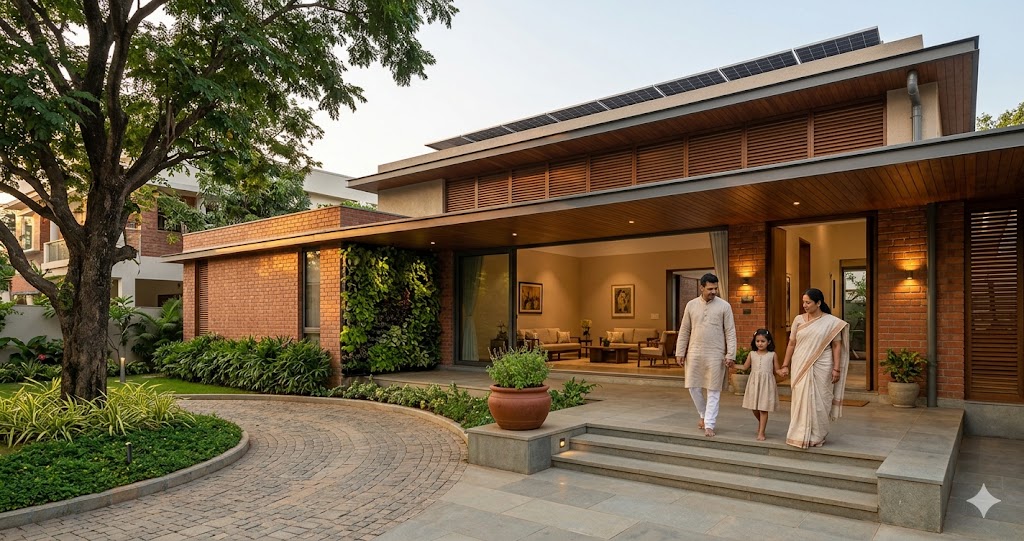
AI Home Design — Whole-Home Integrated AI for Indian Homes (2026)
Architecture + interiors + smart-home + landscape · Integrated AI brief · Studio Matrx + ArchitectAI
AI home design in 2026 is no longer four disconnected tools stitched together — it is one integrated brief that drives architecture, interiors, smart-home, and landscape as a single continuous flow. A 2BHK in Whitefield, a builder-floor in Gurgaon, or a 4BHK villa in Pune now starts the same way: you describe how you want to live, and an AI proposes the plan, the rooms, the lighting scenes, and the terrace garden together — not in sequence, not in silos. The orchestration problem — the seam between "I have a plan" and "I have interiors" and "I have automation" — is where 80% of Indian home projects stall.
That seam is exactly what Studio Matrx and its sibling product ArchitectAI close. Studio Matrx handles the interiors, materials, BoQ, and the smart-home overlay. ArchitectAI handles the architectural plan, elevation, code compliance, and feasibility. Together they share one brief — your lifestyle, your site, your budget, your Vastu preferences — so the room you walk into matches the wall the architect drew.
"The Indian homeowner doesn't want an AI floor planner and an AI render tool and a smart-home configurator. They want one conversation that produces a home."
If you came here looking for a narrower slice, see AI interior design for interiors-only, AI architecture India for the architect-side view, AI floor plan generator for the plan-generation deep dive, and AI room planner for single-room workflows.
This guide refreshes every 12 months. Last verified: May 2026 · Next verify: May 2027.
What AI Home Design Actually Means (and What It Doesn't)
AI home design is the use of generative and computational AI to produce a coherent, end-to-end home — from architectural plan to interior materials to smart-home layout to landscape — driven by a single integrated brief instead of four separate, hand-off-laden workflows.
The distinguishing word is integrated. There are dozens of single-domain AI tools — interior renderers, plan generators, lighting configurators, garden planners. AI home design is the orchestration layer that holds all four domains against one set of constraints (site, budget, family, Vastu, climate) and produces outputs that are internally consistent: the kitchen island the AI rendered actually fits inside the kitchen the AI drew.
This is the whole-home cornerstone. For interiors-only — material palettes, moodboards, room renders — read ai-interior-design. For the architect-side workflow — site analysis, optioneering, code compliance — read ai-architecture-india and ai-architecture-software.
Five things AI home design is NOT:
1. It is not just an AI render tool. A photoreal render of a living room is interior visualization. AI home design includes the plan that defined that living room's dimensions, the structural grid it sits on, the daylight that enters through windows the AI placed, and the smart-home circuits that power its lights.
2. It is not a replacement for an architect or interior designer on a complex project. For a 4,000 sq ft villa with cantilevers, basement parking, swimming pool, and bespoke joinery, AI home design accelerates the first 60% of decisions — but you still need a licensed architect to seal drawings and a senior designer to handle the long tail of site decisions.
3. It is not a code-compliance certifier. AI home design tools flag likely NBC 2016 and IS-code violations (setbacks, staircase widths, parking ratios, fire egress) and accelerate municipal-approval drawings, but the responsibility for the sanctioned plan still sits with the COA-registered architect who signs it.
4. It is not a one-click product. "Tell me what you want, get a home" is marketing copy. Real AI home design is iterative — 5 to 20 brief refinements, plan re-runs, material swaps, smart-home edits — over 3 to 14 days, depending on scope.
5. It is not US software with a Bengaluru sticker. A tool trained on US suburban single-family homes does not understand North-facing Vastu preferences, monsoon overhang requirements, IS 875 wind loads for coastal Chennai, or the reality that your Bangalore plot has a 1.5m setback on three sides and a sewer line on the fourth. India-native context is the difference between a usable answer and a thrown-away render.
Why AI Home Design Matters in 2026 India
Three forces converge in 2026 to make integrated AI home design newly viable in India:
1. India's home-building bottleneck has reached its peak. RERA-registered new launches in MMR, Bengaluru, and NCR hit a 10-year high in FY25-26, but the architect-to-project ratio has not kept pace. The Council of Architecture lists ~135,000 registered architects in India for a population now building 1.2 million new urban housing units per year. The math forces shorter design cycles per project — AI home design compresses the discovery-to-schematic-design phase from 4-6 weeks to 4-7 days.
2. The integrated brief is finally technically feasible. Until 2024, AI tools were narrow: one model rendered interiors, another generated floor plans, a third placed lights. In 2025-2026, multi-modal generative models (text + image + spatial) can hold an entire brief in context — site polygon, Vastu axis, family composition, budget envelope, climate zone, lifestyle persona — and produce consistent outputs across architecture, interiors, smart-home, and landscape. This is what makes "design the whole home, not one room" newly real.
3. Indian homeowners are choosing earlier and louder. Houzz India's 2025 Home Renovation Trends Survey reports 71% of Indian homeowners now research design online for 3-6 months before contacting a professional. They arrive with Pinterest boards, dimensioned ideas, and reference photos. They want a tool that ingests all of that and produces a home — not a tool that asks them to start over in a wireframe editor.
The seam Studio Matrx + ArchitectAI fills sits exactly here. Most US tools — Foyr Neo, Coohom, Planner 5D — solve one domain (interiors, or plan, or BIM). India-native architects and interior designers solve the integration manually, with WhatsApp and PDFs. The integrated AI brief replaces those WhatsApp threads with one canonical state — site, brief, plan, interiors, automation, landscape — that all domains read from and write to.
The Eight Capabilities That Matter
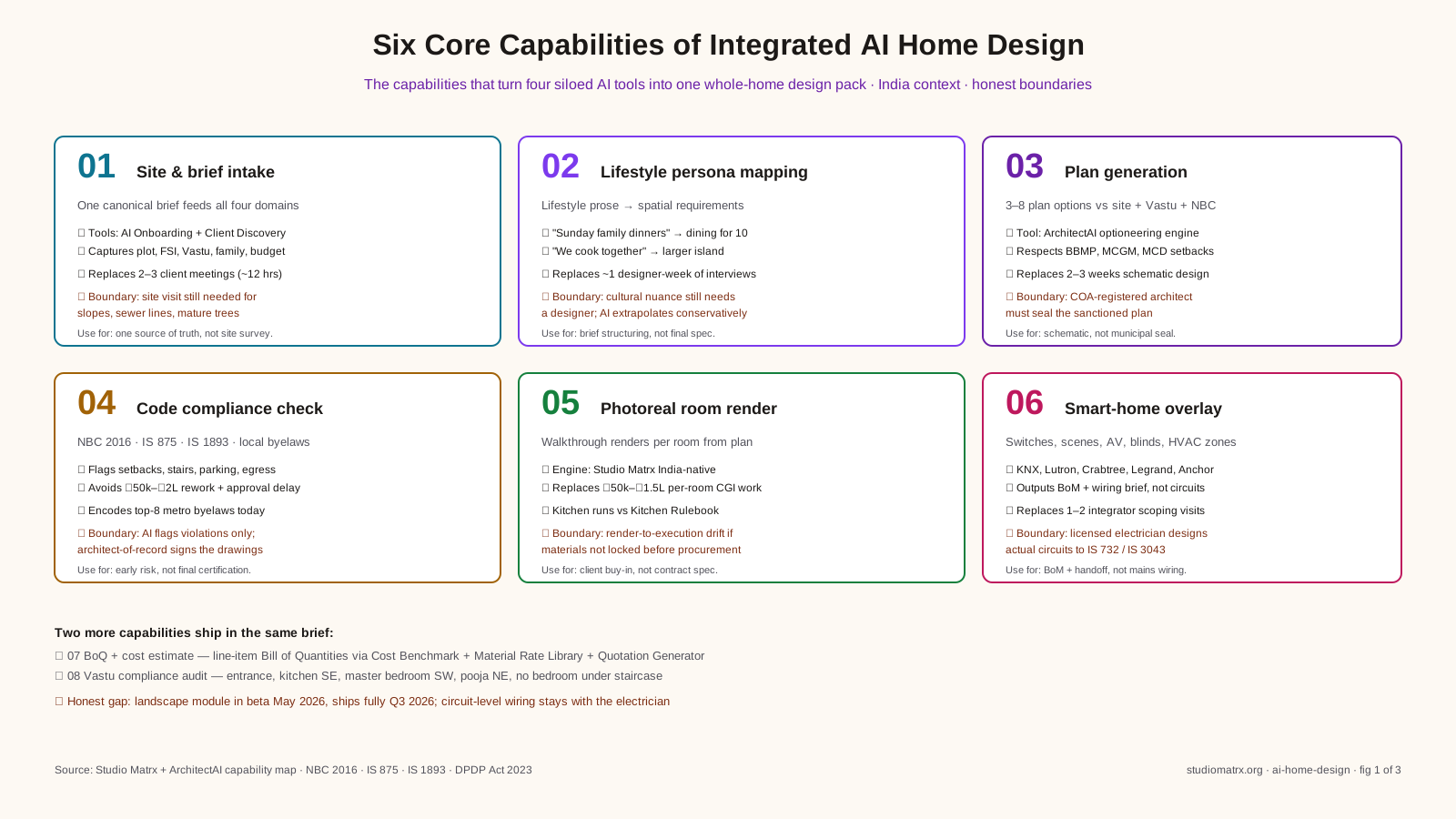
Integrated AI home design is the sum of eight capabilities. Most tools have two or three. Studio Matrx + ArchitectAI together cover all eight; honest gaps are noted.
| Capability | What it does | Time/cost saved | Studio Matrx / ArchitectAI flow |
|---|---|---|---|
| Site & brief intake | Captures plot polygon, FSI, setbacks, family composition, Vastu axis, budget | Replaces 2-3 client meetings (~12 hrs) | Client Discovery + Project Feasibility + AI onboarding |
| Lifestyle persona mapping | Turns "we like cooking together" into spatial requirements (kitchen size, island, dining adjacency) | Replaces 1 designer week of interviews | Lifestyle Persona Mapping |
| Plan generation (architecture) | Generates 3-8 plan options against site constraints + Vastu + NBC | Replaces 2-3 weeks of architect schematic design | ArchitectAI optioneering engine |
| Code compliance check | Flags setback, staircase, fire egress, parking, FSI violations | Avoids ₹50k-₹2L in rework + 2-4 weeks of approval delay | ArchitectAI compliance layer |
| Interior moodboard + materials | Generates moodboards + material palette per room from brief | Replaces 2-3 designer weeks | Moodboard Builder + Material Palette |
| Photoreal room render | Produces walk-through-quality renders for each room | Replaces ~₹50k-₹1.5L of CGI work | Studio Matrx render engine |
| Smart-home overlay | Places switches, lighting scenes, AV, automation circuits on the plan | Replaces 1-2 integrator visits + scope creep | Studio Matrx automation overlay (in beta May 2026) |
| Landscape + terrace | Generates terrace garden, courtyard, balcony planting plan | Replaces 1 landscape architect engagement on small projects | Studio Matrx landscape module (Q3 2026 roadmap — honest gap) |
| BoQ + cost estimate | Produces line-item Bill of Quantities tied to render materials | Replaces 1-2 estimator weeks | Cost Benchmark + Material Rate Library + Quotation Generator |
| Vastu compliance audit | Audits plan + interiors against Vastu axes (entrance, kitchen, bedroom, pooja) | Replaces ~1 Vastu consultant visit (₹5k-₹25k) | Vastu audit layer + Pooja Room Design India reference |
The honest count is eight production capabilities and two partial (landscape Q3 2026, full smart-home automation circuit-level wiring is integrator-handoff today, not in-product).
How Studio Matrx Does AI Home Design — End-to-End Walkthrough
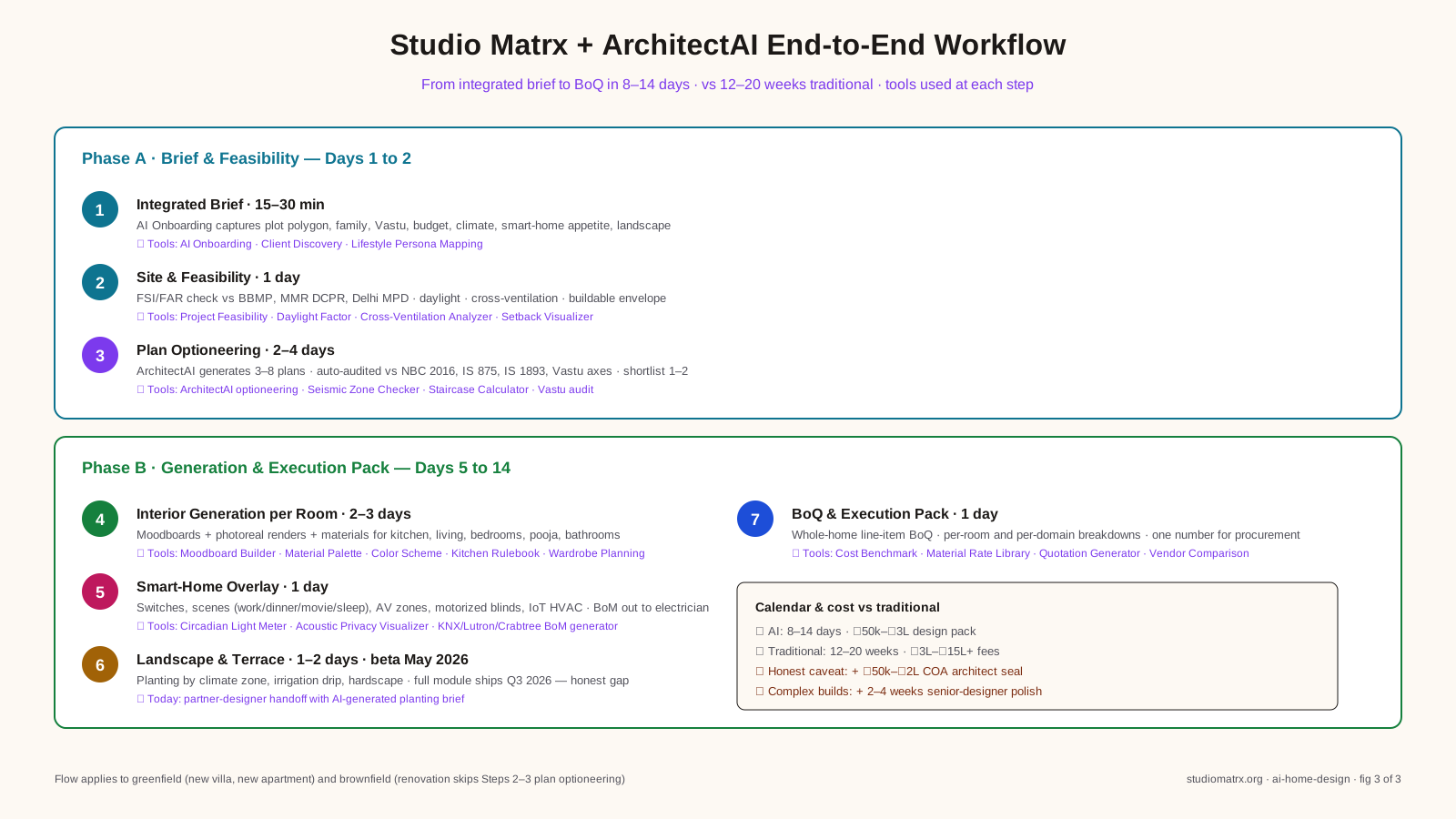
This is the actual flow a homeowner runs today (May 2026) for a whole-home project — whether greenfield (new apartment delivery, new villa build) or brownfield (existing home overhaul).
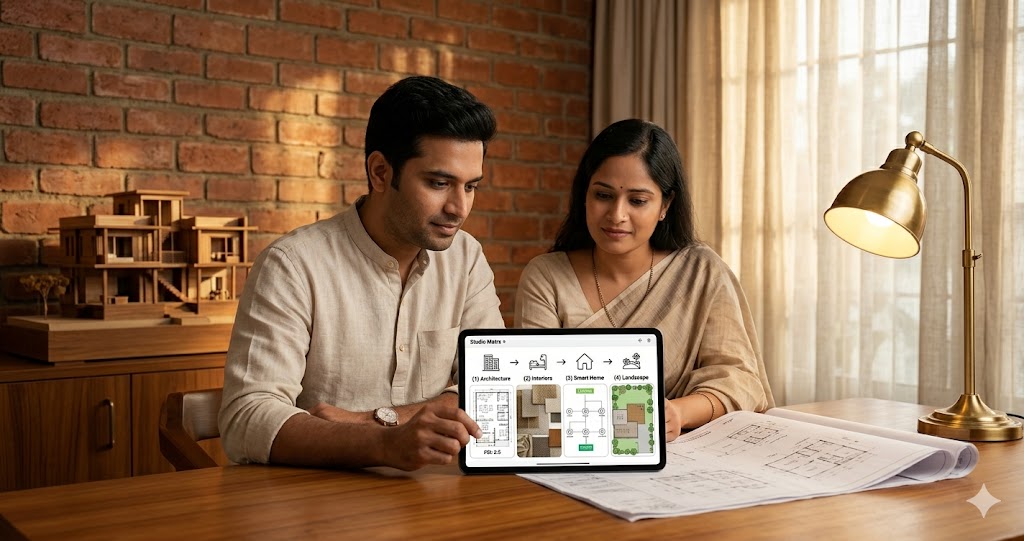
Step 1 — The Integrated Brief (15-30 minutes). You start with AI Onboarding — a conversational intake that captures everything the four domains need in one pass: plot polygon (uploaded as image or sketched), family composition, lifestyle persona, budget envelope, Vastu preferences, climate zone, smart-home appetite, landscape ambition. Crucially, the brief is canonical — every downstream domain reads from this single source, so the plan, the interiors, the automation, and the garden never drift apart.
Step 2 — Site & Feasibility (1 day). Project Feasibility ingests the plot polygon, applies local FSI/FAR rules (Bengaluru BBMP, MMR DCPR, Delhi MPD), checks setbacks, and produces a buildable envelope. For greenfield builds this is ArchitectAI's territory; for brownfield apartment overhauls the buildable envelope is the existing carcass and the focus shifts to interior demolition limits. Daylight (Daylight Factor) and ventilation (Cross-Ventilation Analyzer) get checked here, not later.
Step 3 — Plan Optioneering (2-4 days). ArchitectAI generates 3-8 plan options against the brief — different room arrangements, different staircase placements, different kitchen orientations. Each option is auto-audited against NBC 2016, IS 875 wind, IS 1893 seismic (Seismic Zone Checker), and Vastu axes. You shortlist 1-2 plans. For brownfield projects this step is shorter — the AI proposes interior re-arrangements within existing structural grids rather than new plans.
Step 4 — Interior Generation per Room (2-3 days). Now Studio Matrx takes the locked plan and runs interiors for each room — kitchen, living, master bedroom, kids' bedroom, pooja, bathrooms. Each room generation pulls from Lifestyle Persona Mapping (you cook a lot → larger island), Material Palette, Color Scheme, Furniture Planner. Outputs are moodboards + photoreal renders + material lists per room. Kitchen specifically runs against the Kitchen Rulebook for triangle, work-height, and storage rules; wardrobes through Wardrobe Planning.
Step 5 — Smart-Home Overlay (1 day). Once interiors are locked, Studio Matrx overlays the smart-home layer onto the plan — switch positions, lighting scenes per room (work / dinner / movie / sleep), AV zones, motorized blinds, IoT-aware HVAC zones. The overlay produces a wiring brief for your electrician/integrator and a Bill of Materials for switches, sensors, and hubs. Honest gap: we generate the layout and BoM, not circuit-level wiring diagrams — that handoff still goes to a licensed electrical contractor.
Step 6 — Landscape & Terrace (1-2 days, Q3 2026 module). For homes with terraces, balconies, courtyards, or front/back gardens, the landscape module proposes planting plans by climate zone, irrigation drip layouts, hardscape (deck/pergola/water feature) options, and a watering schedule. This module is in beta May 2026 and ships fully Q3 2026 — until then we hand off a brief to a partner landscape designer.
Step 7 — BoQ & Execution Pack (1 day). The whole design — plan + interiors + smart-home + landscape — converts into a line-item BoQ via Cost Benchmark, Material Rate Library, and Quotation Generator. You get one number for the whole home and per-room/per-domain breakdowns. For procurement and contractor selection, Vendor Comparison and Cost Escalation Tracker come next.
End-to-end calendar time: 8-14 days for the design pack, vs. 12-20 weeks traditional. Cost: a fraction of separate architect + interior designer + smart-home integrator + landscape designer engagements. Honest caveat: complex projects (4,000+ sq ft, structurally bespoke, bespoke joinery) still need a senior designer to take the AI output the last 20%.
AI Home Design vs Traditional Multi-Vendor Coordination
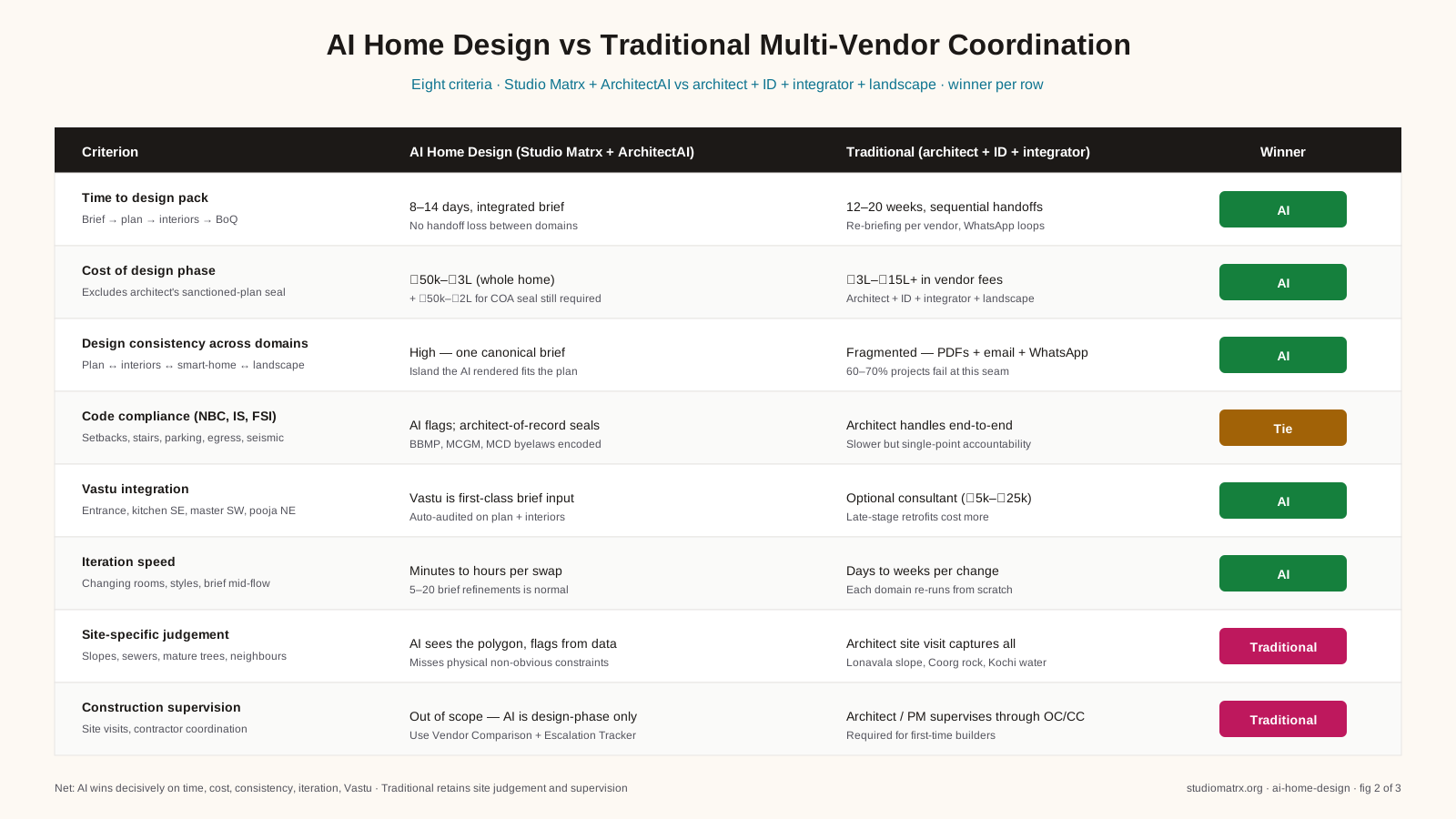
| Criterion | AI Home Design (Studio Matrx + ArchitectAI) | Traditional (architect + ID + integrator + landscape) | Winner + Caveat |
|---|---|---|---|
| Time to design pack | 8-14 days | 12-20 weeks | AI · Traditional better for hyper-bespoke |
| Cost of design phase | ₹50k-₹3L (whole home) | ₹3L-₹15L+ in fees | AI · Includes architect seal? No — still need COA architect to seal sanctioned plan |
| Design consistency across domains | High (one canonical brief) | Often fragmented (WhatsApp + email + PDFs) | AI · Senior designer can also achieve this with discipline |
| Code compliance (NBC, IS, local FSI) | AI flags; architect seals | Architect handles fully | Tie · AI accelerates, architect still required |
| Vastu integration | Built into brief | Optional consultant | AI · For Vastu-critical families AI is faster |
| Iteration speed (changing rooms / styles / brief) | Minutes to hours | Days to weeks | AI |
| Photoreal render quality | High (per-room photoreal) | Depends on CGI vendor (₹50k-₹1.5L per room) | AI on cost; CGI vendor wins on bespoke camera angles |
| Smart-home integration | AI overlay → BoM → integrator handoff | Integrator from scratch | AI · Integrator still wires |
| Landscape | In beta (Q3 2026 full) | Landscape architect engagement | Traditional today; AI parity by Q3 2026 |
| Site-specific judgement (slopes, sewer lines, neighbours) | AI flags from polygon; architect visits | Architect handles by site visit | Traditional · For sites with non-obvious constraints |
| Construction supervision | Out of scope (AI is design-phase) | Architect supervises | Traditional · Required |
| BoQ accuracy | High when material library is current | High when estimator is experienced | Tie |
| Vendor / contractor coordination | Generated comparison + scope; you execute | Architect or PM coordinates | Traditional · For first-time builders |
Net: AI home design wins decisively on time, cost, and consistency for the design phase. Traditional retains the edge on construction supervision, bespoke complexity, and sites with non-obvious physical constraints.
Tool Landscape 2026
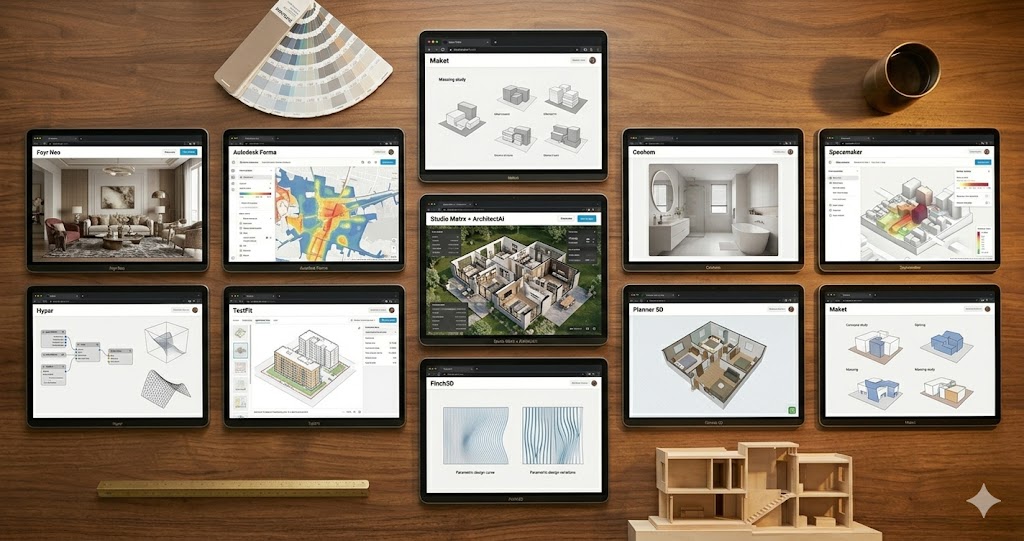
| Tool | Domain coverage | India-native | Strength | Weakness for whole-home India context |
|---|---|---|---|---|
| Studio Matrx + ArchitectAI | Architecture + interiors + smart-home + landscape (Q3) | Yes — India-native, INR pricing, Vastu, NBC, DPDP | Integrated brief across all 4 domains; only India-native whole-home AI | Landscape module in beta; smart-home stops at BoM (no circuit diagrams) |
| Foyr Neo (US) | Interiors + plan layout | No | Fast photoreal renders, easy UI | No India FSI/NBC/Vastu; no smart-home; pricing in USD |
| Autodesk Forma (US, ex-Spacemaker) | Architecture (early-stage urban / site analysis) | No | Strong site analytics, solar, wind | Architect-grade only; no interiors; enterprise pricing |
| Maket (Canada) | Plan generation + 3D | No | Fast plan generation from brief | No India codes; no interiors depth; no smart-home/landscape |
| Coohom (China/Global) | Interiors + BIM | Partial | Huge product catalog, fast renders | India catalog patchy; no architecture optioneering; no Vastu |
| Spacemaker / Forma | Site & massing | No | Best-in-class for greenfield site optioneering | Architecture only; no interiors/smart-home; enterprise |
| Hypar | Computational architecture (BIM blocks) | No | Programmable, parametric | Developer-tool; no homeowner UX |
| TestFit (US) | Feasibility + massing (multifamily) | No | Fast yield studies for developers | B2B developer tool; not for individual homes |
| Finch3D (Sweden) | Generative architecture (early design) | No | Real-time plan exploration | Architecture only; no India context |
| Planner 5D (Global) | DIY interior + simple plan | No | Consumer-friendly, low cost | Toy-grade for whole-home; no compliance; no smart-home |
| Midjourney / DALL-E (general) | Interior visualization only | No | Stunning hero images | Not buildable; no plan, no BoM, no code-compliance |
| Local Indian CAD studios (manual) | Architecture or interiors (rarely both) | Yes | Site-aware, judgement-rich | Slow (8-20 weeks), expensive, no integrated brief |
The seam. Notice that no other tool in this table covers all four domains with an integrated brief and India-native context. Foyr does interiors well, Forma does site analysis well, Maket does plan generation well — but a Bengaluru homeowner using all three has to manually keep their plan, their interiors, and their smart-home in sync. That manual reconciliation is what Studio Matrx + ArchitectAI eliminate.
Eight Risks, Pitfalls and Honest Limits
1. The "AI designed my whole home in one click" myth. AI home design is iterative — typically 5-20 brief refinements over 8-14 days. Mitigation: budget the calendar time; don't expect a one-prompt result. Use the AI as a draft accelerator, not a final word.
2. Code compliance is flagged, not certified. The AI checks NBC 2016 setbacks, staircase widths, parking ratios, fire egress — but a sanctioned municipal plan still needs a COA-registered architect's seal. Mitigation: budget ₹50k-₹2L for an architect to review and seal AI outputs before submission to BBMP / MCGM / MCD / DTCP.
3. Site reality vs polygon model. AI works from your uploaded plot polygon, but real sites have slopes, neighbour overhangs, drainage easements, mature trees, and sewer lines the polygon doesn't show. Mitigation: require a physical site visit + survey before locking the plan; treat AI plans as schematic, not final.
4. Vendor reality varies by city. Bengaluru's HRBR Layout has different fabricators, marble suppliers, and joinery vendors than Andheri East. The AI's material BoQ is national-average; local rates vary ±20%. Mitigation: use Vendor Comparison and Cost Escalation Tracker once you have your local contractor.
5. Smart-home BoM is not a wiring diagram. Studio Matrx tells you "12 KNX-compatible switches, 8 motion sensors, 2 Lutron dimmers, 4 motorized blind motors" — your electrician still designs the actual circuits to IS 732 / IS 3043. Mitigation: hand BoM + room overlay to a licensed electrical contractor; don't DIY mains wiring.
6. Landscape module is beta in May 2026. Full landscape generation (climate-zone planting, irrigation, hardscape) ships Q3 2026. Until then, the landscape output is a brief you hand to a partner. Mitigation: if landscape is your primary scope, wait for Q3 2026 or use a partner now.
7. Render-to-execution drift. A photoreal AI render shows a 60mm Italian marble slab; site reality is your contractor sources a 20mm Indian marble lookalike. Without active material specification discipline, the built home drifts from the render. Mitigation: lock material samples physically before procurement; use Material Rate Library for verified rates.
8. DPDP Act 2023 data residency. Your brief includes your address, plot polygon, family composition, lifestyle preferences, and Vastu beliefs — all "personal data" under DPDP Act 2023. Mitigation: only use platforms that disclose Indian data residency and DPDP compliance; Studio Matrx hosts on India-region infrastructure. Ask any US tool where your data lives before you upload your floor plan.
India-Specific Considerations
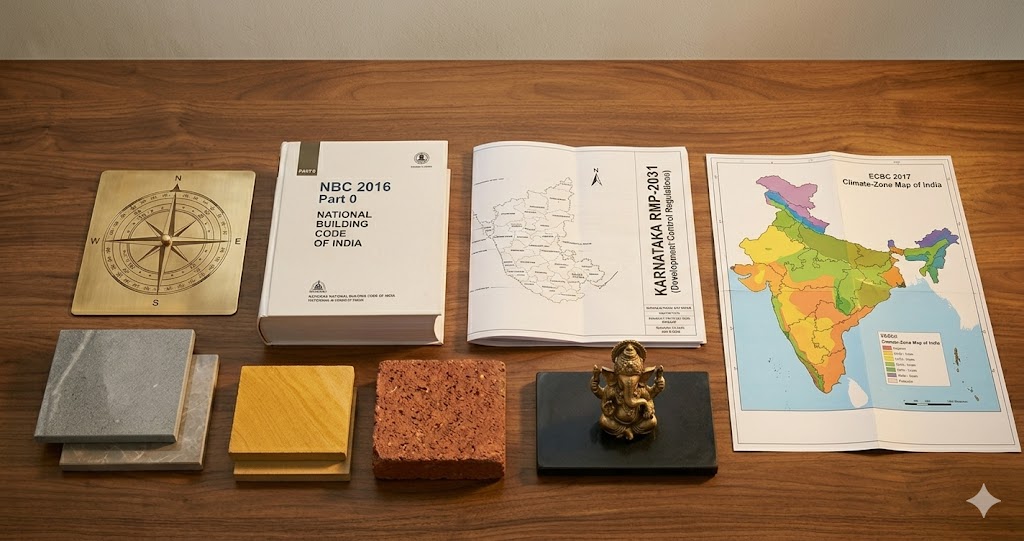
NBC 2016 + State Bye-Laws. The National Building Code 2016 is the federal baseline — fire egress, staircase widths, lift requirements above G+3, parking ratios, setbacks. But your real constraint is the state/city byelaw: BBMP Bengaluru, BMC/MCGM Mumbai, MCD/DDA Delhi, PMC Pune, DTCP Tamil Nadu. AI home design tools must apply both. Studio Matrx's feasibility layer encodes the top-8 metro byelaws; for tier-2 cities a local architect adds the last mile.
IS Codes that touch home design. IS 875 (wind loads — Chennai, Kolkata coastal homes hit 50 m/s zones), IS 1893 (seismic — Delhi NCR is Zone IV, Guwahati is Zone V — see Seismic Zone Checker), IS 456 (RCC), IS 732 (electrical wiring), IS 1172 (water demand — 135 lpcd urban), IS 875 part 3 (wind on cladding). The AI plan generator must respect these; the AI interior generator should at least be aware of seismic for tall wardrobes and TV anchorages in Zone IV/V.
DPDP Act 2023. Your home brief is personal data. Studio Matrx and ArchitectAI host on India-region infrastructure with DPDP-compliant consent flows. US tools (Foyr, Coohom, Planner 5D, Forma) typically host on US/EU regions — that's a data-transfer question you should ask before uploading. For a single-family home this is low-stakes; for a high-profile family it matters.
Vastu compatibility. Roughly 60-70% of Indian homeowners care about some Vastu compliance — entrance direction, kitchen in southeast (Agni), pooja in northeast (Ishanya), master bedroom in southwest (Nairutya), no bedroom under staircase. Studio Matrx + ArchitectAI bake Vastu axes into the brief and audit plan + interiors against them. Cross-reference: vastu-modern-homes, vastu-house-plan-india, vastu-for-kitchen, vastu-for-bedroom, entrance-vastu, north-facing-house-vastu, staircase-vastu, vastu-colors-for-home, pooja-room-design-india.
Regional vendor reality. A 60mm Carrara slab quoted in Andheri arrives at a different rate in Whitefield. AI BoQ is national-average; localize via Material Rate Library once you have a contractor. Modular kitchen vendors (Sleek, Hettich, Hafele, Wuerth) and switch vendors (Crabtree, Legrand, Schneider, Anchor) vary by city stock; check local availability before locking the BoM.
Language. Most homeowner-facing intake should accept Hindi, Tamil, Kannada, Marathi, Telugu, Bengali, Gujarati — for spoken brief, voice notes, and family member input. Studio Matrx supports Hindi voice input today (May 2026), with Tamil and Kannada in Q3 2026 rollout. English remains the canonical brief language for now.
Climate zones (IS-driven). ECBC 2017 / ENS 2021 divides India into Hot-Dry (Jaipur, Ahmedabad), Warm-Humid (Mumbai, Chennai, Kochi), Composite (Delhi, Lucknow), Temperate (Bengaluru, Pune), Cold (Shimla, Leh). The AI must propose different orientation, overhang depth, wall U-value, glazing, and ventilation strategies per zone. A Mumbai apartment needs cross-ventilation + monsoon overhangs; a Delhi villa needs heavy insulation + winter solar gain; a Bengaluru home gets the easiest climate but still needs eastern morning sun and western shade.
Sanctioned plan flow. AI generates a buildable plan; a COA-registered architect seals it; you submit to BBMP / MCGM / MCD / DTCP / PMC; OC (Occupancy Certificate) and CC (Completion Certificate) processes follow. AI home design does not bypass this regulatory flow — it accelerates the upstream design that feeds it.
The Studio Matrx Stack for AI Home Design
When you run a whole-home AI design project on Studio Matrx + ArchitectAI, you'll touch this stack — listed in approximate order of use:
- AI Onboarding — conversational intake for the integrated brief (lifestyle + site + budget + Vastu + smart-home + landscape).
- Client Discovery — for professional users; captures formal brief and design constraints.
- Lifestyle Persona Mapping — turns "we host family dinners every Sunday" into spatial requirements.
- Project Feasibility — site polygon + FSI + setbacks + buildable envelope.
- Daylight Factor — per-room daylight check at plan stage.
- Cross-Ventilation Analyzer — airflow modeling for the locked plan.
- Brise-Soleil Visualizer — sun-shading study on facades.
- Setback Visualizer — local-byelaw setback envelope for the plot.
- Seismic Zone Checker — IS 1893 zone + design implications.
- Soil Bearing Capacity — foundation pre-feasibility for greenfield.
- Staircase Calculator — IS / NBC stair sizing.
- Moodboard Builder — per-room moodboards once plan is locked.
- Material Palette — material families per room (stone, wood, metal, fabric, paint).
- Color Scheme — color stories per room consistent with brief.
- Furniture Planner — furniture placement validation against ergonomics.
- Kitchen Rulebook — kitchen-specific work-triangle, work-height, storage rules.
- Wardrobe Planning — bedroom wardrobe sizing and layout.
- Dimension Handbook — reference dimensions for all furniture and fixtures.
- Ergonomics Guide — anthropometric checks per room.
- Circadian Light Meter — smart-home lighting scenes by time of day.
- Healing View Impact Calculator — view-to-nature ratio per room.
- Acoustic Privacy Visualizer — sound separation between rooms.
- Cost Benchmark — sanity-check the BoQ against city/category benchmarks.
- Material Rate Library — verified material rates for procurement.
- Budget Allocation — distribute total budget across domains and rooms.
- Vendor Comparison — once contractors are quoting.
- Cost Escalation Tracker — for builds running >6 months.
- Quotation Generator — formal BoQ + quotation document.
When NOT to Use AI Home Design
AI home design is not the answer for every project. Honest list:
Heritage restoration. A 1920s Pol house in Ahmedabad, an 1880s bungalow in Fort Kochi, a wooden-pillar haveli in Jaisalmer — the conservation rules, the existing fabric, the cultural specificity, and the consent processes (Heritage Conservation Committee approvals) all require a heritage architect's judgement. AI is not trained for this.
Highly bespoke architectural ambition. Cantilevers, vaulted ceilings, double-height voids with structural drama, integrated water features, complex roof geometries — these are signature-architect work. AI proposes safe, conventional plans; the bespoke 5% you actually want needs a senior architect.
Sites with non-obvious physical constraints. Steep slopes (Lonavala, Coorg, Mussoorie), rock outcrops, high water tables, ancient trees you want to preserve, neighbour overhangs, drainage easements — AI works from a 2D polygon and doesn't see these. Either feed them in explicitly or visit-survey before AI input.
Projects with already-strong existing teams. If you've already engaged a senior architect + senior interior designer who work well together and are 4 weeks into design, dropping an AI layer mid-flow creates more friction than it saves. Use AI on fresh projects from day zero.
Very small interventions. One bedroom repaint + bed change is a Pinterest moodboard exercise, not a whole-home AI project. Use Moodboard Builder or AI Room Planner for single rooms.
Tight, certain, conventional brief. "Standard 2BHK builder fitout, branded modular kitchen, ₹8L budget, 30 days" — a builder's empanelled interior team will deliver faster than AI iteration. AI shines when your brief is rich and your decisions are open.
No willingness to iterate. If you want one PDF that decides everything and you'll commit to it, AI is wrong. AI assumes 5-20 brief refinements. If you want one-and-done, hire a senior designer who'll make decisions for you.
The 5-Year Trajectory: AI Home Design in 2030
By 2030, integrated AI home design is the default starting point for 80-90% of Indian urban home projects — the way Pinterest moodboards are the default starting point today.
Voice-first end-to-end. The 2030 brief is spoken across 8-12 Indian languages, captured over multiple family-member voice notes, and reconciled by AI into one canonical brief. Typing brief intake will feel like typing a search query — quaint but unusual.
Photoreal walkthrough is table-stakes. What is render-quality today becomes interactive VR walkthrough by 2028 and full mixed-reality on-site overlay (point your phone at the empty room, see the design) by 2030. Studio Matrx's VR walkthrough is on the 2026 H2 roadmap, not shipped yet — honest gap.
Live integration with vendor catalogs. By 2027-2028, AI BoQ links live to vendor inventory — the marble slab in your render is the slab in stock at HRBR Layout marble yard at this morning's rate, not a generic library entry. This collapses the render-to-execution drift that plagues 2026 projects.
Code compliance becomes near-real-time. Municipal byelaws (BBMP, MCGM, MCD) move toward machine-readable formats; AI tools auto-check sanctioned-plan-readiness; OC/CC submission becomes a one-click PDF generation rather than a 6-month consultant engagement. The architect-of-record role shifts from drafting to certifying.
Smart-home becomes plan-native. By 2030, smart-home is no longer an overlay — switches, sensors, lighting scenes, AV zones, and IoT-aware HVAC are first-class plan elements from day one of the brief. The wiring BoM ships as a buildable spec for a licensed electrician.
Landscape parity by 2027. Studio Matrx's landscape module reaches plan-level parity Q3 2026, climate-zone-specific planting and irrigation by 2027.
The integrated brief becomes a standard. By 2028-2030, "integrated brief" — one canonical state covering architecture, interiors, smart-home, landscape — is a JSON schema multiple tools speak. You start in Studio Matrx, hand the brief to a partner landscape firm, get the response back, all without reformatting. This interoperability is what makes whole-home AI design genuinely universal.
"By 2030, asking 'should I use AI for my home design?' will feel like asking in 2010 'should I use Google Maps for directions?' The integrated brief becomes the way homes get designed."
Frequently Asked Questions
Q: Can AI design my whole home from scratch?
Yes, with caveats. AI home design — specifically Studio Matrx + ArchitectAI together — can take you from blank site (or empty apartment) to architectural plan + interior design + smart-home overlay + (Q3 2026) landscape in 8-14 days. The honest caveats: you still need a COA-registered architect to seal the sanctioned plan for municipal submission; you still need a contractor to build; and the AI generates schematic-grade output that benefits from a senior designer's last-20% polish on complex projects. For a standard 2-3BHK on a regular plot, AI does take you 80% of the way end-to-end.
Q: Do I need separate tools for architecture and interiors?
Historically yes — that's why most home projects in India stall at the architect-to-interior-designer handoff. The Studio Matrx + ArchitectAI integration is built specifically to solve this: one canonical brief drives both the plan ArchitectAI generates and the interiors Studio Matrx renders, so the kitchen island you see actually fits the kitchen the plan drew. Using separate, disconnected US tools (Foyr for interiors + Maket for plans, for example) means manually reconciling four sources of truth — that manual reconciliation is what fails on 60-70% of projects.
Q: How does Studio Matrx integrate with ArchitectAI?
They share a canonical brief and a canonical plan. ArchitectAI generates the architectural plan (site analysis, optioneering, NBC/IS compliance, sanctioned-plan-ready output). Studio Matrx reads the locked plan and generates interiors (moodboards, materials, renders, BoQ), the smart-home overlay (switches, scenes, BoM), and landscape (Q3 2026). Both products read from and write to the same brief, so changes propagate — if you change family composition mid-flow, both plan and interiors update. Today this is two products on one platform; by Q4 2026 they're a single homeowner-facing experience with the architect-grade tools sitting underneath.
Q: What about smart-home and landscape — does AI cover those too?
Smart-home: yes, today. Studio Matrx overlays switch positions, lighting scenes per room (work / dinner / movie / sleep), AV zones, motorized blinds, and IoT-aware HVAC onto the locked plan, and produces a wiring brief + BoM for your electrician/integrator. We don't generate circuit-level wiring diagrams — that responsibility sits with a licensed electrical contractor per IS 732. Landscape: in beta May 2026, full Q3 2026. The beta produces a planting + irrigation brief; for full plans today, we hand off to a partner landscape designer.
Q: How long does an integrated AI home design take vs traditional?
AI home design: 8-14 days for the full design pack (brief → plan → interiors → smart-home → landscape brief → BoQ). Traditional multi-vendor coordination (architect + interior designer + smart-home integrator + landscape architect): 12-20 weeks for the same scope, plus ongoing coordination overhead between vendors. The 10x compression comes from the integrated brief — no handoff loss, no re-briefing each vendor, no reconciliation meetings between domains. Honest caveat: bespoke / complex projects still benefit from 2-4 additional weeks of senior-designer polish on top of the AI base.
Q: Can AI handle a North-facing Bengaluru plot end-to-end?
Yes — and this is exactly the case Studio Matrx is built for. The flow: upload plot polygon → declare North-facing orientation → AI applies BBMP setbacks and Bengaluru's temperate climate zone (ECBC 2017) → ArchitectAI generates 3-8 plans respecting north-facing-house-vastu guidance (entrance northeast or north, master bedroom southwest, kitchen southeast, pooja northeast) → you shortlist → Studio Matrx renders interiors per room → smart-home overlay → BoQ. The Bengaluru-specific layer: BBMP byelaws, temperate-zone orientation rules (east morning sun, west shade), local material rates (Bengaluru granite, Sadahalli sand), Kannada voice input (Q3 2026 rollout). For a typical 30x40 or 40x60 Whitefield/HSR/Koramangala plot, the end-to-end design pack lands in 10-12 days.
Q: How does AI home design handle Vastu?
Vastu is a first-class input in the integrated brief — not an afterthought. The brief asks for entrance direction, Vastu strictness level (strict / moderate / aware), and pooja-room presence. ArchitectAI generates plans against these Vastu axes (entrance, kitchen southeast, master bedroom southwest, pooja northeast, no bedroom under staircase) and Studio Matrx audits the interior layout against the same axes. For deeper Vastu integration see vastu-modern-homes, vastu-house-plan-india, vastu-for-kitchen, vastu-for-bedroom, and pooja-room-design-india.
Q: What does AI home design cost in India?
The Studio Matrx + ArchitectAI design pack (whole home — plan + interiors + smart-home + landscape brief + BoQ) lands in the ₹50,000-₹3 lakh range depending on project size and complexity, vs ₹3-15 lakh+ for traditional separate architect + interior designer + smart-home integrator + landscape designer fees on the same scope. Architect's sanctioned-plan seal (still required) typically adds ₹50k-₹2L. Contractor / execution costs are separate and depend on materials and labor — typical 2-3 BHK fitout in metro India runs ₹15-50 lakh, structural build ₹1,500-3,500 per sq ft. See Cost Benchmark.
Q: Is my data safe? What about DPDP Act 2023?
Your brief — address, plot polygon, family composition, lifestyle, Vastu beliefs — is personal data under the Digital Personal Data Protection Act 2023. Studio Matrx and ArchitectAI host on India-region infrastructure with DPDP-compliant consent flows; we don't sell or share your design brief. US tools (Foyr, Coohom, Planner 5D, Forma) typically host on US/EU regions — that's a cross-border data transfer question worth asking before uploading. For most homeowners this is low-risk; for high-profile families, India data residency matters.
Q: Can I use AI home design for a renovation, not a new build?
Yes — this is brownfield AI home design. The flow is shorter: upload existing floor plan (or have us extract one from photos), declare structural constraints (load-bearing walls, plumbing risers, electrical mains), declare scope (full gut renovation / partial / cosmetic), then run the Studio Matrx interior + smart-home + BoQ flow against the existing carcass. Brownfield projects skip ArchitectAI's plan generation but still benefit from feasibility, daylight, ventilation, and Vastu audits.
References
1. National Building Code of India 2016, Bureau of Indian Standards. https://www.bis.gov.in
2. Indian Standard IS 875 (Part 1-5): Code of Practice for Design Loads (Other than Earthquake) for Buildings and Structures, BIS.
3. Indian Standard IS 1893 (Part 1): 2016, Criteria for Earthquake Resistant Design of Structures, BIS.
4. Indian Standard IS 456: 2000, Plain and Reinforced Concrete — Code of Practice, BIS.
5. Energy Conservation Building Code (ECBC) 2017 and ENS 2021, Bureau of Energy Efficiency, Government of India. https://beeindia.gov.in
6. Digital Personal Data Protection Act, 2023, Ministry of Electronics and Information Technology, Government of India. https://www.meity.gov.in/data-protection-framework
7. Council of Architecture, India — Registered Architects Database 2025. https://www.coa.gov.in
8. Houzz India, "2025 Home Renovation Trends Survey", Houzz Research, 2025.
9. KPMG India, "Indian Real Estate — Outlook 2025-26", KPMG India Report, 2025.
10. IBEF (India Brand Equity Foundation), "Real Estate Industry Report", March 2026. https://www.ibef.org
11. Statista, "AI in Architecture and Interior Design — Market Size Forecast 2024-2030", Statista Market Insights, 2025.
12. Real Estate Regulatory Authority (RERA) state portals — Maharashtra (MahaRERA), Karnataka (K-RERA), Delhi (DDA/MPD 2041) project registrations FY25-26.
13. BBMP Bengaluru Building Bye-Laws 2003 (as amended); MCGM Mumbai Development Control & Promotion Regulations 2034; MCD/DDA Delhi Master Plan 2041; PMC Pune Development Control Regulations.
14. Autodesk Research, "Generative Design in AEC: 2025 State of Practice", Autodesk, 2025.
15. McKinsey & Company, "The Next Normal in Construction: Generative AI's Impact on Design and Engineering", 2024.
16. World Economic Forum & BCG, "Future of Construction: Reimagining the Industry through AI and Automation", 2024.
17. Vastu Shastra references: B.B. Puri, "Applied Vastu Shastra in Modern Architecture"; Sashikala Ananth, "The Penguin Guide to Vaastu".
Related Guides
- ai-interior-design — the interiors-only sibling cornerstone
- ai-powered-interiors — practitioner reference for AI in interiors
- ai-architecture-software — architect-facing AI tools landscape
- ai-architecture-india — India-context architect-side AI deep dive
- ai-room-planner — single-room AI workflows
- ai-floor-plan-generator — AI floor plan generation deep dive
Export this guide
Related Guides — Deep-dive reading
AI Architecture Software — Firm-Level Comparison for Indian Practice (2026)
ArchitectAI vs Forma vs TestFit · Pre-design · Code compliance · BIM integration
Design StylesAI Floor Plan Generator — Plot-to-Plan + Sketch-to-Plan AI for India (2026)
NBC 2016 + state DCR · Vastu-aware · 30x40 N-facing worked example · ArchitectAI plan-gen
Design StylesAI Interior Design — A 2026 Consumer Cornerstone for Indian Homes
Six capabilities · Studio Matrx walkthrough · India-native vs US tools · DPDP-safe
Design StylesRelated Tools — Try Free
Brise-Soleil Visualizer
Interactive horizontal-louvre cut-off angle calculator — sun altitude, louvre depth, and spacing inputs with a live shadow preview. Computes θ = arctan(spacing/depth) for façade shading, ECBC envelope compliance, hospital daylight design, and tropical sun-control detailing.
Sun Shading ToolCross-Ventilation Analyzer
Estimate airflow and air changes per hour (ACH) from room size, window areas, layout, and local wind — with NBC 2016 Part 8 compliance check.
Ventilation CalculatorHealing View Impact Calculator
Evidence-Based Design dashboard quantifying the recovery impact of nature view + daylight factor on analgesic use, length of stay, and HCAHPS patient-experience uplift. Calibrated against Ulrich 1984 (Science), Park & Mattson 2008, and the CHD EBD evidence base.
EBD Calculator