
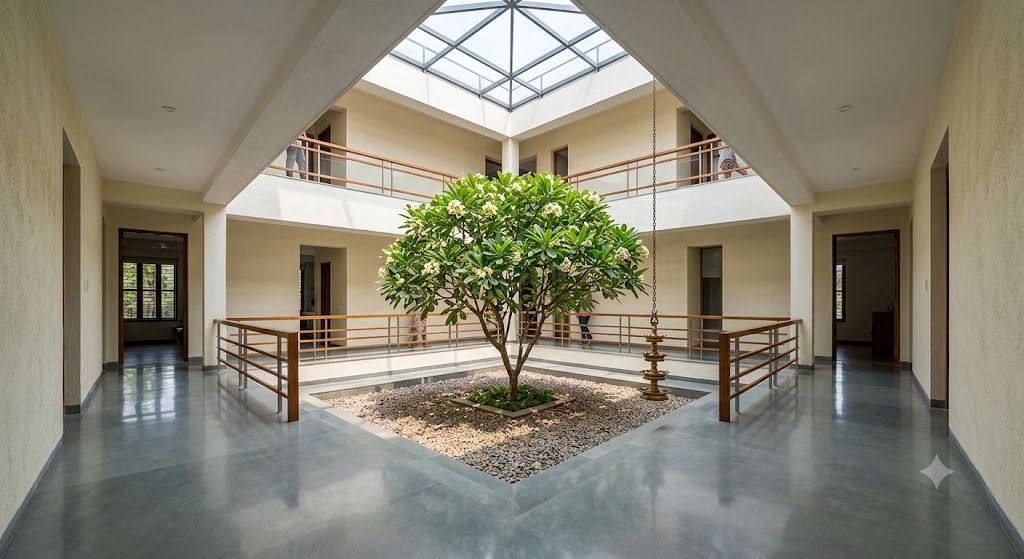
Vastu House Plan — Complete Indian Layout Reference
The 9-Zone Mandala, 20-Room Direction Matrix, Plot Rules, Four Cardinal Reference Plans & Myth-vs-Rule Field Guide
Of every Indian residential design conversation, "is the plan Vastu-compliant?" is asked more often than any other question — by buyers, family elders, brokers, and the buyer's mother-in-law. The answer matters: about 65% of Indian homebuyers filter properties by Vastu compliance, the resale premium for compliant plans runs 8 – 15%, and many orthodox families will refuse to occupy a non-compliant house even after purchase.
Yet the body of "Vastu" in popular Indian conversation is a tangled mix of three different things: authoritative scriptural rules (which are surprisingly few and well-defined), practitioner conventions (which vary by regional school), and folk myths that have accreted over generations and have no textual basis at all. A buyer paying ₹2 L for a Vastu consultation often cannot distinguish which of these three the consultant is selling them.
This guide is a deep architect-led reference to the authoritative layer — what the foundational texts (Manasara, Mayamatam, Samarangana Sutradhara) actually prescribe, expressed as a working layout discipline. It covers the nine-zone Vastu Purusha Mandala with elemental and deity associations, the 16-pada refinement used by advanced practitioners, the 20-room master direction matrix you can spec against, plot-level rules that govern site selection before design, complete reference plans for all four cardinal orientations, and a myth-vs-rule field guide separating the eight authoritative directives from the six most-common folk-Vastu myths.
Vastu is a working planning discipline, not a faith. It survived 2,000 years because the eight authoritative rules align with climate physics, structural sense, and human ergonomics — not because of mystical efficacy.
What "Vastu House Plan" Actually Means
Vastu Shastra is the 2,000-year-old Indian architectural treatise system governing the layout, orientation, and proportion of buildings — temples, palaces, towns, and houses. The residential layer (Griha Vastu) is the most-practised subset, focused on the arrangement of rooms within a dwelling to align with cosmic, climatic, and elemental principles.
A "Vastu house plan" is therefore not a single layout but a rule-set the layout satisfies. The same 3BHK programme can be drawn as an east-facing Vastu plan, a south-facing Vastu plan, or a north-facing Vastu plan — each compliant with the same underlying rules, differing only in entry direction.
The system rests on three layered concepts:
1. The Vastu Purusha Mandala — a 9-zone (or 16-zone, or 64-zone) grid representing the cosmic order, with each zone associated with a directional deity and an element
2. The Pancha Bhuta — the five elements (earth, water, fire, air, space), each ruling specific directions and dictating which rooms belong where
3. The Padas — the equal subdivisions of each face of the building (typically 9 padas per face), determining where doors and windows must be positioned
The rest is application. See Vastu Shastra for Modern Homes for the foundational philosophy guide — this article focuses on layout-specific application.
The Nine-Zone Vastu Purusha Mandala
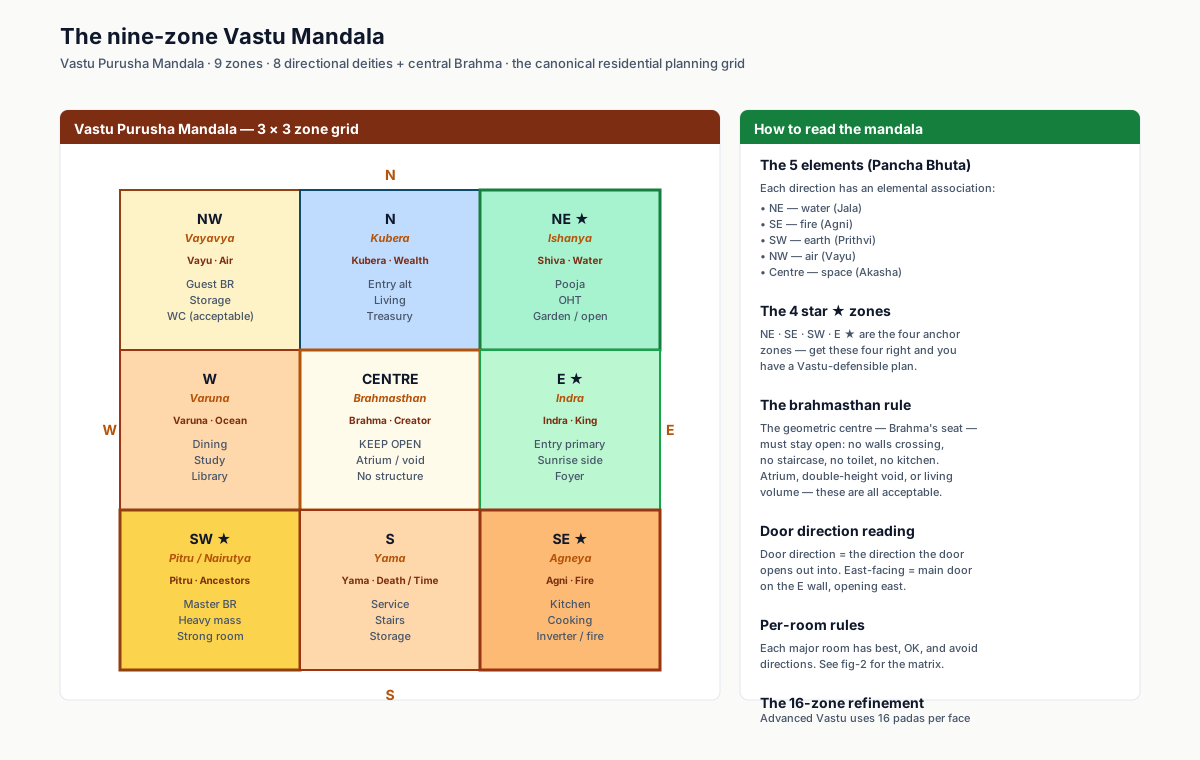
The figure above presents the canonical Vastu Purusha Mandala — a 3 × 3 grid representing the eight cardinal/intercardinal directions plus the central seat of Brahma. Memorise this grid; every layout decision in a Vastu plan derives from it.
The Nine Zones — Names, Deities, Elements
| Zone | Sanskrit Name | Deity Guardian | Element | Primary Room |
|---|---|---|---|---|
| NE ★ | Ishanya | Shiva | Water (Jala) | Pooja, OHT, garden |
| N | Kubera | Kubera (Wealth) | Water-adjacent | Entry alt, living, treasury |
| NW | Vayavya | Vayu (Wind) | Air | Guest BR, storage |
| E ★ | Indra (Purva) | Indra (King of gods) | — | Main entry (best), sunrise |
| CENTRE ★ | Brahmasthan | Brahma (Creator) | Space (Akasha) | KEEP OPEN |
| W | Varuna (Pashchima) | Varuna (Ocean) | — | Dining, study, library |
| SE ★ | Agneya | Agni (Fire) | Fire | Kitchen |
| S | Yama | Yama (Death/Time) | — | Service, stairs, storage |
| SW ★ | Pitru / Nairutya | Pitru (Ancestors) | Earth (Prithvi) | Master bedroom |
The ★ marked zones are the four primary anchor zones — get NE, SE, SW, and Centre right and the rest of the plan can flex.
The Five Elements
| Element | Sanskrit | Direction | Architectural Function |
|---|---|---|---|
| Earth | Prithvi | SW (Pitru) | Heavy mass, stability, root |
| Water | Jala | NE (Ishanya) | Source, light, flow |
| Fire | Agni | SE (Agneya) | Cooking, energy, transformation |
| Air | Vayu | NW (Vayavya) | Movement, transience, guests |
| Space | Akasha | Centre (Brahmasthan) | Void, openness, expansion |
The Brahmasthan Rule
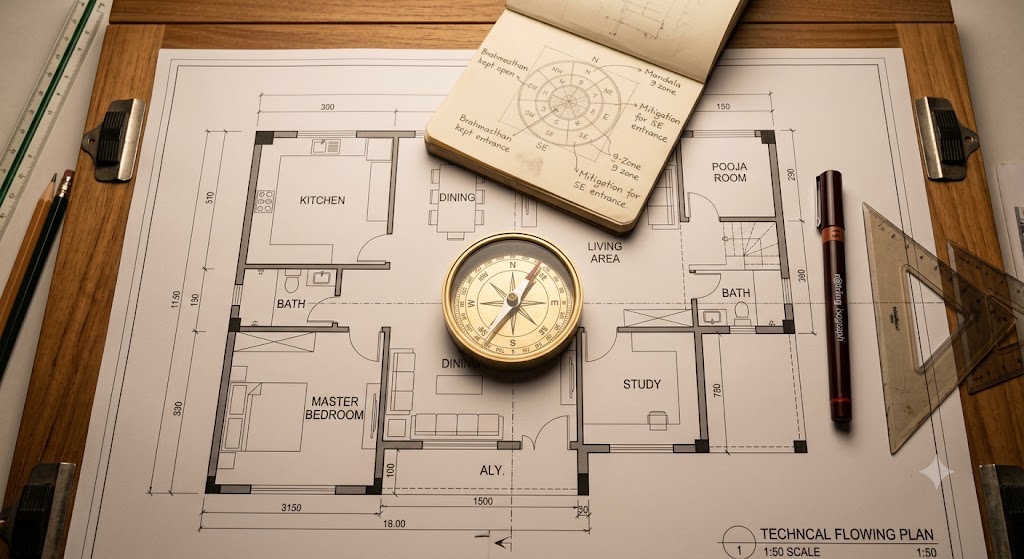
The geometric centre of the building must be kept open. No staircase crossing it, no toilet, no kitchen, no solid wall blocking it. Modern Indian planning typically satisfies this through:
- An atrium (small open well, sometimes with a courtyard plant)
- A double-height void (entrance hall extending up two floors)
- A continuous living-dining volume (the public zone occupying the centre)
- A light-well skylight (where structural geometry permits)
The brahmasthan rule is the single most-violated and most-authoritatively-binding rule in Indian residential Vastu. A house with a toilet or staircase in the geometric centre is doshic regardless of all other rules being honoured.
The 16-Pada Refinement (Advanced)
For door placement, Vastu uses a further subdivision: each face of the building is divided into 9 equal padas (sometimes 16 in advanced practice). Door placement in the 4th, 5th, or 6th pada (centre third) of any face is auspicious; corner padas (1st-3rd and 7th-9th) are doshic.
| Pada Number | Position on Face | Auspiciousness |
|---|---|---|
| 1, 2, 3 (corner band) | Near corner | Avoid |
| 4, 5, 6 (centre band) | Centre | ★ Best for door |
| 7, 8, 9 (other corner) | Near other corner | Avoid |
For an east-facing house: door in the centre third of the east wall. For a south-facing house: door in the centre third of the south wall. For a 30 ft wide face, the centre third occupies feet 10-20 from the corner — a 10-foot band where the door must sit.
The 16-pada system further subdivides for advanced consultation. Most modern Vastu practice uses 9.
The Master Room-Direction Matrix
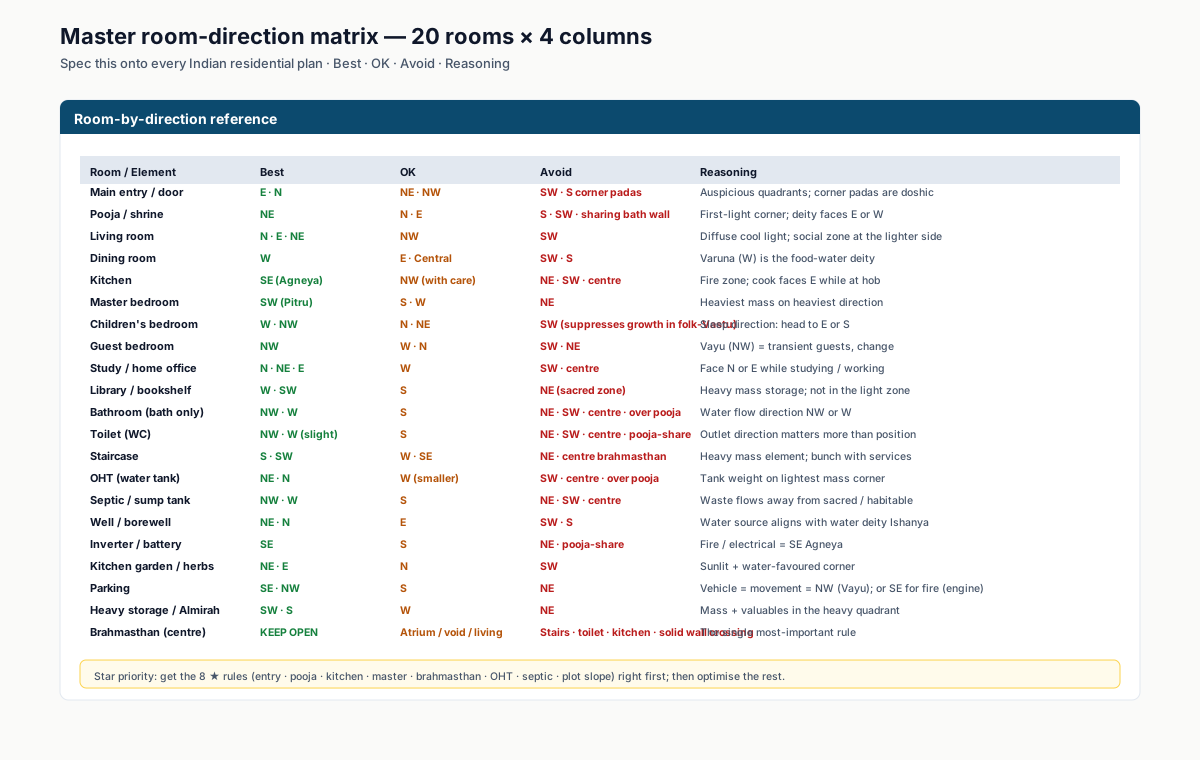
The figure above is the working reference — twenty common Indian residential rooms with their Vastu-prescribed directions. Spec this onto every plan.
Selected Room Rules — Explained
Main entry / door · Best: E, N · OK: NE, NW · Avoid: SW, corner padas of S
The entry is the most-important Vastu decision in any plan because it determines the orientation. East and north are auspicious; the door pada must be in the centre third of whichever face is chosen.
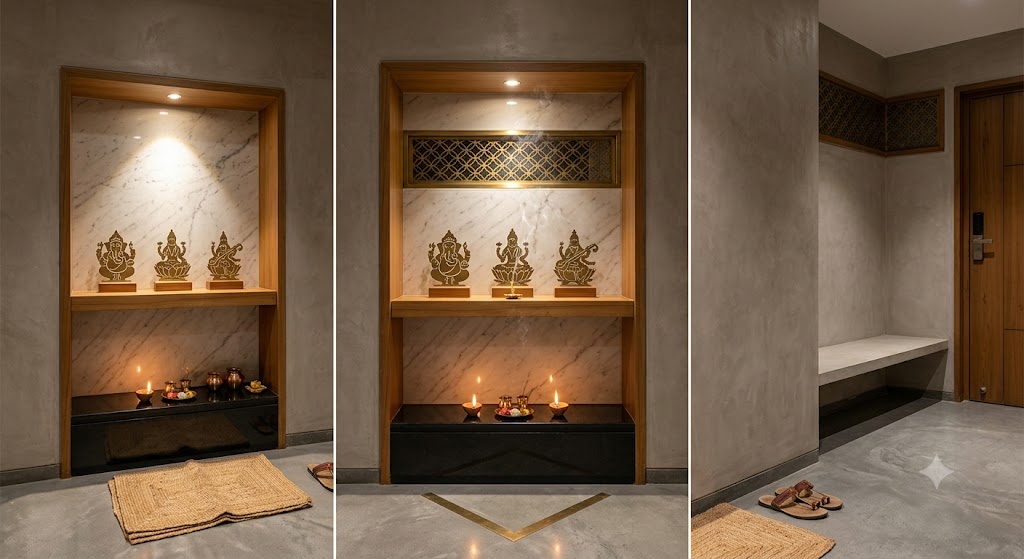
Pooja / shrine · Best: NE · OK: N, E · Avoid: S, SW, bath-wall share
The pooja sits in the Ishanya corner — first-light, water-element, sacred quadrant. Bath wall share is the single most-common pooja dosha.
Kitchen · Best: SE (Agneya) · OK: NW (with mitigation) · Avoid: NE, SW, centre
The fire element rules SE; cooking belongs there. Cook should face east while at the hob — same direction as morning ritual.
Master bedroom · Best: SW (Pitru/Nairutya) · OK: S, W · Avoid: NE
Heaviest mass on heaviest direction. The master in NE is the most-common Vastu violation in builder plans because NE is "the best corner".
Brahmasthan · KEEP OPEN
Already discussed.
Bathroom / WC · Best: NW, W · OK: S · Avoid: NE, SW, centre, over pooja
Water flow direction (the WC outlet pipe) should ultimately discharge to the NW or W; the bathroom position is secondary to the outlet direction.
Staircase · Best: S, SW · OK: W, SE · Avoid: NE, centre
Heavy mass element; bunch with services in the south band.
Overhead water tank · Best: NE, N · OK: W (small) · Avoid: SW, centre
Tank weight on lightest mass corner. SW-tank is structurally unsound and Vastu-doshic.
Septic / sump · Best: NW, W · OK: S · Avoid: NE, SW, centre
Waste flows away from sacred and habitable zones. NE-septic is the single worst-rated Vastu violation.
See East-Facing House Plan and South-Facing House Design for orientation-specific room arrangements.
Plot-Level Rules — What Vastu Evaluates Before Design
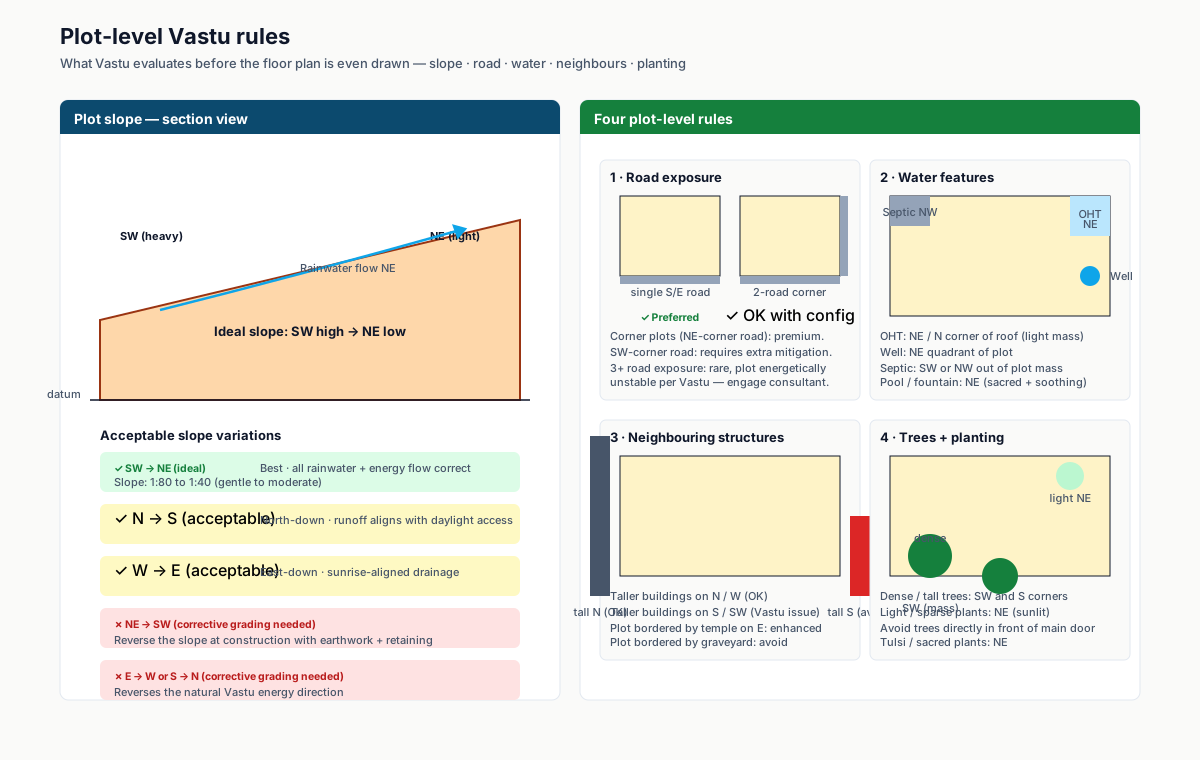
A Vastu plan starts before the building does — at the plot itself. Five plot-level rules govern site selection and grading.
Rule 1 — Plot Slope
| Slope Direction | Vastu Rating | Action |
|---|---|---|
| SW → NE | ★ Ideal | None — natural alignment |
| N → S | ✓ Acceptable | None |
| W → E | ✓ Acceptable | None |
| NE → SW | ✗ Corrective grading | Earth + retaining wall to reverse |
| E → W, S → N | ✗ Corrective grading | Earth + retaining wall to reverse |
Slope gradient should be 1:80 to 1:40 (gentle to moderate). Steeper slopes (>1:20) introduce stability and erosion concerns.
Rule 2 — Road Exposure
| Plot Configuration | Vastu Rating |
|---|---|
| Single road on S or E | ★ Preferred |
| Single road on N or W | ✓ Acceptable |
| Two-road NE-corner plot | ★★ Premium |
| Two-road SW-corner plot | ✗ Doshic — mitigation needed |
| Three or four road exposure | ✗ Energetically unstable |
NE-corner plots — two roads meeting at the NE corner of the plot — are considered the most auspicious; they often command a 12 – 20% premium over single-road plots.
Rule 3 — Water Sources
| Water Feature | Best Position |
|---|---|
| Overhead tank (OHT) | NE or N corner of roof |
| Underground sump | NE corner of plot |
| Well / borewell | NE quadrant |
| Septic tank | NW or W quadrant |
| Swimming pool / fountain | NE (sacred + soothing) |
| Stormwater outlet | NE-facing |
Rule 4 — Neighbouring Structures
- Taller buildings on N / W — acceptable; do not block southern sun
- Taller buildings on S / SW — Vastu issue; blocks the heavy-mass quadrant
- Plot bordered by temple on E — auspicious (enhances energy)
- Plot bordered by graveyard / hospital — Vastu issue, avoid
Rule 5 — Trees and Planting
| Plant Type | Position | Reason |
|---|---|---|
| Tall / dense trees | SW, S | Heavy mass alignment |
| Light foliage / herbs | NE, E | Sunlit + water-favoured |
| Sacred Tulsi | NE | First-light corner |
| Climbers | West / harsh walls | Living facade |
Avoid trees directly in front of the main door — folk-Vastu but widely-respected; trees block the doorway energy line.
Reference Plans — All Four Cardinal Orientations
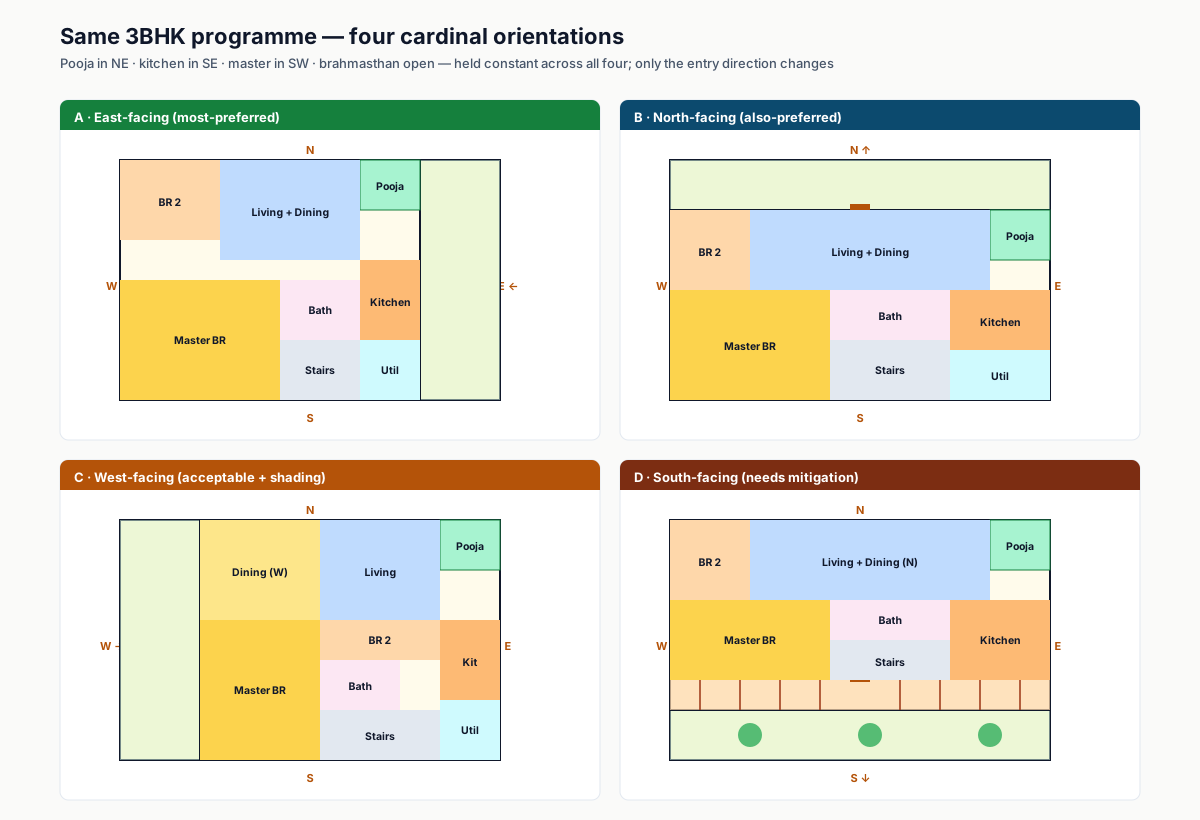
The single most-instructive Vastu drawing: the same 3BHK programme drawn for all four cardinal orientations. The eight primary rules are held constant; only the entry direction changes. This proves that Vastu compliance is achievable on any orientation — what changes is the design discipline required.
Plan A — East-Facing (Most Preferred)
Entry on E, foyer leading north into living, pooja in deep NE, kitchen in SE, master in SW. The simplest plan to draw Vastu-compliant because the entry direction matches the auspicious quadrant.
Plan B — North-Facing (Also Preferred)
Entry on N, foyer leading south, pooja in NE corner (now near the front), kitchen in SE, master in SW. Comparable to east-facing in difficulty.
Plan C — West-Facing (Acceptable with Shading)
Entry on W, foyer leading east, dining (Varuna zone) at the entry side, living and kitchen behind. The master remains in SW. Demands west-shading discipline — see Facade Design for Indian Climates.
Plan D — South-Facing (Acceptable with Mitigation)
Entry on S in the centre pada, deep verandah + louvre fins shielding the entry, pooja in deep NE (now at the rear, beautifully protected), kitchen in SE, master in SW. Demands the six mitigations covered in South-Facing House Design.
Cross-Comparison
| Plan | Entry | Front Yard | Pooja Position | Master Position | Difficulty | Cost Premium |
|---|---|---|---|---|---|---|
| A · East | E | E | NE-front | SW-rear | Easy | +8 to +15% |
| B · North | N | N | NE-front | SW-rear | Easy | +8 to +12% |
| C · West | W | W | NE-rear | SW-front | Medium | -2 to +3% |
| D · South | S (centre pada) | S | NE-rear (deep) | SW-front | Hard, with mitigation | -5 to -10% |
Myths vs Authoritative Rules — Field Guide
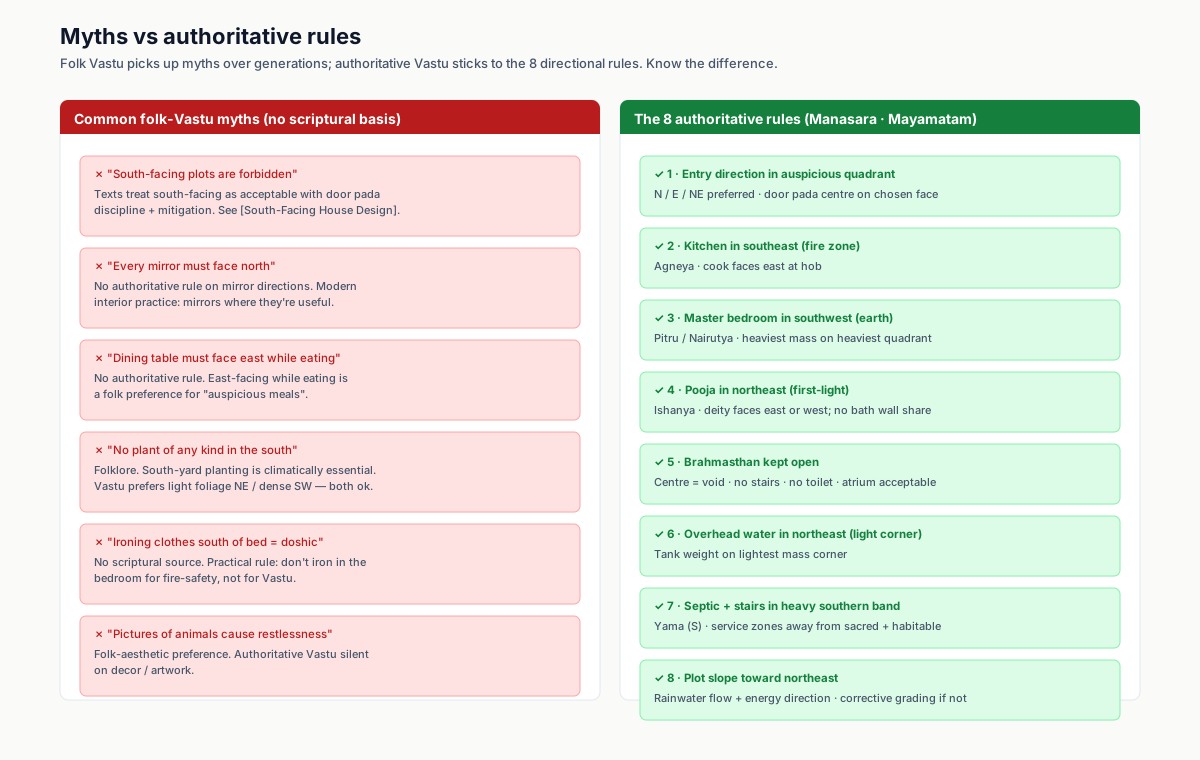
Half of what gets called "Vastu" in popular conversation is folk accretion. Honour the authoritative rules; ignore the myths. The figure above separates the two.
The Eight Authoritative Rules
These eight are sourced from the foundational texts (Manasara 11th-13th century, Mayamatam 9th-12th century, Samarangana Sutradhara 11th century). Honour these and your plan is Vastu-compliant by any orthodox standard:
1. Entry direction in an auspicious quadrant (N / E / NE preferred), with door pada centred (4th-6th of 9)
2. Kitchen in the southeast — Agneya, the fire zone
3. Master bedroom in the southwest — Pitru / Nairutya, the earth zone
4. Pooja / shrine in the northeast — Ishanya, the first-light corner
5. Brahmasthan (centre) kept open — no staircase, no toilet, no kitchen, no solid wall crossing
6. Overhead water tank in the northeast — light-mass corner
7. Septic tank and stairs in the heavy southern band — service zones away from sacred and habitable
8. Plot slope toward the northeast — rainwater + energy direction (corrective grading if natural is reversed)
Six Common Folk-Vastu Myths
The following are widely-believed but have no scriptural basis in the authoritative texts:
- ✗ "South-facing plots are forbidden" — texts say acceptable with door pada + mitigation
- ✗ "Every mirror must face north" — no rule on mirror direction
- ✗ "Dining table must face east while eating" — no authoritative rule
- ✗ "No plant of any kind in the south" — folklore; south-yard planting is climatically essential
- ✗ "Ironing clothes south of the bed = doshic" — no scriptural source
- ✗ "Pictures of animals in bedrooms cause restlessness" — folk-aesthetic, not Vastu
A buyer pressured by a consultant on any of these six can defensibly ignore them. A consultant whose practice rests heavily on these myths is worth re-evaluating.
When to Apply Vastu Strictly vs Flexibly
A practical framework for non-orthodox households:
Strict-Vastu Application
Apply when:
- Family follows orthodox Vastu practice (especially North Indian traditions)
- Spouse, parents, or in-laws will reside in the home
- House is for long-term occupation (>10 years)
- Resale is a serious consideration
- Family astrologer / Vastu consultant is involved
Strategy: all 8 authoritative rules + door pada + plot slope verified. Engage a competent consultant; budget ₹40,000 – 1.5 L for consultation.
Consultative-Vastu Application
Apply when:
- Family respects Vastu but is not strict
- Modern planning takes priority but Vastu is honoured where practical
- Some compromises acceptable if architecturally justified
Strategy: apply rules 2-7 directly (kitchen, master, pooja, brahmasthan, OHT, septic); flex on entry direction if site demands; document the choices.
Cosmetic-Vastu Application
Apply when:
- Family is non-Vastu personally but recognises resale value
- Investment property
- Rental property
Strategy: apply rules 1-4 (entry direction, kitchen SE, master SW, pooja NE) for resale-market acceptability; ignore the others.
Pre-Construction Vastu Checklist for Homeowners
- [ ] Plot orientation confirmed — based on entry direction, not road frontage
- [ ] Plot slope verified — ideally toward NE; corrective grading if not
- [ ] Plot surroundings audited — neighbour structures, road exposure, water sources
- [ ] Vastu consultant selected (if orthodox) or position taken (if flexible)
- [ ] Main entry direction selected — N / E / NE preferred; SW avoided
- [ ] Door pada placement — 4th-6th of 9 padas on the chosen face
- [ ] Pooja in NE corner — no bath / kitchen wall share
- [ ] Kitchen in SE — cook faces east at hob
- [ ] Master bedroom in SW — heaviest mass on heaviest direction
- [ ] Brahmasthan kept open — atrium / void / continuous public volume
- [ ] OHT planned for NE corner of roof
- [ ] Septic + sump in NW or W — outlet pipe to NW
- [ ] Stairs in S or SW — never in brahmasthan
- [ ] Bathroom outlets — to NW or W
- [ ] Water source (well / borewell) in NE quadrant
- [ ] Trees — light on NE, dense on SW; not in front of main door
- [ ] Vastu drawing reviewed by consultant (if engaged)
- [ ] Family elders signed off on the orientation and key room positions
- [ ] Architect and contractor briefed on Vastu non-negotiables
Cross-Links — Going Deeper
Vastu cluster
- Vastu Shastra for Modern Homes — the foundational philosophy guide
- East-Facing House Plan — orientation-specific deep dive
- South-Facing House Design — the feared orientation, decoded
- Pooja Room Design — the NE corner room
Plans and architecture
- 2BHK House Plan
- 3BHK House Design
- Indian House Front Elevation Design
- Modern House Design in India
- Functional House Layout Planning
- Space Planning Principles for Indian Homes
- Space Zoning in Indian Homes
- Compact Urban Home Planning
- Courtyard Homes in India
Climate and orientation
- Designing for the Indian Climate
- Passive Design across Indian Climate Zones
- Cross Ventilation in Indian Homes
- Natural Light Planning
- Daylighting Indian Homes
- Facade Design for Indian Climates
Process
- Complete Guide to Building a House in India
- Building Plan Approval Process
- RERA Guide for Homebuyers
- How to Choose the Right Architect
- Architect Fee Structures
References
1. Manasara (11th-13th century CE). Manasara Shilpa Shastra — Treatise on Architecture and Iconography. Tr. P.K. Acharya.
2. Mayamatam (9th-12th century CE). Treatise of Housing, Architecture and Iconography. Tr. Bruno Dagens, Indira Gandhi National Centre for the Arts.
3. Samarangana Sutradhara (11th century CE, attributed to Bhoja). Treatise on Architecture and Civil Engineering. Oriental Institute, Baroda.
4. Acharya, P.K. (1933-46). Manasara on Architecture and Sculpture — Sanskrit text and English translation, 7 volumes. Oxford University Press.
5. Kramrisch, S. (1946). The Hindu Temple, 2 volumes. University of Calcutta. (Foundational scholarship on the Vastu Purusha Mandala.)
6. Bureau of Indian Standards (1987). SP 41 — Handbook on Functional Requirements of Buildings. New Delhi: BIS.
7. Pandya, Y. (2014). The Grammar of Hindu Architecture. Mapin Publishing.
8. Patra, R. (2014). Vaastu Shastra: Towards Sustainable Development. Sustainable Development, John Wiley.
9. Council of Architecture (1989, amended). Conditions of Engagement and Architectural Practice Bylaws. New Delhi: CoA.
10. Magicbricks Research (2024-25). Vastu Premium and Resale Velocity Study — Tier-1 City Residential.
Author's note: Vastu Shastra survives 2,000 years not because of mystical efficacy but because its eight authoritative rules align with genuine climate physics (kitchen-SE matches solar warming of cooking heat, master-SW matches the building's heaviest mass on the heaviest direction, OHT-NE puts tank weight on the lightest structural corner), ergonomic sense (cook-faces-east matches morning ritual direction), and ritual continuity (NE-pooja receives first light, the household's quietest sacred hour). When stripped of the folk-myth accretion, Vastu reads as a remarkably durable architectural discipline — a thousand-year-old proto-environmental design system that anticipated passive design principles by nine centuries. The eight authoritative rules deserve to be honoured by every Indian residential plan, whether or not the family is orthodox. The folk myths deserve to be retired from the conversation. This guide is the working separation between the two.
Disclaimer: Vastu rules cited reflect mainstream scholarly consensus on the Manasara, Mayamatam, and Samarangana Sutradhara texts; regional practitioner schools (North Indian, South Indian, Bengali, Maharashtrian) may apply additional or modified rules consistent with their tradition. Real-estate premium figures are 2024-25 indicative for Tier-1 and Tier-2 Indian cities and vary by micro-market. Plot-level rules (slope, road exposure, water features) may interact with municipal byelaws — verify both before committing to design. Studio Matrx, its authors, and contributors accept no liability for decisions made on the basis of this guide; engage a licensed architect, a qualified Vastu consultant from your family's tradition (if orthodox), and a competent contractor for site-specific application.
Interactive · 8-Direction Vastu Wheel
North-East · Water + Space · Ishanya / Shiva
Ideal rooms
- Pooja Room
- Meditation
- Water Feature
Avoid
- Toilet (worst defect)
- Staircase
- Heavy structure
Recommended colours
Export this guide
Related Guides — Deep-dive reading
East-Facing House Plan — Complete Guide for India
Vastu Logic, Sun-Path, Room-Direction Matrix & Reference Plans for the Most-Asked Orientation in Indian Homes
Room PlanningPooja Room Design for Indian Homes
Vastu, Layouts, Materials, Lighting & Safety — A Complete Architect's Guide for Apartments, Villas & Compact Homes
Room PlanningNorth-Facing House Vastu — A 2026 Working Reference for Indian Homes
Kubera direction · Seven-pillar advantage · Internal layout decides the win
VastuRelated Tools — Try Free
Cross-Ventilation Analyzer
Estimate airflow and air changes per hour (ACH) from room size, window areas, layout, and local wind — with NBC 2016 Part 8 compliance check.
Ventilation CalculatorBrise-Soleil Visualizer
Interactive horizontal-louvre cut-off angle calculator — sun altitude, louvre depth, and spacing inputs with a live shadow preview. Computes θ = arctan(spacing/depth) for façade shading, ECBC envelope compliance, hospital daylight design, and tropical sun-control detailing.
Sun Shading ToolVaastu + Orientation Advisor
Vaastu room placement by direction, sorted honestly by building science — climate-sound, contingent, or convention. Pick your entrance orientation.
Orientation