
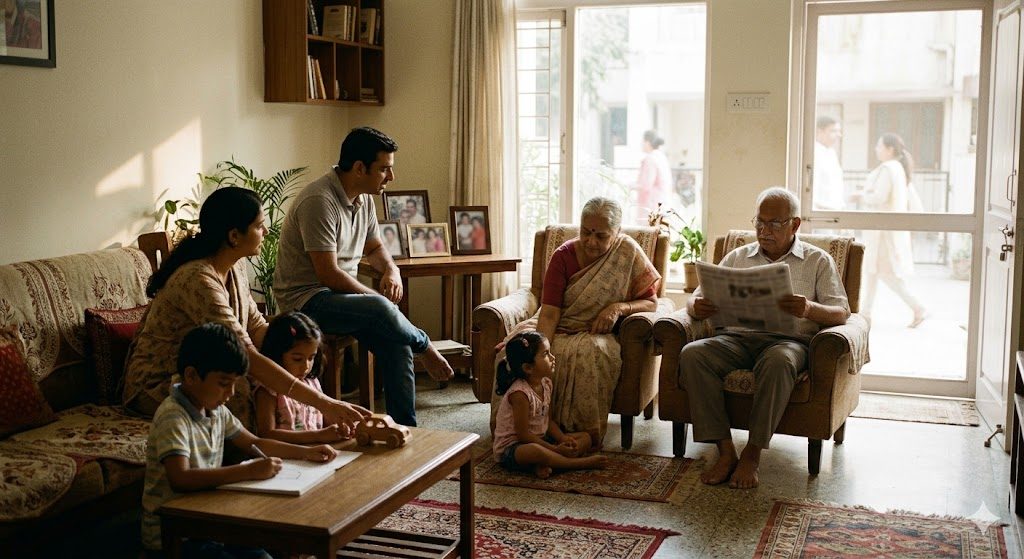
How to Plan a Home for Multi-Generational Living
Designing for grandparents, parents and children under one roof — privacy, accessibility and harmony
The Reddy family in Hyderabad built a beautiful 3,000 sq ft independent house in 2019. Three generations moved in: 74-year-old grandparents, the working couple in their forties, and two teenagers. By 2022 the grandmother had stopped using the upstairs puja room because her knees could not manage the staircase twice a day. The grandfather had fallen once in a slippery first-floor bathroom that was never meant for him. The teenagers' late-night gaming bled through a shared wall into the grandparents' bedroom. And the daughter-in-law and her mother-in-law quietly clashed every evening over one kitchen they were both expected to run. Nothing was wrong with the house as a house. Everything was wrong with it as a multi-generational home.
This guide is about designing a home that genuinely works for three generations under one roof — the most common, most demanding and most poorly served brief in Indian residential design. We will cover why standard layouts fail joint families, the privacy gradient that makes harmony possible, how to give each generation a defensible zone, the accessible ground-floor grandparents' suite, single-versus-dual kitchen strategy, the shared-versus-private bathroom math, vertical distribution by floor, provisions for live-in help, and the conflict-reducing details that decide whether everyone stays — or whether someone quietly starts looking at flats.
The single core idea: a multi-generational home is not a bigger family home — it is several semi-independent homes nested inside one, joined by shared ground and separated by privacy. Get that nesting right and the house holds the family together. Get it wrong and the house becomes the reason the family drifts apart. If you are still at the very start, read it alongside our pillar guide on how to plan your dream home before you meet an architect, which frames the lifestyle audit this brief depends on.
Why most Indian homes fail the joint family
India never stopped living together — roughly half of Indian households are still joint or extended in some form, and even nuclear families routinely fold in ageing parents. Yet the homes we build for them are designed as if a single nuclear unit will occupy them forever. The result is a predictable list of failures.
| Failure | What it looks like in real life | Root cause |
|---|---|---|
| One-size layout | Identical bedrooms for a teenager and a 78-year-old | No zoning by generation |
| No privacy zoning | Guests walk past bedroom doors to reach the sofa | Rooms placed without a public-to-private gradient |
| No senior accessibility | Grandparents' room upstairs; slippery common bath | Elders treated as an afterthought, not a brief |
| Single overloaded kitchen | Two women, two cooking styles, one stove | "We are one family, one kitchen" assumed by default |
| Bathroom math that breaks | 6 people, 2 baths, one morning rush | Bathrooms counted, not allocated |
| Noise conflict | Late-night TV bleeds into early-bedtime rooms | Generations stacked with no acoustic buffer |
| No semi-independent space | Married son's family has a bedroom, not a unit | Home designed as one household, not several |
The deepest failure is conceptual. Families brief their architect for "a 4BHK with a big hall" — a quantity of rooms — when what they need is a structure of zones. The fix is not more square footage: plenty of cramped 1,800 sq ft homes hold three generations gracefully, and plenty of 4,000 sq ft houses fail, because the failure is in the diagram, not the dimensions.
The privacy gradient: the spine of a multi-gen home
Every good multi-generational plan obeys one organising principle: rooms are sequenced along a gradient from public to semi-private to private. A guest entering the home should move through progressively more intimate territory, and should never have to cross a private threshold to reach a public room. This is the same logic Robert Gutman and the classic space-planning literature call the "intimacy gradient", and it is the single most useful idea you can carry into your brief.

Read the three bands as a rulebook:
| Zone | Who it is for | Rooms | Acoustic / access rule |
|---|---|---|---|
| Public | Anyone, including guests | Porch, formal living/drawing, pooja, guest WC | Loudest; placed at the entry; no bedroom visible |
| Semi-private | The family, shared daily | Family living, dining, common kitchen, stair/lift core | Buffer zone; circulation passes through here, not through bedrooms |
| Private | One generation only | Bedrooms, attached baths, grandparents' suite, study | Quietest; door-shut defensible; reached only after crossing the buffer |
The practical test is brutal and clarifying: walk your draft plan as a courier delivering a parcel. If the courier — or a visiting relative, or the electrician — has to pass a bedroom door to reach the living room or a washroom, the gradient is broken and the family will feel the friction every single day. Fixing it is usually free at the drawing stage and impossible after the walls are up. Our deeper treatment of this is in space-planning principles for Indian homes, and you can test arrangements quickly with the layout planner.
Give each generation a defensible zone
The phrase to hold in your head is "defensible zone" — a contiguous patch of the house that one generation can treat as theirs, close a door on, and not have walked through by everyone else. Defensibility is what converts "living together" from a strain into a choice. Three principles make a zone defensible:
- A single controllable entry. A zone with one door (or one stair landing) that its occupants control is defensible. A zone that is a thoroughfare to somewhere else never is.
- A complete set of functions nearby. A bedroom alone is not a zone. A bedroom with its own bathroom, a place to sit, and ideally a tea point becomes a semi-independent unit the occupants rarely need to leave under duress.
- Acoustic and visual closure. You should not see into a private zone from the public one, and you should not hear one generation's evening through another's wall.
The most elegant device for this is the semi-independent unit for the younger married couple or grown children: a bedroom, attached bath, a small living nook and a tea/pantry point grouped together, sometimes with its own entry. It signals "you are adults with your own household, and you are still home." Families who build this almost never lose the next generation to a separate flat, because the home already gives them the autonomy they would otherwise rent elsewhere. We explore the long arc of this in future-proofing your home for the way Indian families change.
Harmony in a joint home is not produced by forcing everyone into the same spaces — it is produced by giving everyone a place they can leave the room to.
The grandparents' suite: ground floor, near but not isolated
If you remember one specific instruction from this guide, make it this: the grandparents go on the ground floor, in a proper suite, near the household's heartbeat — not in the back room, not upstairs. Two failures sit on either side of the right answer. Putting elders upstairs is a mobility failure; their knees, balance and a future walker or wheelchair make a staircase a daily hazard and an eventual prison. Putting elders in an isolated back room is a dignity failure; they came to live with family, and tucking them out of the flow tells them, wordlessly, that they are a burden being stored.
The right placement is ground-floor, one door from the family living room — close enough that a grandchild wanders in, that the morning tea reaches them, that they hear the household's hum; private enough that they can shut the door and rest. Pair it with an attached, genuinely accessible bathroom. A shared family bathroom does not work for an 80-year-old: the queue, the distance and the slipperiness all conspire against them.
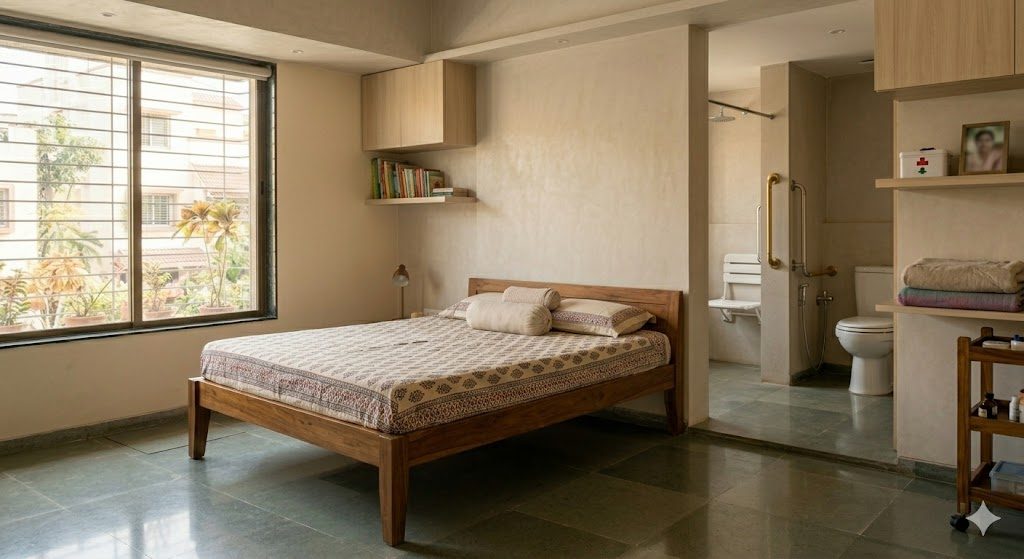

Senior-suite checklist
| Element | Specification | Why it matters |
|---|---|---|
| Location | Ground floor, one door from family living | Step-free access; near, not isolated |
| Entry | No-step / zero-threshold from corridor | Walker, wheelchair, unsteady gait |
| Door width | 900 mm clear leaf (NBC barrier-free guidance) | A wheelchair or two-person assist passes |
| Bedroom clear space | 1.5 m turning circle, bed reachable both sides | Carer access; future mobility aid |
| Attached bath | En-suite, never shared | Night-time safety; no queue, no cold corridor |
| Shower | Curb-free walk-in + fold-down seat | No stepping over a tub lip |
| Grab bars | At WC (both sides) and in shower | The single biggest fall-preventer |
| WC | Wall-hung, seat at ~480 mm | Comfortable height; easy floor cleaning |
| Flooring | Anti-slip, R11-rated, no loose mats | Bathrooms cause most elderly home falls |
| Taps | Lever / single-lever, warm-water mixer | Arthritic hands cannot twist round knobs |
| Lighting | Bright, plus a low night-light path to the bath | Night trips are the danger window |
| Call bell | Bedside and beside the WC | Summons help without shouting |
| Sockets / switches | At 600–1000 mm, reachable seated | No bending, no reaching overhead |
Even if your grandparents are sprightly today, build the suite now. Retrofitting grab bars and widening a door later costs three to five times more and arrives, usually, just after the fall that prompted it. Our companion guide on designing a home that ages well treats this provision for the whole house, not just one suite.
Vertical distribution: who lives where, and why
In an independent house or a stacked builder-floor arrangement, the floor each generation occupies is a design decision with real consequences. The default that works for most Indian families looks like this:

| Floor | Generation | Why here |
|---|---|---|
| Ground | Grandparents | Step-free; near the front door and the family's daily flow |
| First | Parents (the working couple) | The household's centre, equidistant to elders below and children above — the natural mediation floor |
| Second | Young couple / grown children | Late nights and louder lives sit furthest from elders' early bedtimes; ideal spot for a semi-independent unit |
| Terrace | Shared | Common ground for the whole family — celebrations, drying, evening air |
Two structural provisions make this distribution future-proof. First, plan the lift or stair-lift now, even if you only build a shaft and use it as a stacked storage cupboard for ten years. A 1.1 m × 1.4 m shaft costs little at construction and is nearly impossible to insert later; without it, the day a parent's knees go, the whole vertical logic collapses. Second, keep at least one full bedroom-plus-bath on the ground floor beyond the grandparents' suite, or design the suite to flex, so that the household always has a step-free room as people age. The FAR/FSI calculator helps you confirm your plot can carry the floors this distribution needs.
Kitchen strategy: one large or two?
No single decision causes more quiet domestic friction in Indian joint homes than the kitchen. Two competent cooks, two generations of method, sometimes a vegetarian-and-non-vegetarian divide, and one stove is a recipe for daily negotiation that wears people down. There are three workable strategies; choose deliberately rather than defaulting.
| Strategy | Best for | Pros | Cons |
|---|---|---|---|
| Single large kitchen | Families who genuinely cook together; tighter budgets/plots | One investment; shared groceries; togetherness | Two cooks, one space; method clashes; rush-hour collisions |
| Single kitchen + second prep pantry | Most multi-gen families | Daughter-in-law / mother-in-law autonomy; veg/non-veg separation at the pantry; modest cost | Needs ~25-40 sq ft and a second water point |
| Two full kitchens | Two semi-independent households; strict veg/non-veg homes | Full autonomy; no scheduling; respects dietary lines | Higher cost; can feel like two homes; risks drift |
For the majority, the single large kitchen plus a compact secondary pantry is the sweet spot. The main kitchen carries the family's shared cooking; the pantry — a stretch of counter, a two-burner hob, a small sink and a fridge — gives the younger couple or a second cook independence for tea, breakfast, baby food or a separate dietary stream, without the cost or the symbolic separation of two full kitchens. If your family has a firm vegetarian-and-non-vegetarian line or two genuinely separate households, build two real kitchens and accept the cost; forcing the issue into one room rarely ends well.
A note on Vastu, which matters to many Indian families: the kitchen's traditional south-east (Agneya) placement and the cook facing east carry weight here, and where a second kitchen or pantry is added, families often want it to respect the same principles — settle this at the plan stage, not after tiling. Our Vastu house-plan guide covers the kitchen, pooja and bedroom directions in depth.
Bathroom math: shared versus private
Bathrooms are where the morning falls apart. The instinct is to count bathrooms against bedrooms; the better practice is to allocate them. The rule of thumb for a smooth multi-generational morning:
| Provision | Allocation | Notes |
|---|---|---|
| Grandparents | Private attached, accessible | Non-negotiable; never shared |
| Parents (master) | Private attached | Standard expectation |
| Each semi-independent unit | Private attached | Defensibility requires it |
| Children sharing a floor | One shared bath per 2 children | Acceptable if same generation, similar schedule |
| Guests / public | One guest WC near the entry | Keeps guests out of the private zone |
| Live-in help | Separate WC + bath | Dignity and hygiene; see below |
The principle is that anyone whose schedule or vulnerability differs from the rest needs a private bathroom — elders for safety, the working couple for the morning rush, the young unit for autonomy. Children of the same generation can share without strain. A practical six-person, three-generation independent house usually lands at four to five bathrooms plus a guest WC; trying to do it on three turns every weekday morning into a queue. Use the room-measurement tool to confirm each bath can hold the fixtures and the turning space an accessible one needs.
Acoustic separation: the invisible conflict
Noise is the conflict no one briefs for and everyone feels. Elders sleep early and rise early; teenagers and young couples run on the opposite clock. Stack them carelessly and one generation's evening is the other's insomnia. A few inexpensive moves carry most of the load:
- Buffer with wet zones and wardrobes. Place bathrooms, wardrobes and the staircase between bedrooms of different generations — a wall of cupboards is a free acoustic barrier.
- Avoid back-to-back bedheads on a shared wall. A bed against a wall shared with a TV or a teenager's headboard transmits the most.
- Stagger floors so loud rooms sit over loud rooms. A living room over a living room is fine; a living room over the grandparents' bedroom is not. Mind what sits directly above the senior suite's ceiling.
- Use solid-core doors and seal the gaps. Hollow flush doors leak sound; a solid-core door with a threshold seal is a small upgrade with a large effect.
- Soften hard surfaces in shared zones. Indian homes love tile and stone, which bounce sound; rugs, upholstery and curtains in the family living calm the whole house.
Multiple living areas and the shared pooja
A single living room forces one generation's taste, volume and timing on everyone. The robust multi-gen plan has at least two living areas: a formal living/drawing room near the entry for guests and ceremony, and a family living room deeper in the home for the household's daily, informal, louder life. Where space and budget allow, a small sitting area within or beside the grandparents' zone and the young couple's unit lets each generation host on their own terms.
The pooja room is the deliberate exception — the one space designed to be shared. It is where the generations naturally converge, and placing it as a common, accessible, ground-floor-reachable space (rather than upstairs where elders cannot climb to it) is both practical and meaningful. It is the shared heart that the privacy gradient is built to protect, not divide.
Provisions for live-in help
Many multi-generational Indian homes include live-in domestic help — often the carer who makes elder-care at home possible in the first place. Designing for help honestly is both practical and a matter of dignity. Provide a small dedicated room (even 60-80 sq ft) with ventilation and natural light, a separate toilet and bathing facility, and a position with reasonable access to the kitchen and, where there is elder-care, to the grandparents' suite. Avoid the windowless under-stair cell; it is neither humane nor good for retention. A help room near the senior suite also doubles, in time, as a night-carer's room when an elder needs one.
Conflict-reducing design: the details that decide
Most joint-family friction is not about people; it is about poorly drawn space. A handful of design moves quietly prevent the conflicts families assume are inevitable:
| Conflict | Design fix |
|---|---|
| "Whose guests are these?" | Separate or clearly zoned entries; a young unit with its own door |
| Storage wars | Dedicated, lockable storage per family — not one shared store everyone raids |
| Bathroom queues | Allocate baths by schedule, not count |
| Noise resentment | Acoustic buffering and smart vertical stacking |
| Kitchen tension | Secondary pantry or a second kitchen |
| Elder isolation | Suite near the family living, not banished |
| TV / volume clashes | Two living areas; one calm, one lively |
| Money / metering disputes | Sub-metered electricity per zone in larger homes |
The thread running through all of it is the same: give each family unit enough of its own — its own entry, storage, bath, and a place to retreat — and the shared spaces stop carrying a load they were never meant to bear. Generosity with private territory is what makes shared life sustainable.
Get it right, in order
1. Audit the household as units, not people. Map who shares with whom now and in ten years — elders ageing, a child marrying, a grandchild arriving. Plan for the family you will have, not just the one at the door today.
2. Draw the privacy gradient first. Block out public, semi-private and private zones before placing a single room. Walk it as a courier; fix any bedroom on the public path.
3. Lock the grandparents' suite on the ground floor. Accessible attached bath, no-step entry, near the family living. This anchors the whole plan.
4. Assign generations to floors and put the lift/stair-lift shaft on the drawing now, even if you finish it later.
5. Decide the kitchen strategy deliberately — single, single-plus-pantry, or dual — based on cooking styles and dietary lines, not default assumptions.
6. Allocate bathrooms by schedule and vulnerability, not by counting against bedrooms. Give every differing schedule a private bath.
7. Buffer the acoustics with wet zones, wardrobes and considered vertical stacking before you finalise walls.
8. Give each unit its own entry where possible, storage, bath and retreat — then design the pooja and a family living as the deliberate shared heart.
Drafting all of this — the zoning, the floor distribution, the kitchen and bathroom allocations — by hand on graph paper is slow, and most families only realise a mistake after the architect has billed for revisions. DesignAI can turn a plain-language brief about your family — "grandparents who cannot climb stairs, a married son's family, two school-going kids, one vegetarian kitchen and one not" — into draft zoning, a candidate floor distribution and an accessible senior-suite layout you can refine before you ever sit across from an architect. It is the fastest way to arrive at that first meeting with a plan that already respects how three generations actually live.
References
- National Building Code of India (NBC) 2016, Part 3 (Development Control & General Building Requirements) and barrier-free / accessibility provisions, Bureau of Indian Standards.
- IS 4963 and the Harmonised Guidelines and Standards for Universal Accessibility in India (CPWD / Ministry of Housing & Urban Affairs) — door widths, grab bars, turning circles, anti-slip flooring.
- Francis D. K. Ching, "Architecture: Form, Space and Order" — on spatial sequence, zoning and the public-to-private gradient.
- Christopher Alexander et al., "A Pattern Language" — patterns on "Intimacy Gradient", "The Family" and "Old Age Cottage".
- Real Estate (Regulation and Development) Act (RERA), 2016 — carpet-area definitions relevant to sizing private zones in apartments.
- Council of Architecture (CoA), India — guidance on engaging a registered architect for custom residential design.
- WHO, "Global Report on Falls Prevention in Older Age" — evidence on bathroom and stair fall risk informing senior-suite design.
Continue planning across generations with our guides on future-proofing your home for Indian families, designing a home that ages well, space-planning principles for Indian homes and the Vastu house-plan guide — all part of our home-planning pillar.
Export this guide
Related Guides — Deep-dive reading
Designing Adaptable & Universal-Design Homes
Accessibility, Aging-in-Place, and the Multi-Stage Family — Code, Anthropometrics, and Plan-Stage Discipline for Indian Residential Architects
Room PlanningUniversal Design Doors for Indian Homes: Inclusive Doors That Work for Everyone (2026)
How to design and specify doors that serve children, the elderly, pregnant women, the injured and wheelchair users by default - generous width, lever handles, near-flush thresholds, low-force closing, contrast and good lighting - without your home ever looking medical.
Home Doors & EntrancesThe Accessible Home (India): Step-Free, Mobility-Friendly Design for Every Age
Practical, room-by-room accessibility that quietly works for ageing parents, recovery, pregnancy and kids alike.
Home Lifts & AccessibilityRelated Tools — Try Free
Cross-Ventilation Analyzer
Estimate airflow and air changes per hour (ACH) from room size, window areas, layout, and local wind — with NBC 2016 Part 8 compliance check.
Ventilation CalculatorVastu Window Planner
Vastu guidance for window placement and size by wall direction and room — rating and remedies.
VastuChild & Elder Home-Safety Audit
Room-by-room safety audit for households with children or seniors — 10 categories, 70+ checkpoints tagged by audience.
Safety Audit