
Designing a Naturally Energy-Efficient Indian Home
Comfort first, gadgets last — passive design, orientation, insulation, ventilation and the climate wisdom that cuts Indian energy bills
Ask most people how to make a home "green" and they reach for the wrong end of the problem. They picture solar panels on the roof, a smart thermostat, perhaps a fancy inverter AC. All useful — but all of them are gadgets bolted onto a building that may still be fighting the climate every single hour of the day. The cheapest unit of energy is the one your home never needs in the first place.
A naturally energy-efficient Indian home is one that stays comfortable on its own for as much of the year as possible, leaning on the sun, the breeze, the mass of its own walls and the shade of its own roof. Mechanical cooling becomes a top-up, not a life-support system. This is not nostalgia for old havelis; it is simply cheaper engineering. Get the building right first, and every appliance you buy afterwards is smaller, runs less and costs less to feed.
This guide walks through that order of operations for our conditions — a country that is, for most of its people and most of the year, fighting heat rather than cold. So the logic here flips the usual cold-climate advice on its head. We are not trying to trap warmth; we are trying to shed it, shade it, and breathe it out.
Start With the Building, Not the Bill
There is a tidy way to think about home energy: passive measures, then efficiency, then renewables — in that order. Passive design (orientation, shade, mass, ventilation) costs almost nothing if decided early and pays back forever. Efficient fixtures (star-rated ACs, LED lights, BLDC fans) cost a little and pay back fast. Rooftop solar pays back too, but only makes sense once demand is already small — otherwise you are paying to generate power for a home that wastes it.
A solar panel on a poorly shaded house is an expensive way to air-condition the sky.
The trap is doing this backwards. A family spends lakhs on a large solar array and a powerful AC for a west-facing glass living room with an uninsulated terrace overhead. The same comfort, in a well-oriented and shaded home, might have needed half the AC tonnage and a much smaller solar system. The order matters because each earlier step shrinks everything that follows.
| Approach | Typical add-on cost | Where it acts | Lifetime payoff |
|---|---|---|---|
| Passive design (orientation, chajja, mass, cross-ventilation) | Near zero if planned at design stage | Removes the heat load before it enters | Highest — works free for 50+ years |
| Roof and wall insulation, cool roof | ₹150–450 per sq ft of roof/wall | Cuts the biggest heat gains | Very high; payback often 2–5 years |
| Efficient fixtures (5-star AC, BLDC fans, LED) | ₹10,000–60,000 across a home | Reduces what the appliances draw | High; payback 1–4 years |
| Rooftop solar PV | ₹50,000–90,000 per kW installed | Generates the smaller remaining demand | Good once demand is already minimised |
Treat the first two rows as non-negotiable and the last two as the reward for getting them right. (All figures here are indicative ranges for 2026 conditions and vary widely by city, vendor and scheme — treat them as order-of-magnitude, not quotations.)
Orientation: The Free Half of the Job
Where the sun falls on your plot is decided once, on paper, and then locked in concrete for the building's life. Get it right and you have done half the work for free. Get it wrong and you spend the next forty summers paying for it in electricity.
For Indian latitudes the villain is the west sun — low, fierce and arriving in the late afternoon when the day's heat has already built up. West and south-west walls and windows take the worst beating. The friendly direction is north: even, glare-free, cool daylight all day with almost no direct heat. Gentle east morning light is welcome too; it warms early and fades before the day peaks.
A handful of moves follow from this:
- Buffer the west. Park the rooms that do not need to be cool against the hot west and south-west: the utility, store, staircase, toilets, a service passage. They absorb the heat so your living and sleeping spaces don't.
- Open to the north. Put your largest, most-used glazing — living room, study, the spot you sit in all day — on the north for steady daylight without the heat penalty.
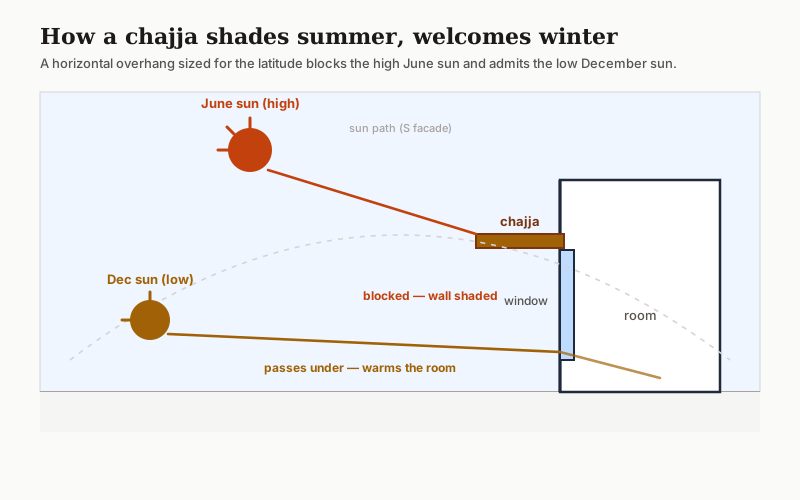
- Shade what faces the sun. Size your chajja (overhang) for the high summer sun. Because the summer sun is nearly overhead at noon, even a 600–900 mm horizontal chajja shades a south window through the hottest months while still letting in the lower, softer light of milder seasons.
- Keep west glazing small and shaded. Where a west window is unavoidable, make it modest and protect it with vertical fins, louvres, deep reveals or a jaali — vertical shading works better than a flat chajja against a low sun.
Orientation is the only design decision that costs nothing and lasts forever — so spend your thinking there first.
Know Your Climate Zone
India is not one climate. The National Building Code and the Eco Niwas Samhita work with five broad zones, and the right passive strategy genuinely changes between them. Thick walls that are brilliant in dry Jaisalmer can trap moisture and misery in humid Kochi.
| Climate zone | Representative cities | The main enemy | Lead passive strategy |
|---|---|---|---|
| Hot-dry | Jaisalmer, Jodhpur, Ahmedabad, Nagpur | Intense dry heat, big day–night swing | Heavy thermal mass, small shaded openings, courtyards, evaporative cooling, light-coloured surfaces |
| Warm-humid | Mumbai, Chennai, Kochi, Kolkata | Heat plus relentless humidity | Maximise cross-ventilation, deep shade, lightweight breathable construction, raised floors, jaali |
| Composite | Delhi, Lucknow, Bhopal, Hyderabad | Hot summer, cool winter, a wet monsoon | Blend both — mass plus operable ventilation; shade in summer, let low winter sun in |
| Temperate | Bengaluru, Pune | Mild much of the year | Modest measures; good ventilation and daylight usually suffice |
| Cold | Shimla, Leh, Gangtok | Genuine cold — the exception | Insulate to retain warmth, capture south winter sun, reduce ventilation losses |
Notice how warm-humid and hot-dry pull in opposite directions: one wants the breeze flowing through and lightweight walls, the other wants heavy walls and small openings shut against the day. Design for the zone you actually live in, not for a magazine photo from another one.
Borrow From What Already Worked
Long before air-conditioning, builders across India solved the heat with geometry and material. These ideas are not decorative throwbacks; they are working climate machines you can fold into a modern home.
The courtyard (aangan)
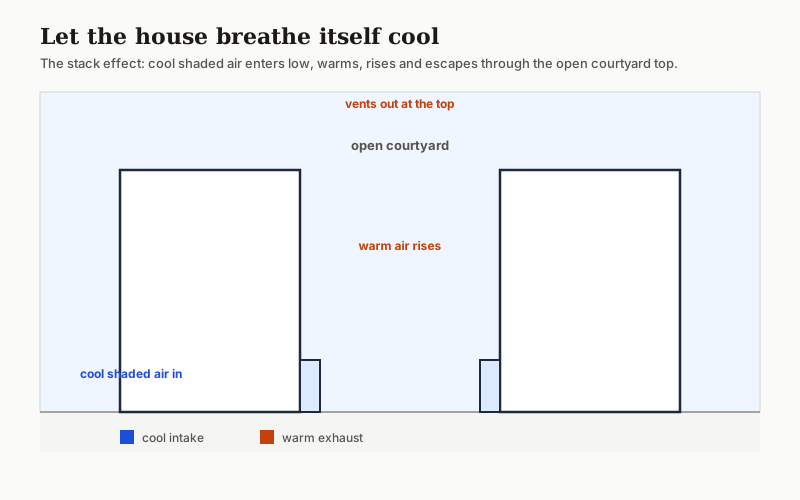
An internal courtyard is a quiet engine. Through the night it fills with cool, dense air; by day, as the surrounding surfaces warm, that air rises and escapes, drawing a gentle draught through the rooms that open onto it. It also brings daylight deep into the plan without a single window facing the harsh outside. Even a small light-court or a double-height void with a vented top behaves the same way.
Jaali, chajja, verandah, jharokha
The perforated stone or terracotta jaali is a masterstroke: it blocks direct sun, scatters glare into soft light, and speeds up the breeze that squeezes through its holes while keeping privacy intact. The verandah wraps a shaded buffer around the building so walls never bake directly. The chajja and the projecting jharokha shade the openings beneath them. Reach for these wherever you have a hot façade.
Mass, height and lime
Thick masonry, stone and lime walls store heat slowly, so the indoor temperature lags and flattens — the room stays cool through the afternoon and gives the warmth back at night. High ceilings let hot air collect well above head height. Lime plaster and terracotta breathe, manage moisture and reflect more heat than dark cement renders. In a humid zone you lighten the construction and lift the floor instead, but the instinct — work with the climate, not against it — is the same.
Seal and Shade the Envelope — Roof First
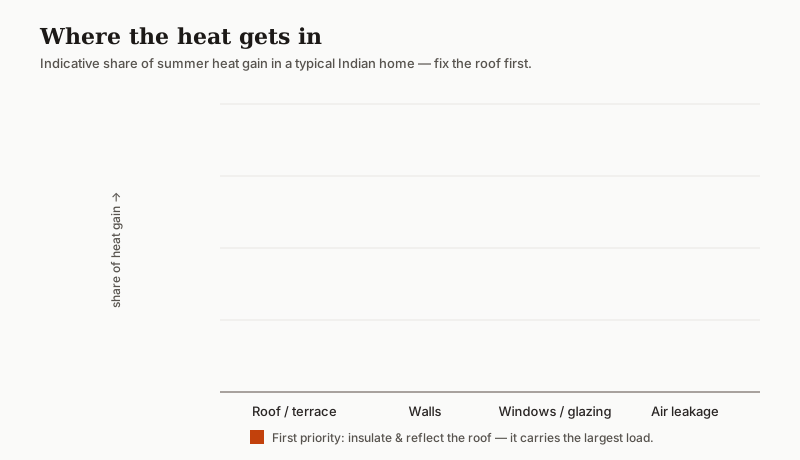
The building's outer shell decides how much heat gets in. In India the single most important surface is the one we routinely ignore: the terrace. A flat roof bakes under the vertical noon sun for hours and radiates that heat straight down into the top floor. Fix the roof before you touch anything else.
| Where heat enters | Rough share of summer heat gain | Priority | First action |
|---|---|---|---|
| Roof / terrace | 40–60% in a top-floor home | 1 — do this first | Cool roof finish + over-deck insulation |
| Walls (especially west/south-west) | 20–35% | 2 | Shade them; insulate or use AAC blocks |
| Windows and glazing | 15–25% | 3 | External shading first, then better glass |
| Air leakage / gaps | 5–15% | 4 | Seal around frames, doors, service holes |
(Shares vary with floor, orientation and construction — they show the order of attack, not precise accounting.)
The roof: cool it and insulate it
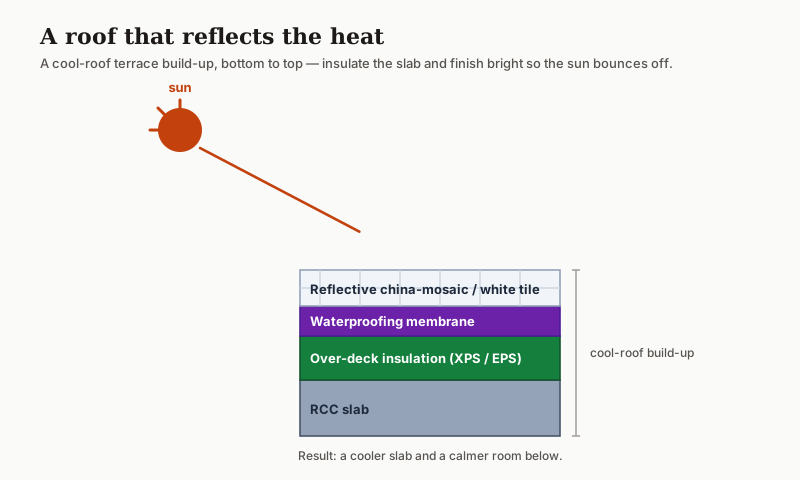
Two jobs here. First, stop the roof absorbing heat — make it reflective (a cool roof). Second, slow whatever heat does soak in from reaching the rooms below — add insulation above the slab. A reflective finish plus over-deck insulation together can drop top-floor ceiling temperatures by several degrees and noticeably cut AC running time.
| Terrace treatment | What it does | Indicative cost | Best for |
|---|---|---|---|
| China-mosaic / broken-china finish | Reflective, durable, traditional, waterproofs too | ₹120–220 per sq ft | Most flat terraces; classic Indian choice |
| White ceramic / SRI cool tiles | High reflectance, clean finish | ₹150–300 per sq ft | Homes wanting a neat modern look |
| Cool-roof reflective paint | Quick reflective coat over existing waterproofing | ₹25–60 per sq ft | Retrofits, tight budgets, rental tops |
| Over-deck XPS/EPS insulation board | Blocks conducted heat — the real insulator | ₹80–180 per sq ft | Anyone serious about a cool top floor |
| Air-gap under inverted clay tiles | Cheap radiant + convective break | ₹60–120 per sq ft | Low-cost, traditional, easily DIY-able |
| Terrace / roof garden | Shades and evaporatively cools the slab | Varies widely | Where structure and waterproofing allow |
The order to remember: a reflective finish keeps heat out, insulation stops what's left getting in, and an air gap or radiant barrier handles the radiant share. A good terrace usually combines two of these.
Walls and windows
For walls, AAC blocks (autoclaved aerated concrete) insulate far better than dense brick or solid concrete and are lighter to build with. Cavity walls with an air gap, or insulated panels, do the same job. But the cheapest wall fix is still shade — a verandah, a planted screen, a jaali or even a neighbouring wing keeping the sun off the surface.
For windows, external shading beats better glass every time, because once sun is through the glass the heat is already inside. After shading, double glazing earns its keep on AC-heavy west and south façades; elsewhere a well-shaded single pane is often plenty. Reflective or low-E coatings help on exposed glazing.
In an Indian summer, a hundred rupees of shade outside the window beats a thousand rupees of clever glass inside it.
Thermal Mass, Night Cooling and Daylight
Let the building flatten the swing
Heavy walls and floors act like a flywheel for temperature: they soak up heat slowly through the day and release it slowly through the night, so the indoors never quite reaches the afternoon peak. The trick is to keep that mass shaded during the day and then flush the house with cool night air so the mass resets before morning. In dry climates with big day–night swings this alone can keep a home comfortable for much of the year. In humid climates, where nights stay warm and sticky, lean less on mass and more on constant airflow.
Daylight without the heat penalty
You want light, not heat — and they don't have to arrive together. North-facing glazing delivers steady daylight with almost no direct sun. Pale walls, ceilings and floors bounce that light deeper into the plan so you switch the bulbs on later. Skylights and light shafts work beautifully but must be handled with care — an unshaded skylight is a heat trap; vent it, shade it, or face it north. Good daylighting cuts the lighting bill and, because lights themselves give off heat, the cooling bill too.
Let the House Breathe
Ventilation is free cooling, and India's traditional homes were built around it. The two mechanisms to design for:
- Cross-ventilation: openings on opposite sides of a room or the house so a breeze can pass straight through. Inlet and outlet roughly facing each other; a smaller inlet and larger outlet speeds the flow.
- Stack effect: hot air rises, so a high opening — a vented courtyard top, a clerestory, a stair-tower window, the old whole-house roof exhaust idea — lets warm air escape while cooler air is drawn in low. A courtyard supercharges this.
Jaali panels and wall ventilators keep air moving even when you want the windows shut for security or privacy. And ceiling fans are the unsung hero: moving air over your skin makes a room feel 3–4 °C cooler, which means you can set the AC several degrees higher — and every degree higher cuts roughly 4–6% off the AC's running cost. Fan first, AC second, and only in the rooms you're actually using.
Buy Efficient, Once Demand Is Small
Now — and only now — the appliances. With the building doing most of the work, you need less of everything, and what you buy should be efficient. The Bureau of Energy Efficiency (BEE) star rating is your shortcut: more stars, less power for the same job. Pay attention to the ISEER value on ACs, not just the star, since the scale tightens over time.
| Fixture | What to choose | Why it pays |
|---|---|---|
| Air conditioner | 5-star inverter; right-sized tonnage, not oversized | A 5-star inverter can use 25–40% less power than an old 3-star fixed-speed unit |
| Ceiling fan | BLDC motor (5-star) | Draws roughly 28–35 W vs ~75 W for a conventional fan — big saving over long hours |
| Lighting | LED, 2700–3000K warm white, CRI 80+ | A fraction of the wattage of CFL/incandescent; less waste heat |
| Refrigerator | 5-star, sized to the family | Runs continuously, so the star rating compounds all year |
| Water heating | Solar water heater; else heat-pump or well-insulated 5-star geyser | Heating water is a major load; the sun does it free much of the year |
| Pumps / motors | BEE-rated, with a timer or level controller | Avoids the silent waste of over-pumping |
Two reminders: size the AC to the cooled, shaded room rather than over-buying tonnage, and choose warm-white LEDs (2700–3000K) for living spaces — cooler 4000K+ light is fine for kitchens and work areas. Good colour rendering (CRI 80+) makes interiors look the way your designer intended.
Materials That Cost the Earth Less
How a home is built carries an energy cost too — the embodied energy locked into making and transporting its materials. Choosing well lowers that footprint and often improves comfort and indoor air at the same time.
| Material choice | Replaces / improves on | Benefit |
|---|---|---|
| Fly-ash bricks | Conventional fired clay bricks | Uses industrial waste; lower embodied energy; uniform, strong |
| AAC blocks | Solid concrete / dense brick walls | Light, insulating, faster to build, less material |
| FSC-certified, reclaimed or salvaged wood | Virgin or illegally logged timber | Responsible sourcing; reclaimed wood has near-zero new footprint |
| Bamboo | Some timber and steel uses | Rapidly renewable, strong, local in many regions |
| Recycled / high-recycled-content steel | Virgin steel | Cuts a large embodied-energy load |
| Low-VOC paints and adhesives | Conventional solvent-based products | Far better indoor air quality — fewer fumes, healthier homes |
| Brick, stone, lime | Resource-heavy alternatives | Long life, repairable, ages well, often local |
Low-VOC paints and adhesives deserve a special mention: a sealed, air-conditioned modern home traps fumes, so the difference between a low-VOC finish and a cheap solvent-based one is something your family breathes every day for years.
Then, and Only Then, Add Renewables
With demand minimised, rooftop solar PV finally makes full sense — and a leaner home needs a far smaller, cheaper array to cover its load. Net metering lets you push surplus daytime generation back to the grid and draw it down later, turning the grid into your battery. Solar water heating is often the easiest win of all, since heating water is pure thermal work the sun does happily.
Government support exists to lower the upfront cost — at the time of writing, the PM Surya Ghar Muft Bijli Yojana offers central subsidies for residential rooftop solar, administered through the Ministry of New and Renewable Energy (MNRE) and your DISCOM. Treat scheme names, subsidy amounts and eligibility as moving targets — they change with policy and budget cycles, so confirm the current terms with MNRE and your state DISCOM before you size a system.
The sequence is the whole point: every rupee spent earlier — on shade, mass, insulation, efficient fixtures — shrinks the solar system you finally need. Renewables reward a home that has already learned to need little.
The Rulebooks Worth Knowing
You don't have to design in the dark. India has codes and rating systems that codify exactly this approach:
- Eco Niwas Samhita (ENS) — BEE's energy conservation code specifically for residential buildings, setting limits on envelope heat gain and minimums for ventilation and daylight. The most directly relevant document for a home.
- Energy Conservation Building Code (ECBC) — its commercial counterpart, useful background for the principles.
- National Building Code of India 2016 (NBC) — BIS's overarching code, including guidance on climate, orientation and ventilation.
- GRIHA — India's homegrown green-building rating system.
- IGBC Green Homes — the Indian Green Building Council's residential rating, popular with developers.
You needn't chase a certificate to benefit. Reading ENS alone will sharpen every envelope decision in this guide.
References
- Bureau of Energy Efficiency (BEE), Eco Niwas Samhita (Energy Conservation Building Code for Residential Buildings), 2018 and 2021 amendment, Government of India.
- Bureau of Energy Efficiency (BEE), Energy Conservation Building Code (ECBC), Government of India.
- Bureau of Indian Standards (BIS), National Building Code of India 2016 (SP 7).
- Ministry of New and Renewable Energy (MNRE), Government of India — PM Surya Ghar Muft Bijli Yojana and rooftop solar programme guidance.
- Bureau of Energy Efficiency (BEE) — Standards and Labelling (Star Rating) programme for appliances.
- Green Rating for Integrated Habitat Assessment (GRIHA Council), GRIHA rating documentation.
- Indian Green Building Council (IGBC), IGBC Green Homes rating system.
- Bureau of Indian Standards (BIS) — relevant standards on building materials, insulation and thermal performance.
- Hirsch, William J. Jr. Designing Your Perfect House: Lessons from an Architect. Dalsimer Press. (A general inspiration for this series' approach to designing a home that is comfortable by nature.)
This guide is part of the Studio Matrx "Home Design Foundations" series. Read it alongside the other pillars — How a Home Feels Right, From Space to Place, Planning Your Home Before You Spend a Rupee, Programming Your Home and Interior Design Budgets in India — then put the ideas to work with our Design Trade-Off Helper and Scale & Proportion Calculator. When you're ready to see your own climate-responsive home take shape, start with Studio Matrx DesignAI.
Export this guide
Related Guides — Deep-dive reading
Energy-Efficient Facades in India: How the Building Skin Cuts Your Cooling, Heating & Lighting Bills
How a building facade drives cooling, heating and lighting energy in India, the three levers of solar-heat-gain control, insulation and daylighting, U-value, SHGC, VLT and WWR in plain terms, ECBC and Eco-Niwas expectations, and real Indian green buildings.
Building FacadesPassive Cooling Strategies for Indian Homes
How to keep a home cool without (much) air-conditioning — the climate-smart design that cuts bills and heat
Design EducationGreen Building Materials Guide (India): Low-Carbon, Healthy & Sustainable Choices (2026)
What actually makes a building material green - low embodied carbon and energy, recycled and renewable content, local sourcing, durability, recyclability, low VOC and water efficiency - mapped honestly across the whole Indian building, with the lifecycle nuance no label can give you.
Building MaterialsRelated Tools — Try Free
Brise-Soleil Visualizer
Interactive horizontal-louvre cut-off angle calculator — sun altitude, louvre depth, and spacing inputs with a live shadow preview. Computes θ = arctan(spacing/depth) for façade shading, ECBC envelope compliance, hospital daylight design, and tropical sun-control detailing.
Sun Shading ToolCross-Ventilation Analyzer
Estimate airflow and air changes per hour (ACH) from room size, window areas, layout, and local wind — with NBC 2016 Part 8 compliance check.
Ventilation CalculatorWindow Orientation Planner
Pick the best window type, glass and shading by wall direction — north, east, south and west.
Window Tool