
Vernacular Architecture of Ladakh: Building Warmth in a Cold Desert
How thick earthen walls, a south-facing rabsal sun-room, a layered flat roof and the heat of stabled animals turn a -30°C Trans-Himalayan desert into a warm home.
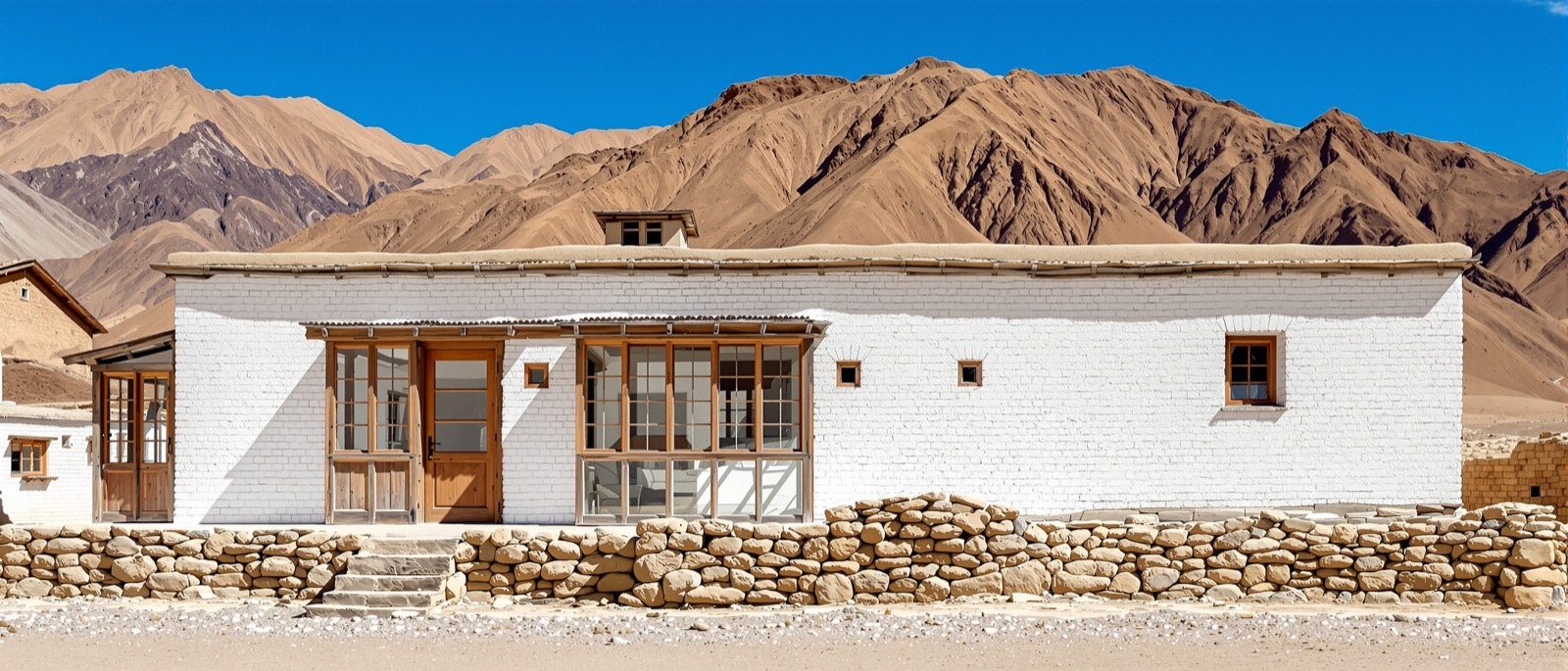
Climb the Indus valley above Leh on a January morning and the air is so thin and so cold it seems to scrape the lungs — minus twenty, perhaps minus thirty by night — yet the sun, when it clears the ridge, is fierce enough to burn your face. This is the Trans-Himalaya, a high desert where the land is brown and bare and water is locked in ice for half the year. And there, against an ochre hillside, sits a Ladakhi house: a thick-walled white-and-earth block, two storeys, flat-roofed, with one face glowing — a tall lattice of painted timber and glass turned to the south, drinking in the low winter light. Step inside that glowing room and, even with snow on the ground, it is warm.
This is the central paradox of Ladakhi vernacular architecture: in one of the coldest inhabited landscapes on Earth, with no fuel forest to burn and almost no rain to fear, people learned to build warmth out of mud, sun, and the bodies of their animals. The house is not heated so much as tuned — oriented, massed, and layered to catch every available joule of solar energy and hold it through the long night.
The vernacular house of Ladakh is a passive-solar machine built in earth — a high-mass, south-facing, sun-trapping instrument tuned to the extreme cold, intense sun, and bone-dry air of a Trans-Himalayan desert.
This guide is for the B.Arch student studying passive solar in a cold climate, the homeowner who wonders how anyone lives comfortably at four thousand metres, and the designer looking to borrow Ladakh's earth-and-sun intelligence honestly rather than as decoration. We move from the climate to the response, through the great elements — the rabsal sun-room, the layered earthen roof, the two-storey house, and the religious set of gompa, chorten, and mani wall — to materials, plan and section, the social life of the hearth, the real monasteries and settlements where it all still stands, and the modern passive-solar revival that has made Ladakh a global teacher. It sits within our broader survey of Indian vernacular architecture; read it alongside its cold-extreme and hot-extreme siblings — the vernacular architecture of North-East India and the desert vernacular of Rajasthan — to see how different climates push building in opposite directions.
In Ladakh the wall does not keep heat out, as it does in the desert below — it gathers heat in. The same mud, the same sun; only the intention is reversed.
1. The Region & Its Climate: Building in a Cold High Desert
Ladakh lies in the rain shadow of the Great Himalaya, a high plateau of the Trans-Himalaya threaded by the upper Indus. Settlements cling to river valleys and oases between roughly 3,000 and 4,500 metres above sea level, where a trickle of glacier-melt makes a thin strip of barley, apricot, poplar, and willow possible against an otherwise barren mountainscape. It is, by every measure, a desert — but a cold one.
Three climate facts dominate everything that follows. First, the cold is extreme: winter temperatures fall to around minus thirty degrees, and the season is long. Second, the solar radiation is intense: at this altitude the thin, dry, clean air filters out little of the sun, so a south-facing surface can gain serious heat even in midwinter. Third, precipitation is very low — the monsoon is spent by the time it reaches the far side of the Himalaya — so the builder need not fear rain, only cold and sun and the daily swing between them.
| Climate factor | Trans-Himalayan condition | Architectural consequence |
|---|---|---|
| Cold | Long winters to ~-30°C | Heat capture and retention; compact massing |
| Solar radiation | Intense at altitude, thin clean air | South-facing glazed sun-rooms; solar gain |
| Precipitation | Very low; little rain or snow load | Flat earthen roofs (no need for pitch) |
| Diurnal swing | Sharp day–night difference | High thermal mass to store daytime gain |
| Fuel | Almost no firewood; scarce dung | Passive solar + animal heat substitute for fires |
The desert house of Rajasthan, far to the south-west, faces the opposite problem and solves it with the same toolkit reversed: there, thick mud walls exclude a punishing heat; here, the very same mass is used to bank a scarce warmth. Mass, orientation, and a flat roof are common to both — the difference is which way the heat is meant to flow.
2. The Climate-Response Logic: How the Ladakhi House Stays Warm
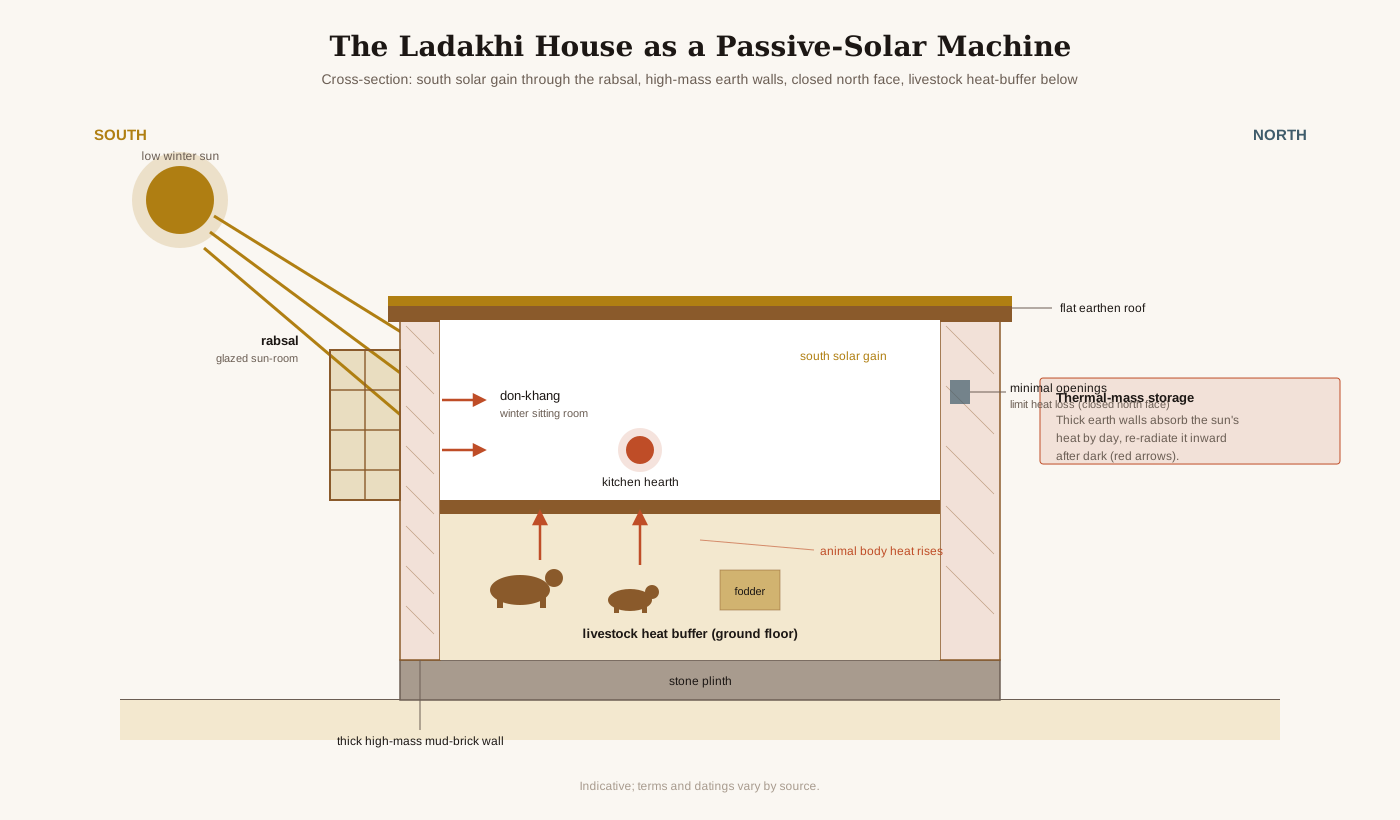
Before naming a single element, it helps to see the physics, because every feature that follows is this logic made visible. A Ladakhi house has to do four things at once: gather solar heat, store it, hold it against the cold, and find supplementary warmth where almost no fuel exists.
Solar capture, turned south. The house faces the winter sun. Living rooms, and above all the glazed sun-room, are placed on the south (and south-east) face, where the low winter sun pours in; the cold north face is kept closed, with few and tiny openings to limit heat loss.
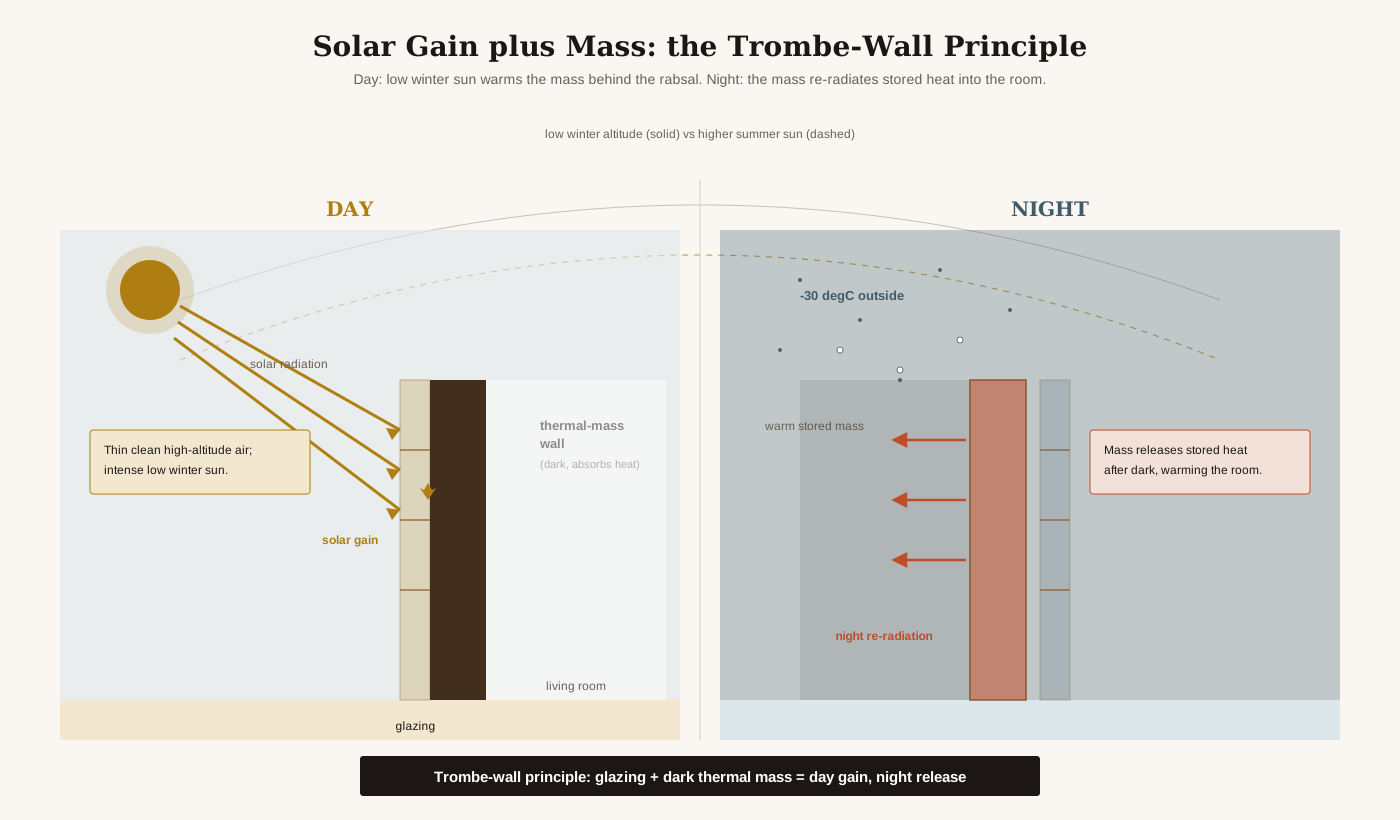
High thermal mass. Walls are massively thick — sun-dried mud brick and rammed earth on stone. By day they absorb the sun's heat; by night they release it slowly inward, smoothing the brutal day-to-night swing so the interior never plunges as the outside air does.
A compact, layered envelope. The plan is compact to minimise the surface losing heat, and the flat roof is built up in many insulating layers of timber, twig, grass, and earth — a thick blanket overhead.
Animals as a furnace. Where there is almost no firewood, the household's livestock become a heat source. Stabled on the ground floor through the winter, their body heat and the warmth of their bedding rise into the living quarters directly above — a slow, free, biological radiator.
| Strategy | Mechanism | Comfort outcome |
|---|---|---|
| South solar capture | Glazed sun-room admits low winter sun | Daytime free heating, light |
| High thermal mass | Earth walls store & re-radiate heat | Night temperature lags & flattens |
| Closed north face | Few, tiny openings | Minimised heat loss |
| Layered flat roof | Timber–twig–grass–earth blanket | Insulation overhead |
| Livestock below | Animal body heat rises | Supplementary warmth without fuel |
3. The Signature Elements
Ladakh's vernacular vocabulary is distinct and consistent across the region, shared by the dwelling house, the palace, and the monastery alike. Here are its defining elements, each glossed once.
The Rabsal — the Sun-Room
The rabsal is the heart of the climate response and the most recognisable Ladakhi element: a projecting, glazed, south- or south-east-facing wooden window or balcony that functions as a sun-room. Set into the otherwise heavy mud wall, it is a deep timber bay that catches the maximum winter sun while sheltering the interior from cold draughts and wind-blown dust. The rabsal is attached to the don-khang, the formal sitting room where guests are received — so the warmest, brightest, most prestigious room in the house is also the place of hospitality.
Before window glass became available in Ladakh, the openings of such sun-facing rooms were filled not with glass but with latticed mesh shutters — known as panjari (also spelled pinjkari) — which admitted light and a measure of sun while breaking the wind.
The Don-khang — the Sitting Room
The don-khang is the household's formal reception and sitting room, the social face of the family, placed on the sunny side and fronted by the rabsal. To receive a guest in a warm, sunlit don-khang was to extend the best the house could offer.
The Flat Layered Earthen Roof
Because rain and snow are scarce, Ladakhi roofs are flat, not pitched — there is little water to shed, and a flat roof becomes valuable usable space. But "flat" hides a sophisticated layered construction (detailed in section 5), and the roof terrace itself does double duty as a store for winter fodder and fuel and as a drying and work platform through the working seasons.
The Two-Storey House
The classic Ladakhi house is two storeys: livestock and storage occupy the ground floor, which acts as a heat buffer and a winter byre; the living quarters sit above, lifted clear of the cold and damp and warmed from below. The whole is compact, heavy-walled, and inward-keeping.
The Religious Set: Gompa, Chorten, Mani Wall, Dzong
Ladakh's built landscape is inseparable from Tibetan Buddhism, and a small set of sacred forms recurs everywhere:
- Gompa — the Buddhist monastery, the dominant building of any valley, usually set high above the village.
- Chorten — the stupa, a reliquary monument; chortens punctuate paths, fields, and village entrances.
- Mani walls — long, low stone walls built up from countless stones each inscribed with a mantra, lining the routes between places.
- Dzong / palace — the fortified, multi-storey royal architecture of the rulers, of which Leh Palace and Stok Palace are the great surviving examples.
| Term | Gloss | Role |
|---|---|---|
| Rabsal | Projecting glazed south/east sun-room | Solar capture; status; warmth |
| Don-khang | Formal sitting / reception room | Social heart of the upper floor |
| Panjari (pinjkari) | Pre-glass latticed mesh shutters | Light + wind-break before glazing |
| Gompa | Buddhist monastery | Dominant building; set above village |
| Chorten | Stupa / reliquary monument | Marks paths, fields, entrances |
| Mani wall | Mantra-inscribed stone wall | Lines routes between places |
| Dzong / palace | Fortified multi-storey royal architecture | Leh Palace, Stok Palace |
4. Materials & Construction
Ladakh builds from what the valley floor and its thin fringe of trees provide: earth, stone, and a little timber. There is no other choice at this altitude, and the limitation produced a refined craft.
The walls are sun-dried mud brick (adobe) and rammed earth, raised on stone foundations. The stone base lifts the earth wall clear of ground moisture and frost; above it, thick earthen walls give the house its great thermal mass. The walls are finished in mud plaster, often mixed with animal dung, which binds and weatherproofs the surface.
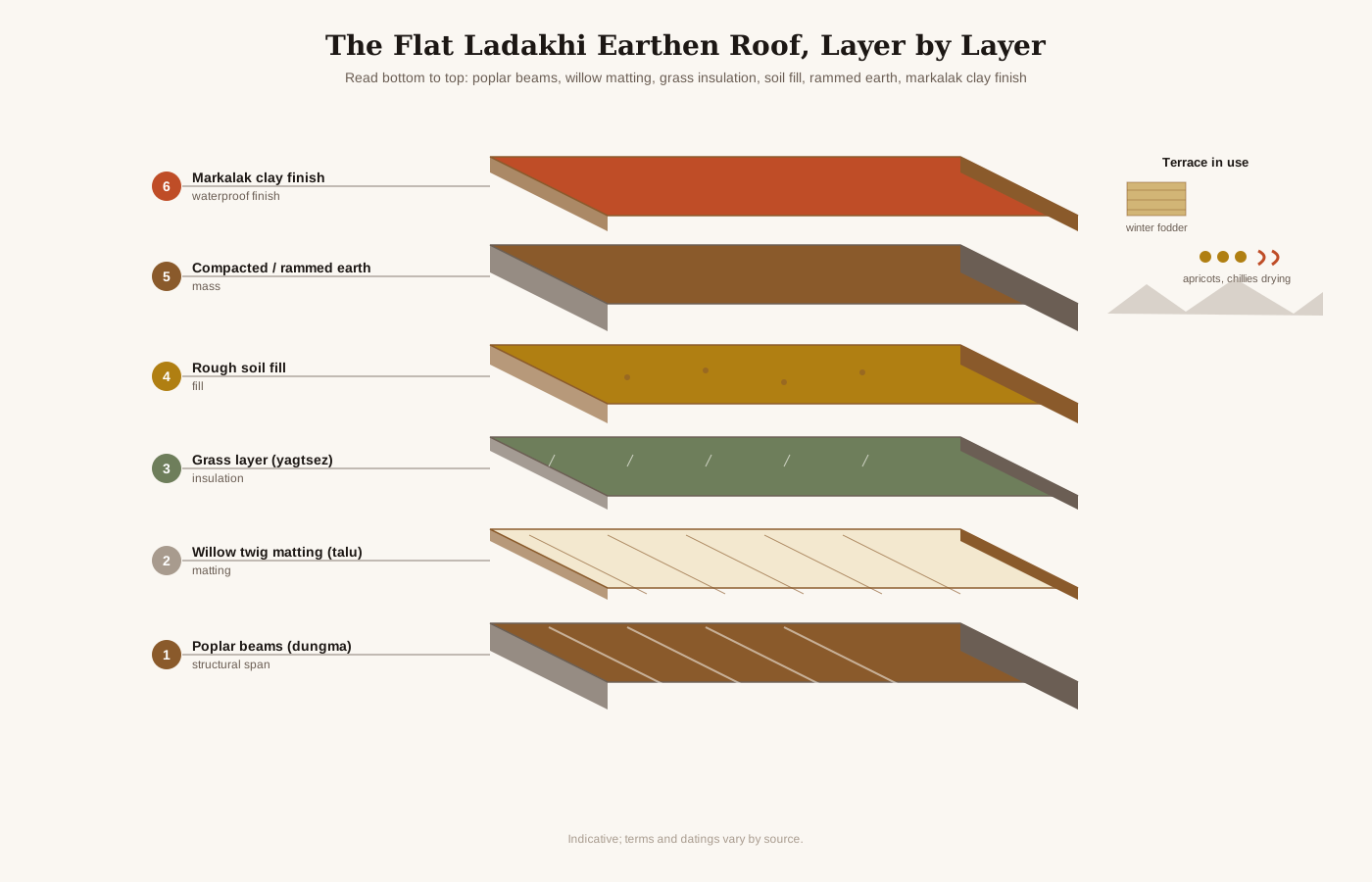
Timber is precious and used sparingly but cleverly. Poplar (Populus) — locally dungma — provides the structural beams that span the rooms. Across these beams is laid a close mat of willow twigs — locally talu (also talbu) — forming the next layer of the roof. The crowning finish is markalak (the spelling markala is also met), a fine, water-resistant clay that is spread and compacted as the final roof skin, sealing the layered build below against the little rain and meltwater that does fall.
| Material | Where used | Properties |
|---|---|---|
| Sun-dried mud brick (adobe) | Walls | High thermal mass; local; low-energy |
| Rammed earth | Walls | Massive, monolithic, insulating-by-mass |
| Stone | Foundations | Lifts earth wall clear of moisture/frost |
| Mud plaster (often with dung) | Wall & surface finish | Binds, weatherproofs, repairable |
| Poplar (Populus) — dungma | Roof beams | Main structural spanning timber |
| Willow twigs — talu / talbu | Roof twig layer | Close-laid matting over beams |
| Markalak (markala) clay | Roof finish | Fine, water-resistant top skin |
5. Plan, Section & the Roof Detail
The Ladakhi house is read in section as much as in plan, because its intelligence is vertical.
The section. At the bottom sits the ground floor of livestock and storage — a winter byre whose animals and stored fodder buffer the living spaces above from the frozen earth and supply, through their body heat, a steady upward warmth. Above lies the living floor, with the kitchen as its social heart and the sunny don-khang and rabsal turned to the south. The compact, heavy envelope keeps the heated volume small and well-insulated. Crowning it all is the flat roof terrace.
The roof, layer by layer. The flat Ladakhi roof is not a slab but a built-up sandwich, laid from the structure upward:
1. Poplar beams span the room as the structural base.
2. A close mat of willow twigs (talu / talbu) is laid across the beams.
3. A layer of grass for insulation — locally yagtsez (also yagdas) — is spread over the twigs.
4. Rough soil is heaped on next.
5. Compacted earth is rammed down over the soil.
6. A final skin of markalak clay seals and weatherproofs the top.
The result is a thick, insulating, low-maintenance deck that keeps heat in, sheds the little water that falls, and provides a working terrace above. Because precipitation is so low, this earthen roof — which would dissolve in a monsoon climate — is entirely appropriate here.
| Roof layer (bottom → top) | Material | Function |
|---|---|---|
| 1 | Poplar beams (dungma) | Structural span |
| 2 | Willow twigs (talu / talbu) | Close-laid matting base |
| 3 | Grass (yagtsez / yagdas) | Insulation |
| 4 | Rough soil | Bulk fill |
| 5 | Compacted earth | Mass & levelling |
| 6 | Markalak (markala) clay | Water-resistant finish |
The thermal strategy, then, is the sum of the parts: high mass to store, a south rabsal to gain, a layered roof and compact form to retain, and livestock below to top up — a complete passive system needing almost no purchased fuel.
6. The Social & Cultural Life of the House
A Ladakhi settlement is a diagram of a Buddhist cosmos, and the house at its centre is a diagram of a family.
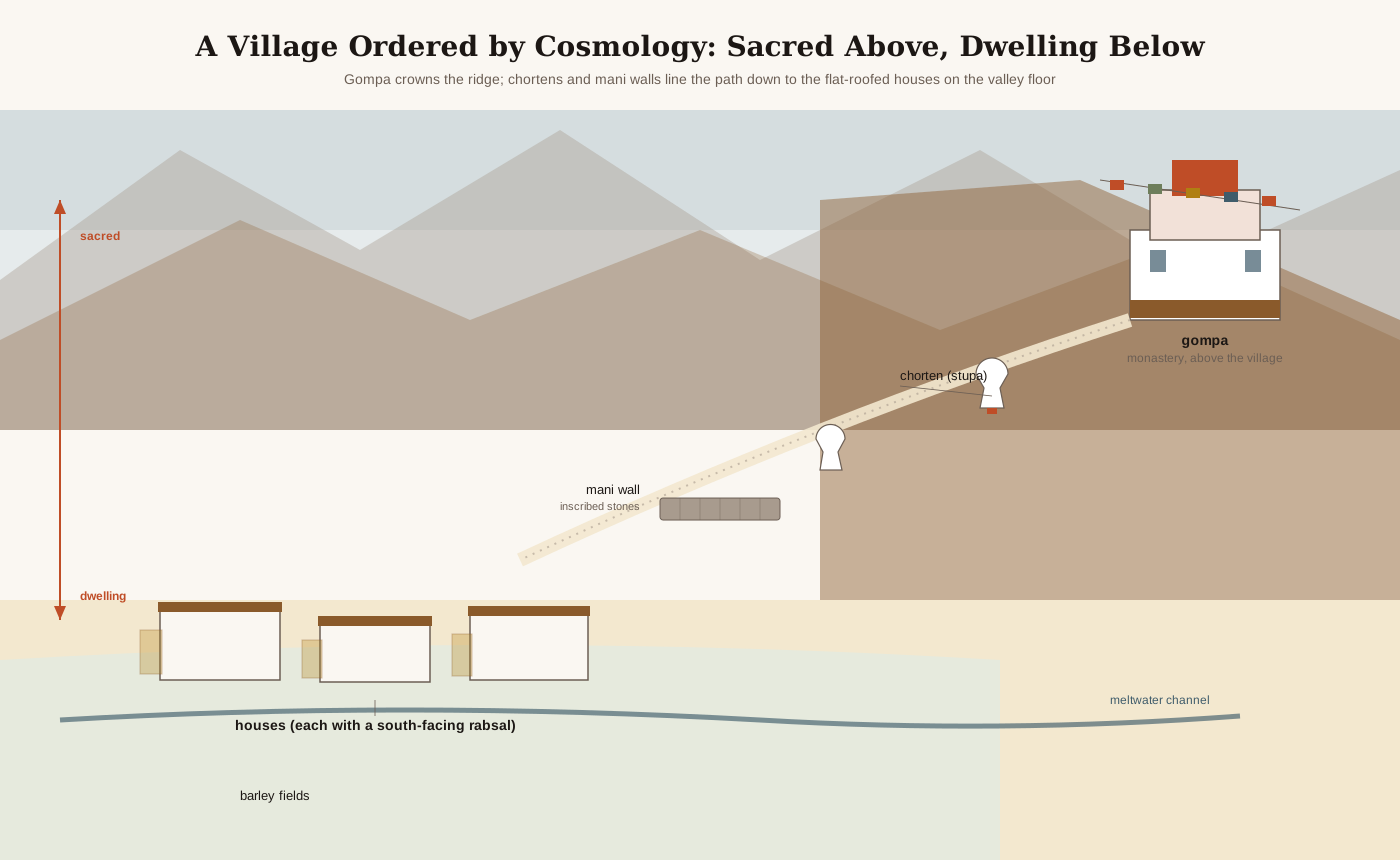
The landscape is ordered by faith. Tibetan Buddhist cosmology orders the whole valley: the gompa stands high above the village, watching over it; chortens and mani walls line the paths between fields and houses, so that to move through the landscape is to move through a devotional sequence. The sacred is not a separate quarter but a layer over everything — the monastery on the ridge, the stupa at the bridge, the mantra-stones along the lane.
The house centres on the hearth. Within the dwelling, the kitchen is the social heart, the warm room where the family gathers, cooks, eats, and sits out the long winter. In a climate this cold, warmth is sociability, and the hearth-room is the centre of family life. Around it the don-khang receives guests, and the rabsal floods both with light.
The rabsal expresses status. Because the sun-room is the most prized and most visible element — the bright, carved, glazed face the house turns to the world — the richness and scale of a family's rabsal became an expression of its standing. As with the jharokha of the Rajasthani desert house far to the south, a climate device doubled as a sign of status; comfort and prestige were built in the same gesture.
Where there is no firewood to spare, warmth itself becomes the measure of hospitality — and the sunlit sitting room, glowing behind its lattice of timber, is both the family's comfort and its pride.
7. Notable Examples & Settlements
The tradition is best read through its surviving monuments — the great monasteries that crown the valleys, the royal palaces of Leh and Stok, the rare intact old town, and the modern campuses that have carried the earth-and-sun logic into the present.
The monasteries are the masterpieces of the religious set. Thiksey rises in tiers up its hill above the Indus in a silhouette often compared to Lhasa's Potala; Hemis is among the largest and wealthiest of the gompas; Lamayuru sits dramatically amid eroded "moonland" badlands; and Alchi, unusually built low on the valley floor rather than on a height, is celebrated for its early wall-paintings of rare quality. The palaces show the fortified dzong tradition: Leh Palace, a nine-storey earth-and-stone royal residence above the old town, and Stok Palace, seat of the Ladakhi royal family.
Leh Old Town is itself a monument — a dense settlement of around two hundred buildings below Leh Palace, and one of the last well-preserved Tibeto-Himalayan urban settlements anywhere.
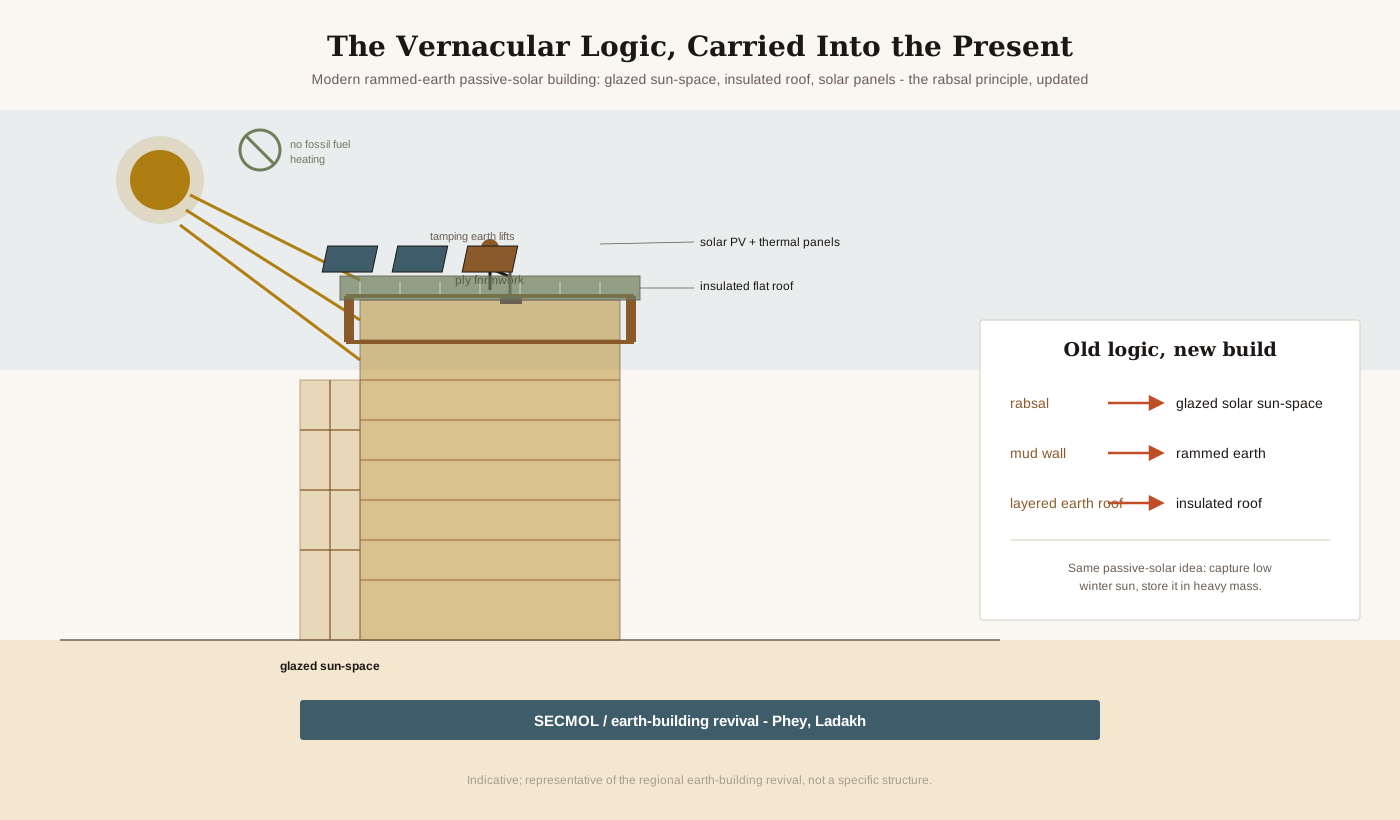
And then there are the modern campuses that turned the vernacular into a living design method. The SECMOL campus at Phey, founded in 1988 by the engineer-educator Sonam Wangchuk, is a rammed-earth, passive-solar, fossil-fuel-free settlement that heats itself through Ladakh's winter on sunlight alone; it won the International Terra Award in 2016. The Druk White Lotus School (Druk Padma Karpo) at Shey, designed by Arup Associates, marries granite and mud-brick Trombe walls with solar thermal and photovoltaic systems — and is confirmed as the "Rancho's School" filming location for the film 3 Idiots (shot in September 2008), which made Ladakhi passive-solar building briefly famous to the whole country.
| Example | Place | Type | Notable feature |
|---|---|---|---|
| Thiksey | Indus valley, near Leh | Gompa (monastery) | Tiered Potala-like silhouette |
| Hemis | Indus valley | Gompa | Among the largest/wealthiest |
| Lamayuru | Lower Ladakh | Gompa | Set amid "moonland" badlands |
| Alchi | Valley floor | Gompa | Early, rare wall-paintings |
| Leh Palace | Above Leh Old Town | Dzong / palace | Nine-storey earth-and-stone royal residence |
| Stok Palace | Stok | Palace | Seat of the Ladakhi royal family |
| Leh Old Town | Leh | Historic settlement | ~200 buildings; rare intact Tibeto-Himalayan town |
| SECMOL campus | Phey | Modern passive-solar | Rammed earth, fossil-fuel-free; Terra Award 2016 |
| Druk White Lotus School | Shey | Modern (Arup Associates) | Mud-brick Trombe walls; "3 Idiots" school |
8. Decline & What Survives — Lessons for Today
Ladakh's vernacular faces the same pressures as the rest of India's, sharpened by the speed of recent change.
The decline. Cement, concrete, and corrugated galvanised iron (CGI) sheet are displacing earth construction — materials that are seen as modern and permanent, but that perform poorly in this climate, conducting away the very heat the earth wall is built to hold, and that must be hauled at great cost and carbon up the mountains. At the same time, the boom in tourism strains Leh, pressing on its old fabric, its water, and its building traditions.
What survives, and is being saved. The Tibet Heritage Fund (THF) ran the Leh Old Town Initiative from 2003, co-directed by André Alexander, restoring around forty buildings with traditional earth-and-timber methods; the work won the 2006 UNESCO Asia-Pacific Award for Cultural Heritage Conservation. And the passive-solar earth tradition is being kept alive and pushed forward by SECMOL and — as is widely reported — the Ladakh Ecological Development Group (LEDeG), who together have demonstrated that earth and sun can heat a building through a Ladakhi winter without fossil fuel.
For the contemporary designer, Ladakh offers some of the clearest passive-solar lessons anywhere — but they must be adapted, not romanticised or copied wholesale.
| Vernacular principle | Modern application | Caveat |
|---|---|---|
| South solar capture (rabsal) | Glazed south sun-spaces, Trombe walls | Only useful where winter sun is reliable |
| High thermal mass | Earth/heavy walls to store solar gain | Needs sun to charge; useless if envelope leaks |
| Compact, layered envelope | Compact form, insulated roofs | Insulation, not just mass, in extreme cold |
| Flat earthen roof | Earth roofs in arid zones | Wrong in any wet/monsoon climate |
| Livestock-below heat buffer | Buffered/unheated service zones | The literal byre rarely transfers; the buffer idea does |
| Local earth + minimal timber | Low-carbon local materials | Cement/CGI underperform and import carbon |
The danger here is the inverse of romanticism: assuming "modern" means concrete. In Ladakh, the high-tech answer and the vernacular answer point the same way — toward earth, mass, and the sun. To build well at four thousand metres is to understand why the old house worked — south orientation, thermal mass, a layered roof, a buffered base — and to rebuild that intelligence, as SECMOL and the Druk White Lotus School have, in durable contemporary form. For a fuller treatment, see our guide on the lessons of vernacular architecture for modern Indian homes and the discussion of why vernacular design is returning in India. To compare the cold and hot extremes of Indian building, set this beside the vernacular architecture of North-East India and the desert vernacular of Rajasthan. You can also browse climate-aware layouts in our house plans library.
References & Further Reading
Foundational / Theory
- Tibet Heritage Fund (THF) — the Leh Old Town Initiative (from 2003), co-directed by André Alexander; documentation and conservation of Ladakhi and Tibeto-Himalayan earthen urban heritage (winner, 2006 UNESCO Asia-Pacific Award for Cultural Heritage Conservation).
- André Alexander's writings on the urban heritage of Leh and the wider Tibetan world.
Regional / Indian sources
- SECMOL (Students' Educational and Cultural Movement of Ladakh) and the work of Sonam Wangchuk — the passive-solar, rammed-earth, fossil-fuel-free campus at Phey (International Terra Award, 2016).
- D'source (NID design resource) — documentation of the rabsal sun-room and the pre-glass panjari / pinjkari lattice shutters and Ladakhi building craft.
- The Ladakh Ecological Development Group (LEDeG) — widely reported for its long work in passive-solar earth building in Ladakh.
Companion Studio Matrx Guides
- Indian Vernacular Architecture — the pillar guide
- Vernacular Architecture of North-East India — the cold-and-wet, high-seismic contrast
- Vernacular Architecture of Rajasthan — the hot-extreme desert counterpart
- Lessons of Vernacular Architecture for Modern Indian Homes
- Why Vernacular Design Is Returning in India
Author's Note: I find Ladakh humbling in a way the warm valleys never quite are. There is no slack in this climate — a badly built house simply will not keep you alive through January — and yet the people of these valleys made not only shelter but beauty out of mud and sun, and turned the warmest room in the house into the room where guests are honoured. To design for the cold today is not to copy the rabsal, but to inherit its attentiveness: face the sun, build heavy, close the north, and let nothing warm escape. — Amogh N P
Disclaimer: Vernacular terms, spellings, and datings vary across sources and regions — talu and talbu, yagdas and yagtsez, markalak and markala, panjari and pinjkari are all in use, and attributions and dates are given differently by different authorities (the LEDeG passive-solar role, for instance, is widely reported rather than independently re-verified here). Named examples and their conservation status change over time. This is an educational overview; verify specifics against the cited scholarship before relying on them. No liability is assumed for decisions made on the basis of this article.
Export this guide
Related Guides — Deep-dive reading
Thiksey Monastery, Ladakh: A Built Mountain of Earth on the Roof of the World
How the Buddhists of the high Himalayan desert raised a whitewashed monastery-town that climbs a hill in twelve tiers — the sacred set highest, all of it built from sun-dried earth, in the architecture of Tibet transplanted to India's far north
Architectural WondersKantana Film and Animation Institute: How 600,000 Handmade Bricks Built a School of Light
Boonserm Premthada's film school outside Bangkok is a low-tech answer to the digital age — eight-metre undulating walls laid from more than 600,000 hand-pressed bricks, a double skin that fends off the tropical heat, and a shaded 'inserted forest' that teaches the eye to read light and shadow. A close study of its craft, its structure, and the community it kept alive.
The Future of ArchitectureVernacular Architecture — Lessons for Modern Homes
Regional Building Traditions of India and Their Architectural Logic — A Reference for Contemporary Practice
Design StylesRelated Tools — Try Free
Cross-Ventilation Analyzer
Estimate airflow and air changes per hour (ACH) from room size, window areas, layout, and local wind — with NBC 2016 Part 8 compliance check.
Ventilation CalculatorBrise-Soleil Visualizer
Interactive horizontal-louvre cut-off angle calculator — sun altitude, louvre depth, and spacing inputs with a live shadow preview. Computes θ = arctan(spacing/depth) for façade shading, ECBC envelope compliance, hospital daylight design, and tropical sun-control detailing.
Sun Shading ToolWindow Orientation Planner
Pick the best window type, glass and shading by wall direction — north, east, south and west.
Window Tool