
The Complete Home Door Guide for Indian Homes (2026): Types, Materials, Cost, Security & Vastu
Everything an Indian homeowner needs to specify the right door for every opening — from main entrance to bathroom — with real 2026 prices, IS/NBC standards and Vastu sense.
A typical Indian home has between 8 and 15 doors, yet most owners decide every one of them in a single rushed conversation with the carpenter. That is a mistake worth lakhs over a building's life: the main door sets your security and first impression, the bathroom door fights moisture for 30 years, and the wrong material warps in the first monsoon. This guide is the map — it walks through every decision (type, material, cost, hardware, security, size, design, Vastu and maintenance) at an overview level, then points you to a deeper Studio Matrx guide for each one. Read it top to bottom once; then dive into the spokes for whatever you are buying.
Start here: how to think about doors
A door is not one product. It is a system of five parts that all have to match: the shutter (the moving leaf), the frame (chowkat), the hardware (hinges, handle, lock, stopper), the finish (paint, laminate, veneer, polish) and the installation. A premium teak shutter on a soft pine frame with cheap pressed-steel hinges will sag, rattle and fail — the door is only as good as its weakest part. Quotes that look cheap usually leave out the frame, hardware or fitting labour, so always ask for an installed, all-in price.
The right door also depends entirely on where it goes. Your main entrance must prioritise security, weather and presence; an internal bedroom door prioritises privacy and looks; a bathroom door must shrug off water; a balcony or living-room opening may want glass for light and views. One material almost never wins everywhere, which is why this guide separates the decisions.
If you want the fastest path, two companion guides condense everything below into decision flows: our practical how to choose doors walkthrough and the room-by-room door buying guide. Professionals planning a whole project should use the architect's guide to residential doors and the residential door planning handbook.
Door types: choose the way it opens first
Before material, decide how the door should move, because that constrains everything else. The common residential types in India:
| Type | How it works | Best for | Notes |
|---|---|---|---|
| Hinged (swing) | Pivots on side hinges | Almost every room | Default; needs swing clearance |
| Flush | Flat hinged shutter, factory-made | Bedrooms, internal | Cheapest, cleanest line |
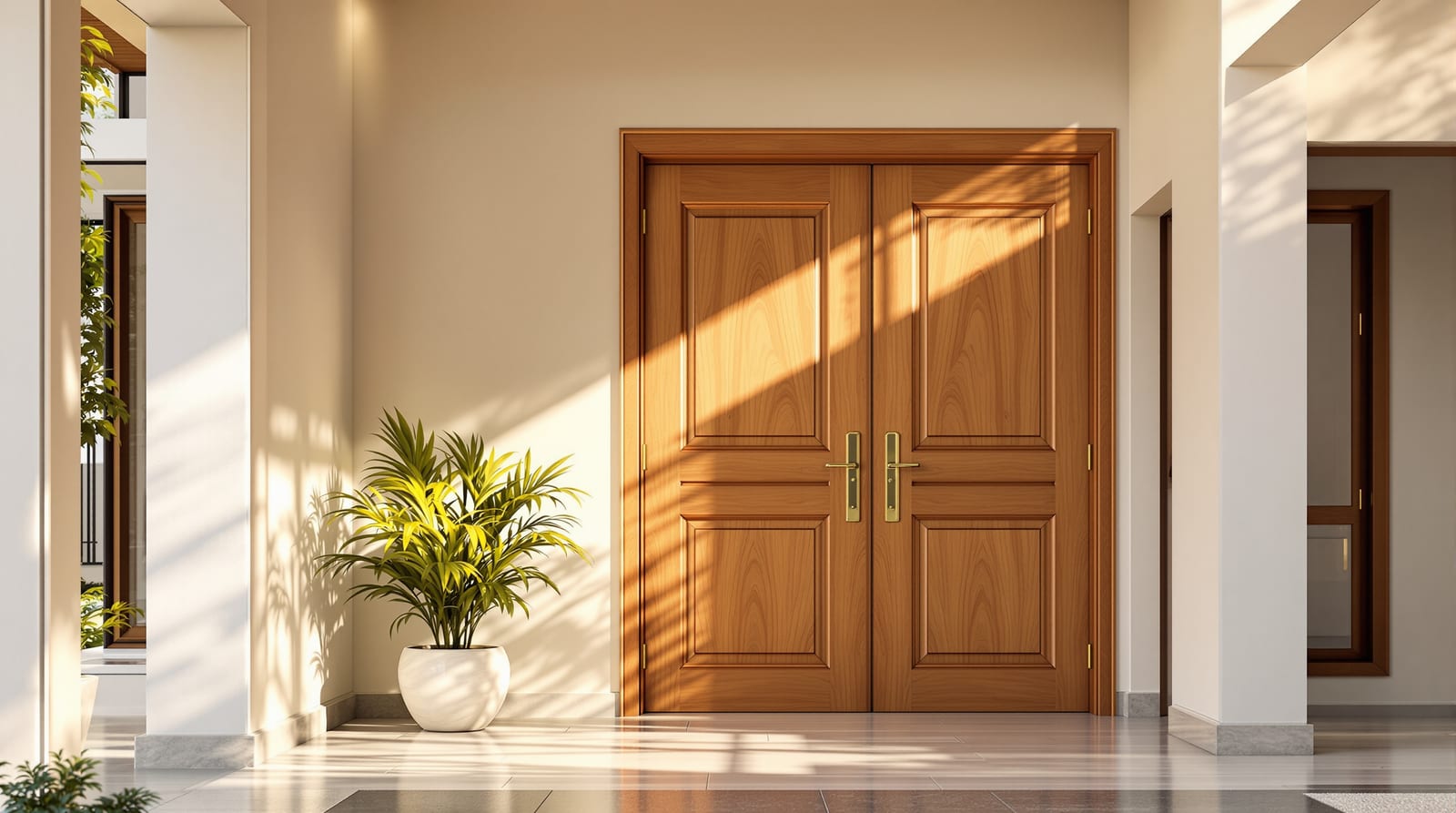
| Panel | Framed with raised/recessed panels | Main door, classic interiors | Traditional Indian look |
| Sliding | Slides along a track | Balcony, wardrobe, tight rooms | Saves swing space |
| Slides into the wall cavity | Compact bathrooms, studies | Needs planning at masonry stage | |
| Bi-fold | Folds in concertina panels | Wide balcony/patio openings | Opens up a full wall |
| French | Paired glazed swing doors | Living-to-garden, balconies | Light + symmetry |
| Pivot | Rotates on a central pivot | Statement main doors | Heavy, premium look |
| Glass | Frameless/framed glazing | Showers, partitions, balconies | Toughened glass essential |
Start with the types of doors overview, then read the spoke for your choice: flush doors, panel doors, sliding doors, pocket doors, bi-fold doors, french doors, pivot doors and glass doors. If you are weighing a heavy solid leaf against a lighter hollow-core one, see solid vs hollow-core doors.
A simple anatomy diagram helps when you read quotes — every part below is a separate line item:
Materials: where the budget really goes
Material decides durability, weight, weather resistance, maintenance and cost. The realistic Indian menu runs from solid teak at the top to uPVC and WPC at the value end. Match material to climate: coastal and high-rainfall homes punish solid wood with swelling and termites, so engineered, WPC or uPVC often win in bathrooms and external utility doors.
| Material | Durability | Moisture/termite | Maintenance | Indicative cost |
|---|---|---|---|---|
| Teak (Burma/CP) | Excellent | Excellent | Low (re-polish) | ~₹800-1,500+/sq ft |
| Other solid hardwood | Good-very good | Good | Medium | from ~₹800/sq ft |
| Engineered wood | Good | Good | Low | ₹4,000-9,000/shutter |
| Flush (ply core) | Moderate | Poor if wet | Low | ₹1,200-4,000/shutter |
| WPC | Good | Excellent | Very low | ~₹75-150/sq ft |
| uPVC | Good | Excellent | Very low | ~₹400-700/sq ft |
| Steel | Excellent | Good (galvanised) | Low | ₹8,000-25,000/set |
| Glass (toughened) | Good | Excellent | Medium (cleaning) | ₹450-1,200/sq ft |
Read the full door materials comparison, then the material spokes: wooden doors, teak wood doors, engineered wood doors (and the engineered-wood lifecycle costing companion), WPC doors, uPVC doors and steel doors. If you just want the verdict by use-case, see best door material. Indian flush and panel shutters should conform to IS 2202 (Part 1) for flush doors and IS 1003 for panelled/glazed shutters; FRP shutters fall under IS 14856.
Cost: budget the whole opening, not just the shutter
The single biggest costing error is pricing only the shutter. A door's installed cost is shutter + frame + hardware + finish + labour + 18% GST. The benchmarks below are 2026 indicative ranges and vary by city and vendor; treat them as planning figures, not quotes.
| Item | Indicative 2026 range |
|---|---|
| WPC flush shutter | ₹2,000-4,500 each |
| Plywood/laminate flush shutter (IS 2202) | ₹1,200-4,000 basic; ₹4,000-9,000 veneered |
| Panel door (engineered/solid) | ₹4,000-12,000 each |
| Solid wood door | ₹10,000-25,000+ |
| Teak carved main door | ₹25,000-1,50,000+ |
| uPVC door | ₹400-700/sq ft of opening |
| Steel security door (set) | ₹8,000-25,000 |
| Frame (chowkat), sal/teak | ₹350-900/ft run |
| Fitting labour | ₹800-3,000/door |
| Hardware set (hinges, handle, lock, stopper) | ₹1,500-8,000 |
| Main entrance, installed (premium) | ₹25,000-1,50,000+ |
For a full breakdown and city variation, use the door cost guide for 2026, the focused main door cost and teak door cost guides, and the door cost calculator and material comparison tools.
A useful rule of thumb when comparing quotes: a factory-made flush or panel door arrives sized, pressed and finished to a repeatable standard, whereas a carpenter-built door is bespoke but only as good as that carpenter's day. Factory doors usually win on consistency, warranty and IS conformance; site carpentry wins on one-off carving, odd sizes and frame fit. Most modern Indian homes mix both — factory shutters for internal rooms, a custom main door — and that is a sensible default. Whatever the route, insist on the IS mark for flush shutters and a written warranty against warping and delamination.
Hardware and locks: the part that wears out
Hardware is where good doors quietly fail. Hinges carry the leaf's weight thousands of times a year — undersized or rust-prone hinges cause the sag and scrape most homeowners blame on the door. Stainless-steel (SS 304) ball-bearing hinges, a quality mortise lock, a proper handle set and a floor or wall stopper are the baseline for a main door. Internal doors can use lighter cylindrical or tubular latches. Get the full picture in the door hardware guide.
For locks, India is shifting fast to smart locks. Budget keypad/RFID units start around ₹5,000-9,000, mid-range fingerprint+app models run ₹10,000-17,000, and premium multi-mode locks (Godrej, Yale, Qubo, Hafele, Lavna) reach ₹15,000-30,000 plus fitting. They add convenience and audit logs but need a power/battery plan and a mechanical key override. Read smart door locks and estimate with the smart-lock cost calculator before committing.
Security: layered, not single-point
Door security is a chain: leaf strength, frame anchoring, hinge side, lock grade and visibility of callers. A strong lock on a hollow leaf or a weak frame is theatre. For the main door, favour a solid or steel-reinforced leaf, a frame bolted into masonry, hinge bolts (dog bolts) so the door cannot be lifted off, a multi-point or quality mortise lock, and a viewer or video door system. The deep door security guide covers grades, common break-in points and what is worth paying for, and the door security rating tool scores your setup.
Sizes and standards: get the openings right at masonry stage
Door sizes are decided when walls go up, not when you shop — an opening that is too small forces an undersized leaf forever. NBC 2016 and common Indian practice give clear defaults:
| Opening | Typical size (mm) | Approx feet |
|---|---|---|
| Main / external | 1000-1200 × 2100 | ~3.5' × 7' |
| Bedroom / internal | 900 × 2100 | 3' × 7' |
| Kitchen / utility | 800-900 × 2100 | ~3' × 7' |
| Bathroom / WC | 700-750 × 2000-2100 | ~2.5' × 7' |
Standard height is 2100 mm (7'); the frame adds about 50-75 mm. NBC 2016 Part 4 sets the main exit door at minimum 1000 mm opening in the direction of egress. For accessibility, keep the threshold (sill) under about 12 mm and provide ~800-900 mm clear width (a 900 mm leaf gives roughly 810-850 mm clear) per the RPwD Harmonised Guidelines 2021. See door size standards, the residential door standards reference, the door size calculator and swing planner, and our accessible doors guide alongside the accessible home design overview. For swing and clearance basics, the students' note on how to measure a small room is a handy primer.
Design: doors as the face of your home
The main door is the most-photographed surface in an Indian home and a genuine design opportunity. Trends in 2026 range from minimalist tall flush doors with concealed hardware to carved teak with brass, and warm laminate or veneer interiors that coordinate with flooring. Explore main door design, modern door designs and traditional Indian doors, plan interiors with interior doors by room, and treat the pooja room door as its own special case. Use the main door design selector to narrow styles, and see how doors and openings work together in windows and doors design.
Two performance variants deserve a mention: soundproof doors for bedrooms and home offices near noise, and energy-efficient doors for sealing conditioned rooms against heat and dust.
Vastu: tradition, reasoning and the main door
In Vastu, the main door is the mukhya dwar — the mouth through which energy enters — so it is treated with great care. Traditional guidance favours a main door in the north, east or north-east (placed on auspicious "padas"), made the largest door in the home, opening inward and clockwise with no obstruction in its path; an even number of leaves/panels and a threshold (dehleez) are considered auspicious, while a south-west main door is usually avoided by default. Read all of this as cultural tradition plus practical sense — a north/east entry also brings gentler morning light and less harsh afternoon heat. Our dedicated Vastu main door guide complements (and links to) the canonical entrance Vastu reference, and the door Vastu planner tool helps you check directions.
Maintenance: protecting the investment
Doors fail in predictable ways: solid wood swells and sticks in the monsoon, hinges loosen and sag, laminate edges peel where water sits, and external finishes chalk under sun. The fixes are cheap if done early — re-polish or oil solid wood yearly, tighten and lubricate hinges, seal bathroom-door bottoms, keep weep paths clear on uPVC, and never let water pond against a wooden frame. In termite-prone and coastal zones, prefer WPC/uPVC/engineered shutters for wet and external openings and treat any timber frame. A door specified for its location, fitted properly and serviced once a year will outlast the home's first paint cycles several times over.
Frequently asked questions
Which door material is best for an Indian main door?
For most homeowners, solid hardwood or teak gives the best mix of security, presence and longevity, while engineered or steel-cored doors offer similar strength at lower cost. In coastal or very humid areas, weigh teak's premium against WPC/steel options that ignore moisture. See best door material for a use-by-use verdict.
How much should I budget for all the doors in a 3BHK?
As a rough planning figure, an internal flush door installed lands around ₹3,000-7,000 each, while a quality main door installed runs ₹25,000-1,50,000+. A full 3BHK with one premium main door and 7-9 internal doors commonly totals ₹1-3 lakh installed, GST included. Use the door cost calculator for your spec; figures are indicative and vary by city and vendor.
What is the standard door size in India?
Internal bedroom doors are typically 900 × 2100 mm (3' × 7'), main doors 1000-1200 × 2100 mm, and bathrooms 700-750 × 2000-2100 mm. NBC 2016 sets the main exit at a minimum 1000 mm opening. Full chart in door size standards.
Are smart locks safe for Indian homes?
Reputable smart locks (Godrej, Yale, Qubo, Hafele, Lavna) are secure when paired with a strong door and frame and a mechanical key override, but a smart lock on a weak leaf adds little. Plan for battery life and power cuts. See smart door locks and door security.
Does the main door direction really matter for Vastu?
Traditionally, north, east and north-east are favoured and south-west avoided, the door is made the largest and opens inward. Treat this as tradition reinforced by practical light and heat logic rather than a hard rule; our Vastu main door guide and the entrance Vastu canon explain the reasoning.
Export this guide
Related Guides — Deep-dive reading
Bedroom Door Design in India: Materials, Sizes, Finishes, Privacy and Cost (2026)
How to choose and design a bedroom door for Indian homes — privacy, light-noise control, finishes that match the room, the right 900x2100 internal door, locks and ₹ budget.
Home Doors & EntrancesBest Door Material in India (2026): The Right Choice for Every Room & Climate
A situation-by-situation verdict on the best door material for Indian homes - teak or steel for the main entrance, WPC or uPVC for bathrooms and coasts, engineered flush for bedrooms - with a by-location decision table and budget-vs-premium picks.
Home Doors & EntrancesDoor Installation Cost in India 2026: Fitting Labour ₹ Per Door + Hardware, City Variance & GST
A focused 2026 guide to what it actually costs to fit a door in India — carpenter labour per door for flush, panel, heavy main and sliding shutters, plus hinges, mortise lock, tower bolt and closer hardware ₹ ranges, with worked bedroom and main-door totals.
Home Doors & EntrancesRelated Tools — Try Free
Door Material Comparison Tool
Compare 2–4 door materials on cost, durability, maintenance, security and moisture resistance.
Comparison ToolDoor Cost Calculator
Estimate the all-in cost of a door — leaf, frame, hardware, fitting and GST — by type, material and size.
Door CalculatorDoor Security Rating Calculator
Score your main door out of 100 across leaf, frame, lock and hardware — and see the top upgrades.
Security Tool