
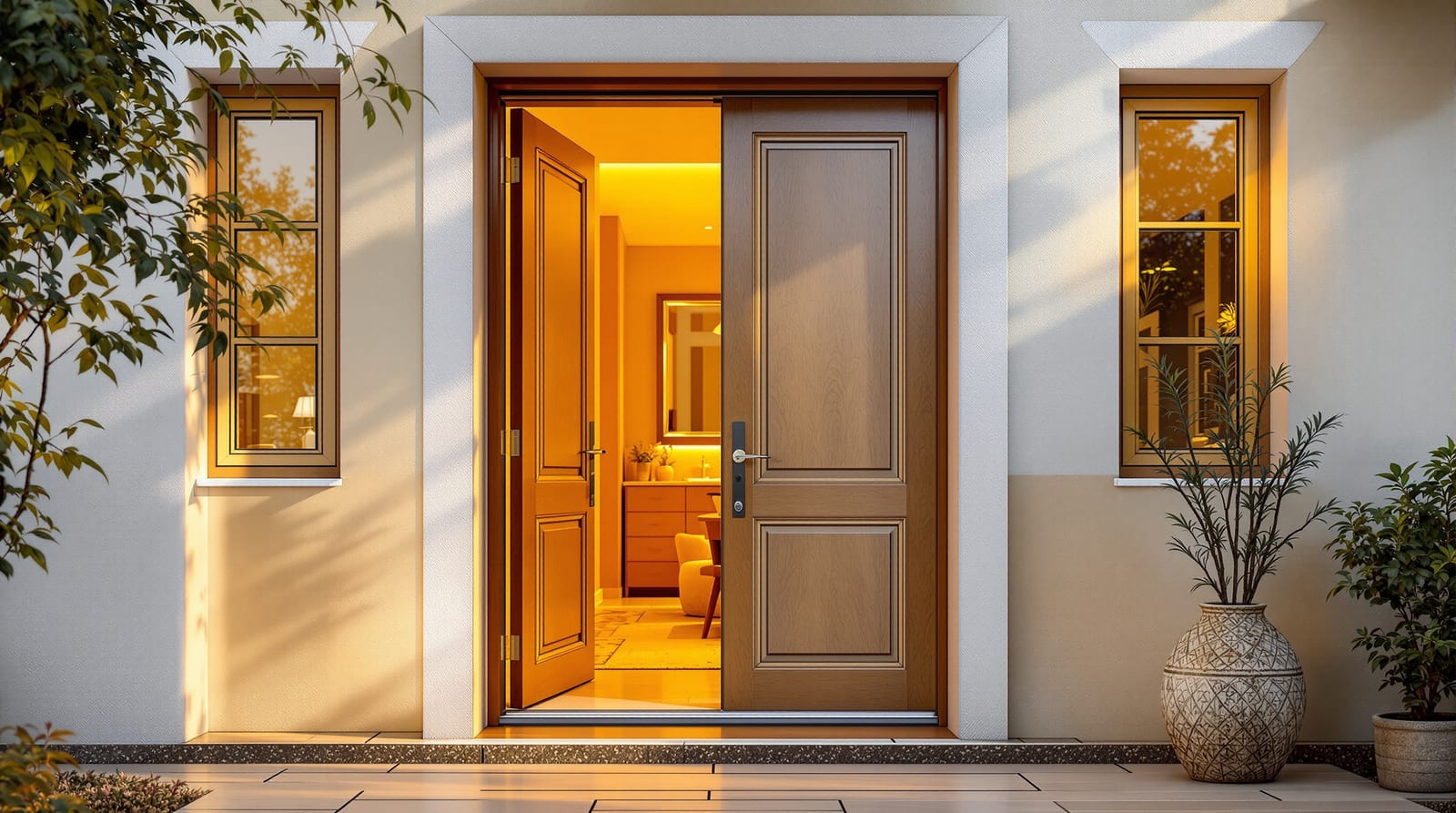
Energy-Efficient Doors in India: Cut AC Bills with Insulated, Draft-Proof Doors (2026)
Doors quietly leak your cooling. This guide shows how insulated cores, weatherstripping, sweeps, thresholds and the right glazing keep conditioned air in - and your electricity bill down.
Most Indians upgrade the AC, the inverter and the windows to save on power - and forget the door. Yet a single ill-fitting external door, or an interior door to an air-conditioned bedroom that has a finger-wide gap underneath, can quietly bleed away a meaningful slice of your cooling every hour the compressor runs. An energy-efficient door is not exotic: it is a door with an insulating core, a tight seal all the way round, and (if it is glazed) the right kind of glass. Get those three things right and you keep more of the cool air you paid for - which, over a long Indian summer, is real money. This guide is about thermal performance and draft-proofing of doors: where it matters, what to specify, and what it costs.
Why a door affects your electricity bill
Heat moves through a door in two ways, and both cost you money:
1. Conduction through the leaf - heat passes straight through the door material. A thin hollow door or a single sheet of glass conducts far more heat than an insulated core. This is measured as the U-value (lower is better - less heat passes through).
2. Air leakage around the edges - the bigger culprit in most Indian homes. Gaps at the top, sides and especially the bottom of a door let conditioned air escape and hot outside air pour in. You can have a great door leaf and still lose cooling through a 10 mm gap under it.
For a glazed door there is a third factor: solar heat gain - sunlight passing through the glass and heating the room directly, like a small greenhouse. This is measured as SHGC (Solar Heat Gain Coefficient; lower means less solar heat enters).
In our climate the priorities flip depending on zone. In hot-dry (Delhi, Jaipur, Ahmedabad), hot-humid (Chennai, Mumbai, Kolkata) and composite zones, the job is to keep heat out and cool in - so insulation, sealing and low solar gain all matter. In the cold north (Shimla, Srinagar, Leh), the job reverses to keeping warmth in, but the door techniques are identical.
Where it actually matters (and where it doesn't)
Do not gold-plate every door in the house. Energy upgrades pay back only where there is a temperature difference across the door. Spend where it counts:
- External main door and balcony/terrace doors - the boundary between conditioned indoor air and the outdoors. The highest-value place to insulate and seal.
- Doors to air-conditioned rooms - the master bedroom you cool at night, a study or a home office. Sealing the bottom gap here keeps the cool in the one room you are paying to cool.
- Utility / kitchen-to-balcony doors - often the leakiest, especially older timber doors that have shrunk.
- Doors between conditioned and unconditioned zones - e.g. the door from a cooled living room to an un-cooled stairwell or stilt parking.
Where it barely matters: interior doors between two rooms that are both at the same temperature (two un-cooled bedrooms, a passage door). Sealing those gives you privacy and sound benefit, but little energy benefit.
The three levers of an energy-efficient door
1. An insulating core (lower U-value)
The leaf itself should resist heat flow. From worst to best for thermal performance:
- Hollow-core flush door - a cardboard honeycomb inside; cheap, light, and a poor insulator. Fine for an internal passage, weak as an external or AC-room door.
- Solid timber / solid-core flush - good thermal mass; teak and good hardwood doors are naturally fair insulators and the traditional Indian main door.
- WPC door - wood-plastic composite; the foamed core gives decent insulation plus it shrugs off monsoon swelling and termites, so the seal stays tight over years.
- uPVC door with a multi-chamber frame - the air pockets in the profile make it one of the best thermal-and-airtight options; common in north-Indian and premium builds.
- Insulated steel door (foam-filled) - a steel skin with a polyurethane foam core; excellent insulation and security, used for premium main doors.
A door that swells, shrinks or warps - as untreated softwood does through our monsoon - is also an energy problem, because the seal opens up. Dimensional stability (WPC, uPVC, well-seasoned hardwood, engineered cores) keeps the door tight year after year.
2. Air-tightness (weatherstripping, sweeps, thresholds)
This is the cheapest, highest-return upgrade, and most Indian doors lack it entirely. You seal the four edges:
- Weatherstripping (the three sides) - adhesive EPDM rubber, silicone or foam tape, or a slotted P-/D-profile gasket, run around the top and two vertical edges of the frame so the leaf presses against it when shut.
- Door sweep / bottom seal (the gap underneath) - the biggest single leak. A brush-bottom or rubber-blade sweep screwed to the bottom of the leaf, or a self-adhesive draft excluder, closes the floor gap. An automatic "drop-down" seal lifts when you open and drops when you close - premium but excellent.
- Threshold / sill - a low aluminium threshold strip with a rubber insert that the sweep meets, sealing the bottom completely. Keep it low (ideally 12 mm or less) so it stays wheelchair- and trip-friendly per accessibility guidance.
The classic DIY test: on a sunny afternoon, switch off interior lights and look for daylight leaking around a closed external door. Wherever you see light, conditioned air is escaping. A ₹300-800 weatherstrip kit usually fixes it.
3. The right glass (for glazed and french doors)
If your door has glass - a balcony slider, french doors, a glazed panel - the glass is often the weakest thermal link:
- Single (one pane) - high heat transfer; fine indoors, poor as an external door in a cooled home.
- Low-E coated glass - a microscopically thin metallic coating reflects infrared heat while passing light; lowers solar heat gain (SHGC) without making the room dark. The single most effective glass upgrade for our sun.
- Double-glazed unit (DGU / IGU) - two panes with a sealed air or argon gap; the gap is the insulator. Cuts both conduction and noise. Common in uPVC and aluminium-framed external doors.
- Tinted / reflective glass - reduces solar gain and glare on a hot west/south balcony, at some cost to daylight and view.
For a sun-facing glazed door, aim for a lower SHGC (less solar heat in) while keeping reasonable visible light. Pair the glass with a chajja, overhang or external shade - shading the glass before the sun hits it is more effective than any coating.
Anatomy of a draft-proof door
The principle is simple: an insulated leaf to resist conducted heat, and a continuous seal on all four edges so air cannot sneak past. Most homes get the leaf roughly right and ignore the seal entirely - which is why the bottom sweep and weatherstripping are the upgrades with the fastest payback.
Door type vs energy performance
Indicative guidance for an external or AC-room door in Indian conditions. "Airtight potential" assumes the door is fitted with proper weatherstripping and a sweep - any door is leaky without them.
| Door type | Insulation (leaf) | Airtight potential | Holds seal over years | Indicative cost | Best energy use |
|---|---|---|---|---|---|
| Hollow-core flush | Poor | Low | Moderate | ₹1,200-3,000 / shutter | Internal passage only |
| Solid timber / teak | Good | Good | Good if seasoned | ₹10,000-25,000+ | Main door, traditional |
| WPC flush | Good | Good | Excellent (no swell) | ₹2,000-4,500 / shutter | AC rooms, utility, wet zones |
| uPVC (multi-chamber) | Excellent | Excellent | Excellent | ₹400-700 / sq ft | External, balcony, cold zones |
| Insulated steel (foam-filled) | Excellent | Excellent | Excellent | ₹8,000-25,000 / set | Premium secure main door |
| Single-glass door | Poor (glass) | Moderate | Depends on frame | ₹450-1,200 / sq ft | Internal/sheltered only |
| Double-glazed (DGU) door | Very good | Excellent | Excellent | + ₹400-900 / sq ft | Sun-facing balcony, cold zones |
Costs are indicative for 2026, vary by city and vendor, and exclude frame, hardware and 18% GST.
Where the codes point: Eco-Niwas Samhita and NBC
India does have an energy code for homes. The Eco-Niwas Samhita (ENS) - the Energy Conservation Building Code for Residential buildings, issued by the Bureau of Energy Efficiency - sets envelope performance targets for new residential construction, expressed through the RETV (Residential Envelope Transmittance Value): a measure of how much heat the walls, windows and doors of a home let through. Doors are part of that envelope. While ENS focuses heavily on windows and walls, the logic applies directly to doors: a lower-U-value, well-sealed, appropriately-shaded glazed opening lowers the whole building's heat load.
For most homeowners the takeaway is not the code arithmetic but its direction of travel: India is moving toward sealed, insulated, shaded envelopes, and an energy-efficient door is part of a "green" or passive home rather than an add-on. The National Building Code (NBC 2016) governs door sizes, exits and fire safety, while ENS governs the thermal envelope - the two work together. If you are building new or doing a deep renovation, ask your architect to treat external doors as part of the envelope, not just an aesthetic choice. For the broader passive-design picture, our windows-and-doors design relationship guide covers how the openings combine.
A practical, payback-ordered plan
You do not need a new door to save energy. In rough order of return-on-rupee:
1. Weatherstrip and add a sweep to existing external and AC-room doors. Cost ₹300-1,500 per door, DIY-able, biggest immediate effect.
2. Fix the threshold - add or level a low aluminium threshold so the sweep seals against it.
3. Add a draft excluder to the under-door gap of the one bedroom you cool at night - the single cheapest cooling saving in many homes.
4. Shade glazed doors - a chajja, deep overhang, external blind or even a pergola cuts solar gain before the glass.
5. Upgrade the glass to low-E or double-glazed when replacing a balcony slider.
6. Replace a leaky, warped external door with WPC, uPVC or an insulated steel door when it is due anyway - retrofit the seal, replace the leaf only when it is failing.
Combine this with the rest of your door plan: choose the leaf material with our best door material guide, get the hardware (including good seals and a quality closer that lets the door seat fully) right with the door hardware guide, and pick the correct glass for glazed openings with the glass doors guide.
Maintenance: an energy door only saves if it stays sealed
- Inspect weatherstripping yearly - rubber hardens and cracks, especially in the heat; replace perished strips.
- Check the sweep drags lightly on the threshold; a worn brush stops sealing.
- Re-seat doors that have dropped on their hinges - a sagging leaf opens a gap at the top corner.
- Watch monsoon swelling on timber doors - a swollen door may seal tight in the rains and gap in the dry season; dimensionally stable WPC/uPVC avoids this.
- Clean and lubricate slider tracks and clear weep holes so glazed doors close fully against their gaskets.
Frequently asked questions
Do energy-efficient doors really lower my electricity bill?
Yes, but mostly through air-sealing rather than the door material alone. The biggest savings come from closing the gaps - weatherstripping and a bottom sweep on external doors and on the doors of rooms you air-condition. Stopping conditioned air from leaking out means the AC cycles less. Insulated cores and better glass add to the effect, especially on sun-facing and external doors.
What is the single cheapest energy upgrade for a door?
A door sweep or draft excluder on the bottom gap, plus adhesive weatherstripping around the frame. A kit costs roughly ₹300-1,500 per door, takes under an hour, and closes the leak that wastes the most cooling - the gap under the door of the bedroom you cool at night.
Are WPC or uPVC doors more energy-efficient than wood?
For external and AC-room use, WPC and uPVC have an edge - not just because of their insulating cores, but because they do not swell, shrink or warp through the Indian monsoon, so the seal stays tight for years. A good solid teak or hardwood door is a fair insulator too, but a softwood door that warps will leak. The seal staying intact matters as much as the raw insulation value.
Does double-glazed glass make sense in a hot Indian climate?
On a sun-facing external glazed door (a west or south balcony slider), yes - double glazing plus a low-E coating cuts both conducted heat and solar gain, and reduces noise as a bonus. Shade it externally with a chajja or overhang as well, because blocking the sun before it reaches the glass is the most effective single step. For internal or fully shaded glazed doors, single glass is usually fine.
What does the Eco-Niwas Samhita say about doors?
The Eco-Niwas Samhita (India's energy code for homes, from the Bureau of Energy Efficiency) treats doors as part of the building's thermal envelope, measured through the RETV - how much heat the whole envelope lets through. It does not prescribe a single door product; the practical implication is to use lower-heat-transfer, well-sealed and well-shaded openings so the home's overall heat load drops. It mainly applies to new construction, but the same logic helps any home.
Export this guide
Related Guides — Deep-dive reading
Soundproof Doors in India: How Doors Leak Sound, STC Ratings, Seals & Real Costs
A door is the weakest acoustic link in any wall - and it usually leaks through the gaps, not the panel - so here is how to actually quieten a bedroom, home theatre or street-facing room, from a 1,500-rupee seal kit to a proper acoustic door.
Home Doors & EntrancesEnergy-Efficient Facades in India: How the Building Skin Cuts Your Cooling, Heating & Lighting Bills
How a building facade drives cooling, heating and lighting energy in India, the three levers of solar-heat-gain control, insulation and daylighting, U-value, SHGC, VLT and WWR in plain terms, ECBC and Eco-Niwas expectations, and real Indian green buildings.
Building FacadesDesigning a Naturally Energy-Efficient Indian Home
Comfort first, gadgets last — passive design, orientation, insulation, ventilation and the climate wisdom that cuts Indian energy bills
SustainabilityRelated Tools — Try Free
Cross-Ventilation Analyzer
Estimate airflow and air changes per hour (ACH) from room size, window areas, layout, and local wind — with NBC 2016 Part 8 compliance check.
Ventilation CalculatorBrise-Soleil Visualizer
Interactive horizontal-louvre cut-off angle calculator — sun altitude, louvre depth, and spacing inputs with a live shadow preview. Computes θ = arctan(spacing/depth) for façade shading, ECBC envelope compliance, hospital daylight design, and tropical sun-control detailing.
Sun Shading ToolWindow Energy Savings Calculator
Compare standard glazing vs Low-E and DGU windows — annual cooling savings, 10-year savings and payback.
Window Calculator