
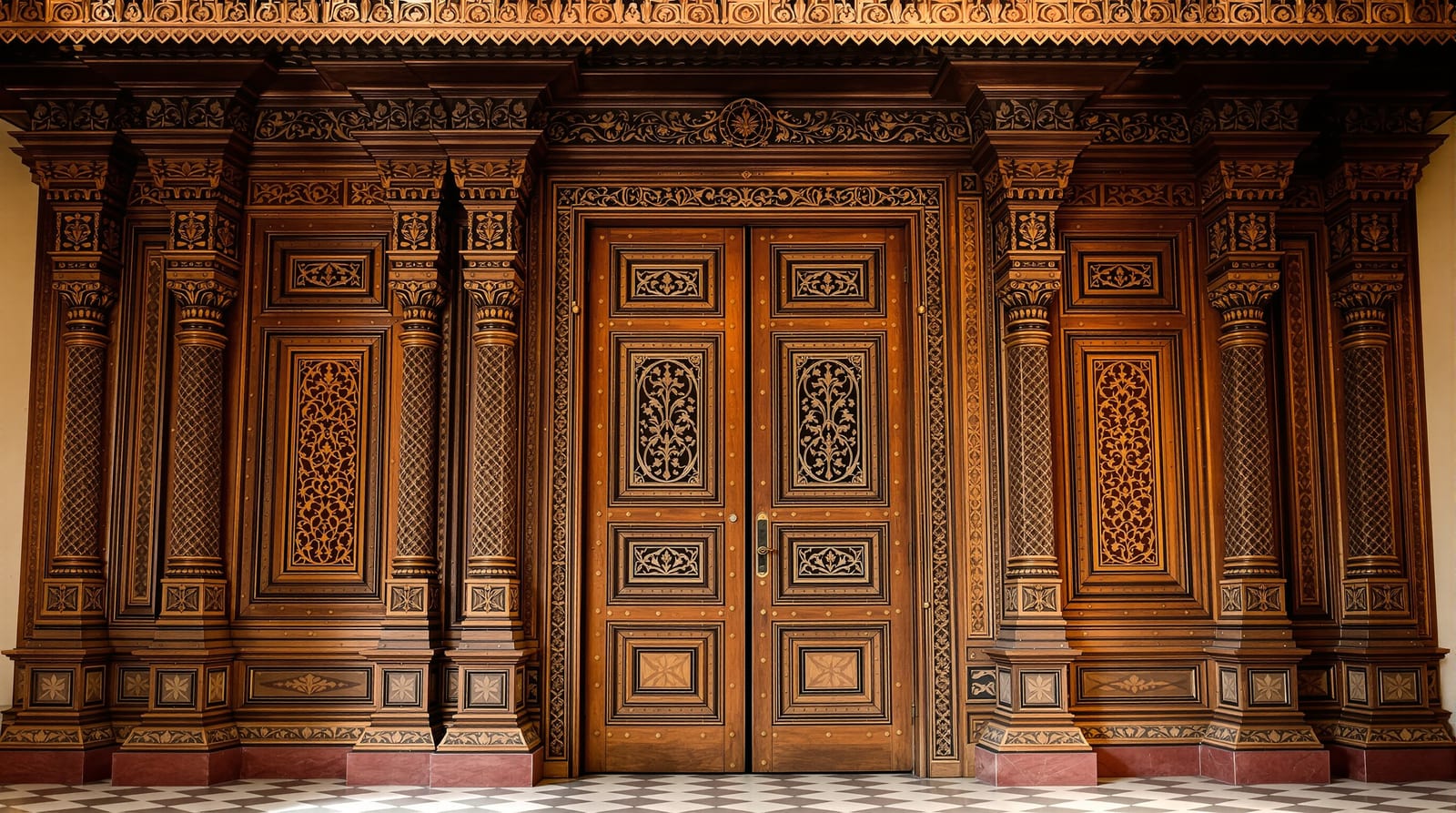
Traditional Indian Door Designs: Kerala, Chettinad, Rajasthani & Temple-Style Heritage Doors
A heritage tour of India's great door traditions - Kerala nalukettu teak, Chettinad mansions, Rajasthani haveli carving, South-Indian temple doors, brass cladding and nakshi work, thresholds and toranas - and how to bring reclaimed and revival traditional doors into a modern home.
A traditional Indian door is never just an entrance. For centuries it has been the family's face to the street, a carved invitation to good fortune, and a quiet record of where the household came from - the timber of the region, the gods of the household, the wealth of the trade that paid for it. From the oiled teak doors of a Kerala nalukettu to the towering Burma-teak portals of a Chettinad mansion and the chisel-deep carving of a Rajasthani haveli, India's door traditions are some of the richest in the world. This guide is a heritage tour: what each great regional tradition looks like and why, the craft vocabulary you will hear from carpenters and antique dealers, and - just as important - how to bring a genuinely traditional door into a modern home without it becoming a maintenance headache or a fake.
Why traditional doors look the way they do
Before touring the regions, it helps to understand the logic. A traditional Indian door is shaped by four forces that still apply today.
Climate and timber. The wood was almost always local and chosen to survive the local climate. Kerala and the coast leaned on teak and anjili (wild jackwood) for monsoon and termite resistance; Rajasthan used sturdy sheesham (Indian rosewood) and sometimes mango; the Chettiars, made wealthy by trade, imported Burma teak by the shipload. Climate also dictated the heavy frame and the raised threshold - both keep a swelling, sticking door square through a brutal monsoon.
Belief and Vastu. The main door (the mukhya dwar) is treated in Vastu as the mouth through which energy and prosperity enter the home, which is why so much carving, colour and symbolism concentrate there. Doors traditionally carried Ganesha, Lakshmi, Gajalakshmi (Lakshmi flanked by elephants), the kalasha (auspicious pot), lotus, peacocks, parrots and creeping vines - all symbols of welcome, fertility and protection. The decorated lintel band above the door, the torana, frames this blessing. These choices are tradition and belief layered over sound practice; for the directional rules (best door in north, east or north-east; door as the largest; opening inward and clockwise), see our entrance Vastu guide and the focused Vastu main door guide.
Craft and status. Carving was hand labour, and labour was the cost. The depth and density of the carving, the use of brass, and sheer scale signalled the family's standing. A merchant's haveli or a Chettiar mansion announced wealth through its door long before a visitor stepped inside.
Joint-family living. Big thresholds, double leaves and generous openings suited households where many people, processions, palanquins and goods moved through a single grand entrance. The even number of leaves you so often see (two, four) is both auspicious in Vastu and practical for a wide ceremonial doorway.
The great regional traditions
India does not have one traditional door - it has many, and a practised eye can place a door by region. Here are the headline traditions.
| Tradition | Region | Typical timber | Signature look | Where you still see it |
|---|---|---|---|---|
| Nalukettu / Kerala | Kerala, coastal Karnataka | Teak, anjili (wild jack) | Oiled dark wood, restrained relief carving, brass studs, deep frame, raised threshold | Heritage homes, resorts, restored tharavadus |
| Chettinad | Tamil Nadu (Chettinad region) | Burma teak, satinwood | Tall, massive double doors, ornate carving, brass and lacquer, jewelled detail | Chettiar mansions, Athangudi-tiled homes, boutique hotels |
| Rajasthani haveli | Rajasthan, Gujarat | Sheesham (rosewood), mango | Chisel-deep relief, brass bosses and studs, bold colour, jharokha-style framing | Havelis, palaces, vintage-decor homes |
| South-Indian temple | Tamil Nadu, Karnataka, Andhra | Teak, rosewood | Heavy carved deities, brass cladding, large brass bells/knockers, vermilion | Temples, pooja rooms, traditional entrances |
| Saurashtra / Kutch | Gujarat | Teak, sheesham | Geometric and folk carving, mirror and brass accents | Folk-art homes, heritage stays |
Kerala and the nalukettu door
The nalukettu is the classic Kerala courtyard house, and its doors set the tone for the whole tradition: dark, oiled, calm and built to outlast the family. The wood is usually teak or anjili, finished with oil rather than high-gloss polish so the grain stays visible and the surface can be re-oiled forever. Carving is present but restrained - a carved top panel, a band of lotus or vine, brass studs (often in rows) and a heavy padi (raised threshold) you literally step over. The whole composition is engineered for the Kerala monsoon: heavy frame, generous overhang and rot-resistant timber. If you love this look, the timber choices matter enormously - read the teak wood doors guide before you commit.
Chettinad: the maximalist masterpiece
If Kerala doors whisper, Chettinad doors announce. The Chettiar trading community of Tamil Nadu built mansions in the 19th and early 20th centuries financed by South-East Asian trade, and they spent it on the entrance. Doors here are tall and massive - often double-leaved and over nine feet high - in imported Burma teak and satinwood, carved with extraordinary density and finished with brass, lacquer and sometimes inlaid detail. They sit within mansions famous for hand-made Athangudi cement tiles, Belgian glass and Burmese teak pillars, so the door is one chapter in a whole grammar of opulence. A genuine antique Chettinad door is now a collector's item; revival versions are made to order by specialist carpenters in Tamil Nadu.
Rajasthani haveli doors
Rajasthan's haveli doors are about depth of carving and boldness of colour. Worked in sheesham (Indian rosewood) or mango, they carry chisel-deep relief - florals, elephants, peacocks, geometric jali-like patterns - studded with brass bosses and large decorative nails, often painted in deep colours or left in rich natural wood. The arched jharokha vocabulary of the region carries into the door framing. These are the doors most often salvaged and resold as statement "antique Indian doors" in the decor trade, precisely because the carving reads beautifully even out of context.
South-Indian temple-style doors
The temple door is the most sacred and the most ornamented. Made in teak or rosewood, it carries carved deities and dwarapalakas (guardian figures), is frequently clad or studded in brass, and is fitted with heavy brass knockers, bells and the large lock-and-bolt hardware of temple practice. This vocabulary flows directly into the home through the pooja room: a smaller carved-and-brass door with bells, a kalasha motif and an auspicious threshold. For doing that thoughtfully in a modern home, see the pooja room door guide.
The craft vocabulary: carving, brass and thresholds
Traditional doors come with their own language. Knowing the terms helps you buy well and talk to a carpenter or dealer.
Nakshi (carving). Nakshi is hand relief carving - the floral vines, deities, peacocks, lotuses and geometric borders chiselled into solid wood. Depth and crispness are everything: deep, undercut carving in seasoned hardwood is the mark of quality, while shallow machine-routed "carving" glued onto a flush door is the budget imitation. Genuine carving is done on solid, well-seasoned timber so it does not crack as the wood moves.
Brass cladding and studwork. Brass appears three ways: thin sheet cladding (sometimes embossed with repousse deity or floral panels) wrapping the door or its panels; rows of studs and bosses (decorative nail-heads) that are both ornamental and structural; and hardware - knockers (often a lion or ring), bells, hinges, bolts and corner brackets. Brass needs occasional polishing or a clear lacquer to control tarnish, and in coastal air it tarnishes faster.
Torana (lintel band). The carved or decorated band across the top of the doorway. In wood it is the carved lintel panel; in living tradition it is also the fresh toran of mango leaves and marigold hung across the door at festivals and weddings - a welcome and a blessing.
Dehleez / padi (threshold). The raised threshold you step over. Traditionally recommended in Vastu, it also has real functions: it stops monsoon water and dust, separates the sacred interior from the street, and stiffens the frame. (Note the modern tension: a high threshold is the enemy of wheelchair access. For accessible homes the threshold is kept to about 12 mm - see the accessible home design guide. A traditional-look door can keep a shallow symbolic sill without a trip hazard.)
Here is the anatomy of a traditional carved main door, labelled:
What a traditional door costs in 2026
Traditional doors split into three honest buckets - newly carved revival doors, genuine salvaged antiques, and traditional-look factory doors. Treat every figure as indicative and varying by city, timber rate, carving depth and vendor; run your own numbers with the door cost calculator.
| Option | What you get | Indicative 2026 cost | Notes |
|---|---|---|---|
| Lightly carved CP-teak main door (new) | Genuine teak, machine-assisted plus hand carving, brass studs | About Rs 25,000-60,000 (shutter) | Plus frame, hardware, fitting; the everyday "traditional" door |
| Hand-carved Burma/CP teak heirloom door (new) | Deep hand nakshi, double leaf, brass | About Rs 60,000 to Rs 1,50,000+ | Carving labour and timber volume drive the price |
| Genuine antique salvaged door (Rajasthani/Chettinad) | Old solid wood, original carving and brass | About Rs 15,000 to Rs 1,00,000+ | Condition, size and provenance dependent; restoration extra |
| Brass-clad temple/pooja door (new) | Carved teak with brass sheet cladding and bells | About Rs 20,000 to Rs 80,000+ | Brass weight and embossing add cost |
| Traditional-look engineered/laminate door | Printed or routed "carved" look on flush/engineered core | About Rs 4,000 to Rs 12,000 | Budget echo, not the real thing; see notes below |
| Carving (hand), add-on | Per panel / per sq ft of carved area | Rs 1,500 to Rs 8,000+ per panel | Deep undercut work costs much more than shallow |
| Frame (chowkat), teak/sal | Per running foot | Rs 350 to Rs 900 per ft run | Heavy traditional frames use more timber |
| Brass hardware set (knocker, studs, handles) | Knocker, bolts, studs, corner brackets | Rs 1,500 to Rs 8,000+ | Solid brass costs more than brass-plated |
Add roughly 18 percent GST, plus installation labour of about Rs 800 to Rs 3,000 per door. A serious carved teak main door, framed, hardware-fitted and installed, easily lands in the Rs 25,000 to Rs 1,50,000-plus band the heritage look implies - the same territory as a premium main door.
Buying genuine vs traditional-look: how not to be fooled
The traditional door market is full of beautiful real things and convincing fakes. A few rules:
- Check it is solid wood, not veneer. Tap it (solid wood is dense and dull, hollow cores ring); look at the door edge and the back of carving for continuous grain, not a glued-on veneer face. Real nakshi is carved into the body of the wood.
- Confirm the timber. "Teak" is the most abused word in the trade - ask which teak (Burma, CP, African) and check grain and oiliness. The teak wood doors guide shows how to spot genuine teak from stains and lookalikes.
- Inspect antique condition honestly. Salvaged doors can hide rot, old borer damage, splits and missing brass. Budget for restoration, re-fitting to a new frame, and termite treatment of non-teak timbers.
- Beware printed "carving." Budget doors fake the look with routed grooves or a printed laminate over a flush/engineered core. They are fine as an affordable nod to tradition, but they are not heirlooms - know which you are buying. For where these sit, see the wooden doors and door materials comparison guides.
- Mind the codes. Even a heritage-look main shutter should respect modern sense: NBC 2016 favours an external door of about 1000-1200 mm width and 2100 mm height, and IS 2202 / IS 1003 cover the shutters and frames a carpenter or factory should be building to. A traditional double door reads grand at about 1200 mm-plus overall.
Bringing tradition into a modern home
You do not need an ancestral tharavadu to live with a traditional door. The most successful modern uses are deliberate, not wholesale:
The hero main door. A single carved teak main door against an otherwise contemporary facade is the highest-impact move - it gives the home a soul and a story without committing the whole house to a period look. Pair it with simpler internal doors.
The pooja room door. The clearest place tradition still lives. A small carved-and-brass door, with a kalasha motif, bells and an auspicious sill, anchors the home's sacred corner - covered fully in the pooja room door guide.
Reclaimed doors as features. Salvaged Rajasthani or Chettinad doors are used as repurposed feature pieces - a headboard, a sliding barn-style partition, a table top, or a genuine entrance after restoration. Buying reclaimed also keeps beautiful old timber out of landfill. Just verify timber, treat for borer, and have it re-hung properly.
Detail, not pastiche. A brass knocker, a carved lintel torana band, a row of brass studs on a plain teak door, or a marigold toran at festivals can evoke the tradition without a full carved facade - useful when budget or a modern scheme rules out a heritage door.
Whatever route you choose, the relationship between door and the rest of the openings matters: a carved heritage door sits more comfortably when windows and secondary doors are coordinated, which our windows and doors design guide walks through.
Frequently asked questions
What is the best wood for a traditional Indian carved door?
Teak (sagwan) is the heritage benchmark - its natural oil and silica resist termites and monsoon swelling, and it holds deep carving crisply. Burma teak is the connoisseur's heirloom timber; CP (Indian plantation) teak is the practical sweet spot for most homes. Rajasthani traditions also use sheesham (rosewood) and mango, which carve beautifully but need termite treatment that teak does not. See our teak wood doors guide for choosing between teak grades.
How can I tell a genuine antique door from a reproduction?
Look for continuous grain through the carving (real nakshi is cut into solid wood, not glued on), honest signs of age and wear, original hand-made brass studs and hardware, and tool marks rather than uniform machine routing. Tap it - solid old wood sounds dense, not hollow. Genuine antiques often hide rot or borer damage, so inspect the back and edges and budget for restoration.
Are traditional doors compatible with Vastu?
Yes - they are often built around it. The main door is treated as the home's mouth of prosperity, traditionally placed in the north, east or north-east, made the largest door, opening inward and clockwise, with auspicious motifs (Ganesha, Lakshmi, kalasha) and an even number of leaves. The raised threshold (dehleez) is itself a Vastu recommendation. Frame these as belief plus sensible practice, and see our entrance Vastu and Vastu main door guides for the directional rules.
Can a traditional door work in a small modern flat?
Absolutely - just be selective. A single carved teak main door or a small brass-accented pooja door gives a flat real character without overwhelming it. Keep the threshold shallow (about 12 mm) for safety and accessibility, choose a lighter, lower-relief carving so it does not feel heavy in a compact space, and let the rest of the doors stay simple and contemporary.
How do I maintain a carved wooden door with brass?
Re-oil or re-polish the wood every year or two (teak loves oil finishes and the grain comes back beautifully), keep deep carving free of dust with a soft dry brush, and polish or lacquer the brass to control tarnish - faster in coastal, humid air. Check the threshold and frame for monsoon water ingress, and treat any non-teak timber periodically against termites and borer.
Export this guide
Related Guides — Deep-dive reading
Kerala Traditional Doors: The Nalukettu Padippura & Carved Main Door Explained (2026)
The heritage door style of the Kerala tharavadu, from the padippura gateway to the carved teak and aanjili main door, its motifs, brass studs and panel proportions, and how it is revived in modern Kerala homes.
Home Doors & EntrancesCarved Door Designs in India (2026): Motifs, Regional Styles, Hand vs CNC & Costs
A design-led guide to ornamental carved wooden doors for Indian homes — regional traditions, motifs, hand-carving vs machine carving, wood choice, where they belong and what they cost.
Home Doors & EntrancesChettinad Doors in India: The Grand Teak Doors of Chettinad Mansions
Massive Burma-teak entrance doors, brass studs, ornate locks and the thinnai context — and how to source, restore and reuse a reclaimed Chettinad door today.
Home Doors & EntrancesRelated Tools — Try Free
Cross-Ventilation Analyzer
Estimate airflow and air changes per hour (ACH) from room size, window areas, layout, and local wind — with NBC 2016 Part 8 compliance check.
Ventilation CalculatorDoor Cost Calculator
Estimate the all-in cost of a door — leaf, frame, hardware, fitting and GST — by type, material and size.
Door CalculatorWindow Hardware Cost Calculator
Estimate window hardware cost — hinges, handles, locks, rollers and multipoint gears.
Window Calculator