
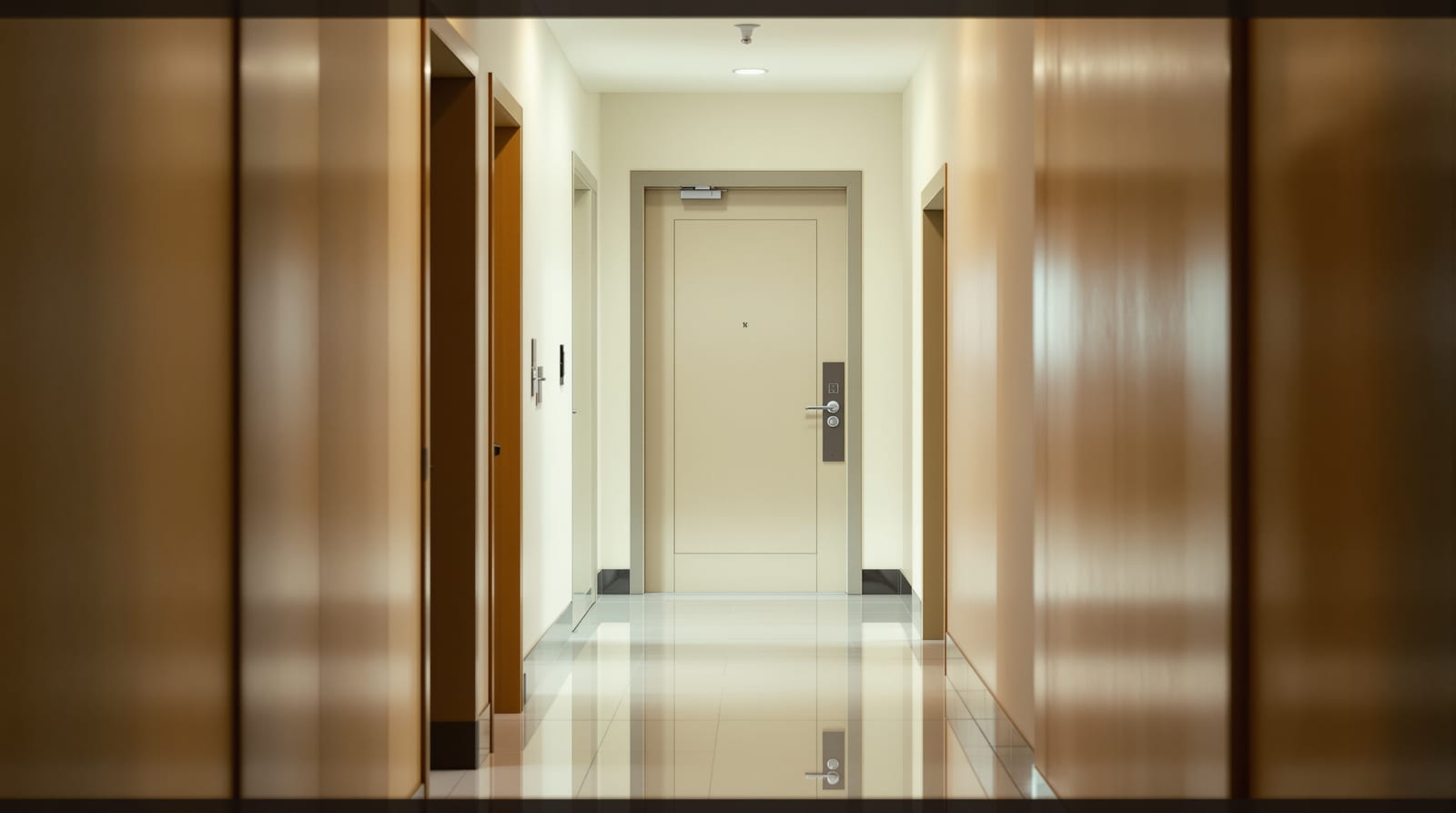
Door Standards India: IS Codes, NBC 2016, Fire & Accessibility Rules for Residential Doors
The consolidated map of every standard that governs a residential door in India — IS material/construction codes, NBC 2016 widths and egress, fire-door ratings, and RPwD accessibility — and which one applies where.
Ask three suppliers what "standard" their door meets and you will get three different answers — one quotes IS 2202, one quotes a fire rating, one shrugs. The truth is that a single residential door is governed by a stack of standards working in parallel: one set tells you how the leaf is built, another how wide the opening must be, another whether it will hold back fire, and another whether a wheelchair can pass through it. This guide is the map of that stack — what each standard covers, where it bites, and which document to cite on your drawings and in your purchase order. It is written for architects, specifiers and serious self-builders who need to get the references right, not just the door.
The standards stack, at a glance
There is no single "door code" in India. A door is regulated by product standards (Bureau of Indian Standards, the IS series — how the thing is made), by the building code (National Building Code of India 2016 — how wide, where, which way it opens), by fire-test standards (ratings and the tests behind them), and by accessibility guidance (the RPwD Harmonised Guidelines). Most are referenced indirectly: your state building bye-laws and the local municipal sanction adopt NBC clauses, and NBC in turn calls up the IS product standards. So when a drawing says "flush door to IS 2202," it is leaning on a chain that ends at a code your plan was sanctioned under.
The single most useful thing you can carry into a project is a clear sense of which standard answers which question. That is the table below.
Which standard governs what
This is the centrepiece — the routing table. Find the question on the left, cite the standard on the right, and follow the link to the deep-dive.
| Question about the door | Governing standard / document | What it actually specifies |
|---|---|---|
| How is a flush (smooth) door shutter built? | IS 2202 (Part 1) | Solid-core / cellular-core wooden flush shutters: core, lipping, face panels, adhesives, end-immersion test, dimensions and tolerances |
| How is a panelled or glazed timber shutter built? | IS 1003 (Part 1) | Timber panelled and glazed shutters — stiles, rails, panel grooves, glazing |
| How are door, window and ventilator timber frames made? | IS 1003 (Part 2) and IS 4021 | Frame (chowkat) sections, joints, sizes and timber grades |
| How is a steel/pressed-metal frame made? | IS 4351 | Pressed-steel door frames — profile, gauge, hinges, fixing |
| How is an FRP / glass-fibre door made? | IS 14856 | Fibre-reinforced plastic shutters and frames — for wet and coastal areas |
| What is the minimum door width and where do doors go? | NBC 2016, Part 3 | Widths of habitable-room, bath/WC and main doors; planning of openings |
| What does an exit / emergency door have to do? | NBC 2016, Part 4 | Min exit-door width (≥ 1000 mm), opening in the direction of egress, no obstruction, fire separation |
| Will the door hold back fire, and for how long? | IS 3614 (Part 1 metallic, Part 2 non-metallic), tested to IS/EN 1634 or BS 476 Part 22 | Fire-check / fire-resistant doors, rated 30 / 60 / 90 / 120 minutes for integrity (and insulation) |
| Can a wheelchair user pass through? | RPwD Harmonised Guidelines 2021 (+ NBC Part 3 accessibility) | Clear opening width (~800-900 mm), flush/low threshold (≤ 12 mm), lever hardware, approach clearances |
| Is the glazing in/around the door safe? | IS 3548 (workmanship) + safety-glass IS codes | Glazing installation and, for large lights, toughened/laminated safety glass |
| Does the door help meet green-building / energy goals? | ECBC-R / Eco-Niwas Samhita, IGBC / GRIHA criteria | Air-tightness, U-value of glazed/external doors, materials and certification — credit-based, not pass/fail |
Treat that table as the index to this whole cluster. The next sections expand the four families that matter most.
Family 1 — IS product standards (how the door is built)
These are the codes you write into a specification clause and a purchase order. They do not care where the door goes; they govern the object itself.
- IS 2202 (Part 1) — wooden flush door shutters. The workhorse for internal doors. It distinguishes solid-core (block-board / particle-board core, heavier, sturdier) from cellular / hollow-core (lighter, cheaper). It sets the lipping (the hardwood edge band), face-veneer or laminate facing, adhesive type, and a 24-hour end-immersion / knife test that is the real differentiator between a door that survives an Indian bathroom doorway and one that delaminates in a monsoon. When a factory door is "ISI marked," this is usually the mark.
- IS 1003 (Part 1) — panelled and glazed shutters; (Part 2) — frames. Governs traditional stile-and-rail panel doors and the timber chowkat. Defines section sizes, panel thickness and glazing rebates.
- IS 4021 — timber door, window and ventilator frames. The frame counterpart, covering sizes, rebates and joinery for solid-timber frames.
- IS 4351 — steel door frames. Pressed-steel chowkats — common in apartments and economy housing for dimensional uniformity and termite immunity. Specifies sheet gauge, profile, built-in hinges and the lugs that grip the masonry.
- IS 14856 — FRP / glass-fibre door shutters and frames. The standard to cite for wet, coastal and corrosion-prone locations where timber and steel both struggle.
Quoting the IS number alone is not enough — add the grade/type and the test you want (for example, "IS 2202 Part 1, solid-core, BWP-grade adhesive, passes end-immersion test"). For the material trade-offs behind these, see the door materials comparison for India and the steel doors guide.
Family 2 — NBC 2016 (widths, exits and egress)
The National Building Code does not specify how a door is made; it specifies how big the opening is and how it behaves in an emergency. Two parts matter.
Part 3 (Development Control & General Building Requirements) drives the everyday sizes. The widely-followed minimums in residential practice:
| Door | Common clear / leaf size | Notes |
|---|---|---|
| Main / entrance | 1000-1200 mm × 2100 mm (often 3.5' × 7') | Should be the widest; the door of record for any access requirement |
| Bedroom / habitable room | 900 mm × 2100 mm (3' × 7') | Standard internal leaf |
| Kitchen / utility | 800-900 mm × 2100 mm | |
| Bathroom / WC | 700-750 mm × 2000-2100 mm | Smallest permitted; affects accessibility |
| Standard height | 2100 mm (7') | Frame adds ~50-75 mm to the masonry opening |
Part 4 (Fire & Life Safety) is the one that turns a door into life-safety equipment. For an exit / emergency egress door the code requires a minimum 1000 mm width, that it open in the direction of escape, that it is never locked against egress while occupied, and — where it forms part of a fire separation — that it is a rated fire door. In a single dwelling these clauses rarely bite at internal doors, but they govern the main exit, common-area and stair doors of apartments and any door in a fire-compartment wall. For the size logic in plain terms, see the dedicated door size standards for India and the clearance basics in how to measure a small room.
Family 3 — fire doors (ratings and the tests behind them)
A "fire door" is not a material; it is a tested assembly — leaf, frame, intumescent seals, hinges, closer and lock — that together resists fire for a stated time. The number you specify is a rating in minutes:
- 30 min (FD30) — typical apartment entrance to a protected lobby.
- 60 min (FD60) — common in higher-rise residential and where two-hour compartments need a half-hour-plus door.
- 90 / 120 min (FD90 / FD120) — service shafts, plant rooms, basement and high-risk separations.
Two attributes hide behind the rating: integrity (E) — it stops flame and hot gases passing — and, for higher specs, insulation (I) — the unexposed face stays cool enough not to ignite what leans against it. So "FD60 EI" is a stronger claim than "FD60 E."
In India the products are covered by IS 3614 — Part 1 for metallic and Part 2 for non-metallic / fire-check doors — and the test evidence comes from a fire-resistance test to IS/EN 1634-1 or the older BS 476 Part 22. When you specify a fire door, demand the test certificate from an accredited lab for the exact assembly, not a generic claim — a rated leaf in an unrated frame with the wrong hinges is not a fire door. This matters in residential work for apartment-entrance and shaft doors flagged by NBC Part 4.
Family 4 — accessibility (RPwD Harmonised Guidelines 2021)
Accessibility for doors is governed by the Harmonised Guidelines and Standards for Universal Accessibility in India, 2021 (under the Rights of Persons with Disabilities Act), which NBC Part 3 echoes. For a residential door the practical asks are:
- Clear opening width of roughly 800-900 mm — a 900 mm leaf yields about 810-850 mm clear once the frame, stop and open leaf are deducted, so the bathroom door at 700 mm is the usual failure point.
- Threshold ≤ 12 mm, bevelled — no step or raised sill to trip a wheelchair or a cane.
- Lever handles, not knobs; reachable hardware and a manageable opening force.
- Approach clearances — floor space beside the latch so a wheelchair user can reach the handle and pull the leaf clear.
These are mandatory for public buildings and increasingly expected in residential common areas; for a private home they are best practice that future-proofs the house for ageing-in-place. See the accessible doors guide for India and the broader accessible home design overview.
How the standards map onto one door — a diagram
The same leaf carries several standards at once. This shows where each one lands.
What this means on a real residential job
For most homes, the standards collapse to a short checklist. Internal doors: an IS 2202 flush or IS 1003 panel shutter on an IS 4021 / IS 4351 frame, sized per NBC Part 3, with at least the bathroom door watched for accessibility clear width. Apartment and high-rise work adds NBC Part 4 egress and IS 3614 fire doors at the flat entrance and shafts. Coastal or perennially-wet openings push you to IS 14856 FRP. Green-rated projects layer IGBC / GRIHA door credits on top — air-tightness and external-door U-values — without changing the underlying product codes.
A note on commercial reality: factory ISI-marked doors carry the IS reference and are easy to specify and verify; the carpenter-made door is governed by the same IS clauses but you must write them into the contract to make them enforceable. Prices (indicative, varies by city and vendor, add ~18% GST) run roughly ₹1,200-4,000 per shutter for a basic IS 2202 flush door, ₹8,000-25,000 for an IS 4351 steel security door set, and a meaningful premium for a certified fire door because you are paying for the test evidence, not just the leaf.
For how all of this becomes drawings, schedules and tolerances on a project, see the architect's guide to residential doors in India.
Frequently asked questions
Is there a single "door standard" in India I can just cite?
No — and treating one as universal is the common mistake. A door is governed by a stack: an IS product standard for how it is made (IS 2202, 1003, 4021, 4351, 14856), NBC 2016 Parts 3 and 4 for width and egress, IS 3614 plus IS/EN 1634 or BS 476 for fire, and the RPwD Harmonised Guidelines 2021 for accessibility. Cite the one that answers your specific question — use the table above to route.
What does a fire-door "rating" actually mean?
It is the time in minutes the tested assembly resists fire — typically 30, 60, 90 or 120. The leaf, frame, seals, hinges and closer are tested together to IS/EN 1634-1 or BS 476 Part 22, and the product is covered by IS 3614. Always insist on a test certificate for the exact assembly; a rated leaf in the wrong frame is not a fire door.
What is the minimum door width by law in India?
NBC 2016 Part 3 drives common minimums — about 1000-1200 mm for the main door, 900 mm for bedrooms, 700-750 mm for bathrooms, all at 2100 mm height. NBC Part 4 sets a separate, stricter floor for exit/emergency doors at 1000 mm minimum, opening in the direction of escape. See the door size standards guide for the full chart.
Do accessibility rules apply to a private home?
Strictly, the RPwD Harmonised Guidelines 2021 are mandatory for public buildings and common areas, not private interiors. But applying them — roughly 800-900 mm clear width, a threshold under 12 mm and lever handles — is strong best practice that future-proofs a home for ageing and reduced mobility, and costs little if planned early.
Does a factory ISI-marked door automatically meet the building code?
The ISI mark confirms the door meets its product standard (for example IS 2202). It does not confirm the door meets NBC width or egress requirements, fire rating or accessibility — those depend on size, location and the assembly. Product compliance and building-code compliance are separate checks; you need both.
Export this guide
Related Guides — Deep-dive reading
NBC Door Requirements India: A Plain-Language Guide (NBC 2016)
What the National Building Code 2016 actually asks for on door sizes, exits, fire safety and accessibility — and how local bye-laws layer on top.
Home Doors & EntrancesDesigning Adaptable & Universal-Design Homes
Accessibility, Aging-in-Place, and the Multi-Stage Family — Code, Anthropometrics, and Plan-Stage Discipline for Indian Residential Architects
Room PlanningThe Architect's Guide to Residential Doors (India): Specification, Schedules & Standards
How to specify residential doors that survive procurement, the monsoon and site: door schedules, leaf-frame-hardware specs, IS codes, fire and egress, accessibility, handing and tolerances.
Home Doors & EntrancesRelated Tools — Try Free
Accessible Door Checker
Check a door against wheelchair-accessibility guidance — clear width, threshold, handle and closer force per RPwD 2021.
Compliance ToolWindow Material Comparison Tool
Compare uPVC, aluminium, wood, steel and composite windows on cost, life, upkeep and insulation.
CompareCross-Ventilation Analyzer
Estimate airflow and air changes per hour (ACH) from room size, window areas, layout, and local wind — with NBC 2016 Part 8 compliance check.
Ventilation Calculator