
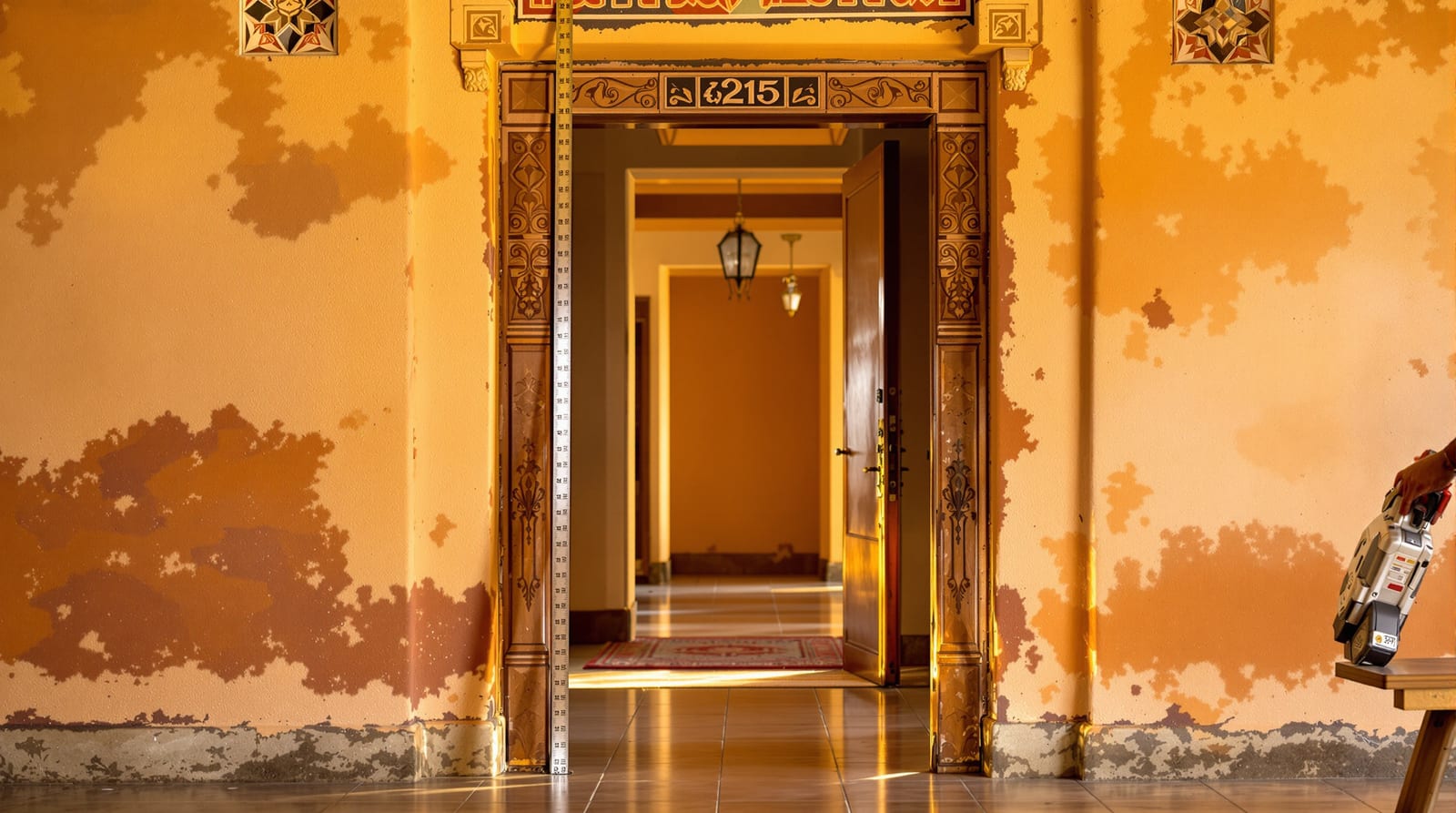
Door Size Standards in India: Standard Door Sizes by Room (mm & feet), NBC 2016 Widths & Frame Allowances
The complete dimensional reference for every door in an Indian home — standard sizes for main, bedroom, bathroom, kitchen and utility doors in millimetres and feet, the universal 2100 mm height, frame and swing allowances, NBC 2016 widths and the accessible clear-width rule.
Ask a carpenter for "a normal door" and you will get whatever fits the hole the mason left — which is exactly how homes end up with a 6'6" bedroom door, a bathroom door too narrow for a bucket, and a main door that looks mean against a tall living room. Door sizes are not folklore; they follow the National Building Code (NBC) 2016, the relevant IS standards, and a few clearances that decide whether the leaf actually swings without scraping the floor. This is the dimensional reference for the whole house: what size each door should be, in both millimetres and feet, why the height is almost always 2100 mm, and how much extra to leave for the frame and the swing. Get these numbers onto the plan before the chowkats (frames) are cast, and you never have to break a wall to widen an opening.
The one number that almost never changes: height
Across an Indian home, door height is standardised at 2100 mm (7 ft) for nearly every internal and external door. Keeping a single height makes the frames, architraves and shutters consistent, lets a factory cut to one length, and simply looks calmer than a wall of mismatched tops. You will occasionally see 2000 mm (6'6") for tight bathrooms or a service door, and grand main doors stretched to 2400 mm (8 ft) in double-height foyers — but treat 2100 mm as the default and vary it only with a reason.
What changes room to room is width, and width is chosen by function: how wide a thing has to pass through (a person, a wardrobe carcass, a fridge) and how much privacy, security or airflow the room needs.
The standard door size chart (India)
This is the centrepiece — the sizes you can hand to an architect, carpenter or factory. All figures are leaf/shutter sizes (width × height); the masonry opening must be larger to take the frame (see the frame-allowance section). Sizes are indicative and vary by city, vendor and plan.
| Door | Width (mm) | Height (mm) | Width (feet) | Height (feet) | Typical leaf |
|---|---|---|---|---|---|
| Main / external entrance | 1000-1200 | 2100 | 3'3" - 4'0" | 7'0" | Single (often 3.5') or double |
| Master bedroom | 900 | 2100 | 3'0" | 7'0" | Single |
| Other bedrooms | 800-900 | 2100 | 2'8" - 3'0" | 7'0" | Single |
| Kitchen | 800-900 | 2100 | 2'8" - 3'0" | 7'0" | Single |
| Utility / service / rear | 800-900 | 2100 | 2'8" - 3'0" | 7'0" | Single (often paired with steel grille) |
| Bathroom / WC | 700-750 | 2000-2100 | 2'3" - 2'6" | 6'6" - 7'0" | Single |
| Pooja room | 700-800 | 2000-2100 | 2'3" - 2'8" | 6'6" - 7'0" | Twin leaf (even number traditional) |
| Balcony / terrace access | 900-1200 | 2100 | 3'0" - 4'0" | 7'0" | Sliding / French |
| Store / pantry | 600-750 | 2000-2100 | 2'0" - 2'6" | 6'6" - 7'0" | Single |
A few practical reads of this chart:
- The main door should be the largest in the house. A 1000-1200 mm (≈ 3.5-4 ft) leaf both reads as the entrance and lets furniture in. This also aligns with the Vastu instinct that the entrance be the biggest door — more on that below.
- 900 mm is the workhorse internal width. It is wide enough for almost everything you need to carry through and, crucially, gives an accessible clear width. Drop to 800 mm only where space is genuinely tight, and never on a door you might one day need wheelchair access through.
- Bathrooms are the narrowest at 700-750 mm — but going below 700 mm makes daily use awkward and forecloses accessibility, so resist the temptation to steal the last inch.
Width in inches, the way carpenters actually talk
On site, most Indian carpenters and contractors quote doors in feet and inches, not millimetres, and round to convenient figures. It helps to be fluent in both. Here is the rough correspondence so a plan in mm survives translation on site.
| Feet / inches | Millimetres (approx) | Common use |
|---|---|---|
| 2'0" | 600 mm | Store / pantry |
| 2'3" | 685 mm | Bathroom (tight) |
| 2'6" | 750 mm | Bathroom / WC |
| 2'8" | 800 mm | Small bedroom / kitchen |
| 3'0" | 900 mm | Bedroom / kitchen (standard) |
| 3'6" | 1050 mm | Main door (single) |
| 4'0" | 1200 mm | Main door (wide / double-leaf each ~600) |
When you specify a door, give the carpenter both: "900 × 2100 mm, that's 3 by 7." It removes the rounding ambiguity that produces a door 25 mm off the plan.
Frame, swing and clearance: the allowances that make sizes work
A door size is meaningless without the allowances around it. Three of them decide whether the leaf you ordered will actually fit and function.
Frame (chowkat) allowance. The masonry opening must be bigger than the leaf to take the frame. A timber frame section is typically 100-125 mm × 60-75 mm, so add roughly 50-75 mm to each side and to the head when sizing the wall opening. As a rule of thumb, a 900 × 2100 mm leaf wants a masonry opening of about 1000-1050 mm wide × 2175-2200 mm high. Cast the opening to the frame, not to the leaf.
Leaf-to-frame clearances. Once hung, the shutter needs small gaps so it swings without binding and so timber can move with monsoon humidity: about 2-4 mm at the head and each side, and 6-10 mm at the bottom (12-18 mm undercut where you want air to flow under a bathroom or kitchen door). These gaps are why a shutter is always made a touch smaller than its frame rebate.
Swing and clearance. A standard hinged door needs a clear arc equal to its width. A 900 mm leaf sweeps a 900 mm radius, so you must keep that floor space — and the approach in front of it — free of furniture, wardrobes and the path of a second door. Hinge the door against an adjacent wall so it opens flat against it, leave roughly 300-450 mm of dead wall beside the hinge, and make sure two doors near a corner do not collide when both are open. For the room-by-room measuring routine behind these clearances, our students' guide on how to measure a small room walks through swing arcs and approach space step by step. Where swing space is scarce, switch the door type rather than shrink the leaf — a sliding or pocket door removes the arc entirely.
What NBC 2016 actually requires
The chart above reflects common practice; the National Building Code sets the floor for safety, especially on widths for exit and main doors. The headline rules for homes:
- Minimum main / exit door width in a dwelling is 1000 mm, and an exit door should open in the direction of egress (outward, on the way out) under NBC 2016 Part 4 (Fire & Life Safety).
- Internal doors should be no less than 750 mm; bathroom and WC doors may go to 700 mm but narrower is discouraged.
- Height of habitable-room doors is taken as 2000-2100 mm as standard.
- Door swings must not obstruct corridors, stairs or landings when open — a planning rule that quietly governs where a door can be hinged.
NBC also points to the Harmonised Guidelines and Standards for Universal Accessibility (2021) for accessible homes, which is where the clear-width rule below comes from. These are minimums and broad strokes; the IS material standards (next section) govern how the shutter itself is built.
The IS codes behind the shutter
Sizes live in NBC; the quality and construction of the shutter and frame live in the IS standards. When you buy a factory-made door, ask which IS mark it carries.
| Standard | Covers |
|---|---|
| IS 2202 (Part 1) | Wooden flush door shutters (solid and cellular core) |
| IS 1003 (Part 1/2) | Timber panelled and glazed shutters / door frames |
| IS 4021 | Timber door, window and ventilator frames |
| IS 4351 | Steel door frames |
| IS 14856 | FRP / glass-fibre door shutters and frames |
| IS 3548 | Glazing and installation workmanship (general) |
| IS 3614 (Part 1/2) | Metallic and non-metallic fire-check doors |
A door marked to IS 2202 or IS 1003 has been made to defined dimensional tolerances and construction, which is part of why factory doors hold their sizes better than ad-hoc site-made ones.
Accessibility: the clear-width rule that overrides the leaf size
The size that matters for accessibility is not the leaf width but the clear opening width — the actual gap you can pass through when the door is open 90 degrees, measured from the face of the open leaf to the frame stop on the other side. An open leaf eats roughly 50-90 mm of its own width.
So a 900 mm leaf gives about 810-850 mm clear, which meets the practical minimum. The RPwD-aligned Harmonised Guidelines 2021 call for a minimum clear width of around 800-900 mm for wheelchair access. The corollaries:
- Specify 900 mm leaves on any door a wheelchair might use — and at minimum on the main door, a bedroom and a bathroom, so the home is convertible later.
- Keep the threshold (sill) low — ideally ≤ 12 mm and chamfered, so a wheelchair or a person with a stick is not tripped at the door.
- Pair the size with lever handles (not knobs) and enough clear floor space either side to manoeuvre.
For the full picture of designing doors and homes around mobility, see our companion guides on accessible doors in India and the broader accessible home design.
Sizes, Vastu and the main door
Traditional Vastu guidance overlaps neatly with the size logic here: the main door is meant to be the largest in the home, ideally placed in the North, East or Northeast, opening inward and clockwise without obstruction, with a threshold (dehleez) considered auspicious and an even number of leaves/panels seen as favourable. None of that conflicts with the dimensional standards — a 1000-1200 mm largest-in-the-house main door satisfies both NBC's exit-width floor and the Vastu preference at once. Treat Vastu as belief plus a useful prompt rather than a hard rule, and where it collides with structure or egress, let safety win. For the directional detail, read our entrance Vastu guide and the dedicated Vastu main door guide.
How to use these sizes when you plan
Sizes are one column of a bigger decision. Once you know each door's dimensions, you still have to settle how many doors you need, which way each swings, and where exactly it sits in the wall — that is door planning, and our residential door planning handbook carries the room-by-room door schedule that pairs with this size reference. If you want the masonry-opening and clear-width numbers worked out for your own leaf size, the door size calculator does the arithmetic for you. And because doors and windows share frames, sills and elevation lines, it is worth reading them together via our windows and doors design guide.
The discipline is simple: fix the height at 2100 mm, set widths by room from the chart, add the frame and swing allowances, and check the clear width on any door that must one day be accessible. Do that on paper, and the masons cast the right openings the first time.
Frequently asked questions
What is the standard door size in India?
The most common internal door size is 900 × 2100 mm (3 ft × 7 ft), used for bedrooms and kitchens. The main door is larger at 1000-1200 mm × 2100 mm, and bathroom doors are narrower at 700-750 mm × 2000-2100 mm. Height is standardised at 2100 mm (7 ft) across almost all doors in a home.
What is the standard door height in India?
2100 mm (7 ft) is the standard height for nearly every door in an Indian home — main, bedroom, kitchen and most bathrooms. Tight service or bathroom doors are sometimes 2000 mm (6'6"), and grand main doors in double-height foyers can rise to 2400 mm (8 ft), but 2100 mm is the default that keeps frames and shutters consistent.
How much bigger should the masonry opening be than the door?
Add roughly 50-75 mm on each side and at the head for the frame (chowkat). A 900 × 2100 mm leaf needs a wall opening of about 1000-1050 mm wide × 2175-2200 mm high. Always cast the opening to the frame size, not to the leaf size.
What is the minimum door width for wheelchair access?
A clear opening width of about 800-900 mm is needed for wheelchair access under India's Harmonised Guidelines 2021. Because an open leaf eats 50-90 mm, a 900 mm leaf (giving ~810-850 mm clear) is the practical minimum — so specify 900 mm leaves on the main door and at least one bedroom and bathroom, with a threshold ≤ 12 mm.
What size is a main door in India?
A main / external door is typically 1000-1200 mm wide × 2100 mm high (≈ 3.5-4 ft × 7 ft), and should be the largest door in the home. NBC 2016 sets the minimum exit-door width at 1000 mm, and the exit should open in the direction of egress.
Export this guide
Related Guides — Deep-dive reading
Door Standards India: IS Codes, NBC 2016, Fire & Accessibility Rules for Residential Doors
The consolidated map of every standard that governs a residential door in India — IS material/construction codes, NBC 2016 widths and egress, fire-door ratings, and RPwD accessibility — and which one applies where.
Home Doors & EntrancesDesigning Adaptable & Universal-Design Homes
Accessibility, Aging-in-Place, and the Multi-Stage Family — Code, Anthropometrics, and Plan-Stage Discipline for Indian Residential Architects
Room PlanningResidential Door Planning Handbook (India): Sizes, Swings, Placement & the Door Schedule
Plan every door in your home before the masons arrive — a room-by-room door schedule, the right sizes, swing direction and clearances, placement logic, how many doors you actually need, and the build sequence so nothing gets fixed twice.
Home Doors & EntrancesRelated Tools — Try Free
Door Size Calculator
Get the standard door and frame size by room, with swing clearance and the accessible clear-width check.
Door ToolAccessible Door Checker
Check a door against wheelchair-accessibility guidance — clear width, threshold, handle and closer force per RPwD 2021.
Compliance ToolCross-Ventilation Analyzer
Estimate airflow and air changes per hour (ACH) from room size, window areas, layout, and local wind — with NBC 2016 Part 8 compliance check.
Ventilation Calculator