
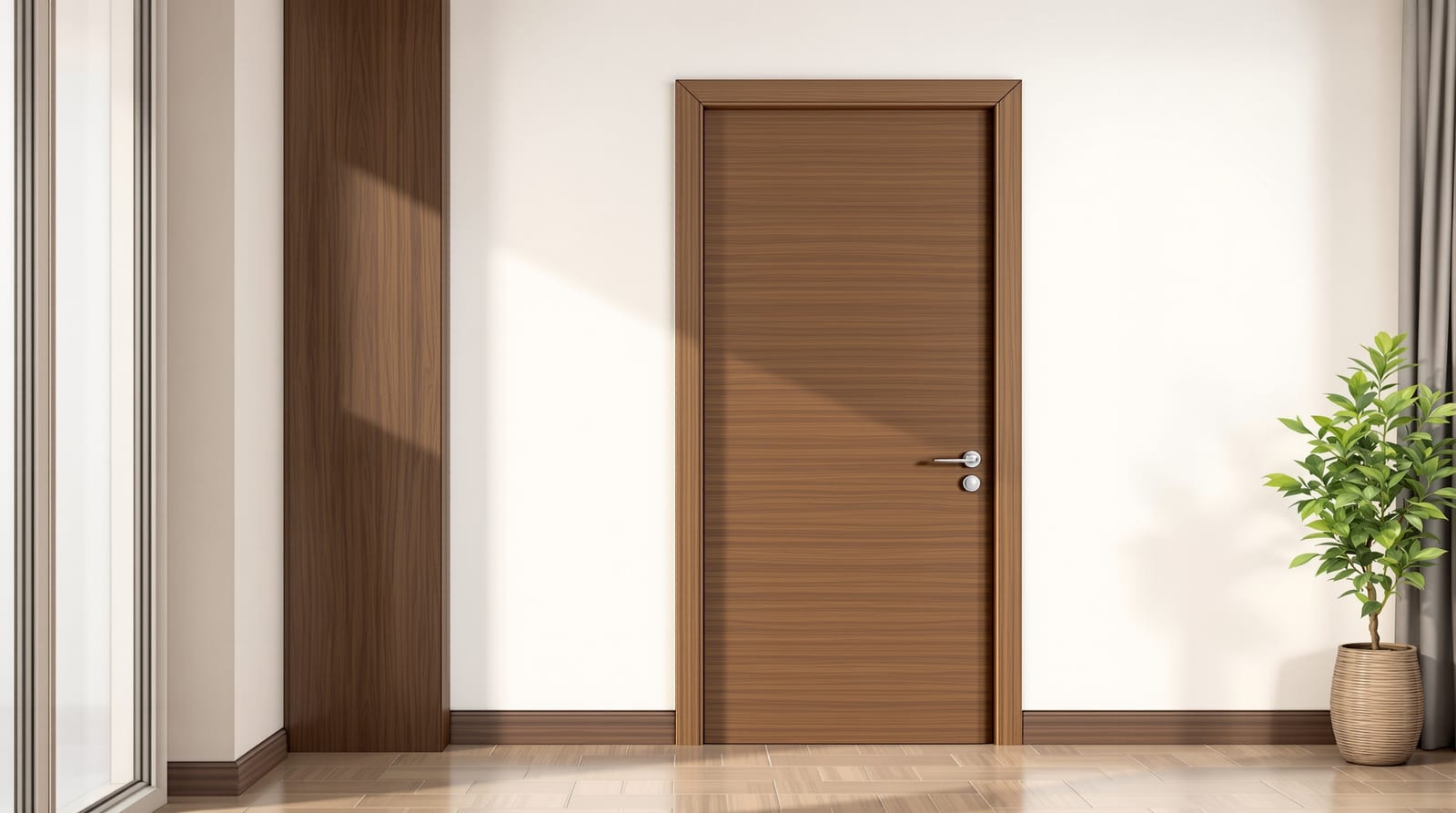
Engineered Wood Doors in India: HDF, MDF, Moulded and Veneered Doors Explained
How engineered-wood doors are built, why they stay straighter than solid wood, how they behave in the monsoon, the finishes you can choose, where they belong in the house and what they cost in 2026.
"Engineered wood" sounds like marketing, but it describes something specific and genuinely useful: instead of carving a door from one large log, the factory builds it up from layered, reconstituted and pressed wood products. The result is a door that stays straighter than solid timber, costs a fraction as much, takes paint and veneer beautifully - and behaves very differently in an Indian monsoon. This guide explains what is actually inside an engineered-wood door, how the main types differ, where each one belongs in your home, and what you should expect to pay in 2026.
What "engineered wood" actually means in a door
A solid-wood door is cut from natural timber - one species, one grain, prone to all the movement that a living log carries with it. An engineered-wood door is assembled from manufactured wood components: fibreboard, particleboard, finger-jointed rails, plywood and thin skins, bonded under heat and pressure. The point of all this engineering is dimensional stability - by breaking wood down and re-forming it, the manufacturer cancels out the directional swelling and warping that plagues a single plank.
In Indian homes you will meet engineered-wood doors in three broad families, and the terms get used loosely by carpenters and showrooms alike:
- Moulded skin (HDF/MDF) doors - two pre-pressed fibreboard skins, often moulded to look like a panel door, bonded to a timber/engineered frame around a hollow or filled core.
- Engineered flush doors - a stable engineered core (block-board, particle-board or a tubular/honeycomb cellular core) faced with plywood, HDF or MDF skins. These overlap heavily with the flush-door family.
- Veneered engineered doors - any of the above given a thin slice of real wood (veneer) on the face, so you get the look of teak or walnut over a stable, affordable core.
The boundaries blur on purpose. A "moulded panel door" and a "veneered flush door" can share the same engineered core; only the skin and finish change. For a fuller treatment of how cores and skins combine, see the companion guide on flush doors, and for the panel look specifically, panel doors.
The materials, from board to skin
The word "engineered" hides several very different boards. Knowing which one is inside your door tells you how it will behave.
| Material | What it is | Density / feel | Strength | Moisture behaviour |
|---|---|---|---|---|
| HDF (high-density fibreboard) | Fine wood fibres pressed at high density | Hard, smooth, heavy | Good for skins; dents resist well | Swells if water sits, but denser than MDF |
| MDF (medium-density fibreboard) | Wood fibres + resin, medium density | Smooth, uniform, no grain | Holds shape, takes paint well | Poor when soaked; edges swell and crumble |
| Particle board | Wood chips bonded with resin | Light, coarser inside | Weak as a structural core | Worst of the lot when wet |
| Block board | Softwood battens between veneers | Light but rigid | Excellent for cores; resists sag | Better than fibreboard if edges sealed |
| Plywood (BWR/BWP) | Cross-laminated veneer plies | Strong, stable | Very good for skins and cores | BWR/BWP grades tolerate damp far better |
| Veneer | Thin slice of real wood on the face | Looks like solid timber | Cosmetic layer only | Inherits the core's behaviour |
The single most important takeaway: the core decides the strength and the moisture life; the skin and veneer decide only the looks. A beautiful teak-veneer door over a plain MDF core is still an MDF door where it matters.
Engineered wood vs solid wood: the honest comparison
This is the comparison most buyers actually want. Both have a place; neither is "better" outright.
| Factor | Engineered-wood door | Solid-wood door |
|---|---|---|
| Dimensional stability | Excellent - very low warp/bow | Moderate - can warp, bow, twist over years |
| Weight | Lighter (easier on hinges/frames) | Heavy, feels solid and premium |
| Cost (per shutter) | Roughly ₹2,500-9,000 | Roughly ₹10,000-25,000+ (teak far more) |
| Sound deadening | Good if solid-cored; poor if hollow | Very good - mass blocks sound |
| Water/monsoon tolerance | Core-dependent; fibreboard swells if soaked | Swells/sticks seasonally but recovers; rot if untreated |
| Termite resistance | Resin-bonded boards less appealing to termites; veneer/edges still vulnerable | Vulnerable unless treated/teak |
| Repairability | Hard to repair; skins chip, cores crumble | Sandable, plane-able, refinishable for decades |
| Lifespan | 10-20 years typical indoors | 30-50+ years, often a generation |
| Best use | Internal bedroom/study/wardrobe doors | Main door, where mass and longevity matter |
Notice that engineered wood wins on stability and price while solid wood wins on mass, repairability and sheer lifespan. This is why a sensible Indian home often mixes them: a solid or teak main door (for security, mass and pride of entry), and engineered-wood internal doors everywhere else. The lifespan and money side of that decision deserves its own analysis - this guide deliberately stays on construction and selection, and hands the rupee-over-time maths to the dedicated engineered-wood lifecycle costing guide, which compares replacement cycles and total cost of ownership properly.
How engineered-wood doors behave in the Indian monsoon
This is where engineered wood earns its reputation - good and bad - in India.
The good: because the core is reconstituted and the construction is symmetrical, an engineered door rarely warps or bows the way a solid plank does after a humid Mumbai or Kochi monsoon. A solid-wood bedroom door that sticks in its frame every July is a familiar problem; a well-made engineered flush door largely avoids it.
The bad: most fibreboard (especially MDF and particle board) is very poor at handling standing water. If a bathroom door's bottom edge sits in splashed water, or a moulded skin door takes rain through an un-sealed edge, the fibre swells, the skin bubbles and the corner crumbles - and unlike solid wood, it does not dry back to shape.
Practical rules for Indian conditions:
1. Seal every edge - top, bottom and sides - with paint, primer or laminate. Bare fibreboard edges are the failure point.
2. For bathrooms, utility and any wet zone, prefer WPC or uPVC over fibreboard engineered doors, or insist on a BWP-plywood-cored, fully-sealed unit. See WPC doors and uPVC doors.
3. In coastal and high-rainfall belts, demand BWR/BWP-grade boards and marine-grade adhesive; cheap interior-grade MELA-bonded board will delaminate.
4. Keep a small gap above the floor and a threshold to stop mopping water wicking into the bottom edge.
5. Termite-treat the frame (chowkat) - the door may resist termites better than the frame does.
Anatomy of a moulded engineered door
A moulded HDF/MDF door is the most common engineered door in Indian flats. Here is what is inside one.
The two skins are pressed in a mould, which is how a flat fibreboard sheet gains the appearance of a raised-and-fielded panel door without any joinery. Inside, the door may be hollow (a light cellular/honeycomb core, cheaper and lighter) or filled (a solid engineered core, heavier, quieter, more expensive). When a salesperson says "panel door" but the door is feather-light and the panels have soft, rounded edges, you are almost certainly holding a hollow moulded skin door, not a true joined panel door.
Finishes: paint, laminate, veneer and membrane
One of engineered wood's biggest advantages is how readily it takes a finish, because the surface is uniform and grainless (MDF/HDF) rather than fighting natural grain.
| Finish | What it is | Look | Durability | Indicative add-on |
|---|---|---|---|---|
| Primer + paint | Site-painted PU/enamel over primer | Any colour, smooth | Good; repaintable | ₹40-120 / sq ft |
| Laminate | Pre-pressed decorative sheet | Wood-look or solid, matte/gloss | Very good; scratch-resistant | ₹60-150 / sq ft |
| Natural veneer | Thin slice of real wood | Authentic teak/walnut grain | Good; can be polished | ₹120-300 / sq ft |
| Membrane / PVC foil | Vacuum-pressed foil wrap | Seamless, moulded shapes | Moderate; can peel at edges in heat | ₹80-180 / sq ft |
A few India-specific notes. Membrane/foil finishes look flawless in the showroom but can lift at the edges in hot, humid kitchens - ask about the adhesive and warranty. Natural veneer over an engineered core gives you the prized teak look at a fraction of solid-teak cost; this is the sweet spot for many Indian buyers who want warmth without the price of a teak-wood door. Laminate is the most maintenance-free choice for families with children.
Where engineered-wood doors belong in the house
Match the door to the room and you will rarely go wrong.
| Location | Recommended engineered choice | Why |
|---|---|---|
| Main entrance | Generally avoid (use solid/teak/steel) | Needs mass, security, weather and pride of entry |
| Bedrooms | Veneered or laminate engineered flush/panel | Stable, quiet if solid-cored, looks rich |
| Study / box room | Moulded HDF (hollow ok) | Light, cheap, fine for low traffic |
| Living-room internal | Veneered engineered or designer laminate | Showpiece look at moderate cost |
| Bathroom / WC | Prefer WPC/uPVC; or sealed BWP-cored only | Fibreboard fails with standing water |
| Kitchen / utility | WPC, or fully sealed engineered | Heat, steam and splashes |
| Pooja room | Veneered engineered with carved overlay, even number of leaves | Warm, traditional look; see Vastu note below |
| Wardrobe / storage | MDF/HDF shutters | Cosmetic, dry, indoor use |
For the room-by-room logic across all materials, the cluster's interior doors by room guide goes deeper, and the relationship between door and window design is covered in windows and doors design.
Standards, sizes and what to ask for
Engineered flush doors in India are made and tested to IS 2202 (Part 1) for wooden flush door shutters, which distinguishes solid-core from cellular (hollow) core construction - the same code that governs ordinary flush doors. Panelled looks may be referenced against IS 1003. Frames follow IS 4021 for timber frames. Always ask the showroom which IS standard the shutter is marked to; a door with no standard claimed is a door with no quality floor.
Common sizes follow NBC 2016 practice and are the same as for any internal door:
- Bedroom / internal: 900 mm x 2100 mm (3' x 7')
- Bathroom / WC: 700-750 mm x 2000-2100 mm
- Kitchen / utility: 800-900 mm x 2100 mm
- Standard height 2100 mm (7'); the frame adds ~50-75 mm.
Engineered doors are not usually recommended for the main door, so the 1000-1200 mm external sizes matter less here. For the full size logic and clearances, see door size standards.
A short buyer's checklist:
1. Ask solid-core or hollow-core - and tap the door; a dull thud is solid, a drum-like echo is hollow.
2. Ask the core board (block board / BWP ply / MDF / particle) - this is the real spec.
3. For wet or coastal zones, insist on BWR/BWP grade and marine adhesive.
4. Confirm all four edges are sealed/lipped, not bare fibreboard.
5. Get the IS 2202 marking and any moisture/termite warranty in writing.
6. Confirm finish warranty for membrane/veneer against peeling in heat.
What engineered-wood doors cost in 2026
Prices are indicative and vary by city, vendor and finish; treat them as ranges, not quotes. Costs below are for the shutter (door leaf) only - frame (chowkat), hinges, handle, lock and fitting are extra, and roughly 18% GST usually applies on factory-made doors.
| Door type | Indicative shutter cost | Notes |
|---|---|---|
| Hollow moulded HDF/MDF (skin) door | ₹2,000-4,500 | Light, internal, budget bedrooms/study |
| Solid-cored engineered flush door | ₹2,500-6,000 | Quieter, sturdier internal door |
| Veneered engineered (panel/flush) | ₹4,000-9,000 | Teak/walnut look over stable core |
| Designer laminate engineered | ₹4,000-7,500 | Maintenance-free, family-friendly |
| Solid-wood door (for comparison) | ₹10,000-25,000+ | Teak/carved far higher |
Add-ons to budget separately: frame sal/teak ₹350-900 per running foot (WPC/steel frames are cheaper and more uniform); fitting labour ₹800-3,000 per door; hardware (hinges, handle, lock, stopper) ₹1,500-8,000. For a structured cost build-up and a place to plug your own numbers, use the cluster's cost resources - door cost India 2026 and the door cost calculator - and for the long-run replacement maths specifically, the engineered-wood lifecycle costing guide.
A note on Vastu and the engineered main door
Vastu tradition places great weight on the main door - ideally the largest in the home, best oriented North, East or North-East, opening inward and clockwise, with an even number of leaves and a threshold (dehleez). Because Vastu emphasises a substantial, dignified entrance, engineered-wood doors are usually a poorer fit for the main door specifically - solid wood or teak better satisfies both the tradition and the practical need for mass and security. Engineered doors are entirely appropriate for internal doors, including a veneered, carved-overlay pooja-room door with an even number of leaves. Treat all of this as belief plus practical reasoning, and read the canon in the entrance Vastu guide.
Frequently asked questions
Are engineered wood doors good for Indian homes?
Yes, for internal doors. They stay straighter than solid wood through humid monsoons, cost much less, and take veneer or laminate well. The main caution is moisture: keep fibreboard-cored doors out of bathrooms and wet zones, seal all edges, and use solid wood, WPC or uPVC where standing water is a risk.
Is engineered wood the same as MDF?
No. MDF (medium-density fibreboard) is one type of engineered wood, but "engineered wood" also covers HDF, block board, particle board and plywood. A door may use any of these as its core or skin. Always ask specifically which board is inside - it is MDF that performs worst with water.
How long do engineered wood doors last?
Typically 10-20 years for internal use if edges are sealed and they are kept dry. Solid-wood doors often last 30-50 years or more and can be sanded and refinished, while engineered doors are hard to repair once a skin chips or a core swells. For the full replacement-cost picture over a home's life, see the engineered-wood lifecycle costing guide.
Can engineered wood doors be used for the main entrance?
It is generally not recommended. The main door needs mass for security and sound, weather resistance, and the visual weight a front entry deserves - all areas where solid wood, teak or steel outperform engineered wood. Reserve engineered-wood doors for bedrooms, studies and other internal openings.
How can I tell a hollow door from a solid-core one?
Knock on it and lift it. A hollow (cellular/honeycomb-core) door sounds drum-like and feels noticeably light; a solid-cored door gives a dull thud and clear weight. Hollow doors are cheaper and fine for low-traffic rooms, but solid-cored doors are quieter, sturdier and worth the small premium for bedrooms.
Export this guide
Related Guides — Deep-dive reading
Flush Doors for Indian Homes: Construction, Cost and Buying Guide (IS 2202)
What a flush door actually is, why solid core beats cellular core, how veneer and laminate finishes change the price, and where flush doors belong in an Indian home.
Home Doors & EntrancesThe Complete Home Door Guide for Indian Homes (2026): Types, Materials, Cost, Security & Vastu
Everything an Indian homeowner needs to specify the right door for every opening — from main entrance to bathroom — with real 2026 prices, IS/NBC standards and Vastu sense.
Home Doors & EntrancesDoor Repair Guide India: Fix Holes, Dents, Swelling, Hinges & Locks (2026)
A fix-it reference for Indian homes: every common door problem with a quick fix, a proper repair, a replace verdict, the materials needed, and indicative rupee costs.
Home Doors & EntrancesRelated Tools — Try Free
Door Cost Calculator
Estimate the all-in cost of a door — leaf, frame, hardware, fitting and GST — by type, material and size.
Door CalculatorDoor Material Comparison Tool
Compare 2–4 door materials on cost, durability, maintenance, security and moisture resistance.
Comparison ToolWindow Hardware Cost Calculator
Estimate window hardware cost — hinges, handles, locks, rollers and multipoint gears.
Window Calculator