
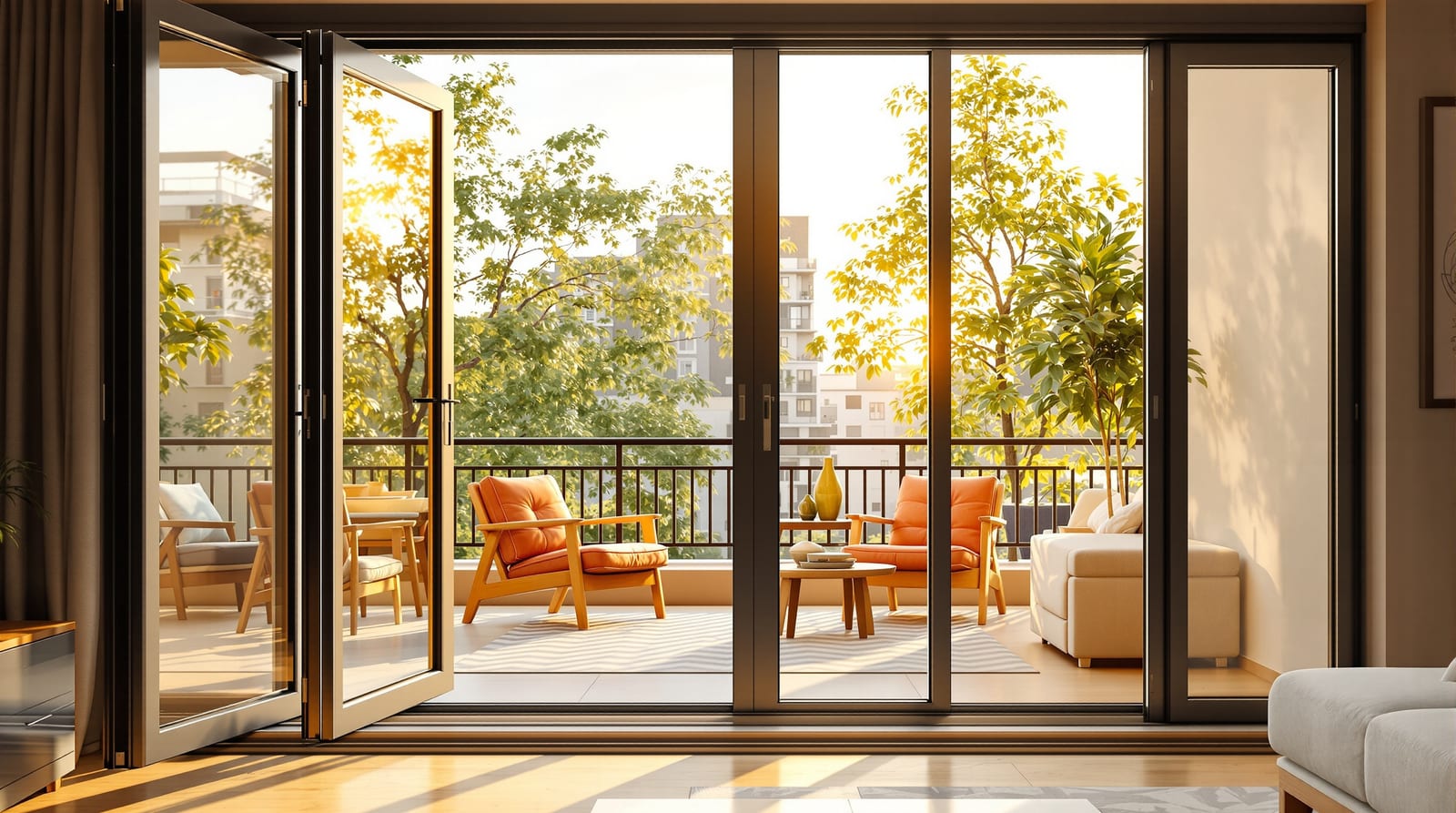
Bi-Fold Doors for Indian Homes: Cost, Hardware and Where They Work
How concertina folding doors open a whole wall to the balcony or garden - aluminium, uPVC and glass options, track and weather sealing, ₹ costs and an honest comparison with sliding and french doors.
There is one move that transforms an ordinary living room more than any other: opening a whole wall. A bi-fold door does exactly that. Instead of a fixed frame with a hole punched in it, you get a run of slim glazed panels that concertina back on themselves and stack neatly to one side, turning a balcony or garden edge into a single uninterrupted opening. For an Indian flat with a tight balcony, or a ground-floor home that wants to spill onto a lawn on a December evening, nothing else dissolves the line between inside and out quite so completely. The catch - and there is always a catch - is that a folding door is the most mechanically demanding door in the house, and it lives or dies on the quality of its track, hardware and weather sealing. Get those right and it is a joy for twenty years; get them wrong and it sags, sticks and leaks by the second monsoon.
This guide explains how bi-fold doors actually work, where they earn their keep in an Indian home, the real differences between aluminium, uPVC and timber systems, what they cost in 2026 rupees, and - most usefully - when a humble sliding or french door is the smarter buy.
How a bi-fold door works
A bi-fold (also called a folding, concertina or, in older catalogues, "accordion" door) is a set of panels hinged to each other in pairs. The whole run hangs from rollers in a top track and is guided by a bottom track. When you push, the pairs fold against each other like a screen and slide to one or both ends, stacking flat. Unlike a sliding door - where panels merely pass each other and you can never open more than half the width - a bi-fold opens almost the entire span.
Three things define any bi-fold:
- Configuration. Written as a number plus a letter, e.g. "3L" means three panels stacking left, "5L" five panels left, "4-2" four stacking one way and two the other. A "traffic door" or access leaf is one panel that swings open on a normal hinge for everyday use, so you do not fold the whole run every time you step onto the balcony.
- Stacking direction. Inward (panels fold into the room) or outward (onto the balcony). In India, inward-folding to the balcony side is common so the stacked panels and their rain-side faces sit under the chajja, but the choice depends on which side has space and shelter.
- Track type. Either top-hung (the weight hangs from the top track, the bottom track only guides) or bottom-rolling (weight bears on the floor track). Top-hung needs a strong lintel but gives the cleanest, lowest floor threshold; bottom-rolling is easier on the structure but the floor channel collects dust and grit - a real consideration in Indian conditions.
Where bi-fold doors actually work in an Indian home
The honest answer is: in fewer places than the brochures suggest, but where they do work, they shine.
Living room to balcony or deck. This is the classic and best use. A 7-10 ft opening from the living room to a covered balcony, folded fully open on a pleasant evening, doubles your usable space. Because the balcony is usually sheltered by the slab above, the door is protected from the worst direct rain.
Living/dining to garden or terrace in independent homes and villas - the wide, gracious opening a bi-fold gives onto a lawn is hard to beat, and far more dramatic than a french door of the same width.
Internal partitions. A lighter, frequently overlooked use: folding a study, home office or formal "drawing room" off the main living area, or closing a kitchen from the dining space when cooking heavy, smoky food (a real concern in Indian kitchens). Internal bi-folds need no weather sealing, so they are cheaper and simpler.
Where they do NOT belong: as a main entrance door (too many gaps, weak security - see the door security guide); on bedrooms and bathrooms (a swinging or pocket door is quieter, cheaper and more private); and on any opening fully exposed to driving monsoon rain or coastal salt spray without a generous chajja, where even good seals will eventually be tested. For the relationship between large glazed doors and the windows around them, the windows and doors design guide is worth a read.
Materials: aluminium vs uPVC vs timber
Bi-folds are almost always framed in metal or plastic with glass infill - solid timber bi-folds exist but are heavy, expensive and prone to swelling, which is the last thing a folding mechanism needs.
| Frame material | Indicative cost (per sq ft of opening) | Strengths | Weaknesses | Best for |
|---|---|---|---|---|
| Aluminium (powder-coated / anodised) | ₹900-2,000+ | Slimmest sightlines, strong, holds large glass, corrosion-resistant, premium look | Conducts heat (get a thermal-break section for AC rooms), priciest | Living-to-balcony, statement openings, coastal (anodised/marine grade) |
| uPVC | ₹650-1,200 | Excellent seals, good thermal + sound insulation, low maintenance, no rust | Bulkier frames, fewer panels per run, can yellow with years of harsh sun | AC living rooms, value-led wide openings, noisy or dusty plots |
| Timber / engineered wood | ₹1,200-2,500+ | Warm look, can match other wooden doors | Heavy on the track, swells in monsoon, high maintenance | Sheltered, premium, traditional interiors only |
| WPC / composite (emerging) | ₹700-1,400 | Water- and termite-proof, paintable | Limited large-panel systems, fewer vendors | Internal partitions, humid utility zones |
The glass matters as much as the frame. For a folding door you want toughened (tempered) glass as a minimum for safety (it shatters into blunt granules, per the spirit of IS workmanship norms), and double-glazed (DGU) units if the room is air-conditioned or faces traffic noise - the air gap cuts both heat gain and decibels. Tinted, reflective or low-E coatings help on west- and south-facing openings that cop the afternoon sun. For the broader material picture across all door types, see the door materials comparison.
Track, rollers and hardware - where the money should go
A bi-fold is only as good as its mechanism, and this is exactly where cheap systems fail. Spend here before you spend on glass.
- Rollers / carriages. Top-hung stainless-steel rollers in a sealed bearing are the heart of the door. Branded systems (Hafele, Hettich, Giesse, Schueco and similar) cost more but carry the panel weight smoothly for years. Avoid bargain nylon rollers - they flat-spot and the door starts to drag.
- Hinges. Multiple heavy-duty hinges per joint; loose or under-specified hinges let panels sag, and once they sag they bind.
- Top and bottom tracks. A robust, well-anchored aluminium track is non-negotiable. The bottom track is a dust and grit trap in Indian conditions - look for a slim, easily brushed-out profile, or a top-hung design with only a low guide channel (or a flush, recessed track) at the floor for a near-level threshold.
- Multi-point locking. Good systems lock at several points up the leading edge into the frame head and sill, which is both more secure and what keeps the door weather-tight. A single central latch is a red flag.
- Magnetic catches and finger guards. Catches hold folded panels neatly stacked; finger guards (anti-pinch gaskets at the hinge joints) matter in homes with small children - a genuine safety point with folding doors.
Insist on a written warranty on the hardware specifically, and ask who services it. A folding door needs its tracks cleaned and rollers checked roughly twice a year (before and after monsoon is the natural rhythm).
Weather sealing for the Indian monsoon
This is the make-or-break for any external bi-fold in India. The folding joints and the bottom track are the natural weak points for water, dust and insects.
- Gaskets and brush seals run along every panel edge and at each fold; EPDM rubber gaskets last far longer than cheap PVC ones.
- A weeped, drained bottom track lets any water that gets in escape outward rather than pooling and seeping into the room - essential where rain can blow onto the door.
- A chajja or deep overhang above the opening is the cheapest, most effective rain defence; no seal system fully replaces simply keeping the door under cover.
- Coastal homes (Mumbai, Chennai, Kochi, Goa) should specify marine-grade anodised aluminium or quality uPVC and stainless 316 fasteners - ordinary aluminium and mild-steel screws pit and seize in salt air within a couple of years.
For the same reasons, a bi-fold is rarely the right choice for an unsheltered, west-facing opening that takes both the monsoon and the harshest sun; a well-sealed sliding door is often the more sensible pick there.
What bi-fold doors cost in India (2026)
Treat every figure as indicative and city- and vendor-dependent, and add the usual 18% GST. Folding doors are quoted by the square foot of the whole opening (width x height), inclusive of frame, glass and hardware, with installation usually separate or bundled by the fabricator.
| Item | Indicative range |
|---|---|
| Aluminium glazed bi-fold (supplied + fitted) | ₹900-2,000+ per sq ft of opening |
| uPVC glazed bi-fold (supplied + fitted) | ₹650-1,200 per sq ft of opening |
| Premium thermal-break aluminium + DGU | ₹1,800-3,000+ per sq ft |
| Branded hardware upgrade (Hafele/Hettich-class) | adds ₹15,000-50,000+ per door, by size |
| Toughened single glazing vs double-glazed (DGU) | DGU adds roughly 25-40% to glass cost |
| Installation / fitting (if charged separately) | ₹3,000-12,000+ per opening |
A worked example: a 9 ft wide x 7 ft tall (63 sq ft) aluminium bi-fold to the balcony, mid-spec, at around ₹1,300/sq ft works out near ₹82,000 for the door, plus GST and any separate fitting - call it roughly ₹1,00,000 installed. The same opening as a simple two-track aluminium sliding door might be ₹40,000-55,000 installed - which is precisely why the next section matters. For a full budget across door types use the door cost guide for 2026, and to play with numbers try the door cost calculator.
Bi-fold vs sliding vs french - the honest comparison
These three are the contenders whenever you want to open a wide opening to a balcony or garden. None is "best"; each wins a different argument.
| Factor | Bi-fold | Sliding | French (pair) |
|---|---|---|---|
| Opening width achieved | Almost the full span | At most half (one panel parks behind the other) | The full doorway, but limited to ~4-6 ft total |
| Indicative installed cost | ₹900-2,000+/sq ft | ₹450-1,200/sq ft | ₹15,000-60,000 / pair |
| Floor footprint when open | Panels stack to the side (small) | Zero (panels stay in plane) | Needs swing space inside or out |
| Threshold / step | Low possible (top-hung), but a track remains | Lower, flatter track | Floor-level, easiest |
| Weather + dust sealing | Good but most joints to seal | Good, fewest moving joints | Moderate (two leaves to seal) |
| Maintenance | Highest (most rollers, hinges, seals) | Low | Low |
| Best when you want | To open a whole wall, indoor-outdoor flow | A clean, low-cost wide opening with no swing | A classic, gracious look on a modest width |
The decision shortcut: choose a bi-fold when fully opening the wall is the whole point - entertaining, garden access, that dissolve-the-boundary effect - and you have the budget for good hardware. Choose a sliding door when you mainly want light, a view and a tidy opening at the lowest cost and maintenance. Choose french doors when the opening is modest and you want a timeless look over maximum opening. For the deeper dives, see the sliding doors guide and the french doors guide, and compare the whole field in types of doors for Indian homes.
Pros and cons at a glance
Pros: opens almost the entire wall for true indoor-outdoor flow; floods the room with light and air; a genuine wow factor and value-add for a home; flexible - leave one access leaf for daily use, fold the rest open for occasions; works as an internal partition too.
Cons: the priciest way to open an opening; most moving parts, so the most maintenance and the most that can go wrong with cheap hardware; the bottom track collects dust and grit; weak as a security door; needs a chajja or shelter to survive monsoon and sun gracefully.
A note on Vastu and large openings
Bi-fold doors are not the main entrance in Vastu terms, so the strict directional rules for the front door do not apply to a balcony or garden bi-fold. Tradition does favour large, light-filled openings to the north and east - the directions associated with morning light and positive energy - which happens to align with good passive-design sense, since north and east glazing brings light without the harsh western heat. A wide bi-fold opening the living room to a north or east balcony is therefore both pleasant and, by tradition, auspicious. If the opening is on the south-west, simply lean on good shading and DGU glass to manage the heat. For the canonical rules on door direction - which govern the main door, not balcony openings - see the entrance Vastu guide. As always, treat Vastu as tradition and intent; the practical comfort reasoning usually points the same way.
Frequently asked questions
Are bi-fold doors a good idea in the Indian monsoon?
Yes, with two conditions: specify quality EPDM gaskets, a drained bottom track and multi-point locking; and keep the opening under a chajja or deep overhang. A sheltered, well-sealed aluminium or uPVC bi-fold handles the monsoon fine. An unsheltered one taking driving rain head-on is asking for trouble - there, a sealed sliding door is the safer bet.
How wide an opening can a bi-fold cover?
Practically, most home bi-folds run from about 6 ft up to 15-18 ft using 3 to 7 panels; very wide spans are possible with the right structural lintel and heavy-duty hardware. Each panel is typically 600-900 mm wide. The wider the run, the more it matters that the lintel above is strong enough to carry a top-hung system.
Is a bi-fold more expensive than a sliding door?
Almost always, yes - often roughly twice the installed cost per square foot, because of the extra hinges, rollers, seals and panels. You are paying for the ability to open the whole wall rather than half of it. If full opening is not essential, a sliding door gives most of the light and view for much less money and maintenance.
Are bi-fold doors secure enough?
Not for a main entrance - never use one as your front door. For a balcony or garden opening they are acceptable if you specify multi-point locking that engages the head and sill, toughened glass, and the door sits within a secured balcony or compound. Pair it with sensible overall home security rather than relying on the door alone; see the door security guide.
How much maintenance does a bi-fold door need?
More than any other door. Clean and brush out the bottom track every couple of months (more in dusty cities), wash the gaskets, and have the rollers and hinges checked and lightly lubricated about twice a year - before and after the monsoon is the natural schedule. Budget for an occasional service call from the fabricator, and keep that hardware warranty handy.
Export this guide
Related Guides — Deep-dive reading
French Doors for Indian Homes: Glazing, Security, Cost & Monsoon Sealing
The double-leaf glazed door that opens a living room to a balcony or garden - where it works, how to specify the glass, frame and seals, what it costs, and how it stacks up against sliding and bi-fold.
Home Doors & EntrancesAluminium Door Cost in India 2026: ₹/Sq Ft by Profile Grade, Finish, Glazing & Hardware
A focused 2026 cost guide for aluminium doors in India — ₹ per sq ft of opening by profile grade (economy domal vs branded system sections vs thermal-break), powder-coat vs anodised vs wood-finish surcharge, glazing, rollers/locks/handles, sliding vs openable, fitting and GST, with a worked balcony/utility example.
Home Doors & EntrancesFloor-to-Ceiling Windows (India): Maximum Light, and the Heat Trade-Off
Full-height glazing for Indian homes — how to win the daylight and view without losing the energy code, comfort or safety.
Windows & GlazingRelated Tools — Try Free
Cross-Ventilation Analyzer
Estimate airflow and air changes per hour (ACH) from room size, window areas, layout, and local wind — with NBC 2016 Part 8 compliance check.
Ventilation CalculatorWindow Material Comparison Tool
Compare uPVC, aluminium, wood, steel and composite windows on cost, life, upkeep and insulation.
CompareDoor Material Comparison Tool
Compare 2–4 door materials on cost, durability, maintenance, security and moisture resistance.
Comparison Tool