
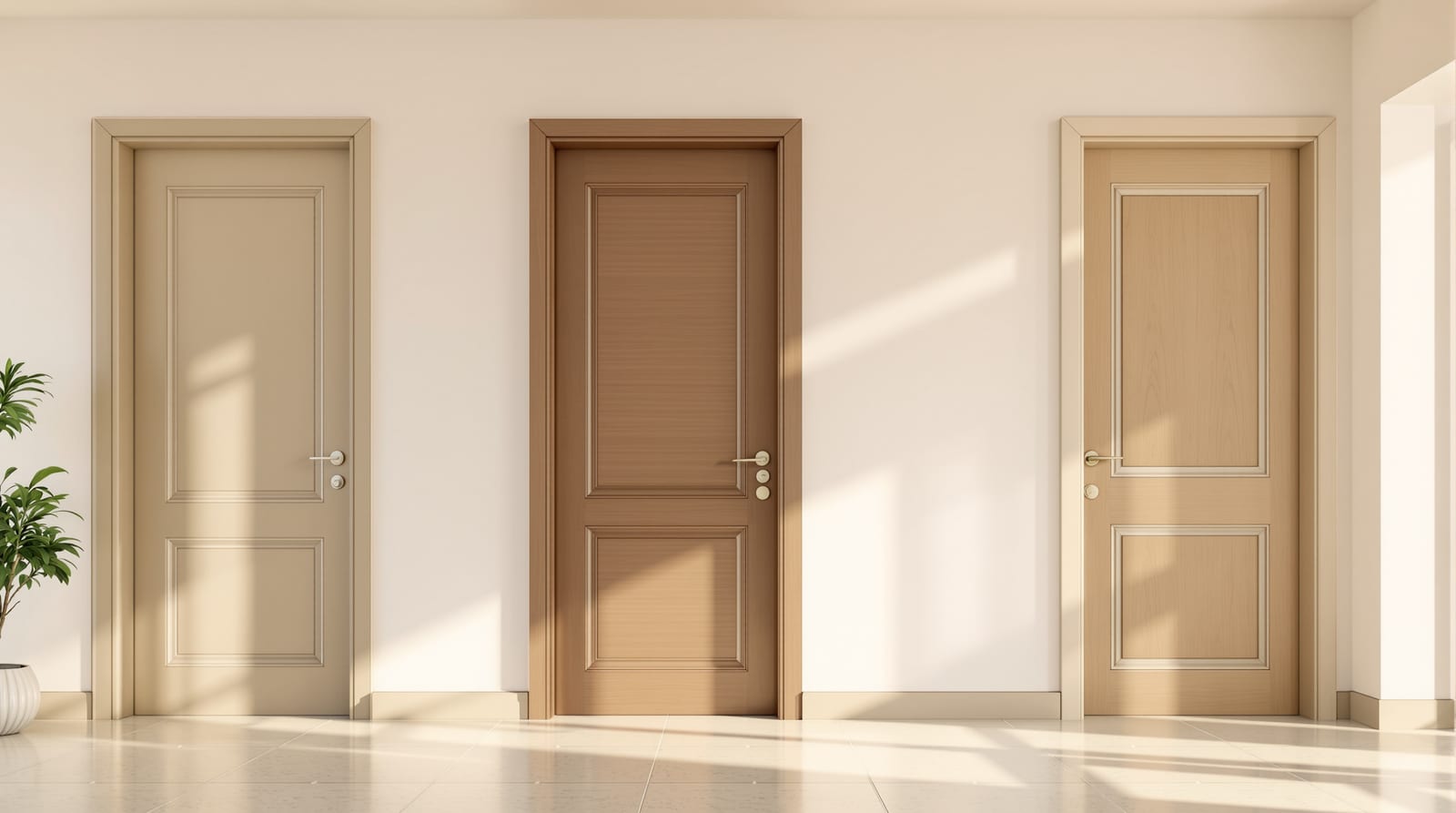
How to Choose the Right Door for Your Home (India): A Room-by-Room Decision Guide
A practical step-by-step method and decision tables to pick the right door for every opening by room, use, budget, security and climate.
Most Indian homes have between 8 and 14 doors, and almost everyone chooses them the same way: copy the neighbour, trust the carpenter, or pick whatever the builder offers. That is how you end up with a beautiful teak main door and a bathroom door that swells shut every monsoon. The right way is to choose each door for its job, the opening, your budget and your climate. This guide gives you a repeatable method and a set of decision tables so you can specify every door in your home with confidence.
If you only have ten minutes, read the four-step method, then jump straight to the room-by-room table.
The four-step method to choose any door
Run every opening in your home through these four questions, in order. The answers narrow your choice from "hundreds of options" to two or three sensible picks.
1. What is the job? A main door fights weather, intruders and first impressions. A bathroom door fights water and steam. A bedroom door fights nothing but needs privacy and a clean look. Define the job first, because it sets your non-negotiables.
2. What is the opening? Measure the structural opening (width × height) and note the wall thickness, which way it must swing, and how much space you have for the swing. A 3-foot bedroom door and a 3.5-foot main door are different beasts. Tight spaces may rule out a hinged door entirely and push you toward sliding or pocket doors.
3. What is the climate exposure? Is the opening exposed to rain, direct sun, coastal salt air, or termite-prone ground? External and wet-area doors must resist moisture and swelling; internal dry-area doors can be cheaper and lighter.
4. What is the budget? Decide a per-door budget band, then allocate generously to the main door and pooja door, modestly to bedrooms, and minimally to bathrooms and utility. Spending equally on every door is the most common money mistake.
Only after these four answers do you pick the material (teak, engineered wood, WPC, uPVC, steel, glass), the type (flush, panel, sliding, pocket, French, bi-fold), and the hardware (hinges, lock, handle). Material and style are the last decision, not the first.
Decision table by room
This is the fast answer. Use it as your default, then adjust for budget and climate using the tables below. Sizes follow NBC 2016 and common Indian practice; costs are for the shutter (make + material) and are indicative, varying by city and vendor.
| Room / opening | Recommended type & material | Standard size (mm) | Why | Indicative shutter cost |
|---|---|---|---|---|
| Main entrance | Solid wood or teak panel door (or premium engineered-wood) | 1000-1200 × 2100 | Security, weather, first impression, Vastu prominence | ₹25,000-1,50,000+ installed |
| Bedroom | Flush door (plywood/laminate) or engineered panel | 900 × 2100 | Privacy, light, low cost, clean finish | ₹1,200-9,000 |
| Bathroom / WC | WPC or PVC flush door | 700-750 × 2000-2100 | Waterproof, no swelling, termite-proof | ₹2,000-4,500 |
| Kitchen / utility | Flush or WPC; consider sliding if tight | 800-900 × 2100 | Durable, wipe-clean, handles humidity | ₹2,000-6,000 |
| Pooja room | Teak/solid wood panel, often with bells/carving | 700-900 × 2100 | Tradition, reverence; many keep two leaves | ₹8,000-40,000+ |
| Balcony / terrace | uPVC or aluminium glazed sliding / French door | varies | Light, view, weather seal, ventilation | ₹450-1,200 / sq ft |
| Study / guest | Flush or glass-panel door for light | 800-900 × 2100 | Privacy with borrowed light | ₹3,000-12,000 |
| Wardrobe / storage | Sliding or bi-fold (space-saving) | varies | No swing clearance needed | ₹450-900 / sq ft |
A reliable rule of thumb: the main door is the only one most families should over-invest in; everything internal should be matched to its job, not to the main door.
Decision table by use and priority
Sometimes the room matters less than the dominant need. If one of these is your top priority, let it override the room default.
| Top priority | Best choice | Avoid | Note |
|---|---|---|---|
| Maximum security | Solid wood/teak or steel security door with multi-point lock | Hollow-core flush, single-glazed glass | Pair with a good lock; the door is only as strong as its frame and hinges |
| Lowest cost | Hollow-core (cellular) plywood flush door | Teak, carved doors | Fine for dry internal rooms only |
| Wet areas | WPC, uPVC or FRP door | Any solid timber, MDF | Zero swelling, termite-proof |
| Sound privacy | Solid-core flush or solid panel door with seals | Hollow-core, undercut doors | A solid core plus a threshold seal makes a real difference |
| Small/tight space | Sliding or pocket door | Wide hinged door | Saves the swing footprint |
| Light and openness | French, glass or glazed-panel door | Solid flush | Use frosted/laminated glass for privacy |
| Accessibility | 900 mm leaf, lever handle, threshold ≤ 12 mm | Round knobs, high sills, narrow leaves | RPwD Harmonised Guidelines 2021 want ~800-900 mm clear |
For a deeper material decision, see our door materials comparison and best door material guide.
Choosing by climate: India's real test
India is not one climate, and the same door fails differently in Kochi, Jaipur and Shillong. Match the door to your exposure.
- Heavy monsoon / high humidity (coastal Maharashtra, Kerala, Goa, the North-East): Timber swells, jams and warps. Use WPC, uPVC or FRP for external and wet-area doors. If you want a timber main door for looks, insist on seasoned, kiln-dried wood, a generous gap at the bottom, and marine-grade or melamine sealing on all six faces, including the top and bottom edges most carpenters skip.
- Coastal salt air (Mumbai, Chennai, coastal Gujarat): Salt corrodes steel hardware. Choose stainless-steel or brass hinges and locks, and avoid raw mild-steel frames unless galvanised (IS 4351).
- Hot-dry (Rajasthan, interior Deccan): Timber shrinks and develops gaps. Solid teak and good engineered wood cope well; flush doors with stable cores are fine internally.
- Termite-prone soils (much of peninsular and eastern India): Avoid cheap softwood frames and untreated ply. WPC frames and shutters are inherently termite-proof; treat any timber with a borate/anti-termite coat and keep the bottom edge off direct floor contact.
A practical climate rule: wet and exposed openings should default to WPC/uPVC; dry internal openings can be timber or engineered wood. See WPC doors and uPVC doors for the wet-area workhorses, and energy-efficient doors for balcony and external glazing.
Choosing by budget
Set a total door budget, then split it the way experienced architects do: roughly half on the main door (and pooja door), a third on bedrooms and living-area doors, and the rest on bathrooms and utility. Here is how three realistic budgets play out for a typical 2-3 BHK; figures are indicative and exclude frames, hardware and 18% GST unless stated.
| Budget band | Main door | Bedroom doors | Bathroom doors | Typical total (10 doors) |
|---|---|---|---|---|
| Economy | Engineered/laminate flush, decorative laminate face (₹6,000-12,000) | Hollow-core flush (₹1,200-2,500) | WPC flush (₹2,000-3,000) | ₹30,000-55,000 |
| Mid-range | Solid engineered or modest teak veneer panel (₹15,000-30,000) | Solid-core flush / veneer (₹3,000-6,000) | WPC flush (₹2,500-3,500) | ₹70,000-1,30,000 |
| Premium | Carved teak / solid wood main door (₹40,000-1,50,000+) | Veneered designer / solid panel (₹6,000-12,000) | WPC or designer (₹3,500-6,000) | ₹1,50,000-3,50,000+ |
Remember the hidden costs: a frame (chowkat) runs roughly ₹350-900 per running foot in sal or teak; fitting labour is ₹800-3,000 per door; and hardware (hinges, handle, lock, stopper) adds ₹1,500-8,000, far more if you fit a smart lock. For exact numbers use our door cost guide and the door cost calculator.
Choosing by security
Not every door needs to be a fortress, but the main door, and any door to a balcony a person could reach, deserves real thought. Security comes from three parts working together: the leaf (solid, not hollow), the frame (firmly anchored, ideally steel or hardwood), and the lock (multi-point or a graded mortise/smart lock). A ₹40,000 teak door with a ₹150 lock is not secure.
| Security level | Door + lock combination | Suited to |
|---|---|---|
| Basic | Solid-core flush + good mortise lock | Internal, low-risk |
| Standard | Solid wood/teak panel + 6-lever or multi-point lock | Most main doors |
| High | Steel security door (IS-grade) or solid teak + smart lock + door viewer | Ground floor, independent houses |
| Layered | Above + video door phone + grille / safety door | Apartments, families wanting visitor screening |
For locks, viewers and door phones, see door hardware, smart door locks, door security and video door systems.
Get the size and swing right
A perfectly chosen door is useless if it does not fit the opening or fouls the furniture when it swings. Below is the door-anatomy and swing geometry every buyer should understand before ordering.
Use these standard sizes as your starting point (NBC 2016 and common practice):
| Opening | Common leaf size (mm) | Equivalent | Notes |
|---|---|---|---|
| Main / external | 1000-1200 × 2100 | ~3.5' × 7' | Larger is auspicious in Vastu and practical for moving furniture |
| Bedroom / internal | 900 × 2100 | 3' × 7' | The everyday standard |
| Bathroom / WC | 700-750 × 2000-2100 | 2'3"-2'6" × 7' | Smaller leaf, often WPC |
| Kitchen / utility | 800-900 × 2100 | ~2'9"-3' × 7' |
The frame adds about 50-75 mm around the opening, and a threshold for accessibility should sit at 12 mm or less. For the full method, see door size standards, the door size calculator, and our note on measuring a room and door swing.
Don't forget the codes and the Vastu
Two non-negotiables in Indian door buying. First, standards: factory flush doors should conform to IS 2202 (Pt 1), panelled and glazed timber shutters to IS 1003, frames to IS 4021, steel frames to IS 4351, and FRP shutters to IS 14856. For exits, NBC 2016 wants an external/exit door of at least 1000 mm opening in the direction of escape; fire-rated openings follow IS 3614 with 30 to 120-minute ratings. These matter most for the main door and any apartment fire door.
Second, Vastu for the main door, which still guides most Indian families. Tradition favours a main door in the north, east or north-east, made the largest and most prominent door in the home, opening inward and clockwise without obstruction; an even number of leaves or panels is considered auspicious, and a threshold (dehleez) is recommended. Treat this as cultural belief reinforced by sensible practice (a prominent, well-lit, unobstructed entrance is genuinely good design) and read the full canon in our entrance Vastu guide and the main-door Vastu guide.
For the styling layer once the engineering is settled, browse main door designs, modern door designs and interior doors by room. If you want the complete reference, start at the home doors complete guide.
Frequently asked questions
Which door material is best for an Indian home?
There is no single best material; it depends on the opening. Solid wood or teak is best for the main door, WPC or uPVC for bathrooms and wet areas, engineered or laminate flush doors for bedrooms, and aluminium or uPVC glazing for balconies. Choose by job and climate, not by prestige.
Should I buy doors from a carpenter or factory-made?
Factory-made flush and WPC doors (IS-certified) are more consistent, dimensionally stable and often better value for internal and wet-area doors. A skilled carpenter still wins for a bespoke carved teak main door or pooja door. Many Indian homes sensibly mix both.
What is the best door for a bathroom in monsoon climates?
A WPC, PVC or FRP flush door. These do not swell, warp or rot, are termite-proof, and shrug off the constant humidity that destroys timber bathroom doors. Avoid any solid wood or MDF in wet areas.
How much should I budget for doors in a 2-3 BHK?
Indicatively, ₹30,000-55,000 for an economy set, ₹70,000-1,30,000 mid-range, and ₹1,50,000 upward for premium, before frames, hardware and 18% GST. Spend generously on the main door and modestly on internal ones. Use our door cost calculator for your city.
Does the main door really need to follow Vastu?
Vastu is a tradition many families choose to honour, favouring a large, prominent main door in the north, east or north-east. Much of its advice (an unobstructed, well-lit, generous entrance) is also good practical design, so following it rarely conflicts with function. See our entrance Vastu guide for the full picture.
Export this guide
Related Guides — Deep-dive reading
The Complete Home Door Guide for Indian Homes (2026): Types, Materials, Cost, Security & Vastu
Everything an Indian homeowner needs to specify the right door for every opening — from main entrance to bathroom — with real 2026 prices, IS/NBC standards and Vastu sense.
Home Doors & EntrancesBest Door Material in India (2026): The Right Choice for Every Room & Climate
A situation-by-situation verdict on the best door material for Indian homes - teak or steel for the main entrance, WPC or uPVC for bathrooms and coasts, engineered flush for bedrooms - with a by-location decision table and budget-vs-premium picks.
Home Doors & EntrancesGuest Room Door in India: Privacy, Quiet and Smart Picks Without Overspending (2026)
How to choose a guest bedroom door for an Indian home - privacy and acoustics so visitors feel comfortable, but budget-sensible for a room used only now and then: solid-core flush for quiet, panel or laminate for looks, the right privacy lock, simple soundproofing, and a finish that matches the rest of your doors - with picks ranked and indicative rupee costs.
Home Doors & EntrancesRelated Tools — Try Free
Door Cost Calculator
Estimate the all-in cost of a door — leaf, frame, hardware, fitting and GST — by type, material and size.
Door CalculatorDoor Material Comparison Tool
Compare 2–4 door materials on cost, durability, maintenance, security and moisture resistance.
Comparison ToolWindow Hardware Cost Calculator
Estimate window hardware cost — hinges, handles, locks, rollers and multipoint gears.
Window Calculator